
The Job Search Sweet Spot: Why 12 is the Magic Number for Applications in 2026
If you’ve sent out 50 job applications in a week and heard nothing back, you’re not alone. You’re also not doing yourself any favors.
The traditional wisdom says job searching is a numbers game. Apply to everything. Cast the widest net. The more applications you send, the better your chances. Right?
Wrong. Dead wrong.
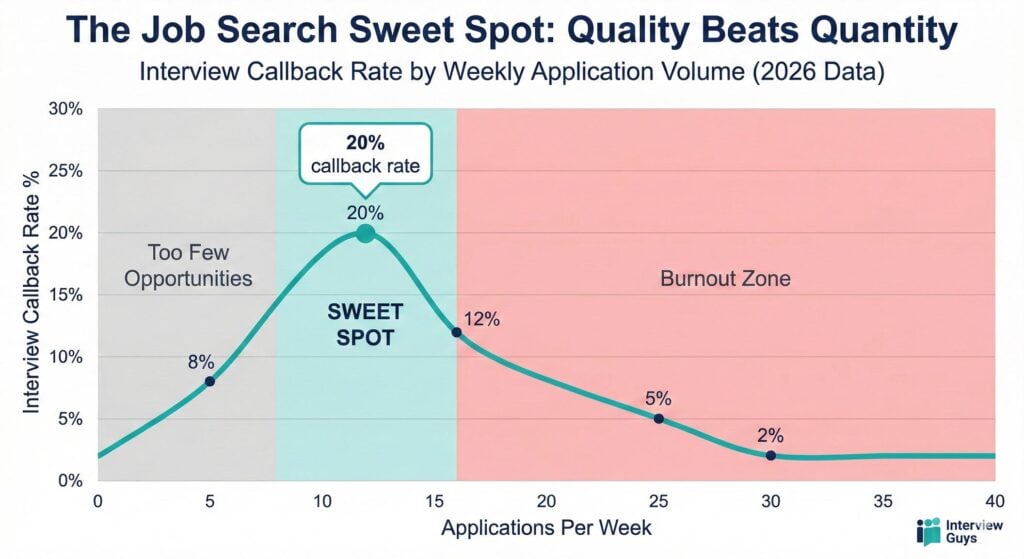
In 2026’s AI-dominated hiring landscape, more applications don’t equal better results. In fact, recent data reveals something shocking: there’s a precise application volume that maximizes your interview callbacks while minimizing the burnout that destroys your job search stamina.
Welcome to the job search sweet spot. And the magic number is 12.
☑️ Key Takeaways
- The average job seeker applies to 16 roles per week, but data shows 10-12 applications yield 15-25% higher response rates through deeper personalization and strategic targeting
- Applying to 30+ positions weekly reduces callback rates by up to 40% due to application fatigue, formatting errors, and generic submissions that fail AI screening
- Quality applications take 30 minutes to customize properly and can boost response rates from 2% to 15% compared to “spray and pray” approaches
- The sweet spot varies by career level and industry, with tech roles requiring 5-8 high-effort applications versus operations roles needing 15-20 lower-effort submissions
The Death of the Volume Game
Here’s what’s changed. In 2026, approximately 98% of Fortune 500 companies use Applicant Tracking Systems (ATS) powered by sophisticated AI to screen candidates. These aren’t the basic keyword-matching systems from five years ago.
Modern AI screening understands context, analyzes career progression patterns, and even predicts job performance with up to 87% accuracy. When you blast out 30 generic applications in a week, these systems can tell.
Research from Huntr’s Q2 2025 Job Search Trends Report shows that the typical job seeker submits about 16 applications per week. But here’s the problem: that “typical” approach is actually above the optimal range for most candidates.
The data is clear. Candidates who focus on 10-12 carefully tailored applications per week see response rates between 15-25%, compared to just 2-3% for those sending 25+ generic applications.
Interview Guys Tip: Think of AI screening systems as incredibly sophisticated spam filters. They’re not just looking for keywords anymore. They’re analyzing how naturally those keywords appear, whether your experience progression makes sense, and if your achievements are quantified. A rushed application triggers every red flag.
The reality is that most resume templates weren’t built with ATS systems or AI screening in mind, which means they might be getting filtered out before a human ever sees them. That’s why we created these free ATS and AI proof resume templates:
Still Using An Old Resume Template?
Hiring tools have changed — and most resumes just don’t cut it anymore. We just released a fresh set of ATS – and AI-proof resume templates designed for how hiring actually works in 2026 all for FREE.
Why 12 Applications Hit the Sweet Spot
The number isn’t arbitrary. It’s based on how long it actually takes to create what researchers call an “agent-proof” application, one that’s optimized for both AI screening and human review.
A quality application takes approximately 30 minutes to customize properly. That includes tailoring your resume to match the job description’s specific keywords, adjusting your achievement statements to align with the company’s stated priorities, and writing a targeted cover letter if required.
At 30 minutes per application, 12 applications represents about 6 hours of focused work per week. That’s sustainable. That’s strategic. And most importantly, that’s effective.
When you try to send 30+ applications weekly, each one gets maybe 10-12 minutes of attention. That’s barely enough time to update your contact information and company name, let alone the deep customization that modern hiring systems demand.
A study published in 2025 found that job seekers applying to 15+ positions daily report 40% higher stress levels and significantly lower response rates. The culprit? Application fatigue leads to careless mistakes, poor keyword alignment, and formatting errors that AI systems immediately flag.
The Anatomy of a Quality Application
Not all applications count equally toward your magic number of 12. Here’s what separates a strategic application from wasted effort.
- Keyword Optimization: Your resume needs to include 70-80% of the keywords from the job description, but they must appear naturally. Modern AI systems detect and penalize keyword stuffing.
- Quantified Achievements: According to Huntr’s analysis of 59,000 resumes, interviewed candidates included fewer but more detailed achievements (4.35 per job at 164 characters each) compared to rejected candidates who listed more but shorter accomplishments (4.88 per job at 161 characters each). Quality beats quantity even at the micro level.
- ATS-Friendly Formatting: Up to 75% of resumes never make it past initial ATS screening. Use standard section headers like “Work Experience” and “Education.” Avoid tables, graphics, and text boxes that AI can’t parse. Save as PDF from a professional resume builder to preserve formatting.
- Strategic Customization: Don’t just swap company names. Research the organization, identify their biggest challenges, and position your experience as the solution. This level of personalization takes time, which is exactly why you can’t do it 30 times a week.
If you’re struggling to create these quality applications efficiently, our guide on how to tailor your resume for different industries provides a systematic framework that saves time while maintaining customization quality.
The Burnout Threshold Nobody Talks About
Here’s the hidden cost of the volume approach that career advisors rarely discuss: job search burnout occurs after just 6 weeks of applying to 20+ roles per week.
The data on workplace burnout is sobering. Our comprehensive State of Workplace Burnout in 2025 research report found that 82% of employees are at risk of burnout, with Gen Z and millennials experiencing peak burnout at just 25 years old.
Job searching amplifies these stress levels dramatically. When you’re sending 30 applications weekly and hearing nothing back, the mental toll compounds. Constant rejection from impersonal, high-volume applications destroys motivation and decision-making ability.
The sweet spot approach extends your job search stamina to 14+ weeks. That’s not just about feeling better. It’s about maintaining the energy and focus required to nail the interviews you do get.
Interview Guys Tip: Track your application-to-interview ratio weekly. If you’re sending 20+ applications and getting zero callbacks, you’re wasting energy on quantity when quality is the real problem. Cut your volume in half and triple the effort per application. Your response rate will improve dramatically.
The Sweet Spot by Industry and Career Level
The 10-12 application sweet spot works for most mid-level professionals, but it’s not universal. Your optimal volume depends on your industry and career stage.
Tech and Creative Roles (5-8 applications/week): These positions require extensive portfolio reviews and highly customized applications. Each application might take 45-60 minutes of preparation time. Companies like Apple, Microsoft, and Netflix receive thousands of applications for every opening, making customization critical.
Management and Senior Positions (3-5 applications/week): Executive searches rely heavily on networking rather than mass applications. Your application becomes a substantial project requiring hours of research and tailoring. Focus on quality connections and referrals.
Service and Operations Roles (15-20 applications/week): Retail, hospitality, and logistics positions often have faster hiring cycles and less demanding application processes. You can maintain quality while increasing volume slightly.
Entry-Level and Recent Graduates (12-18 applications/week): Facing a larger applicant pool means a modest volume increase makes sense. However, the data from our analysis of how many applications it takes to get hired shows that even entry-level candidates benefit more from strategic targeting than spray-and-pray approaches.
Career Changers (5-8 applications/week): When you’re pivoting industries, each application requires heavy customization to translate transferable skills. Spend more time per application to make your case compelling.
Your Weekly Application Blueprint
Wondering how to actually implement the sweet spot strategy? Here’s a realistic weekly schedule that balances volume and quality without turning job searching into a second full-time job.
- Monday (2 hours): Research and identify 4-5 target companies and open positions that genuinely match your skills. Save job descriptions and company information for detailed review. This reconnaissance work prevents wasted effort on mismatched roles.
- Tuesday-Thursday (1.5 hours each day): Customize and submit 4 applications. That’s about 90 minutes per day, giving you 30-45 minutes per application to tailor your resume, write a targeted cover letter if needed, and research the company’s recent news or challenges.
- Friday (1 hour): Submit your final application of the week and follow up on any previous applications from two weeks ago. This follow-up strategy, detailed in our follow-up email hack sheet, can revive applications that got buried in hiring manager inboxes.
- Total weekly time investment: 6-7 hours. That’s sustainable whether you’re currently employed or searching full-time.
Interview Guys Tip: Set your target at 10 applications weekly rather than 12. This gives you flexibility for life events without the stress of falling behind. Consistently hitting 10 quality applications beats sporadically sending 20 rushed ones.
The Quality Multiplier Effect
Here’s where the math gets interesting. One properly tailored application is mathematically equivalent to 3.5 cold applications in terms of interview conversion.
This “3x rule” comes from analyzing response rates across application types. Generic applications convert at 2-3%. Customized applications convert at 15-25%. A single strategic application does the work of three or four rushed ones.
The multiplier increases dramatically with referrals. Research consistently shows that 70-85% of jobs are filled through networking rather than cold applications. Our guide on turning LinkedIn connections into job opportunities shows how to leverage your network effectively.
When you apply within your sweet spot range and one of those 12 applications includes a referral, your success rate increases by 450%. You’re not just more likely to get an interview. You’re more likely to bypass initial AI screening entirely.
This is why the volume game is fundamentally flawed. Spending 6 hours sending 30 generic applications yields fewer interviews than spending those same 6 hours on 12 strategic applications, three of which come through warm referrals.
The AI Screening Reality Check
Let’s be brutally honest about what you’re up against. By the end of 2025, 83% of companies planned to use AI for resume reviews. That number has only increased in 2026.
These systems analyze far more than keywords. They evaluate:
- Career progression consistency
- Achievement quantification patterns
- Writing style and communication clarity
- Skills alignment with job requirements
- Educational background relevance
- Employment gap explanations
When you rush through 30 applications weekly, you inevitably make mistakes that AI systems flag immediately. Formatting inconsistencies. Keyword stuffing. Vague achievement statements. Generic objective statements that could apply to any job.
Our comprehensive guide on ATS resume optimization breaks down exactly how to pass these AI filters without gaming the system. The key insight? You can’t optimize 30 resumes weekly to this standard. But you can optimize 12.
Breaking Free from Easy Apply
The biggest trap in modern job searching is the “Easy Apply” button. LinkedIn, Indeed, and other platforms make it effortless to blast your generic resume to dozens of companies in minutes.
It feels productive. It’s actually destructive.
Research from Google Jobs shows that while LinkedIn captured up to 80% of job saves in the first half of 2025, Google Jobs delivered a 9.3% response rate compared to LinkedIn’s 3.3%. Why? Because Google Jobs listings typically require more effort to apply, which self-selects for serious, qualified candidates.
Easy Apply applications get lost in a sea of similarly generic submissions. Hiring managers receive hundreds of these cookie-cutter applications and have learned to ignore them.
The paradox of effort: The harder an application is to complete, the better your chances of standing out. When a company requires a cover letter, a questionnaire, or a portfolio upload, most candidates give up. That’s your opportunity.
What Success Actually Looks Like
Let’s talk real numbers. Huntr’s data shows that the most common path to a job offer involves 10-20 applications. But here’s the nuance: that’s for targeted, quality applications, not spray-and-pray submissions.
The median time to first offer in Q2 2025 increased to 68.5 days. Job searches are taking longer, which makes stamina and sustainability crucial. You can’t maintain a 30-application weekly pace for 10+ weeks without burning out completely.
Successful job seekers using the sweet spot approach typically see:
- First interview callback within 2-3 weeks
- 2-4 simultaneous interview processes by week 4-6
- First offer by week 8-10
- Multiple competing offers allowing negotiation
Compare this to the volume approach where candidates send 200+ applications over 8 weeks, experience crushing rejection, lose motivation, and still end up with fewer interview callbacks than strategic applicants.
The math is simple. Quality compounds. Quantity dilutes.
Advanced Sweet Spot Strategies
Once you’ve mastered the basic 10-12 application framework, these advanced tactics can boost your effectiveness further:
The Portfolio Approach: Categorize target companies into tiers. Tier 1 companies (dream jobs) get maximum effort and customization. Tier 2 companies get solid, professional applications. Tier 3 companies provide practice and fallback options. Distribute your 12 weekly applications across tiers: 3-4 Tier 1, 5-6 Tier 2, 2-3 Tier 3.
The Weekly Theme Strategy: Each week, focus your applications on a specific industry or role type. This allows you to research industry trends once and apply those insights across multiple applications. You’ll write more compelling, knowledgeable applications without duplicating research effort.
The Resume Rotation System: Create 2-3 master resume versions highlighting different skill sets or experiences. Rather than customizing from scratch each time, start with the master version closest to the job requirements and fine-tune from there. This saves time while maintaining quality.
The Referral Multiplier: For every 12 applications, aim to have at least 2-3 come through referrals or networking connections. Use your LinkedIn profile strategically to identify connection opportunities at target companies.
Common Mistakes to Avoid
Even within the sweet spot range, certain mistakes can sabotage your success:
Mistake 1: Sending All 12 Applications on Monday: Spread your applications throughout the week. Hiring managers review candidates in batches, and you want fresh eyes on your application, not the fatigued review that happens after they’ve seen 50 resumes in one sitting.
Mistake 2: Counting Rejected Applications Toward Your 12: If you know you don’t meet 70%+ of the job requirements, that application doesn’t count toward your weekly goal. You’re wasting one of your precious 12 slots on a long shot.
Mistake 3: Ignoring Industry Hiring Patterns: Some industries hire heavily in Q1, others in Q4. Research seasonal patterns and adjust your timing accordingly. Our seasonal hiring patterns analysis report provides detailed insights.
Mistake 4: Forgetting to Follow Up: A strategic follow-up email 7-10 days after applying can resurrect applications that got buried. Budget 15-30 minutes weekly for follow-ups in addition to your application time.
The Reality Check
Let’s acknowledge the elephant in the room. Some job seekers are desperate. Bills are due. Savings are depleting. The sweet spot strategy feels like a luxury they can’t afford.
If you’re in crisis mode, here’s the compromise approach: Allocate 70% of your job search time to 10 strategic, quality applications within your field. Use the remaining 30% for higher-volume, lower-effort applications in adjacent fields or industries.
This “barbell strategy” balances immediate needs with long-term career goals. You’re not abandoning quality entirely, but you’re acknowledging that sometimes quantity provides psychological relief and potential short-term income sources.
However, be honest with yourself. Even in desperate situations, sending 50 applications weekly rarely works. You’re better off with 15-20 quality applications than 50 rushed ones.
The Bottom Line
In 2026’s AI-driven job market, success isn’t about sending more applications. It’s about sending better ones.
The sweet spot of 10-12 weekly applications represents the perfect balance between market coverage and customization quality. Below this range, you’re not creating enough opportunities. Above this range, you’re sacrificing the quality that modern hiring systems demand.
The companies that want to hire you aren’t looking for candidates who apply everywhere. They’re looking for candidates who apply strategically, who demonstrate genuine interest through customized applications, and who understand that quality always beats quantity.
Your job search isn’t a lottery where more tickets improve your odds. It’s a precision operation where each application is a strategic investment of time and energy. Make those investments count by focusing on the magic number: 12.
Stop applying to everything. Start applying to the right things. Your interview callback rate, your mental health, and your career trajectory will all improve dramatically.
The sweet spot isn’t just about getting hired faster. It’s about getting hired better, by companies that value the same attention to detail and strategic thinking that your application demonstrates.
That’s the real magic of 12.
The reality is that most resume templates weren’t built with ATS systems or AI screening in mind, which means they might be getting filtered out before a human ever sees them. That’s why we created these free ATS and AI proof resume templates:
Still Using An Old Resume Template?
Hiring tools have changed — and most resumes just don’t cut it anymore. We just released a fresh set of ATS – and AI-proof resume templates designed for how hiring actually works in 2026 all for FREE.

BY THE INTERVIEW GUYS (JEFF GILLIS & MIKE SIMPSON)
Mike Simpson: The authoritative voice on job interviews and careers, providing practical advice to job seekers around the world for over 12 years.
Jeff Gillis: The technical expert behind The Interview Guys, developing innovative tools and conducting deep research on hiring trends and the job market as a whole.