
Udemy vs Coursera: Which Platform Will Actually Help Your Career in 2026?
If you’re looking to level up your career in 2026, you’ve probably found yourself staring at two of the biggest names in online learning: Udemy and Coursera. Both platforms promise to transform your skills and boost your career prospects. But here’s the thing: they’re actually built for very different purposes, and choosing the wrong one could waste your time and money.
The decision isn’t just about course count or pricing. It’s about whether you need a quick tutorial to solve tomorrow’s problem or a comprehensive credential that will open doors for years to come. Your choice between these platforms should align directly with your career goals, whether that’s switching careers entirely, climbing the ladder in your current field, or simply staying relevant in a rapidly changing job market.
By the end of this article, you’ll know exactly which platform fits your situation, what each one actually delivers for your career, and how to maximize your investment in either one.
☑️ Key Takeaways
- Coursera partnerships with 325+ universities and companies like Google, IBM, and Microsoft give their certificates significantly more weight on resumes than Udemy’s marketplace-based credentials
- Udemy offers 250,000+ courses starting around $11.99, making it the budget-friendly option for quick skill-building, while Coursera provides structured career paths with professional certificates
- 87% of Coursera learners report career benefits within six months, including new jobs and promotions, compared to Udemy’s focus on practical, hands-on learning
- A Coursera Plus subscription ($399/year) becomes cost-effective if you’re completing 3+ certificates annually, offering unlimited access to 10,000+ courses and recognized credentials
Disclosure: This article contains affiliate links. If you purchase through these links, we may earn a commission at no additional cost to you.
The Core Difference That Changes Everything
Before diving into features and pricing, you need to understand the fundamental philosophical difference between these platforms. This shapes everything from course quality to how employers will view your certificates.
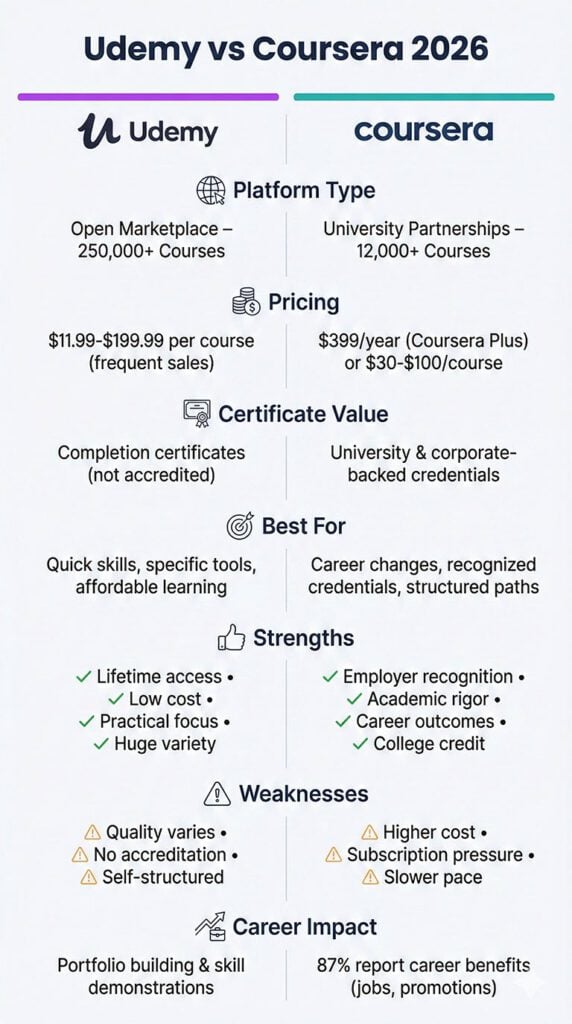
Udemy operates as an open marketplace. With over 250,000 courses from 80,000 instructors, it’s essentially the Amazon of online learning. Anyone with expertise (or sometimes just enthusiasm) can create and sell a course. This creates incredible variety and often very practical, hands-on instruction. Technology and business courses drive 74.6% of all enrollments, with tech courses alone accounting for over 328 million enrollments.
Coursera functions as a curated ecosystem. They partner exclusively with 325+ top-tier universities and companies including Google, IBM, Stanford, and Yale. Their catalog of around 12,000 courses is much smaller but far more controlled. The curriculum is designed by university professors or senior industry experts, building from theory to practical application in a structured format.
Think of it this way: Udemy gives you the “how” through quick, practical tutorials. Coursera provides the “why” behind the “how” through academic-style courses with readings, graded assignments, and peer reviews.
Here’s what most people don’t realize: employers now expect multiple technical competencies, not just one specialization. The days of being “just a marketer” or “just an analyst” are over. You need AI skills, project management, data literacy, and more. Building that skill stack one $49 course at a time is expensive and slow. That’s why unlimited access makes sense:
Your Resume Needs Multiple Certificates. Here’s How to Get Them All…
We recommend Coursera Plus because it gives you unlimited access to 7,000+ courses and certificates from Google, IBM, Meta, and top universities. Build AI, data, marketing, and management skills for one annual fee. Free trial to start, and you can complete multiple certificates while others finish one.
Certifications: Where the Career Impact Really Shows
When it comes to advancing your career, certifications can make or break your resume. This is where Coursera pulls significantly ahead for most professionals.
Coursera’s Certification Advantage
Coursera built its entire reputation on partnerships with institutions that matter to employers. When you complete a Professional Certificate from Google or a specialization from Stanford, you’re not just getting a participation trophy. You’re earning a credential that recruiters actively recognize and value.
Here’s what makes Coursera certificates stand out:
University-branded credentials signal academic rigor. These represent structured learning paths with rigorous, graded assignments that prove you’ve mastered the material. Companies like Danone, P&G, Reliance, Novartis, and Capgemini use Coursera to upskill their own employees, which speaks volumes about the platform’s credibility.
Professional certificates prepare you for specific roles. Programs like the Google Data Analytics Professional Certificate are designed to make you job-ready in 3-6 months. These aren’t theoretical overviews. They include hands-on projects that become portfolio pieces you can show during interviews.
Some certificates offer college credit. The Google Career Certificates offer up to 15 college credits through ACE (American Council on Education), equivalent to five courses at the bachelor’s degree level. This means your online learning can actually contribute toward a degree.
Real career outcomes back up the claims. According to Coursera’s own data, 87% of learners report positive career benefits after completing their programs, including new jobs, promotions, and salary increases. A 2021 study found that 75% of Coursera graduates reported positive career outcomes within six months.
The most in-demand professional certificates in 2026 include:
- Google Data Analytics Professional Certificate for data analyst roles earning $70,000-$95,000
- IBM AI Developer Professional Certificate for artificial intelligence positions
- Meta Data Analyst Professional Certificate for marketing and business analytics
- Google IT Support Professional Certificate for help desk and IT support roles
- Google UX Design Professional Certificate for user experience design positions
Udemy’s Certificate Reality
Udemy provides a certificate of completion for every course you finish. However, these certificates aren’t accredited or partnered with any external university or organization. This doesn’t mean they’re worthless, but it does mean they work differently on your resume.
The value of a Udemy certificate comes from two things:
Demonstrating initiative and self-directed learning. Even if a hiring manager isn’t familiar with the specific Udemy course, the fact that you invested time and money to develop new skills signals important qualities. You take ownership of your professional development and stay current with industry trends.
Practical skills matter more than the credential itself. For technical roles in software development, data science, UX design, and similar fields, what you can actually do matters more than where you learned it. If you can demonstrate the skill through a portfolio project or during a technical interview, the Udemy certificate served its purpose.
Many professionals have successfully used Udemy courses as stepping stones. One DigitalCrafts alum shared: “Before DigitalCrafts, I taught myself to code with Udemy, which gave me enough knowledge to land an internship at a local startup.” The key was using Udemy for the learning, then proving the skill through real-world application.
The Coursera Plus Subscription: Is It Worth It for Your Career?
If you’re serious about online certifications that pay well, the Coursera Plus subscription deserves a close look.
Coursera Plus costs $399 per year (or $59 per month) and provides unlimited access to 10,000+ courses, specializations, and professional certificates. This includes programs from Google, IBM, Meta, Microsoft, and hundreds of universities. Every course you complete includes a certificate at no additional cost.
Here’s the math that matters: a single Professional Certificate on Coursera typically costs $40-50 per month, and most take 3-6 months to complete. That’s $120-300 per certificate if you pay individually. If you’re planning to complete 2-3 certificates in a year, the Plus subscription pays for itself.
Beyond the cost savings, Coursera Plus offers strategic career advantages:
Portfolio development across multiple skills. Every professional certificate includes several hands-on projects. These become tangible proof of your skills that you can share during job interviews. Instead of just saying “I know data analysis,” you can show the dashboard you built using real-world data.
Stackable credentials build expertise. You can earn multiple certificates to develop a comprehensive skill set. Someone pursuing a tech career might complete the Google IT Support Professional Certificate, then specialize further with the IBM Generative AI Engineering Professional Certificate to stay ahead of industry trends.
Career exploration without financial risk. With unlimited access, you can explore different career paths without worrying about wasting money on courses that don’t pan out. This is particularly valuable for career changers who need to test different waters before committing to a new direction.
7-day free trial lets you test before committing. You can explore the full catalog, start courses, and determine if the platform meets your needs before spending a dollar. Many learners use this trial period to map out their complete learning path for the year.
Start your Coursera Plus free trial here and get unlimited access to professional certificates that employers actually recognize.
Course Quality and Learning Experience
Quality varies significantly between the platforms due to their different approaches to instructor vetting and content creation.
Coursera’s Academic Structure
Coursera courses feel like university classes because, in many cases, they are. Professors with 25+ years of experience or industry experts at the top of their field create and teach the content. The platform maintains strict quality standards through its university and corporate partnerships.
What this means for you:
- Structured learning paths with clear prerequisites and progression. Courses build on each other logically, taking you from beginner to advanced in a systematic way.
- Graded assignments and peer reviews ensure you’re actually learning, not just watching videos. You’ll complete quizzes, projects, and assessments that test your understanding.
- Theory combined with practical application. You learn the underlying principles that make skills transferable across different contexts, not just how to follow steps in one specific tool.
The downside is that this structure means courses take longer to complete. A Coursera specialization might require 3-6 months of consistent study. For someone who needs a quick answer to a specific problem, this can feel like overkill.
Udemy’s Practical Approach
Udemy’s strength lies in practical, hands-on instruction that gets you results quickly. Instructors are often working professionals who teach based on real-world experience rather than academic theory.
What this means for you:
- Immediate applicability to work problems. If you need to learn a specific Excel function, Photoshop technique, or programming library, Udemy courses jump straight into the practical application.
- Course length matches the topic complexity. You’ll find everything from 2-hour quick tutorials to 40-hour comprehensive bootcamps, letting you choose based on your time commitment.
- Lifetime access to purchased courses means you can revisit material whenever you need a refresher, even years later.
The trade-off is inconsistency. Course quality on Udemy varies dramatically because anyone can publish a course. Some courses are taught by genuine experts who create outstanding content. Others are created by instructors who barely understand the topic themselves. You need to carefully read reviews, check instructor credentials, and watch preview videos before purchasing.
Fortunately, Udemy’s 30-day money-back guarantee protects you if a course doesn’t meet expectations.
Pricing: What You Actually Pay
The pricing structures reflect each platform’s philosophy, and understanding them helps you calculate true costs.
Udemy’s Individual Course Model
Udemy courses are individually priced, typically ranging from $11.99 to $199.99. However, Udemy runs frequent sales where courses drop to $10-20 regardless of their original price. If you’re patient and wait for these sales (which happen almost monthly), you rarely need to pay full price.
The lifetime access model is a major advantage. Once you purchase a Udemy course, it’s yours forever. You can complete it at your own pace without worrying about subscription deadlines, and you can return to it years later when you need a refresher.
For someone who needs to learn one specific skill or wants to explore a hobby, this makes Udemy incredibly affordable. You can build a library of courses on diverse topics without any ongoing costs.
The challenge comes when you need comprehensive skill development. If you’re building the certifications needed for your resume in 2026, purchasing 10-15 Udemy courses individually can actually cost more than a Coursera Plus subscription.
Coursera’s Flexible Options
Coursera offers multiple pricing tiers to match different learning goals:
Free audit option provides access to course videos and reading materials without assignments, quizzes, or certificates. This works for casual learners exploring topics before committing financially.
Individual course certificates cost $30-100 depending on the course. You pay once and can take as long as you need to complete the material.
Professional certificates and specializations typically cost $40-50 per month. Most take 3-6 months to complete at the recommended pace of 4-5 hours per week.
Coursera Plus subscription at $399/year (or $59/month) provides unlimited access to 10,000+ courses. For anyone completing multiple certificates, this quickly becomes the most cost-effective option.
Financial aid is available for learners who can’t afford the full cost. Coursera offers this for many courses and specializations, though you’ll need to apply and explain your situation.
Which Platform Fits Your Career Goals?
The right choice depends entirely on what you’re trying to achieve professionally.
Choose Coursera If You:
Need credentials that employers recognize. If you’re applying for jobs where having a certificate from Google, IBM, or a top university will actually open doors, Coursera is the clear winner. This is particularly true for roles in data analytics, IT support, digital marketing, and other tech-adjacent fields.
Are making a significant career change. Switching careers requires comprehensive skill development and credentials that prove you’re serious. Coursera’s structured Professional Certificates provide the systematic learning path and recognized credentials you need.
Value structured learning paths. If you learn best with clear milestones, deadlines, and feedback through graded assignments, Coursera’s academic approach will serve you better than Udemy’s self-paced format.
Plan to complete multiple courses. The Coursera Plus subscription makes sense for ambitious learners who will work through 3+ certificates in a year. The unlimited access model encourages exploration and deep skill development.
Want to eventually pursue a degree. Some Coursera certificates offer college credit, and the platform also partners with universities to offer complete online degrees. If a bachelor’s or master’s degree is in your long-term plan, starting with Coursera certificates can be a stepping stone.
Choose Udemy If You:
Need a specific skill immediately. When you need to learn how to use a particular software tool, fix a specific technical problem, or master a defined technique for tomorrow’s work presentation, Udemy’s focused tutorials get you there faster.
Prefer to own your courses outright. The lifetime access model means you’re building a permanent library of resources you can reference throughout your career. There’s no pressure to “use it or lose it” with a subscription.
Want to explore diverse topics affordably. If you’re interested in learning everything from photography to stock investing to watercolor painting alongside your professional development, Udemy’s individual course pricing lets you build a eclectic skill set.
Learn best through practical demonstration. Many Udemy instructors are working professionals who teach exactly how they solve problems in their daily work. This “over the shoulder” learning style resonates with hands-on learners.
Are supplementing formal education or credentials. If you already have the degrees or recognized certifications on your resume, Udemy courses can fill specific knowledge gaps without the need for additional formal credentials.
The Hybrid Approach
Many successful professionals don’t choose between Udemy and Coursera. They use both strategically:
Use Coursera for career-advancing credentials. Complete professional certificates in your core skill areas through Coursera Plus, focusing on programs from Google, IBM, and other recognized brands that belong on your resume.
Use Udemy for specific skill gaps and supplementary learning. When you need to quickly learn a specific tool, technique, or technology that’s not covered in your Coursera program, grab the best-rated Udemy course during a sale.
Invest in Coursera for best jobs for the future and emerging skills. Use their AI, data science, and technology programs to stay ahead of industry trends. Use Udemy for timeless skills and creative pursuits that round out your profile.
The Drawbacks You Should Know About
No platform is perfect, and both have limitations worth considering.
Coursera’s Challenges
Higher cost can be a barrier. Even with the Plus subscription, $399/year is a significant investment compared to picking up individual Udemy courses during sales. If you’re not planning to complete multiple certificates, the value proposition weakens.
Subscription pressure creates artificial deadlines. With monthly billing for individual certificates or the annual Plus subscription, you might feel rushed to complete courses before your access expires. This can detract from thorough learning.
Not all courses are included in Plus. Degree programs, some MasterTrack certificates, and certain specialized courses require separate payment even with a Plus subscription. You’ll need to verify what’s included before assuming unlimited access means everything.
Academic pace can feel slow. If you’re an experienced professional who just needs to fill a specific knowledge gap, working through pre-requisite material and academic foundations can feel tedious.
Udemy’s Limitations
Quality inconsistency requires careful vetting. The open marketplace model means course quality ranges from excellent to terrible. You’ll need to invest time reading reviews, checking instructor credentials, and watching previews before purchasing.
Certificates carry less weight professionally. While Udemy certificates demonstrate initiative, they don’t carry the institutional backing that impresses hiring managers the way Coursera’s university and corporate partnerships do.
No structured learning paths. You’re responsible for determining the right sequence of courses to build a comprehensive skill set. There’s no curated curriculum to guide your development.
Sales pricing creates decision fatigue. While the frequent sales save money, they also create a sense that you should always wait for the next deal. This can delay your learning if you’re not careful.
Making Your Decision
The Udemy vs Coursera debate isn’t about which platform is objectively better. It’s about which one aligns with your specific career goals and learning needs right now.
If you’re building a resume for a career transition, targeting roles in AI, data analytics, IT support, or digital marketing, Coursera’s recognized credentials from Google, IBM, and Microsoft will serve you better. The Coursera Plus subscription offers the best value for serious career development, giving you unlimited access to professional certificates that employers actively seek.
If you need practical skills quickly, prefer self-paced learning, and want to own your courses outright, Udemy’s marketplace provides affordable, focused instruction on virtually any topic you can imagine.
Many successful professionals use both platforms strategically, earning recognized Coursera certificates for their core competencies while filling specific knowledge gaps with targeted Udemy courses.
The most important factor isn’t which platform you choose. It’s whether you actually complete the courses and apply the skills. According to research on online learning completion rates, active engagement through note-taking, practice projects, and real-world application matters far more than the platform itself.
Choose the platform that matches your learning style, budget, and career goals. Then commit to the work. Your career advancement depends not on the logo on your certificate, but on the skills you develop and how effectively you showcase them on your resume and during interviews.
Start your Coursera Plus free trial or explore Udemy’s course library to begin your learning journey today. The skills you build now will shape the career opportunities you’ll have tomorrow.

BY THE INTERVIEW GUYS (JEFF GILLIS & MIKE SIMPSON)
Mike Simpson: The authoritative voice on job interviews and careers, providing practical advice to job seekers around the world for over 12 years.
Jeff Gillis: The technical expert behind The Interview Guys, developing innovative tools and conducting deep research on hiring trends and the job market as a whole.