
The State of Skills-Based Hiring in 2025: 85% of Companies Claim It, But Only 1 in 700 Hires Are Actually Affected – A Comprehensive Research Report
Something doesn’t add up.
Every major company now claims they’ve embraced skills-based hiring. LinkedIn reports that 85% of employers say they’re prioritizing skills over degrees. Corporate press releases trumpet the death of degree requirements. HR conferences overflow with sessions on “skills-first transformation.”
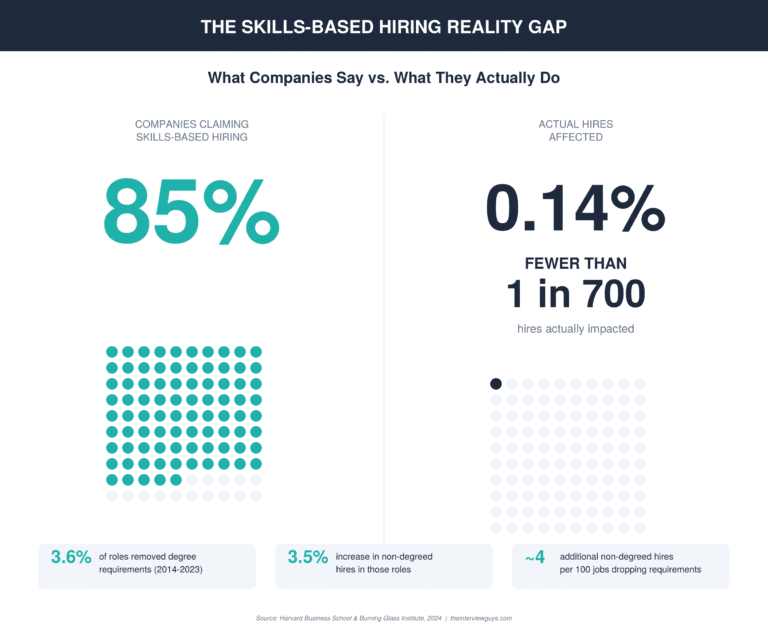
But here’s what the data actually shows: fewer than 1 in 700 actual hires are affected by these policy changes.
That’s the bombshell finding from Harvard Business School and The Burning Glass Institute’s comprehensive 2024 analysis of actual hiring patterns. While 85% of companies talk about skills-based hiring, only 0.14% of hires are actually impacted by degree requirement removal.
This isn’t an indictment of the skills-based hiring movement. It’s a reality check about what’s actually happening versus what companies say is happening.
More importantly for job seekers, it reveals a critical insight: skills-first resume formatting works brilliantly because of how recruiters search ATS systems, not because companies have transformed their formal hiring policies. Understanding this distinction could be the difference between landing interviews and getting filtered out.
This comprehensive research report synthesizes data from Harvard Business School, the World Economic Forum, TestGorilla, LinkedIn, and over 15 authoritative sources to reveal what’s really happening with skills-based hiring in 2025.
☑️ Key Takeaways
- 85% of employers now use skills-based hiring, yet Harvard research reveals fewer than 1 in 700 actual hires are affected by companies dropping degree requirements
- Hiring for skills is 5x more predictive of job performance than hiring based on education, making skills-first formatting strategically essential
- 16+ states have dropped degree requirements for government jobs, with Pennsylvania opening 92% of positions and Maryland seeing 41% more hires in year one
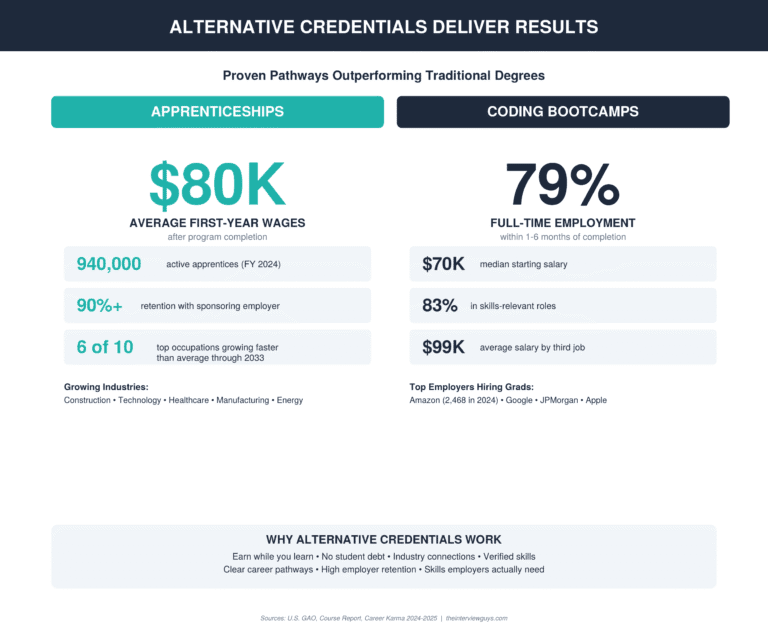
- Alternative pathways deliver proven results, including 940,000 active apprentices earning $80,000 average first-year wages
The Reality Gap: What Companies Say vs. What They Actually Do
The skills-based hiring movement has captured enormous attention. But the gap between corporate announcements and actual hiring behavior tells a more complex story.
The Harvard Bombshell
Harvard Business School researchers analyzed actual hiring patterns across thousands of companies to determine whether skills-based hiring claims translated into changed behavior. Their findings were striking:
| What They Measured | What They Found |
|---|---|
| Roles removing degree requirements (2014-2023) | 3.6% |
| Increase in non-degreed hires in those roles | 3.5% |
| Actual hires affected by skills-based policies | Fewer than 1 in 700 (0.14%) |
| Additional non-degreed hires per 100 jobs dropping requirements | ~4 |
This doesn’t mean skills-based hiring is a fraud. It means the gap between policy announcements and actual hiring behavior is enormous. Companies are changing their job postings far more readily than they’re changing their actual selection decisions.
The math is revealing: if a company drops degree requirements for 100 roles, they’ll hire approximately 4 additional candidates without degrees compared to what they would have hired anyway. That’s genuine progress, but it’s far from the transformation that press releases suggest.
Three Types of Employers
The Harvard research identified three distinct employer categories based on their actual behavior:
| Type | % of Employers | Actual Behavior |
|---|---|---|
| Skills-Based Hiring Leaders | 37% | Removed requirements AND increased non-degreed hiring by 20%+ |
| In Name Only | 45% | Changed job postings but hiring rates stayed the same |
| Backsliders | 18% | Reinstated requirements or reduced non-degreed hiring |
The 45% “In Name Only” category explains the massive gap between corporate claims and actual impact. These employers changed their words but not their actions.
What distinguishes the 37% of genuine leaders?
- Concrete skills assessment protocols replacing credential screening
- Hiring manager training on evaluating non-traditional candidates
- Performance tracking systems proving skills-based hires succeed
- Executive accountability for diverse talent pipeline outcomes
Interview Guys Take: The “In Name Only” majority reveals something uncomfortable about corporate hiring. Many companies announce skills-based hiring because it generates positive press and expands their theoretical talent pool. But when it comes to actual selection decisions, degree preferences remain deeply embedded in organizational culture and individual hiring manager behavior. Changing a job posting is easy. Changing human judgment is hard.
Why the Gap Exists
Several factors explain why companies say one thing and do another:
- Hiring manager discretion remains enormous in selection decisions. Even when postings drop requirements, individual managers often still favor traditional credentials when reviewing resumes.
- Skills verification challenges persist. Degrees provide standardized signals that alternative credentials can’t yet match consistently. A bachelor’s degree from State University means roughly the same thing everywhere. A “data analytics certificate” could represent anything from a weekend course to a rigorous six-month program.
- Legal and compliance concerns create hesitation about changing established selection criteria. HR departments worry about documentation and defensibility of new evaluation methods.
- Measurement systems lag behind policy changes. Most organizations track posting changes but not actual hiring behavior, so they never discover the gap between policy and practice.
- Organizational inertia means that even with official policy changes, the humans making decisions continue doing what they’ve always done.
What’s Actually Working: Skills-Based Hiring Success Stories
Despite the gap between claims and reality, genuine transformation is happening in certain sectors. These success stories provide roadmaps for what works and where job seekers should focus their efforts.
State Governments Lead the Way
State governments have emerged as the most aggressive and measurable adopters of skills-based hiring. According to BestColleges research, at least 16 states have now dropped degree requirements for most government positions.
| State | Action | Results |
|---|---|---|
| Maryland | First to eliminate requirements (March 2022) | 41% increase in hires year one |
| Pennsylvania | 92% of state jobs (65,000 positions) opened | ~60% of new hires without degrees |
| Utah | 98% of classified positions opened | Significantly expanded talent pool |
| Colorado | 76% of postings now skills-based, targeting 100% by mid-2025 | Vacancies down 23.9% to 19.7%; turnover down 21.4% to 14.5% |
| Delaware | Removed requirements for Family Service Specialists | 575% more applicants; 13% fewer unqualified applicants |
| Virginia | Dropped requirements for most executive branch positions | Expanded access to state employment |
| Alaska | Removed degree requirements for government roles | Broader candidate pool in underserved areas |
Governor Josh Shapiro’s executive order on his first full day in office represented one of the most dramatic changes. Utah’s Governor Spencer Cox stated directly: “Degrees have become a blanketed barrier to entry in too many jobs.”
The Delaware results are particularly instructive. By removing degree requirements for Family Service Specialists, the state didn’t just get more applicants. They got better applicants. The 13% decrease in unqualified applications suggests that degree requirements were filtering out qualified candidates while failing to filter out unqualified ones.
Why Government Succeeds Where Corporations Struggle
Key success factors that differentiate government implementation:
- Standardized job classifications with clear competency requirements that can be evaluated independently of credentials
- Political accountability creating pressure for measurable results and public reporting
- Centralized hiring processes rather than individual manager discretion, ensuring consistent application of new policies
- Clear advancement pathways enabling performance comparison between degree-holding and non-degree employees
- Budget pressures incentivizing access to the full talent pool rather than artificial restrictions
- Public sector unions supporting broader access to employment opportunities
Interview Guys Take: The state government experience proves skills-based hiring can work at scale when organizations commit to genuine implementation. The key factors are standardized competency frameworks, centralized hiring processes, and accountability for results. Job seekers should pay particular attention to government opportunities, which offer both skills-based entry and strong benefits packages.
Private Sector Bright Spots
While the overall private sector picture is mixed, certain companies and sectors demonstrate genuine transformation:
Technology companies with proven skills-based approaches:
- IBM’s “New Collar” initiative removing degree requirements for technical roles
- Google’s career certificates creating direct pathways to employment
- Apple’s apprenticeship programs for technical and retail positions
- Accenture’s significant non-degree hiring in consulting and technology
Retailers and service companies expanding access:
- Walmart’s skills-first approach for management advancement
- Target’s internal development programs prioritizing capability over credentials
- Starbucks’ tuition reimbursement combined with skills-based promotion
The common thread: these companies invested in skills assessment infrastructure and hiring manager training, not just policy announcements.
The Rise of Alternative Credentials
While formal skills-based hiring policies show mixed results, alternative credential pathways are delivering proven outcomes for millions of workers.
Apprenticeships: The $80,000 Pathway
Registered Apprenticeship Programs (RAPs) have experienced explosive growth and deliver exceptional outcomes. According to the U.S. Government Accountability Office:
| Metric | Data |
|---|---|
| Current participants (FY 2024) | ~940,000 |
| Average first-year wages after completion | $80,000 |
| Industries covered | Construction, tech, healthcare, manufacturing, energy |
| Job growth projection | 6 of top 10 occupations growing faster than average through 2033 |
| Wage comparison | 9 of 10 top occupations pay above median for all workers |
| Retention rates | 90%+ remain with sponsoring employer |
Key benefits for job seekers:
- Earn while you learn with no student debt accumulation
- Enter workforce with both verified skills and substantial experience
- Higher retention rates mean stronger employer investment in your success
- Federal support: recent $244 million allocation to expand programs
- Industry-recognized credentials portable across employers
- Clear career progression pathways built into program structure
Growing apprenticeship sectors beyond traditional trades:
- Healthcare: medical assistant, pharmacy technician, dental assistant
- Technology: cybersecurity analyst, software developer, IT support
- Financial services: financial advisor, insurance underwriter
- Advanced manufacturing: CNC machinist, industrial maintenance
Coding Bootcamps: Accelerated Technical Pathways
Coding bootcamps provide another proven alternative, particularly for technology careers. According to Course Report’s comprehensive analysis:
| Metric | Data |
|---|---|
| Full-time employment rate | 79% |
| Time to employment | 1-6 months after completion |
| Median starting salary | ~$70,000 |
| Graduates in skills-relevant roles | 83% |
| Second job average salary | ~$80,000 |
| Third job average salary | ~$99,000 |
| Average tuition | $12,000-$14,000 |
| Typical program length | 12-24 weeks |
The bootcamp market continues growing, with projections reaching $2.4 billion by 2030.
Top employers consistently hiring bootcamp graduates:
- Amazon: 2,468 hires in 2024 (up 129% from 2021-22)
- Google: significant hiring through career certificate programs
- JPMorgan Chase: technology and operations roles
- Accenture: consulting and technical positions
- Apple: 378 hires in 2024
- Capital One: technology and data roles
- Deloitte: consulting and technical positions
Top programs with strong employer networks:
- Flatiron School: strong career services and employer partnerships
- General Assembly: global presence and diverse program offerings
- Hack Reactor: intensive software engineering focus
- App Academy: income share agreements reducing upfront cost
- Springboard: mentorship-focused approach with job guarantee
The Council on Integrity in Results Reporting (CIRR) provides standardized outcomes data to help prospective students evaluate programs objectively.
Microcredentials and Professional Certifications
Beyond apprenticeships and bootcamps, the broader alternative credentials ecosystem continues expanding. LinkedIn data shows:
- 70% of paid job posts now require specific skills
- Posts mentioning skills see 19% higher view-to-apply rates
- Skills-based profiles receive more recruiter attention
High-value certification areas by category:
Cloud Computing:
- AWS Certified Solutions Architect
- Microsoft Azure Administrator
- Google Cloud Professional
- Average salary premium: 15-25%
Cybersecurity:
- CompTIA Security+
- CISSP (Certified Information Systems Security Professional)
- CEH (Certified Ethical Hacker)
- Average salary premium: 20-30%
Data and Analytics:
- Google Data Analytics Certificate
- IBM Data Science Professional Certificate
- Tableau Desktop Specialist
- Average salary premium: 10-20%
Project Management:
- PMP (Project Management Professional)
- Scrum Master certifications
- Six Sigma certifications
- Average salary premium: 15-25%
Interview Guys Take: Alternative credentials aren’t “second best” options. For many career paths, they’re genuinely superior. Apprenticeships provide paid training with industry connections. Bootcamps compress years of learning into months. Certifications demonstrate specific, verified capabilities employers actually need. Evaluating these pathways alongside traditional credentials is essential for strategic career planning.
The Skills Gap Crisis: Why This Matters
Understanding skills-based hiring isn’t just about job search tactics. It’s about navigating a labor market undergoing fundamental transformation.
The World Economic Forum’s Warning
The World Economic Forum’s Future of Jobs Report 2025 presents sobering projections. Drawing on data from over 1,000 companies representing 14 million workers across 55 economies:
| Projection | Data |
|---|---|
| New jobs created by 2030 | 170 million |
| Jobs displaced by 2030 | 92 million |
| Net job increase | 78 million |
| Total job disruption | 22% of current employment |
| Workers’ core skills expected to change | 39% by 2030 |
| Employers citing skills gaps as primary barrier | 63% |
| Workforce completing training (2024) | 50% (up from 41% in 2023) |
According to the WEF press release, if the global workforce were represented by 100 people:
- 41 will not require significant training by 2030
- 29 will require training and be upskilled within current roles
- 19 will require training and be reskilled/redeployed to new roles
- 11 will require training but won’t have access to it
That last number translates to over 120 million workers at medium-term risk of redundancy globally. The skills training gap represents one of the most significant workforce challenges of our era.
What Skills Actually Matter
The WEF research identifies the fastest-growing skills through 2030:
Technology Skills (Growing Fastest):
- AI and big data literacy
- Networks and cybersecurity
- Technological literacy broadly
- Programming and data analysis
- Digital marketing and content creation
Human Skills (Enduring Value):
- Creative thinking and innovation
- Resilience, flexibility, agility
- Curiosity and lifelong learning
- Leadership and social influence
- Analytical thinking and problem-solving
- Emotional intelligence
- Collaboration and teamwork
Declining Skills (Being Automated):
- Manual dexterity and precision
- Reading and writing (basic level)
- Basic data entry and processing
- Routine cognitive tasks
The pattern is clear: the most valuable skill profiles combine technical capabilities with distinctly human attributes. Workers who develop both categories position themselves for strongest outcomes regardless of how quickly skills-based hiring policies spread.
The 2025 Hiring Landscape
Current labor market conditions create urgency around skills development and positioning. Our State of Job Search 2025 report documents the challenges:
- Median time to first offer: 68.5 days (22% increase year over year)
- Many seekers need 100-200+ applications before landing offers
- Only 41% find positions within one month
- Interview-to-offer conversion rates declining
- Salary negotiations increasingly competitive
In this environment, demonstrable skills that differentiate you from other candidates are essential for success.
Interview Guys Take: The skills gap isn’t abstract. It’s creating real consequences for millions whose current capabilities don’t match evolving employer needs. But the same forces creating displacement also create opportunity for those who proactively develop in-demand skills. The window for adaptation is now, while programs are expanding and employers are actively seeking skilled workers.
Why Skills-First Resume Formatting Works Regardless of Policy
Here’s the crucial insight that changes everything: skills-first resume formatting delivers results because of how recruiters actually search for candidates, not because companies have transformed their formal hiring policies.
How Recruiters Actually Find Candidates
Understanding recruiter behavior reveals why skills-first formatting works even when companies haven’t genuinely adopted skills-based hiring:
| Recruiter Behavior | Percentage |
|---|---|
| Use keyword filters when searching ATS | 99.7% |
| Start ATS searches with skills keywords | 76.4% |
| Look at skills section first on resumes | 41% |
| Focus on hard skills when screening | 88% |
| Use Boolean searches combining skills | 67% |
When a recruiter opens an ATS to find candidates for a project manager role, they don’t search “bachelor’s degree holders.” They search “project management,” “PMP,” “Agile,” “stakeholder management,” and other skill-based terms.
The implications are profound: regardless of whether a company has a formal skills-based hiring policy, the actual process of finding candidates in ATS systems is inherently skills-focused. If your resume doesn’t surface in skills-based searches, you’re invisible to recruiters before they ever see your credentials.
This is why skills-first formatting works even at companies that haven’t transformed their hiring policies. The discovery process is skills-based even when the final selection process may still favor traditional credentials.
The Performance Data
Skills-first resume formatting delivers measurable advantages across multiple metrics:
| Metric | Result |
|---|---|
| ATS pass rate (skills-first vs. traditional) | +40% |
| Response rate for career changers | +60% |
| Interview rate (tailored vs. generic) | 5.75% vs. 2.68% (115% improvement) |
| Interview increase with job title in headline | 10.6x more interviews |
| Callback rate with skills-matched keywords | 2.3x higher |
| Time to first interview | 35% faster |
According to Huntr’s Q2 2025 analysis, tailored resumes prominently featuring relevant skills dramatically outperform generic versions across virtually every measurable outcome.
Making Your Skills Visible
Translating this insight into action requires strategic optimization of your resume:
Step 1: Analyze Target Job Postings
- Extract recurring skills requirements from 5-10 similar postings
- Note exact terminology employers use (not your preferred phrasing)
- Identify both required and preferred skills
- Our skills-based resume guide provides detailed instructions
Step 2: Create a Dedicated Skills Section
- Position near the top of your resume for immediate visibility
- Organize by category (technical, industry-specific, transferable)
- Include proficiency levels where appropriate
- Match terminology to job posting language
Step 3: Integrate Skills Throughout Experience
- Weave skill keywords naturally into accomplishment statements
- Quantify skill application with specific examples
- Show progression and growth in key skill areas
- Connect skills to measurable outcomes
Step 4: Customize for Each Application
- Generic skills lists underperform targeted versions
- Prioritize skills mentioned most frequently in target posting
- Adjust emphasis based on specific role requirements
- Track which variations generate best response rates
Step 5: Verify ATS Compatibility
- Complex formatting can prevent skill extraction
- Use ATS-friendly templates to ensure discoverability
- Test your resume through ATS simulation tools
- Avoid graphics, tables, and unusual fonts
Interview Guys Take: Companies may not have transformed their formal hiring policies, but they’ve all adopted ATS systems that search by skills. Your resume strategy needs to lead with skills whether or not the company has a formal “skills-based hiring” policy. Optimize for how recruiting actually works, not for corporate announcements about how it supposedly works.
Industry Variations: Where Skills-Based Hiring Actually Matters
Skills-based hiring adoption varies dramatically across industries. Understanding these variations helps job seekers target efforts strategically.
| Industry | Adoption Level | Key Considerations |
|---|---|---|
| Technology | High (78%) | Technical skills easily assessed; strong bootcamp hiring; portfolios valued |
| Government | Very High (16+ states) | Most reliable skills-based entry; strong benefits; measurable implementation |
| Skilled Trades | Very High | Apprenticeships dominant; always prioritized demonstrated capability |
| Healthcare | Mixed | Licensed roles require credentials; support/admin roles increasingly open |
| Financial Services | Evolving | Major banks announcing changes; regulatory roles still require credentials |
| Professional Services | Mixed | Core roles (lawyers, CPAs) require credentials; support roles opening |
| Retail/Hospitality | High for entry | Internal advancement increasingly skills-based |
| Manufacturing | Growing | Technical certifications gaining recognition |
Technology: Walking the Talk
The technology sector leads genuine transformation. According to CompTIA’s Workforce Survey:
- 78% of tech companies implemented skills-based hiring for technical roles
- 45% increase in candidate diversity after implementation
- 35% improvement in retention rates for skills-based hires
- 28% reduction in time-to-productivity
For tech career seekers, skills demonstration matters more than credentials:
- Build portfolios showcasing actual work products
- Contribute to open source projects with public commit histories
- Complete relevant certifications from recognized providers
- Prepare for technical assessments and coding challenges
- Document projects with measurable outcomes
Skilled Trades: Skills Have Always Mattered
The skilled trades represent perhaps the purest skills-based hiring example. Apprenticeships dominate entry:
- Elevator installers/repairers: $48.11 hourly mean wages
- Electrical power-line installers: $36.62 hourly mean wages
- Multiple trades exceed $30/hour
- Strong demand growth projections through 2033
- No degree requirements for most positions
- Clear advancement pathways based on skill development
Healthcare: Credential Requirements with Flexibility
Healthcare presents a nuanced picture:
Roles requiring traditional credentials:
- Physicians and surgeons
- Registered nurses
- Pharmacists
- Physical therapists
- Licensed clinical positions
Roles increasingly open to alternative pathways:
- Medical assistants
- Healthcare administrators
- Medical billing and coding
- Patient care technicians
- Health information technicians
The Gen Z Factor: A Generation Built for Skills-Based Hiring
Generation Z’s workforce entrance intersects uniquely with skills-based hiring trends.
Entry-Level Challenges
| Metric | Data |
|---|---|
| Recent graduates still searching for full-time work | 58% (vs. 25% for previous generations) |
| Decline in 0-2 years experience postings since Jan 2024 | 29 percentage points |
| Junior tech role decline | 35% |
| Junior logistics decline | 25% |
| Junior finance decline | 24% |
| Average applications before first interview | 47 (up from 32 in 2023) |
These challenges create urgency around skills-based approaches. Traditional credential pathways aren’t delivering the employment outcomes they once promised. The degree-to-job pipeline that worked for previous generations is increasingly broken.
Natural Skills-Based Adapters
Gen Z demonstrates natural affinity for skills-based approaches:
- 75% use AI tools to learn new skills (highest of any generation)
- Comfortable with online learning platforms and certifications
- Prefer demonstrating capabilities through portfolios and projects
- Build online presence to showcase work directly to employers
- Skeptical of traditional credentialing based on cost and outcomes
- Entrepreneurial orientation toward creating own opportunities
Recommendations for Gen Z job seekers:
- Build demonstrable skill portfolios rather than accumulating credentials for their own sake
- Pursue internships and projects providing tangible, portfolio-worthy experience
- Develop both technical skills and human capabilities AI cannot replicate
- Leverage LinkedIn to demonstrate capabilities directly to employers
- Consider apprenticeships and bootcamps as primary pathways, not just backups
- Document everything with measurable outcomes
Interview Guys Take: Gen Z is the test generation for skills-based hiring’s viability. If the movement succeeds, this generation will pioneer new pathways into professional careers. If it stalls at policy announcements, Gen Z will bear the consequences. The stakes couldn’t be higher for workers entering the labor market now.
Your Action Plan: Navigating Skills-Based Hiring Reality
Understanding the gap between claims and reality enables strategic navigation. Different job seekers need different approaches based on their current credentials and target careers.
For Job Seekers Without Traditional Degrees
| Priority | Strategy | Why It Works |
|---|---|---|
| 1 | Target government positions first | 16+ states with proven implementation; Pennsylvania’s 65,000 opened positions demonstrate genuine commitment |
| 2 | Investigate apprenticeships | 940,000 participants; $80K first-year wages; strong retention; earn while learning |
| 3 | Consider bootcamps for tech | 79% employment; $70K median salary; accelerated pathway with employer relationships |
| 4 | Pursue industry certifications | Cloud, cybersecurity, project management provide verifiable skill signals |
| 5 | Build portfolio evidence | Projects, contributions, freelance work demonstrate capability better than credentials |
| 6 | Target “Leaders” category employers | Research which companies actually hire non-degreed workers, not just those announcing policies |
For Job Seekers With Traditional Degrees
| Priority | Strategy | Why It Works |
|---|---|---|
| 1 | Optimize resume for skills-first | Recruiters search ATS using skills keywords regardless of your credentials |
| 2 | Supplement degree with certifications | Differentiate from other degree holders with specific, verified capabilities |
| 3 | Prepare for skills demonstrations | Behavioral questions, assessments, work samples increasingly common even for degreed candidates |
| 4 | Consider strategic career changes | Skills-based hiring makes pivots more viable; identify transferable skills |
| 5 | Build portfolio alongside credentials | Demonstrated work products increasingly valued even with strong educational background |
For Career Changers
| Priority | Strategy | Why It Works |
|---|---|---|
| 1 | Identify transferable skills | Articulate transfers explicitly rather than hoping employers connect dots |
| 2 | Fill specific skill gaps | Targeted bootcamps or certifications more efficient than entire new credentials |
| 3 | Leverage skills-first formats | Emphasize capabilities over chronological experience to reframe your background |
| 4 | Target genuine skills-based employers | Use Harvard categories to identify behavior vs. announcements |
| 5 | Build bridge experience | Freelance projects, volunteer work, side projects in target field demonstrate commitment |
FAQ: Skills-Based Hiring in 2025
Q: Is skills-based hiring real, or just corporate PR?
The truth lies in between. Skills-based hiring is real in certain contexts: government positions (16+ states with measurable results), technology companies (78% implementation), and alternative credential pathways like apprenticeships (940,000 participants with $80K outcomes). However, the Harvard research showing only 0.14% of hires actually affected demonstrates massive implementation gaps in corporate settings generally. Research actual hiring behavior rather than accepting announcements at face value.
Q: Should I skip college because skills-based hiring is expanding?
Not necessarily. The decision depends on:
- Your specific career goals and target industry
- Regulatory requirements in your field
- Your financial situation and risk tolerance
- Alternative pathways available in your area
- Your learning style and preferences
Some fields genuinely require degrees for regulatory or professional reasons. Others increasingly value demonstrated skills over credentials. Evaluate specific requirements in your target career path before making decisions about education investments.
Q: Which alternative credentials actually work?
| Credential Type | Key Outcomes | Best For |
|---|---|---|
| Registered Apprenticeships | 940,000 participants; $80K first-year wages; excellent retention | Trades, healthcare, technology |
| Coding Bootcamps | 79% employment; $70K median salary; accelerated timeline | Technology careers |
| Industry Certifications | Verifiable skill signals; salary premiums 10-30% | Adding to existing experience |
| Professional Certificates | Google, IBM, Microsoft programs with employer relationships | Entry-level positions |
Q: How do I know if a company actually practices skills-based hiring?
Research beyond announcements using these strategies:
- Look for evidence of non-degreed workers in target positions on LinkedIn
- Check employee profiles for credential patterns in roles you’re targeting
- Read Glassdoor reviews mentioning hiring practices and actual requirements
- Ask recruiters directly about actual requirements vs. posted preferences
- Research whether company appears in “Leaders” category studies
- Look for concrete skills assessment in their interview process
Q: Will skills-based hiring eliminate degree preferences entirely?
Unlikely in the near term. The 45% “In Name Only” category demonstrates how deeply embedded credential preferences remain in organizational culture and individual decision-making. Transformation is happening but slowly, and primarily in specific sectors. Practical strategy assumes ongoing employer preference for traditional credentials in many contexts while positioning yourself to succeed with genuine skills-based employers.
Q: How should I format my resume for skills-based hiring?
Regardless of employer policies, optimize for how recruiters actually search:
- Create dedicated skills section near top with target job keywords
- Integrate skills throughout experience descriptions with specific examples
- Use ATS-friendly formatting to ensure discoverability
- Customize skills emphasis for each application
- Quantify skill application wherever possible
- Match terminology to job posting language exactly
Q: Are certain industries more receptive to skills-based hiring?
Yes. Based on current implementation data:
- Government (very high): 16+ states with proven results
- Technology (high): 78% implementation rate
- Skilled trades (very high): Always prioritized demonstrated capability
- Healthcare support roles (growing): Non-licensed positions increasingly open
- Financial services (evolving): Major banks expanding access
- Retail management (high): Internal advancement increasingly skills-based
The Bottom Line: Strategy Over Optimism
Skills-based hiring represents genuine transformation in how some employers evaluate candidates. Alternative credential pathways deliver proven results for millions of workers. Government initiatives have successfully opened tens of thousands of positions to candidates without traditional degrees.
But the Harvard research is a necessary reality check. When 85% of companies claim skills-based hiring but fewer than 1 in 700 hires are actually affected by degree requirement removal, we’re dealing with a massive gap between rhetoric and reality.
Smart job seekers navigate this landscape strategically:
- Target employers with proven skills-based hiring behavior, not just policy announcements
- Pursue alternative credentials with demonstrated outcomes and employer relationships
- Format resumes for skills-first discovery regardless of employer policies
- Maintain appropriate skepticism about claims that don’t match actual behavior
- Invest in skills that matter regardless of how quickly hiring policies evolve
The future increasingly belongs to those who can demonstrate what they can do, not just what credentials they hold. But navigating from here to there requires clear-eyed assessment of where transformation has actually occurred and where it remains more aspiration than reality.
Position yourself for the labor market as it actually exists, not as corporate press releases describe it.
Resources & References
This report synthesizes research from authoritative sources including academic studies, government data, industry surveys, and labor market analyses current as of Q3-Q4 2025.
Primary Research Source
Harvard Business School & Burning Glass Institute: Skills-Based Hiring Research
TestGorilla State of Skills-Based Hiring 2025
World Economic Forum Future of Jobs Report 2025
LinkedIn Economic Graph Skills-Based Hiring Analysis
McKinsey Workforce Transformation Research
Government and Institutional Sources
U.S. Government Accountability Office Apprenticeship Report
SHRM: Pennsylvania Drops Degree Requirements
Bureau of Labor Statistics Apprenticeship Data
BestColleges: States Without Degree Requirements
Alternative Credentials Research
Course Report: Coding Bootcamp Outcomes
Career Karma: State of the Bootcamp Market
CompTIA Workforce Survey
Labor Market Analysis
Huntr Q2 2025 Job Search Trends
Indeed Hiring Trends Research
ZipRecruiter Skills-Based Hiring Statistics
Related Interview Guys Content
How to Write a Skills-Based Resume
Skills-First Resume Guide
63% of Employers Say Skills Gaps Are Their Biggest Barrier
The Skills Mismatch Crisis
Top Jobs That Pay $100K Without a Degree
Best Paying Jobs Without a Degree
State of Job Search 2025 Research Report
The State of Gen Z in the Workplace 2025
The State of AI in the Workplace 2025
Top 7 Microcredentials to Boost Your Resume

BY THE INTERVIEW GUYS (JEFF GILLIS & MIKE SIMPSON)
Mike Simpson: The authoritative voice on job interviews and careers, providing practical advice to job seekers around the world for over 12 years.
Jeff Gillis: The technical expert behind The Interview Guys, developing innovative tools and conducting deep research on hiring trends and the job market as a whole.