
The State of Career Longevity in 2025: A Comprehensive Research Report
How job security replaced salary as the top priority, why job hopping died, and which skills will keep your career alive for decades
Career longevity in 2025 looks radically different than it did just three years ago. The pandemic-era job-hopping boom has reversed completely, with workers now clinging to their current roles in what consultants call “job hugging.” For the first time since 2010, staying at your job pays just as well as switching, eliminating the primary financial incentive for career moves.
This report analyzes the convergence of economic uncertainty, technological disruption, and demographic shifts that have fundamentally altered how workers approach career longevity in 2025.
Methodology: This research synthesizes data from 15+ authoritative sources including the U.S. Bureau of Labor Statistics, Federal Reserve wage tracking data, World Economic Forum Future of Jobs Report 2025, Pew Research Center workforce studies, and LinkedIn’s 2025 Workplace Learning Report. The analysis covers employment trends, compensation patterns, skills development, and career sustainability across industries and demographics.
☑️ Key Takeaways
- Job security now trumps salary: 81% of workers prioritize job security over salary increases in 2025, with 43% willing to accept pay cuts for stability
- The death of job hopping: Job switchers now earn only 4.8% raises compared to 4.6% for those who stay, the smallest gap in over a decade (down from 7.7% vs 5.5% in 2023)
- Promotion timelines are lengthening: The average time to promotion has increased to 30.4 months (2.5 years) across major corporations, with 75% of workers leaving before ever getting promoted
- AI anxiety is real but misguided: 55% of workers express job security concerns due to AI, yet healthcare, skilled trades, and creative roles show the strongest future-proofing characteristics
- Skills are becoming obsolete faster: 39% of current skills will be outdated by 2030, while the skills required for a single job increase by 10% year-over-year
- Americans are working longer: The number of employed Americans 65+ has grown 33% since 2015, with 70% of workers considering delaying retirement due to financial concerns
The Great Shift: From Job Hopping to Job Hugging
How the Financial Incentive Vanished
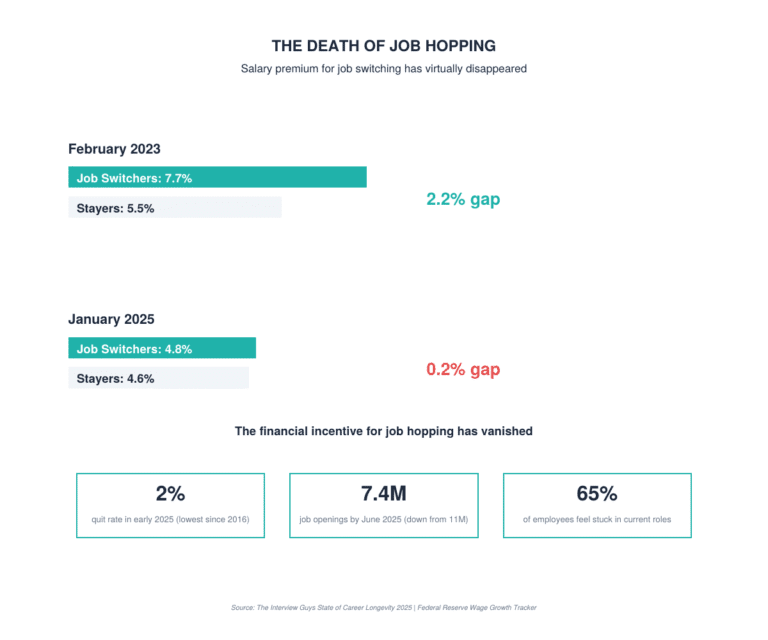
The job-hopping strategy that defined the 2021-2022 labor market has collapsed with stunning speed. According to Federal Reserve wage tracking data, workers who switched jobs in January and February 2025 saw raises of just 4.8%, compared to 4.6% for those who stayed put. This represents the smallest differential in over a decade.
The salary premium for job switching has evaporated:
- February 2023: Job switchers got 7.7% raises vs. 5.5% for stayers (2.2% advantage)
- January 2025: Job switchers got 4.8% raises vs. 4.6% for stayers (0.2% advantage)
- The gap dropped from 2.2 percentage points to just 0.2 points in under two years
This financial reality has triggered what Korn Ferry consultants call “job hugging.” Workers are holding onto their positions “for dear life,” even when dissatisfied, because there’s simply no financial reward for leaving.
The data reveals a fundamental reversal in market dynamics. During the peak of the Great Resignation in 2022, job hoppers commanded wage premiums of 20% in some industries. By July 2025, according to Bank of America analysis, that premium had collapsed to just 7%, exactly matching the raises received by employees who stayed.
The Numbers Behind Job Hugging
The quit rate tells the story most clearly. The percentage of workers voluntarily leaving their jobs has hovered around 2% since early 2025, according to the U.S. Labor Department’s Job Openings and Labor Turnover Survey. Outside of the initial COVID-19 pandemic days, this represents the lowest levels since early 2016.
Why workers are staying put:
- Job openings have fallen from 11 million at peak to 7.4 million by June 2025 (BLS data)
- The ratio of job openings per unemployed person dropped from 2.0 in March 2022 to 1.1 by 2025
- Only 2.2% of workers switched jobs in recent months, down from 2.6% in June 2022
- 65% of employees report feeling “stuck” in their current roles (Glassdoor survey)
The job-to-job move rate, tracked by Bank of America, has fallen sharply from its 2022 peak and now sits just 2% higher than pre-pandemic levels. The era of the job hopper has definitively ended, replaced by the age of the job hugger.
Industry-Specific Patterns
Not all industries experienced the same shift. Finance remains the one sector where job hopping still pays premium wages, with experienced banking professionals joining new banks receiving record pay premiums following unprecedented earnings in 2024.
However, the technology sector tells a different story. After layoffs swept through tech in 2024 and software development vacancies hit a 5-year low, many tech job seekers settled for pay cuts. Applicants for senior tech roles were hit hardest as companies slashed manager headcount.
In white-collar sectors broadly, the decline in job-hopping proved most pronounced. Meanwhile, some blue-collar and service sectors maintained higher mobility, though still well below pandemic-era peaks.
Discover Your Top 8 Perfect Career Matches in 60 Seconds
Take our quick “Career Code” Assessment and get your top 8 career matches. We rank these based on your unique combination of strengths, energy patterns, and motivations
The Job Security Revolution: When Stability Beat Salary
The Priority Inversion
One of the most striking shifts in 2025 involves worker priorities. For the first time in modern labor market history, job security has decisively overtaken salary as workers’ primary concern.
The security-first mindset:
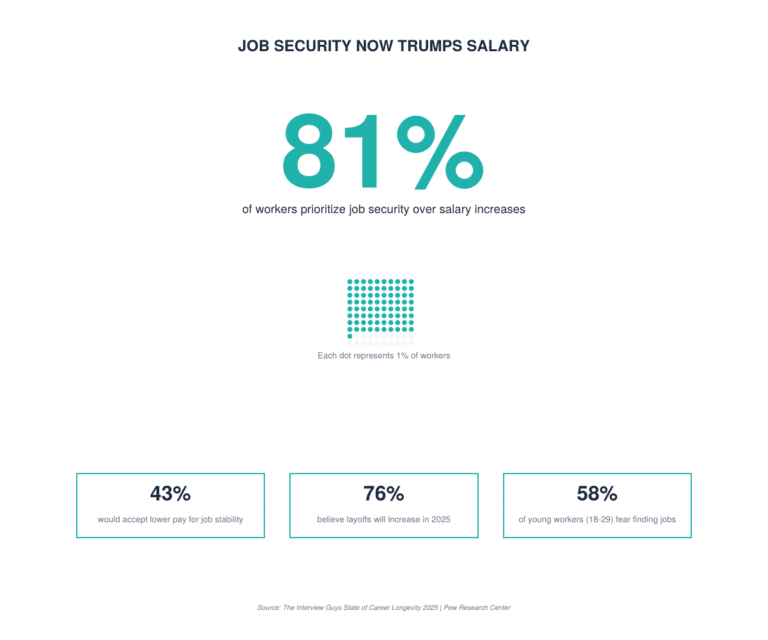
- 81% of workers now prioritize job security over salary increases (Pew Research Center, December 2024)
- 43% of workers would accept lower compensation for greater job stability
- 23% of job seekers would take a salary decrease for a better-aligned, more secure position
- 76% of workers believe layoffs will increase in 2025
This represents a complete reversal from historical norms. Previous research from the 1990s showed that only about 30-40% of workers prioritized security over compensation. The shift reflects both economic anxiety and the psychological scars left by recent mass layoffs.
The Anxiety Drivers
The numbers behind worker anxiety are sobering. Over 806,000 job cuts were announced in 2025, the highest figure since 2020. Workers see colleagues getting laid off and respond by tightening their grip on current positions, even when those roles don’t align with long-term goals.
Among young workers aged 18-29, the anxiety is particularly acute. 58% say finding their desired job would be difficult, the highest percentage across all age groups. College-educated Americans in this demographic saw unemployment hit 5.8% in March 2025, the highest level in four years.
Even in uncertain times, keeping your skills current remains essential. Workers who proactively develop in-demand capabilities position themselves for both stability and future opportunities.
Geographic and demographic patterns:
- Class of 2025 graduates prioritize location and family proximity over compensation
- More than half apply to jobs within 250 miles of their school
- Less than 10% are preparing for cross-country moves (down from 25%+ in previous years)
- Millennials, once the job-hopping generation, now lead the charge in strategic job selection for security
For those considering major career transitions in this environment, the priority has clearly shifted from maximizing salary to ensuring stability and alignment with personal values.
The psychological impact extends beyond employment statistics. Research shows 36% of workers report a direct correlation between compensation and mental health, yet 52% anticipate that burnout rates will worsen in 2025. This creates a dangerous cycle where financial stress and job security anxiety compound each other.
The Mental Health Cost
Workers staying in unsuitable roles for security reasons often experience decreased job satisfaction and increased stress levels. When large percentages of employees feel trapped in their roles, workplace culture suffers. Productivity can decline as engagement drops, creating the very instability that workers sought to avoid by staying.
Research on workplace burnout shows that 52% anticipate burnout rates will worsen in 2025, creating a dangerous cycle where financial stress and job security anxiety compound each other. Success in today’s job market requires adapting strategies to match current realities while positioning yourself for future opportunities when market conditions improve.
Promotion Timelines: The Lengthening Path to Advancement
How Long Does It Really Take?
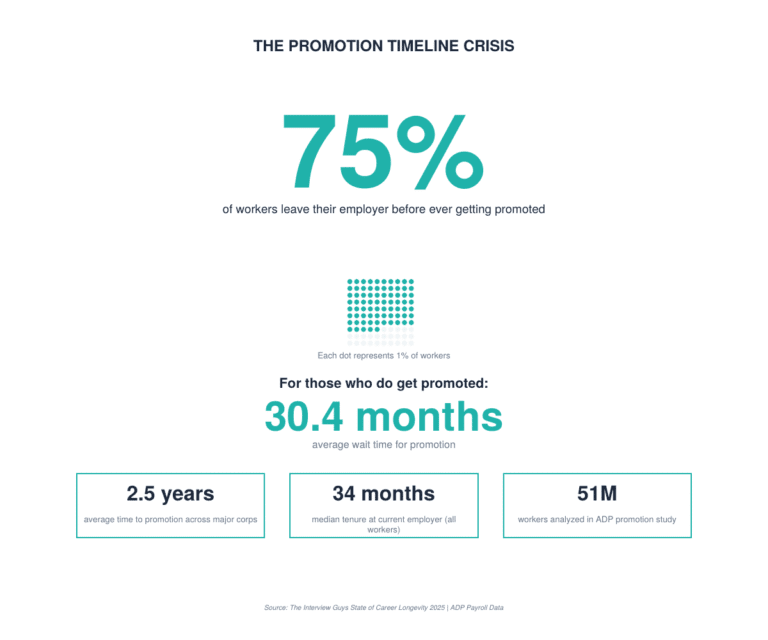
One of the most consequential shifts in career longevity involves promotion timelines. A comprehensive analysis of career histories from 19,363 employees at major corporations reveals that it takes an average of 30.4 months (about 2.5 years) to receive a promotion.
However, this average masks significant variation:
Fastest promotion timelines:
- Tesla: 10.4 months (fastest in the study)
- JP Morgan: 17.2 months
- Microsoft: 16.0 months
- Amazon: 18.8 months
- NVIDIA: 19.9 months
Slowest promotion timelines:
- Rio Tinto: 98 months (8+ years, longest in the study)
- Broadcom: 44.4 months
- Traditional manufacturing: 3-5 years typical
- Government/public sector: 3-4 years average
The tech sector generally offers faster promotion cycles (1-3 years), while traditional industries like manufacturing typically require 3-5 years between promotions.
The Promotion Rate Reality
Even more concerning than timeline length is the promotion rate itself. Analysis of 2023 payroll data from ADP covering more than 51 million workers reveals a stunning statistic: 75% of workers leave their employer before ever getting promoted.
This finding upends conventional wisdom about career advancement. Only 43.1% of current employees across major corporations had been promoted from within to reach their current position. The data suggests that for most workers, the only viable path to advancement is leaving their current employer.
Promotion rates by company (percentage of employees promoted internally):
- Linde: 57.2% (highest in study)
- Eli Lilly: 52.0%
- Broadcom: 51.7%
- HSBC: 51.4%
- Microsoft: 40.0%
- Amazon: 43.1%
- Meta: 23.0%
The Experience Gap
Promotion timelines also vary significantly by career stage and role level:
By seniority level:
- Intern to next level: 8.7 months average
- Associate to next level: Varies by company, 18-24 months typical
- Mid-level to senior: 2-3 years
- Senior to Vice President: 22.1 months average
- Vice President: 90.3% promoted from within (highest rate by level)
The data shows a clear pattern: promotions happen less frequently as you climb the career ladder. Your first promotion might come relatively quickly, but subsequent advancements take progressively longer as employers want to maximize the value they get from each level before moving employees up.
The Gen Z Expectation Gap
The promotion timeline reality creates particular friction with Gen Z workers, who expect their first promotion within 12 months of starting a job, according to LaSalle Network research of 2,500 graduating college seniors. This expectation crashes against the reality that most first-time workers should expect a promotion once every three years, according to ZipRecruiter CEO Ian Siegel.
This disconnect has implications for retention. When Gen Z workers don’t see advancement within their expected timeframe, they’re more likely to leave. Yet 75% of workers across all generations already leave before getting promoted, suggesting the path to advancement through internal promotion has broken down for most organizations.
The “Two-Year Itch”
HR professionals describe a “two-year itch” phenomenon where employees who haven’t been promoted within their company start actively looking elsewhere. Nectar’s December survey of 800 full-time U.S. workers found:
- 60% of workers had been promoted in the past two years
- 15% said it had been 3-4 years since their last promotion
- 8% hadn’t been promoted in five or more years
- 14% had never received a promotion at all
Most employees reach this critical two-year window having worked at their current level for 48.6 months on average, which is 18.2 months longer than they spent in their previous position at the company before promotion. This suggests that most employees are overdue for promotion by traditional standards.
The AI Paradox: Fear vs. Reality
The Anxiety Epidemic
AI-related job security anxiety has reached fever pitch in 2025, but the data reveals a fascinating disconnect between fear and actual risk. An Authority Hacker survey found that 55% of U.S. workers have job security concerns, with AI as a primary driver.
Who worries most about AI:
- 75% of workers earning $125,000-$150,000 express concern (highest income bracket)
- 72.48% of workers earning $150,000+ express concern
- 62.2% of workers aged 25-44 express concern (highest age bracket)
- Less than 50% of workers 45+ share these concerns
- 61.02% of workers with 4+ years of college education express concern
Paradoxically, higher earners and more educated workers express the greatest AI anxiety, despite these groups typically having more transferable skills and career flexibility.
The Reality Check
The fears may be warranted in some respects. An OpenAI study estimates that 19% of U.S. workers could see 50% of their workplace tasks impacted by GPT-4 technology. The World Economic Forum’s Future of Jobs Report predicts that 44% of workers’ skills will be disrupted between 2023 and 2028.
However, the same research forecasting disruption also predicts significant job creation. While AI may displace 85 million jobs by 2030, it will simultaneously create 97 million new positions, resulting in a net gain of 12 million jobs globally.
The automation risk reality:
- McKinsey projects 30% of hours currently worked could be automated by 2030
- Goldman Sachs suggests 300 million full-time jobs may be exposed to automation
- However, 87% of executives believe job roles are more likely to be augmented than replaced by AI (IBM study)
Which Jobs Are Actually AI-Proof?
Analysis from multiple sources reveals clear patterns in which careers maintain longevity despite AI advancement. The most resilient roles share four key characteristics:
1. Emotional Intelligence Requirements Healthcare professionals, therapists, social workers, and teachers all require genuine human empathy that AI cannot replicate. Nurse practitioners face less than 1% automation risk and show 45.7% projected growth through 2033.
2. Physical Dexterity in Unpredictable Environments Skilled trades workers operate in unique, variable environments that robots cannot easily navigate. Geoffrey Hinton, the Nobel Prize-winning “Godfather of AI,” specifically suggested plumbing as one of the most secure, future-proof careers. Electricians show 11% growth with median wages of $48,912.
3. Creative Problem-Solving While AI can generate content, it struggles with original creativity and cultural understanding. Choreographers show zero automation risk with 29.7% projected growth.
4. Complex Judgment and Ethical Decision-Making Cybersecurity professionals make nuanced decisions about threat response that require human judgment. The field shows 33% projected growth through 2033, with information security analysts facing minimal automation risk.
The Skills That Matter
Rather than specific job titles, the World Economic Forum identifies skills that will maintain value:
Top growing skills 2025-2030:
- AI and big data literacy
- Networks and cybersecurity
- Technological literacy
- Analytical thinking
- Resilience, flexibility, and agility
- Creative thinking
- Curiosity and lifelong learning
Declining in importance:
- Manual dexterity
- Endurance and precision
- Reading, writing, and math (basic levels)
The key insight: hybrid skill sets combining technical literacy with distinctly human capabilities command 40% higher salaries and show 58% more resilience during economic downturns, according to LinkedIn’s Global Talent Trends report.
The Skills Revolution: Racing Against Obsolescence
The Acceleration of Skill Decay
One of the most sobering findings for career longevity involves the pace of skill obsolescence. According to the World Economic Forum’s Future of Jobs Report 2025, workers can expect that 39% of their existing skill sets will be transformed or become outdated over the 2025-2030 period.
This represents a slower rate of skill instability compared to previous projections (down from 44% in 2023 and 57% in 2020), potentially because more workers are actively upskilling. However, the challenge remains enormous.
The skill transformation timeline:
- 39% of skills will be outdated by 2030 (World Economic Forum)
- 44% of workers’ skills will be disrupted between 2023-2028
- Skills required for a single job increase by 10% year-over-year (Gartner)
- 30% of skills needed three years ago are no longer relevant
- 32% of skills needed for the average job have changed in just the last three years
The Upskilling Gap
Despite the urgent need, most workers aren’t getting adequate training. Research reveals a troubling disconnect:
The employer side:
- 85% of employers plan to prioritize upskilling their workforce
- 70% of employers expect to hire staff with new skills
- Only 26% of U.S. employees strongly agree their organization encourages learning new skills (Gallup)
- Only 19% of employees are encouraged by organizations to explore internal role changes (LinkedIn)
The employee side:
- 52% of workers admitted they need to learn new skills within the next year to continue their careers
- 46% of these employees admitted they are not as skilled as they need to be
- 29% of workers don’t feel optimistic about training opportunities
- 59% of workers claim they’ve had zero workplace training and their skills are entirely self-taught
- This jumps to 70% among tech talent, particularly developers
The Training That Matters
When companies do invest in training, the impact is substantial. Companies that offer comprehensive employee training earn over double the income per employee and have a 24% higher profit margin overall. Companies are 17% more productive and 21% more profitable when they offer training to engaged employees (Gallup).
What drives retention:
- 94% of employees would stay longer at a company that invests in their career development (LinkedIn)
- 74% of Millennials and Gen Z workers would quit a job that didn’t offer upskilling opportunities (Workplace Intelligence)
- 45% of workers said they would be more likely to stay at current jobs if employers offered more training
The Skills Employees Are Developing
According to LinkedIn’s 2025 Workplace Learning Report and Udemy Business platform data, these skills see the highest consumption:
Top business skills:
- Leadership capabilities (50% of learning hours)
- Communication skills (50% of learning hours)
- Digital marketing (highest consumed in marketing category)
Top technical skills:
- Cryptocurrency and stock trading (finance category)
- SAP and financial accounting (highest increase in consumption)
- AI and big data (fastest-growing overall)
- Networks and cybersecurity
- Cloud computing (AWS, Azure, GCP)
Preferred learning methods:
- 68% of employees prefer to learn or train in the workplace
- 58% prefer to learn at their own speed
- 49% prefer need-based training
- 33% prefer quarterly training (most common preference)
- Only 25% want monthly training
The gap between preferred training frequency (quarterly) and what organizations offer (monthly for 36% of companies) suggests a mismatch in approach.
Career Tenure: The New Normal
The Median Job Tenure Reality
According to the U.S. Bureau of Labor Statistics, median employee tenure has remained remarkably stable at approximately 5 years over the past four decades. However, this overall stability masks significant changes within demographic groups.
Current median tenure by age:
- Workers 25-34 years: 2.8 years
- Workers 35-44 years (Gen X): 7 years average position tenure
- Workers 45-54 years: 10 years average
- Workers 55-64 years: 9.6 years median, 11 years average position tenure
- Workers 65+ years: Varies, but typically 10+ years
2024 data reveals declining tenure:
- Overall median tenure: 3.9 years in January 2024 (down from 4.1 years in 2022)
- This marks the lowest level since January 2002
- 22% of workers had been with their employer for a year or less
- 28% of wage and salary men had 10+ years of tenure
- 24% of women had 10+ years of tenure
The Generational Differences
Baby Boomers maintain the longest tenure at 8.4 years, consistent since 2002. This generation continues to impact the workforce by staying on jobs longer than previous generations, with 24% of people aged 55-64 employed full-time, compared to 18% a decade ago.
Generation X shows strong tenure patterns, with most reporting 7-10 years in the same position. Despite experiencing the turbulent 2008 recession, Gen X managed to better sustain workforce presence due to continued focus on professional development and stability.
Millennials show median tenure of approximately 5 years in 2022, increasing from prior years. This likely reflects overall improvement in job security and wages as Millennials gain experience and move into leadership roles.
Gen Z workers show the shortest tenure patterns, though current data is limited given their recent workforce entry. Projections suggest Gen Z job tenure will be much shorter than previous generations, attributed to their desire for flexible working arrangements and readily available technology-driven jobs.
The Industry Variation
Longest average tenure (private sector):
- Mining, quarrying, oil and gas extraction: 5.7 years median
- Manufacturing: 4.9 years median
- Financial activities: 4.7 years median
- Insurance: 5.5 years
- Healthcare: 5.4 years
Shortest average tenure:
- Leisure and hospitality: 2.1 years median
- Retail trade: Lower than average
- Food preparation and serving: Down 30.4% from 2012 to 2022
Public vs. Private sector:
- Public sector workers: 6.2 years median tenure
- Private sector workers: 3.5 years median tenure
- Federal employees: 8.2 years average
- State government: 5.6 years
- Local government: 6.6 years
The 10-Year Cliff
Research from Visier reveals a critical insight: your potential for promotions decreases significantly after 10 years at a company. The most likely time to receive a promotion is in your third year at a company, with promotion rates dropping off substantially after the 10-year mark.
This creates an optimal timeline for career decisions. If you’re in a role for less than 12 months without promotion, you’re probably leaving too soon. But if you’ve been there for four years without advancement, you’re likely doing yourself a disservice by staying.
Working Longer: The New Career Math
The Retirement Age Reality
Americans are working significantly longer than previous generations, driven by both financial necessity and changing life expectancies. The average retirement age now stands at 62-64 (varying by gender), up from age 57 in 1991.
The shifting retirement landscape:
- Current average retirement age: 64.7 for men, 62.1 for women
- Expected retirement age has increased from 63 in 2002 to 66 in 2022
- Full Social Security retirement age: 67 for those born in 1960 or later (Social Security Administration)
- Life expectancy at 65: 19.5 years average (20.7 for women, 18.2 for men)
- Current U.S. life expectancy: 79.1 years, projected to reach 85.6 by 2060
The Financial Drivers
The increase in working years stems from multiple factors. The Social Security full retirement age rose from 65 to 67 (for those born in 1960+), incentivizing longer careers to avoid reduced benefits. Claiming at 62 results in a benefit about 30% less than the full benefit, a sacrifice that’s locked in for life.
The retirement funding gap:
- Americans believe they need $1.8 million to retire comfortably (average expectation)
- The required savings to fund a 19.5-year retirement at $5,000/month: approximately $1.17 million
- Average Social Security benefit: $1,976/month ($23,712/year in 2025)
- Social Security will cover about $462,000 over 19.5 years
- Personal savings needed to close the gap: approximately $710,000
The reality versus requirements:
- Median retirement account balance: $35,286 (Vanguard 2023)
- Average retirement account balance: $134,128 (skewed by high earners)
- This reveals a shortfall of nearly $700,000 for typical retirees
- 40% of Gen Xers have zero retirement savings
- Gen X average savings: $150,000 (far below the $1.5 million target)
The Extended Career Trend
The number of employed Americans age 65 and older has ballooned more than 33% between 2015 and 2024. By comparison, the labor force for all workers 16 or older increased less than 9% during the same period.
Who’s working longer:
- 39% of older households (65+) receive income from work nationally
- 42% of older households in major cities draw income from work
- Average employment income for workers 65+: $78,100 in cities, $74,800 nationwide
- Labor force participation rate for 65+ increased from 17.2% to 19.2% nationally (2013-2023)
More Americans are working past traditional retirement age than ever before, fundamentally changing what career longevity means in practice.
The Planning vs. Reality Gap
While 70% of U.S. workers have considered delaying retirement, the strategy faces significant challenges. Over half of retirees end up leaving the workforce earlier than expected, often due to health issues or job loss.
Why working longer is risky:
- Only 21% of early retirees left because they were financially stable
- 79% left due to circumstances beyond their control
- Age discrimination makes it harder for 50+ workers to find new positions
- The labor market may not value skills acquired over 40 years
- Health issues force many into earlier retirement despite financial needs
The two-thirds reality: About two-thirds of workers over 65 who are still working do so “because they have to,” not out of passion or preference, according to The New School’s Retirement Equity Lab.
The Peak 65 Zone
More Americans are expected to turn 65 in 2025 than in any past year, according to the Alliance for Lifetime Income. This “Peak 65 zone” in the late 2020s will put unprecedented pressure on Social Security, healthcare systems, and retirement planning strategies.
As Baby Boomers continue to delay retirement (24% of people aged 55-64 work full-time, up from 18% a decade ago), they’re reshaping expectations for career longevity across all generations.
What This Means for Your Career Longevity Strategy
The New Career Longevity Playbook
Given these dramatic shifts in the employment landscape, what’s the optimal strategy for career longevity in 2025 and beyond?
1. Focus on Skills Over Titles
With 39% of skills becoming outdated by 2030 and promotion timelines lengthening, continuous skill development matters more than climbing a traditional corporate ladder. Prioritize:
- Hybrid skill sets (technical + human capabilities)
- AI literacy combined with creative problem-solving
- Adaptability and learning agility over static expertise
2. Strategic Stability With Active Development
Job hugging out of fear is different from strategic staying. If you’re staying at your current position:
- Ensure you’re actively developing new skills
- Seek lateral moves or stretch assignments
- Build relationships across departments
- Document achievements for future opportunities
- Set a timeline for expected advancement
If no growth occurs within 2-3 years, external opportunities may be necessary despite market challenges.
3. Build AI-Proof Capabilities
Focus on developing skills that complement rather than compete with AI:
- Emotional intelligence and empathy
- Complex judgment in ambiguous situations
- Creative and strategic thinking
- Physical dexterity in variable environments
- Ethical decision-making
- Relationship building and influence
4. Own Your Career Timeline
Don’t wait for your employer to manage your career:
- Initiate promotion discussions 4-6 months before formal reviews
- Clearly communicate growth aspirations to managers
- Seek stretch assignments that demonstrate readiness
- Build visibility with decision-makers
- Consider external advancement if internal paths are blocked after 3+ years
5. Prepare for an Extended Career
With retirement ages increasing and life expectancies growing:
- Start retirement savings earlier and more aggressively
- Maintain skills relevant for age 60+ employment
- Consider phased retirement or consulting transitions
- Build multiple income streams beyond primary employment
- Prioritize health and wellness for long-term career sustainability
6. Navigate the Job Security vs. Growth Dilemma
The current job-hugging trend creates risks:
- Skills atrophy without development
- Market value declines without external validation
- Opportunities narrow as tenure lengthens in single role
- Mental health suffers from feeling trapped
Balance security with strategic risk-taking. The market will eventually improve, and workers who used this period to prepare will be best positioned to benefit.
Looking Forward: Career Longevity Beyond 2025
The Forces Shaping Careers Through 2030
Several macro trends will continue to reshape career longevity in the coming years:
1. The Continued AI Integration While current AI anxiety may be overblown for many roles, AI will increasingly augment work across industries. Workers who learn to collaborate with AI rather than compete against it will thrive.
2. The Skills Velocity Increase The pace of skill obsolescence will likely accelerate, not slow. Continuous learning must become a non-negotiable career habit, not a nice-to-have benefit.
3. The Talent Market Pendulum The current job-hugging phase won’t last forever. When economic conditions improve, a new wave of “Great Resignation” activity is likely as pent-up demand for career changes is released. Companies that haven’t fixed workplace issues will face mass exodus.
4. The Demographic Reality As Baby Boomers work longer and delay retirement, Gen Z and Millennial workers face increased competition for senior roles. This could further lengthen promotion timelines and increase the importance of lateral skill development.
5. The Security-Flexibility Tension The pendulum has swung heavily toward security in 2025. Eventually, workers will again prioritize flexibility, purpose, and growth opportunities. Companies that can offer both security and development will win the talent wars.
The Career Longevity Mindset
Perhaps the most important shift is psychological. Career longevity in 2025 requires a new mindset:
- From linear to adaptive: Careers are no longer predictable progressions up a ladder. Adaptability, continuous learning, and strategic pivots matter more than long-term planning to specific roles.
- From employer-dependent to self-managed: With 75% of workers leaving before getting promoted and promotion timelines lengthening, you must own your career development rather than waiting for organizational processes.
- From job security to skill security: True security comes not from holding a job for 10+ years but from maintaining skills that remain valuable across roles and industries.
- From retirement at 65 to phased transitions: With life expectancies increasing and retirement funding gaps widening, career longevity increasingly means finding sustainable ways to remain productive and engaged well into your 60s and potentially 70s.
- From job hopping to strategic moves: The financial incentive for frequent job changes has vanished, but strategic career moves every 3-5 years based on growth opportunities remain essential.
Conclusion: Navigating the New Normal
Career longevity in 2025 looks nothing like it did in 2022. The job-hopping boom has turned into job-hugging anxiety. Salary increases have stagnated whether you stay or leave. Promotion timelines have lengthened while 75% of workers never get promoted at all. Skills become obsolete faster than ever. And Americans are working longer than any previous generation, often out of necessity rather than choice.
Yet within these challenges lie opportunities. Workers who develop AI-proof skills, maintain adaptability, pursue strategic rather than fearful career decisions, and commit to continuous learning will build resilient careers regardless of economic cycles.
The key insight from all this research is simple: career longevity in 2025 isn’t about staying in one job forever, nor is it about hopping every year for raises. It’s about strategically building skills, relationships, and reputation that remain valuable across roles and decades.
The new career longevity requires balancing security with growth, stability with adaptation, and current reality with long-term preparation. Those who master this balance won’t just survive the changing job market. They’ll thrive in it.
Key Takeaways
Career longevity in 2025 requires a fundamental shift in mindset: from chasing promotions to building skills, from job hopping for raises to strategic career moves, from employer-dependent security to self-managed adaptability, and from planning to retire at 65 to preparing for extended working years. Success belongs to those who develop AI-proof capabilities, embrace continuous learning, and balance current stability with long-term growth.
Job security has replaced salary as the primary driver of career decisions, with 81% of workers prioritizing stability over compensation in 2025. This represents a complete reversal from the job-hopping boom of 2021-2022, when workers could command 20% raises by switching jobs. Today, job switchers earn just 0.2% more than those who stay, eliminating the financial incentive that drove the Great Resignation.
The path to promotion has become longer and less certain, with 75% of workers leaving their employer before ever getting promoted. Among those who do advance internally, the average wait time is 30.4 months, with significant variation by industry and seniority level. This reality undermines the traditional “loyalty pays” narrative and forces workers to seek advancement through strategic external moves rather than internal patience.
Skills are becoming obsolete faster than workers can update them, with 39% of current skills expected to be outdated by 2030 and the skills required for a single job increasing by 10% year-over-year. Yet only 26% of employees feel their organization encourages learning new skills, creating a dangerous gap between the pace of change and the rate of adaptation. Workers who commit to continuous skill development, particularly in AI literacy combined with distinctly human capabilities, will maintain career longevity despite technological disruption.
Resources & References
Related Resources from The Interview Guys
For more insights on building a resilient career in 2025:
Why Job Security Became More Valuable Than Salary in 2025
From Job Hopping to Job Hugging: Why the Era of Job Switching for Raises Is Over
The Promotion Prediction Formula: How to Know You’re Getting Promoted 6 Months Before It Happens
Top AI-Proof Career Skills You Need to Master Now
The Career Longevity Index: Mapping Which Jobs Will Thrive for Decades
Essential AI Skills: The Complete Guide to Future-Proofing Your Career
The State of Gen Z in the Workplace 2025
The State of AI in the Workplace in 2025
Workplace Burnout in 2025 Research Report
How to Navigate Career Changes in an Uncertain Job Market
External Resources
For additional research and data referenced in this report:
Bureau of Labor Statistics – Employee Tenure Data
Federal Reserve Bank of Atlanta – Wage Growth Tracker
World Economic Forum – Future of Jobs Report 2025
Pew Research Center – Job Security and Worker Satisfaction
LinkedIn – 2025 Workplace Learning Report
Gallup – Employee Engagement and Upskilling Research
McKinsey Global Institute – Workforce Automation Research
CNBC – Working Longer: Retirement Age Trends
Vanguard – How America Saves Report
Social Security Administration – Retirement Age and Benefits
Fortune – The Demise of the Job-Hopping Economy
Bank of America – Labor Market Analysis on Job Mobility
IBM – AI and Workforce Transformation Research
ADP – Promotion and Career Mobility Data
Workplace Intelligence – Employee Upskilling Survey
© 2025 The Interview Guys. All rights reserved.
For questions about this research or to request additional data, please contact our research team.