
The Rise of “Vibe Working”: When AI Meets Workplace Culture (And Your Job Title Gets Weird)
Ever seen a job posting for “Chief Vibe Officer” or “Vibe Growth Manager” and wondered if you clicked on a parody site? Welcome to 2025, where your workplace vibes are apparently serious business, and AI is your new coworker who never needs coffee breaks.
Companies are slapping “vibe” onto everything from job titles to work philosophies while rolling out AI tools that promise to revolutionize how we work. Microsoft just launched “vibe working” for their Office suite. Tech companies are hiring “vibe managers” with six-figure salaries.
“Vibe working” represents the collision of AI-assisted productivity tools with culture-focused workplace branding. Companies are trying to appeal to Gen Z and Millennials through informal language and AI integration, but experts warn this approach may prioritize style over substance and risk creating jobs that sound exciting but lack clear value.
Whether you’re job hunting, managing a team, or trying to future-proof your career, knowing the difference between genuine innovation and trendy rebranding matters. We’ll break down what “vibe working” actually means, explore these new job titles, examine the statistics, and give you practical insights on navigating this trend.
☑️ Key Takeaways
- “Vibe working” is Microsoft’s term for AI-assisted productivity where tools like Copilot handle document creation through conversational prompts, similar to how “vibe coding” transformed software development.
- Companies are creating trendy job titles like “Vibe Growth Manager” to appeal to younger talent, but critics warn this risks undervaluing actual expertise and professional experience.
- Only 23% of employees globally are engaged at work, and organizations are betting that AI-enhanced culture and flexible work arrangements can reverse this 10-year low in engagement.
- Gen Z workers embrace AI enthusiastically with 60% saying they’re more experimental with AI tools than other generations, yet 46% worry about job security as entry-level roles evolve rapidly.
What Is “Vibe Working” and Where Did It Come From?
The Origins: From Vibe Coding to Vibe Everything
The “vibe” phenomenon started with “vibe coding.” OpenAI co-founder Andrej Karpathy coined the term in February 2025, describing a new approach where developers describe a project to AI, which generates code without traditional human review.
Karpathy described it as “fully giving in to the vibes” and “forgetting that the code even exists.” Basically, let AI do the coding while you provide direction and copy-paste results.
By July 2025, Y Combinator reported 25% of startup companies had codebases that were 95% AI-generated. But according to a KPMG survey, 60% of Gen Z described themselves as more experimental with AI tools than other generations, yet the Wall Street Journal reported senior engineers citing “development hell” when working with vibe-coded projects.
Microsoft’s “Vibe Working” Launch
On September 29, 2025, Microsoft launched “Agent Mode” in Word and Excel. Users provide simple prompts like “Help me update this monthly report for September,” and Copilot handles updates, formatting, and refinements through conversation.
Here’s the reality check. Microsoft’s own data shows Agent Mode in Excel scored 57.2% accuracy on the SpreadsheetBench benchmark, significantly low by their admission. You’re basically flipping a coin on whether your spreadsheet is right. Plus, Microsoft is quietly switching from OpenAI to Anthropic’s AI models while promoting this as revolutionary.
Interview Guys Tip: When companies rebrand basic AI-assisted features with trendy terminology, ask yourself: Is this genuinely making work more efficient, or is it marketing dressed up as innovation? The 57% accuracy rate suggests we might be in the hype phase rather than the revolution phase.
The reality is that most resume templates weren’t built with ATS systems or AI screening in mind, which means they might be getting filtered out before a human ever sees them. That’s why we created these free ATS and AI proof resume templates:
Still Using An Old Resume Template?
Hiring tools have changed — and most resumes just don’t cut it anymore. We just released a fresh set of ATS – and AI-proof resume templates designed for how hiring actually works in 2026 all for FREE.
The Job Title Evolution: When “Manager” Becomes “Vibe Manager”
What Is a Vibe Manager, Really?
The “vibe manager” role emerged from tech around 2017-2018 for planning office parties, team outings, and culture events. Today, they create “a sense of community” and plan “activities that bring people together.”
The Bateman Group in San Francisco has a “Talent and Vibe Manager” with a “vibe squad” of 10 people. Salary range? $75,000 to $680,000 per year.
Research shows companies create these roles because “Millennials today are looking for employees who are cool and can match up to their lifestyle.” Trendy office arrangements supposedly boost satisfaction levels.
The “Vibe Growth Manager” and Other Trendy Titles
Ramp, a fintech company, posted a job for “Vibe Growth Marketing Manager” in 2025, seeking “a builder who prototypes and ships faster than most teams can spec a brief.” Requirements include AI tools, APIs, and automation platforms with a “bias toward shipping over spec’ing.”
Translation? A growth marketer who builds technical solutions using AI without waiting for approval. It’s legitimate technical work, but “vibe” is doing heavy lifting in that title. Other variations: Chief Vibe Officer, Vibe Squad Leader, Head of Workplace Culture (with “vibe” added).
The Critique: Style Over Substance?
Critics argue these titles undervalue expertise. The risk? Younger workers accept lower-responsibility roles because they sound exciting.
Employee engagement in the US dropped to 31% in 2024, its lowest point in a decade. Only 2 in 10 US employees feel connected to their company’s culture. Companies create “vibe” positions while actual engagement plummets.
Are we fixing culture problems or just rebranding them?
Interview Guys Tip: Before accepting a job with “vibe” in the title, dig into what you’ll actually be doing and learning. Will this role build transferable skills? Does it have clear advancement paths? Or is it a fun-sounding title that might pigeonhole your career? The best workplace culture comes from genuine respect and development opportunities, not just trendy job titles.
Discover Your Top 8 Perfect Career Matches in 60 Seconds
Take our quick “Career Code” Assessment and get your top 8 career matches. We rank these based on your unique combination of strengths, energy patterns, and motivations
The Statistics Behind the Vibe: What the Data Actually Shows
The State of Workplace Engagement (Not Pretty)
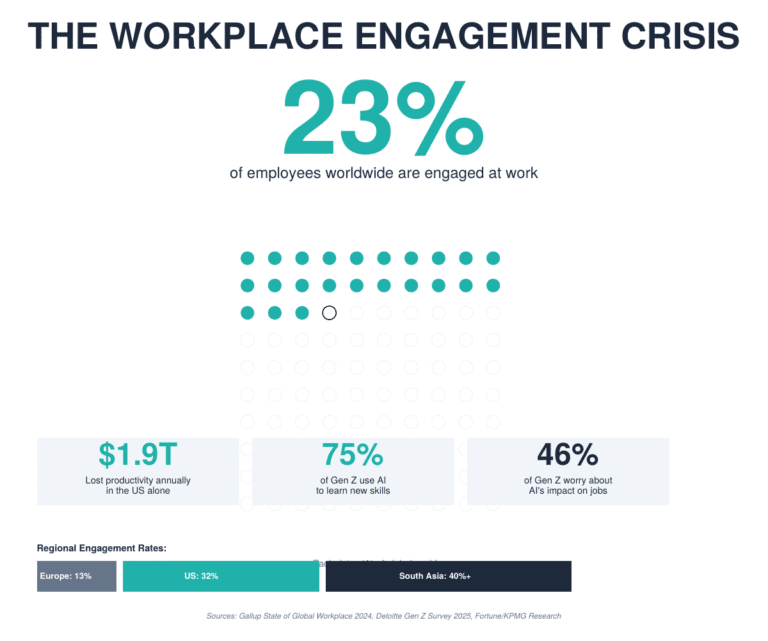
Only 23% of employees worldwide are engaged at work, according to Gallup’s 2024 report. That means 85% are unengaged.
Disengaged employees contribute to approximately $1.9 trillion in lost productivity annually in the US alone.
In the US, only 32% of workers are engaged, while 16% are actively disengaged. Europe has the lowest engagement at 13%, while South Asia leads with over 40%.
Companies are betting cultural initiatives and AI tools can reverse this decade-long decline.
Gen Z, AI, and the Changing Workplace
75% of Gen Z use AI to learn new skills, ahead of Millennials (71%), Gen X (56%), and Boomers (49%). Additionally, 79% of Gen Z say they can learn new skills quickly, and 58% are excited about AI’s potential.
But 46% of Gen Z worry about AI’s impact on their jobs, up from 40% a year ago.
Between January 2023 and August 2025, Gen Z representation at large public tech companies dropped from 15% to 6.8%. The average age at tech companies rose from 34.3 to 39.4 years, a five-year jump in 30 months.
58% of Gen Z graduates are still searching for their first job, compared to just 25% of previous generations. Companies promote “AI collaboration” while entry-level roles disappear.
The AI Adoption Reality Check
57% of Gen Z and 56% of Millennials report using GenAI in daily work. Three-quarters believe GenAI will impact how they work within the next year.
But when Great Place to Work surveyed 43,000 employees, only 51% are excited to use AI to improve work. Worse, only 45% believe their company will use AI in ways that benefit them.
High adoption, low trust in implementation.
Interview Guys Tip: When evaluating a job opportunity, don’t just ask about AI tools. Ask how the company is training employees to use them effectively, how they’re protecting jobs during AI integration, and what their long-term vision for human-AI collaboration looks like. Vague answers about “embracing AI vibes” should raise red flags.
What This Means for Your Career (The Practical Takeaways)
For Job Seekers: Reading Between the Vibe Lines
Red flags in job descriptions: vague responsibilities hidden behind trendy terminology, emphasis on “culture fit” without concrete skills, salary ranges wildly inconsistent, no clear reporting structure or advancement path.
Green flags: specific technical skills required, clear success metrics, integration with established teams, and training programs mentioned.
For Current Employees: Leveraging AI Without Losing Your Edge
Focus on skills AI can’t replicate: critical thinking, relationship building, strategic decision-making.
80% of Gen Z and Millennials say developing soft skills like empathy and leadership is more important than technical skills. Not because technical skills don’t matter, but because AI handles execution while humans provide judgment, creativity, and emotional intelligence.
Learn AI tools as enhancers. Document your human contributions. Position yourself as the expert who guides AI tools, not someone accepting output blindly. Professionals thriving now combine technical fluency with distinctly human capabilities.
For Managers and Leaders: Creating Real Culture, Not Just Vibes
Managers account for 70% of variance in team engagement, yet only 30% of managers worldwide are engaged themselves.
Companies with highly engaged employees see 21% higher profitability. But only 65% of workers feel their organization supports their wellbeing.
Real culture beats trendy titles. Focus on clear communication, growth opportunities, recognition, and actual work-life balance. Mental health support shows 40% higher engagement.
Companies succeeding aren’t the ones with coolest “vibe” branding. They’re the ones treating employees like valuable humans who need support, development, and respect.
Innovation or Just Another Buzzword?
AI tools can genuinely improve productivity when implemented thoughtfully. Flexible, culture-focused workplaces do attract talent. Informal communication can break down barriers. Gen Z’s tech fluency positions them well for AI-augmented roles.
But “vibe” terminology often masks lack of substance. There’s real risk of creating jobs that sound good but offer limited development. Microsoft’s 57% accuracy rate suggests we’re not ready for full automation. Engagement is at a 10-year low despite these initiatives.
The realistic take? AI tools will improve. Cultural initiatives matter, but execution matters more. Job titles matter less than responsibilities and growth.
92% of Gen Z believe they can adapt to AI automation of 20% of their jobs. Will companies invest in helping them adapt or just replace them?
The Bottom Line
“Vibe working” captures something real: AI is changing how we work, and companies are trying to make it feel exciting rather than threatening. Whether you encounter “vibe” in a job title, a Microsoft feature, or a culture pitch, look past the branding to the substance.
Ask hard questions. What skills will this role develop? How is AI being used responsibly? Does this workplace culture translate to genuine support, or just Instagram-worthy perks?
The future of work isn’t about vibes. It’s about value, skills, and using new tools while maintaining irreplaceable human judgment. Master that balance, and you’ll succeed regardless of what trendy terminology comes next.
The reality is that most resume templates weren’t built with ATS systems or AI screening in mind, which means they might be getting filtered out before a human ever sees them. That’s why we created these free ATS and AI proof resume templates:
Still Using An Old Resume Template?
Hiring tools have changed — and most resumes just don’t cut it anymore. We just released a fresh set of ATS – and AI-proof resume templates designed for how hiring actually works in 2026 all for FREE.

BY THE INTERVIEW GUYS (JEFF GILLIS & MIKE SIMPSON)
Mike Simpson: The authoritative voice on job interviews and careers, providing practical advice to job seekers around the world for over 12 years.
Jeff Gillis: The technical expert behind The Interview Guys, developing innovative tools and conducting deep research on hiring trends and the job market as a whole.