
The $2.9 Trillion Management Problem: Why Bad Bosses Are Your Biggest Retention Risk
Here’s a sobering thought: more than one in four of your employees right now would fire their boss tomorrow if they could. That’s not a minor frustration. That’s a company-wide emergency hiding in plain sight.
According to recent research by Nectar, 27% of employees would replace their manager if given the chance. But this isn’t just about hurt feelings or personality clashes. Poor management is fueling a $2.9 trillion crisis that’s quietly draining American businesses dry. And the worst part? Most companies are too busy focusing on employee retention programs to notice that the real problem is sitting in their management offices.
Think about that for a second. While HR departments scramble to offer better perks, flexible schedules, and pizza Fridays, they’re completely missing the fact that their managers are actively driving people out the door. It’s like trying to fill a bathtub while ignoring the massive hole in the bottom.
☑️ Key Takeaways
- 27% of employees would replace their current manager if given the opportunity, with 72% experiencing burnout under poor leadership
- Organizations lose $2.9 trillion annually to voluntary turnover, with 71% stemming directly from inadequate management
- 42% of employee turnover is preventable through better management practices and meaningful conversations with staff
- Manager training delivers 200-300% ROI while reducing turnover costs that can reach up to 200% of an employee’s salary
The Real Cost of “Replaceable Managers”
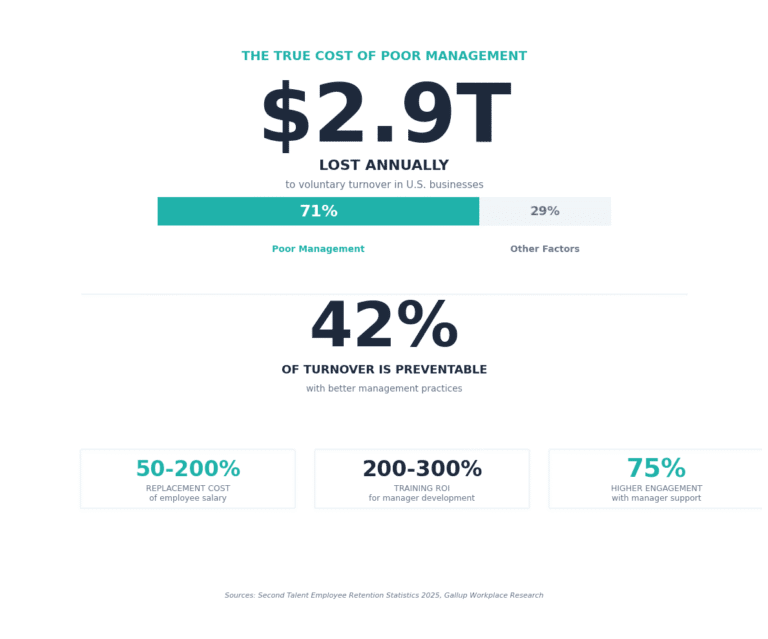
The numbers tell a devastating story. Organizations collectively lose $2.9 trillion every year to voluntary turnover in the United States alone. That’s not a typo. Nearly three trillion dollars walking out the door because people can’t stand working for their current leadership.
But here’s where it gets even worse. According to Second Talent’s comprehensive retention research, 71% of voluntary turnover stems directly from poor management. Not compensation. Not benefits. Not office location. Management.
Let’s break down what that actually means for your company. Replacing a single employee costs anywhere from 50% to 200% of their annual salary, depending on their role. For a mid-level professional earning $60,000, you’re looking at $30,000 to $120,000 just to replace them. That includes recruiting costs, training expenses, lost productivity, and the ripple effects on team morale.
Now multiply that across every position affected by poor management. A 100-person company with average salaries of $50,000 could be hemorrhaging between $660,000 and $2.6 million annually just from turnover. That’s not business overhead. That’s a management failure tax.
Interview Guys Tip: If you’re job hunting right now, pay close attention to how potential managers communicate during interviews. Ask about their leadership style and how they support team growth. Red flags include vague answers, defensive responses, or an inability to describe how they’ve developed their team members.
What Makes a Manager “Replaceable”?
The Nectar study reveals exactly what happens under poor leadership, and it’s a complete disaster for business. Nearly three in four employees (72.3%) working under replaceable managers report experiencing burnout. Compare that to just 22.2% under effective managers. That’s more than triple the burnout rate, and it aligns perfectly with broader workplace burnout trends we’re seeing across industries.
But the damage doesn’t stop there. Among employees stuck with poor managers:
- 57.2% plan to leave within three months
- 40% actively oppose their manager’s decisions
- 65% would feel relief if their manager left
- Teams face layoffs at double the rate of well-managed teams
When employees were asked to describe their replaceable managers, the words weren’t pretty: lazy, selfish, incompetent, arrogant. Meanwhile, effective managers earned descriptions like supportive, awesome, and amazing.
The contrast couldn’t be starker. You’re either building a team that trusts and respects you, or you’re creating a toxic environment where people are actively planning their escape route.
The Five Skills That Separate Good Managers from Disasters
So what’s actually broken? According to employees working under replaceable managers, the top five areas where their leaders fall short are crystal clear:
- Communication leads the list. Only 45% of employees rate their company’s communication as great. That means more than half of your workforce feels left in the dark about important decisions, changes, and expectations. Regular check-ins, transparency, and genuine feedback loops aren’t optional anymore. They’re the foundation of effective management. Strong communication and interpersonal skills have become non-negotiable for anyone in a leadership position.
- Leadership skills come in second. This might seem obvious, but being promoted to management doesn’t automatically make someone a leader. Real leadership means inspiring teams, setting clear direction, and creating an environment where people can do their best work. As companies shift toward skills-based hiring practices, management capabilities are becoming just as measurable and important as technical skills.
- Accountability ranks third. Replaceable managers either avoid holding people accountable or do it poorly, creating resentment and confusion. Great managers strike the balance between supporting their teams and ensuring everyone pulls their weight.
- Fairness matters tremendously. When employees perceive favoritism or inconsistent standards, trust evaporates. Fair managers apply the same rules to everyone and make decisions based on merit, not politics.
- Supportiveness rounds out the top five. Employees need to know their manager has their back. According to Gallup research on workplace engagement, 53% of employees who would fire their boss disagree with the statement “My supervisor seems to care about me as a person.” When people don’t feel supported, they start looking for the exit.
The Preventable Turnover Nobody’s Preventing
Here’s the part that should keep executives up at night. Research from Gallup shows that 42% of employees who voluntarily left their jobs say their manager or organization could have done something to prevent it. Think about that. Nearly half of your turnover is completely preventable.
Even more alarming? Forty-five percent of people who quit report that neither their manager nor company leadership had a single conversation with them about job satisfaction, performance, or their future in the three months before they left. They just… stopped checking in. And then they were surprised when valuable employees walked out.
What could have prevented these departures? When researchers asked people who quit, 70% cited issues directly related to daily management:
- 21% wanted more positive interactions with their manager
- 13% needed organizational issues addressed
- 11% wanted career advancement opportunities
- 9% needed better staffing or workload management
Only 30% said compensation was the issue. The rest? Fixable management problems that nobody bothered to fix.
Interview Guys Tip: During your job search, try to connect with current or former employees of companies you’re considering. Ask specific questions about management support, career development, and how issues get resolved. LinkedIn makes this easier than ever, and most people are surprisingly willing to share honest feedback in private messages.
The ROI of Actually Training Your Managers
Now for the good news. Companies that invest in manager training see returns that dwarf almost any other business investment.
Research on training ROI consistently shows that effective manager development programs deliver between 200% and 300% returns. That means for every dollar invested in training managers to actually manage well, companies get back $2 to $3 through improved performance, reduced turnover, and increased productivity.
Let’s make this concrete. Say you invest $50,000 in a comprehensive manager training program for your leadership team. Based on typical ROI metrics, that training should generate between $100,000 and $150,000 in measurable benefits over the following 12 months through:
- Reduced turnover costs (remember, replacing employees costs 50-200% of salary)
- Increased productivity from engaged teams
- Improved employee retention rates
- Better performance outcomes
Compare that to the cost of doing nothing. If poor management is driving just 10 employees to quit annually at an average salary of $50,000, you’re burning through $250,000 to $1 million in turnover costs. That same $50,000 investment in training could save your company five to twenty times its cost.
The math isn’t complicated. Training managers is exponentially cheaper than replacing the employees they drive away.
What Great Management Actually Looks Like
According to research across multiple studies, employees who feel supported by their managers report 75% higher engagement levels. That engagement translates directly to retention. When people feel valued, heard, and developed by their leaders, they stick around.
Here’s what separates great managers from replaceable ones:
- They have regular, meaningful conversations. Not annual reviews. Weekly or bi-weekly check-ins where they actually listen to concerns, discuss career goals, and address problems before they become crises.
- They develop their people. Great managers see their role as building the next generation of talent, not hoarding knowledge or feeling threatened by ambitious employees.
- They handle problems quickly. When issues arise with workload, staffing, or team dynamics, they address them immediately instead of letting frustrations fester.
- They model the behavior they expect. Want a team that respects work-life balance? Don’t send emails at midnight. Want accountability? Hold yourself to the same standards.
- They advocate for their teams. When their people need resources, support, or recognition, great managers fight for them with senior leadership.
The Bottom Line
Companies keep investing millions in employee retention programs while ignoring the elephant in the room: bad managers are the retention problem.
Twenty-seven percent of your workforce would fire their boss today if they could. Another 42% of people who quit say you could have prevented it with better management. The cost of this failure? Nearly $3 trillion annually across American businesses.
The solution isn’t complicated. Stop treating management like a promotion you give to your best individual contributors and hope they figure it out. Invest in actual training. Teach communication, leadership, accountability, fairness, and support. Give managers the tools and skills they need to do the job well.
The ROI is there. The research is clear. The only question is whether you’ll act before your best people decide their manager isn’t worth staying for.
Because right now, one in four of them is already planning their exit. The only thing left to decide is whether you want to fix the management problem or keep paying the $2.9 trillion tax on leadership failure.

BY THE INTERVIEW GUYS (JEFF GILLIS & MIKE SIMPSON)
Mike Simpson: The authoritative voice on job interviews and careers, providing practical advice to job seekers around the world for over 12 years.
Jeff Gillis: The technical expert behind The Interview Guys, developing innovative tools and conducting deep research on hiring trends and the job market as a whole.