
The State of Job Search Mental Health in 2026: Why 72% of Job Seekers Are Breaking Down Before They Ever Get Hired (A Comprehensive Research Report)
By 2026, the simple act of looking for a job has become a mental health crisis.
While headlines tout low unemployment rates and a “resilient economy,” half a million Americans have quietly given up searching for work entirely. Not because they don’t want jobs. Because they’ve been rejected so many times they now believe no jobs exist for them.
Another 6.4 million want to work but aren’t actively looking. And for those still searching? The psychological toll is devastating.
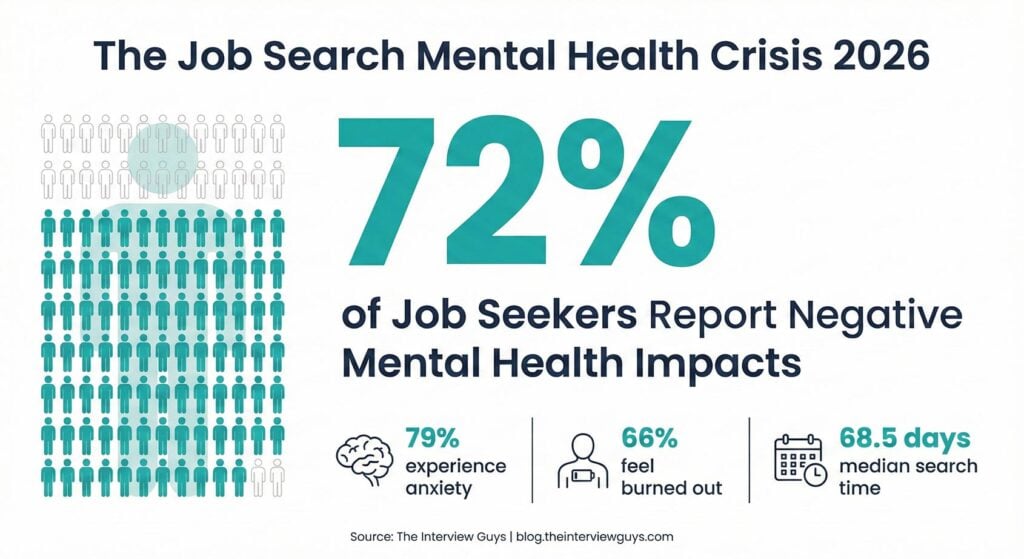
Here’s the reality: 72% of job seekers report that searching for employment negatively impacts their mental health. Nearly 80% experience anxiety. Two-thirds feel burned out before they even land a job.
This isn’t normal career transition stress. This is a full-blown mental health crisis driven by AI systems that reject you silently, employers who ghost you indefinitely, and a job market that’s fundamentally broken the promise that hard work leads to opportunities.
What This Report Reveals
We’ve synthesized data from 15+ authoritative sources to uncover what’s really happening to job seekers’ mental health in 2026. The sources include Bureau of Labor Statistics employment data, Mind Share Partners’ 2025 Mental Health at Work Report, NAMI’s 2025 Workplace Mental Health Poll, and comprehensive surveys of thousands of job seekers.
What we found isn’t just concerning. It’s alarming.
The numbers reveal a hidden epidemic affecting millions of Americans. The specific factors driving people from stressed to clinically depressed. And the systematic failures in hiring processes that are inflicting measurable psychological damage at scale.
This research provides concrete insights for job seekers struggling with search-related anxiety and depression, and for organizations that need to understand why their hiring processes are creating a mental health crisis that affects everyone.
☑️ Key Takeaways
- 72% of job seekers report negative mental health impacts from searching, with 79% experiencing anxiety and 66% feeling burned out by the process
- 514,000 “discouraged workers” have stopped looking entirely, believing no jobs exist for them, while 6.4 million want work but aren’t actively searching
- 55% cite “waiting to hear back” as their biggest stressor, revealing that employer ghosting has measurable psychological consequences beyond frustration
- The median search time of 68.5 days creates prolonged stress exposure that significantly increases depression and anxiety risks compared to shorter searches
The Hidden Mental Health Epidemic: By the Numbers
The Psychological Toll of Modern Job Searching
The data reveals a mental health crisis hiding in plain sight. 72% of job seekers in 2025 report that searching for employment negatively impacts their mental health. This isn’t temporary stress. It’s sustained psychological damage affecting daily functioning.
79% experience anxiety during their search. 66% feel burned out by the process. This represents a fundamental shift from historical job searches where stress was expected but psychological breakdown was not.
Mind Share Partners’ 2025 report shows 76% of U.S. workers experience some level of burnout, with 53% at moderate to severe levels. For job seekers without employment structure or income, these numbers are likely even higher.
The Time Factor
The median time to first offer has increased to 68.5 days in Q2 2025, a 22% increase from previous periods. That’s over two months of sustained anxiety, rejection, and uncertainty.
The Waiting Game: Ghosting as Psychological Warfare
Ask job seekers what stresses them out most, and one factor dominates everything else. It’s not the rejections. It’s not even the interviews themselves.
It’s the waiting.
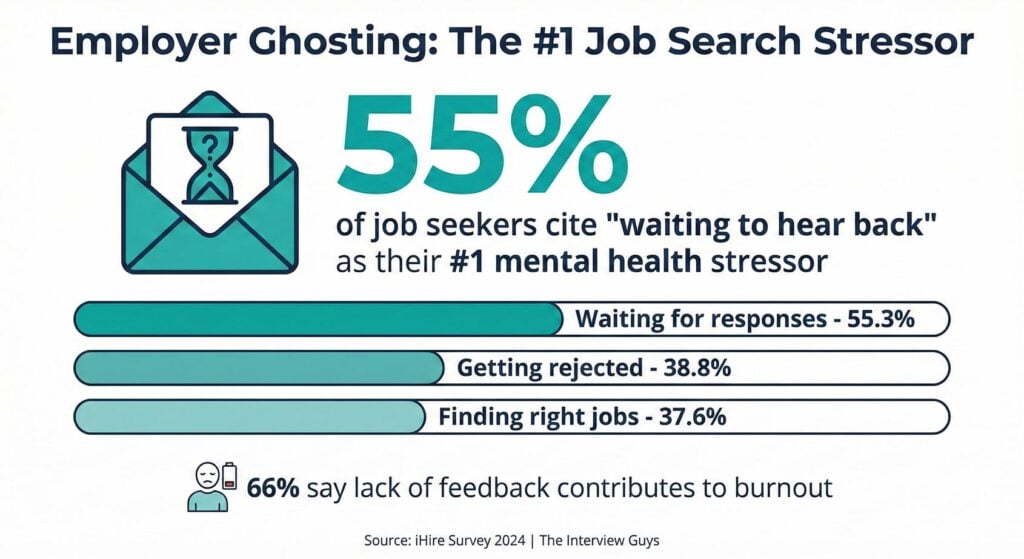
55.3% cite “waiting to hear back from an employer after applying or interviewing” as their primary source of job search-related mental health challenges, according to iHire’s comprehensive survey of over 2,000 U.S. job seekers.
Think about that. More than half of all job seekers identify the silence after applying as their biggest mental health stressor. Not the hard work of customizing applications. Not the stress of interviewing. The simple act of waiting for a response that may never come.
The Uncertainty Effect
This statistic reveals something critical about modern hiring: employer ghosting isn’t just frustrating. It has measurable psychological consequences that extend far beyond annoyance.
The uncertainty creates what researchers call “ambiguous loss,” where the lack of closure prevents emotional processing and recovery. You can’t move on because you don’t know if it’s over. You’re stuck in limbo, watching your inbox, refreshing your email, wondering if you should follow up or if that would hurt your chances.
Getting rejected comes in second at 38.8%, followed by finding the right jobs to apply to at 37.6%. The pattern is clear: modern job searching creates multiple sustained stressors that compound over time rather than discrete challenges you can address and resolve.
And here’s the kicker: 66% of job seekers say lack of feedback contributes to their burnout. The AI-driven screening process provides no human interaction, no explanation, no path forward. Just silence.
Interview Guys Take: The fact that two-thirds of job seekers are burning out simply from lack of feedback reveals something fundamental about modern hiring: we’ve built systems that treat humans like data points. When three or more symptoms of burnout appear (constant fatigue, avoiding applications, difficulty concentrating, mood changes, social withdrawal), the problem isn’t the job seeker’s resilience. It’s a hiring process so dehumanizing that it breaks people before they even get hired.
The Discouraged Worker Crisis
The Bureau of Labor Statistics tracks what happens when job search mental health deteriorates completely: discouraged workers who’ve stopped looking entirely.
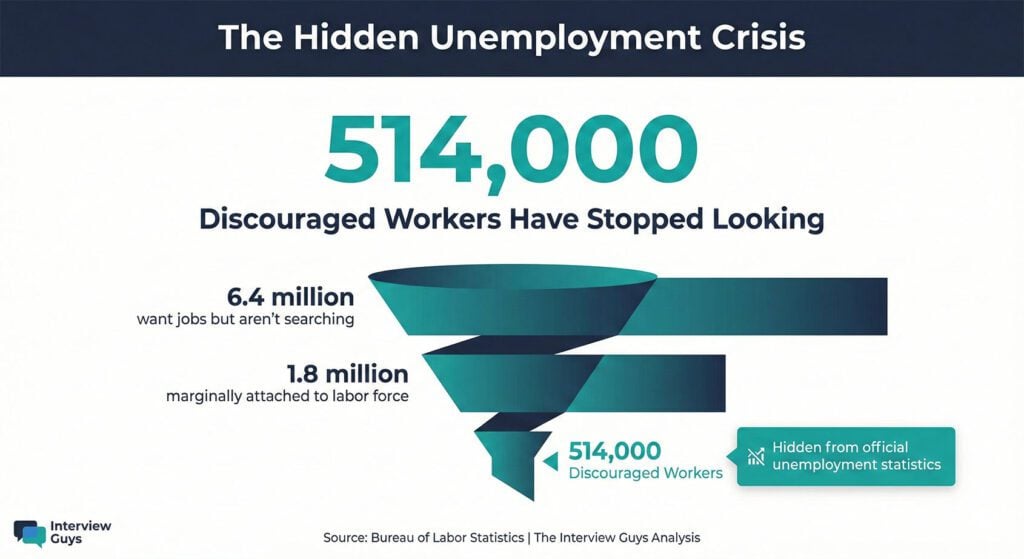
In August 2025, 514,000 Americans were officially classified as “discouraged workers”. That’s half a million people who want jobs, who would take jobs if offered, but who’ve stopped actively searching because they believe the system has nothing for them.
Beyond the Official Numbers
But 514,000 only tells part of the story. 6.4 million people want jobs but aren’t actively searching, up 722,000 from the previous year. Add in the 1.8 million marginally attached to the labor force, and you’ve got millions sitting on the sidelines while the official unemployment rate claims everything is fine.
By December 2025, discouraged workers decreased to 461,000. Marginal progress considering the scale. The U-4 unemployment rate (which includes discouraged workers) stood at 4.5% versus the official U-3 rate of 4.3%. That 0.2 point difference represents hundreds of thousands hidden from headlines.
Over 60% of marginally attached workers are 55+, facing age discrimination that pushes qualified candidates out before they get a chance.
Interview Guys Take: Here’s what the 514,000 discouraged worker statistic really means: half a million talented, capable Americans have been rejected so many times by broken AI screening systems that they’ve internalized the lie that “no jobs exist for them.” These aren’t people who lack skills or work ethic. They’re victims of a hiring system that values keyword matching over human potential. The real tragedy isn’t that they stopped looking. It’s that the system drove them to that point.
Generation-Specific Mental Health Impacts
The mental health crisis of job searching doesn’t affect all age groups equally. Younger workers face particularly acute psychological challenges that compound traditional job search stress.
Mental Health Diagnoses
46% of Gen Z Americans have been diagnosed with a mental health condition, most often anxiety, depression, or ADHD, according to Harmony Healthcare IT’s 2025 survey. More than one-third of young adults (37%) believe they may be living with an undiagnosed mental health condition.
40% of Gen Z report needing help with their mental health, according to UNICEF research. Deloitte’s 2025 survey found that 40% of Gen Z feel stressed or anxious all or most of the time, with much of that stress stemming from their employment situation.
The Employment Gap
For Gen Z entering the job market, the challenges are unprecedented. 58% of recent graduates are still searching for their first full-time job, compared to just 25% of previous generations.
Nearly 40% of earlier graduates secured full-time work by their graduation ceremony, but only 12% of recent Gen Z grads achieved this milestone.
Peak burnout now hits workers at age 25 for Gen Z, compared to 42 for the average American worker, according to workplace research. This early burnout fundamentally changes their approach to career advancement and creates a generation entering the workforce already psychologically depleted.
Financial Stress Amplification
Financial anxiety compounds mental health challenges for younger workers. Gen Z financial insecurity surged from 30% to 48% in just one year, representing a 60% increase.
Over half are living paycheck to paycheck, and more than one-third struggle to cover basic living expenses each month.
Only 41% of Gen Zers expect to own a home one day, according to McKinsey research, reflecting the economic realities that create additional psychological pressure during job searches.
Interview Guys Take: When financial survival is at stake, every job rejection transforms from professional disappointment into existential threat. Gen Z’s financial anxiety isn’t irrational pessimism. It’s a mathematically accurate response to a system where basic stability requires luck most people won’t have. The mental health crisis isn’t separate from the economic crisis. Financial desperation turns normal job search stress into genuine psychological trauma because the stakes aren’t “which job?” but “can I survive?”
The AI Anxiety Factor
A new psychological stressor has emerged in 2025 that previous generations of job seekers never faced: automation anxiety during the job search itself.
47% of U.S. adults report feeling anxious about their job security due to the rapid integration of AI, while 72% worry about its broader economic effects, according to recent mental health research. For job seekers specifically trying to land positions they fear may not exist in a few years, this creates additional psychological burden.
86% of Gen Z report burnout at work, partly driven by the pressure to demonstrate AI fluency while simultaneously worrying about AI replacing entry-level positions traditionally filled by new graduates.
The irony is stark: job seekers must use AI tools to compete in an AI-screened job market while fearing AI will eliminate the jobs they’re pursuing. This cognitive dissonance creates sustained psychological stress that compounds traditional job search anxiety.
The Root Causes: Why Job Search Mental Health Has Deteriorated
The AI Screening Wall
Modern applicant tracking systems have created a psychological dynamic that previous generations never experienced. Your parents or grandparents? Their applications were reviewed by humans who could see potential beyond perfect keyword matches.
Today? Your resume hits an AI wall before any human ever sees it.
74% of hiring managers have detected AI-generated content in applications, according to workplace surveys. This has created an arms race where job seekers feel pressured to use AI just to compete, while knowing their AI-generated content might get them automatically disqualified.
The Invisible Rejection
Here’s what’s really happening: qualified candidates with non-traditional backgrounds or career gaps get filtered out before any human reviews their application. Resumes that don’t match exact keywords get automatically rejected, regardless of actual qualifications or potential.
This systematic exclusion creates feelings of helplessness that feed directly into depression and anxiety. You’re not being judged by a person who might see your potential. You’re being judged by an algorithm looking for exact matches.
And the psychological damage compounds because of one simple fact: when a human rejects your application, you can theoretically learn and improve. When an algorithm rejects you silently, there’s nothing to learn from. No feedback. No explanation. No path to improvement.
You’re left wondering: was it a missing keyword? The wrong format? A career gap? You’ll never know, which means you can’t fix it for next time.
Interview Guys Take: The AI screening wall has fundamentally broken the relationship between effort and improvement. In traditional job searches, rejection taught you something. Now, algorithms reject you for reasons you’ll never understand and can’t address. This isn’t just inefficient. It’s psychologically devastating because it destroys the core belief that hard work and learning lead to progress. When the system is opaque and arbitrary, mental health deteriorates because humans need to believe effort matters.
The Ghosting Epidemic
Employer ghosting has evolved from occasional rudeness to systematic practice creating measurable harm. 66% say lack of feedback contributes to burnout.
Ambiguous loss research shows uncertainty prevents emotional processing, keeping job seekers in sustained stress. Unlike definitive rejection allowing closure, ghosting creates perpetual waiting. Should you move on or stay hopeful? This cognitive dissonance increases anxiety.
Economic Pressure and Financial Desperation
Mental health impact amplifies dramatically when financial survival is at stake. 81% of workers worry about job security. 76% expect layoffs to rise in 2025, making transitions feel riskier.
For unemployed workers, pressure is acute. Those with poor mental health report 12 days of unplanned absences annually versus 2.5 days for those with better mental health. A vicious cycle where mental health struggles make employment harder to maintain.
Interview Guys Take: The cruelest aspect is the cycle: financial pressure destroys mental health, which makes landing jobs harder, which increases pressure. People who most desperately need jobs are least able to present effectively because stress and desperation show in interviews. Companies want the “best candidate” but systematically disadvantage anyone whose circumstances create anxiety undermining performance.
The Competition Intensity
Here’s the brutal math of modern job searching: hundreds or thousands of people applying for single positions. The probability of your application succeeding? Vanishingly small, no matter how qualified you are.
The Numbers Game
This creates a mathematical reality that feels deeply personal. When 500 people apply for one job, 499 will be rejected.
Think about that. In a pool of 500 applicants, you could be the second-best candidate in that entire group and still get nothing. Rationally, you know rejection says nothing about your individual worth or capabilities. Emotionally? It feels like personal failure, especially after your tenth, twentieth, thirtieth rejection.
On average, job applicants send their CVs to 11-15 openings and receive about 6-10 rejections. And here’s where the psychological damage really begins: after the fifth rejection, people start losing confidence in themselves.
That’s when the spiral starts. The self-doubt creeps in. The internal voice asking “what’s wrong with me?” The progressive difficulty of continuing to search when every fiber of your being is screaming that it’s hopeless.
The Time Investment Paradox
Modern job searching requires enormous time investment per application. Tailoring resumes, writing custom cover letters, completing assessments, and navigating multi-stage interview processes can consume hours per application.
The Effort-Rejection Cycle
This creates a paradox: the more effort you invest, the more psychological damage each rejection causes. Job seekers who spend two hours customizing an application experience the rejection more acutely than those who submit generic applications.
Only 41% found their job within 1 month, meaning most face extended periods of sustained high-effort applications with low success rates. This effort-to-reward ratio is psychologically unsustainable.
Interview Guys Take: Modern job searching has become a mathematical impossibility disguised as a merit system. When success requires hundreds of hours of customized applications with a single-digit success rate, failure is statistically guaranteed for most applicants. The system demands unsustainable effort levels, then blames job seekers for “not trying hard enough” when the math was rigged against them from the start. This isn’t a meritocracy. It’s a psychological endurance test that breaks people before they get hired.
The Warning Signs: When Job Search Stress Becomes Clinical
From Normal Stress to Depression
Some job search stress is rational. But certain warning signs indicate the line has been crossed to clinical concern.
One in four employees have considered quitting due to mental health concerns, and 7% actually quit. For job seekers, impacts can be more severe without employment structure and income.
Warning signs requiring professional attention: persistent hopelessness lasting over two weeks, anxiety interfering with daily activities, sleep or appetite changes, social withdrawal affecting relationships, thoughts of self-harm.
The Burnout Progression
Job search burnout follows a predictable progression. Warning signs: constant fatigue even after sleep, avoiding applications, difficulty concentrating, irritability and frustration, withdrawing from loved ones.
Job search burnout links to 70% increased risk of developing mental health issues like depression and anxiety. Those experiencing burnout have 45% higher likelihood of anxiety and depression symptoms.
Prolonged rejection and uncertainty create “learned helplessness,” where individuals believe they have no control over outcomes. This state strongly correlates with clinical depression.
Interview Guys Take: There’s a point where stress stops being a challenge and becomes medical emergency. The line between “tough but manageable” and “clinically depressed” isn’t fuzzy. Persistent hopelessness, interfering anxiety, sleep/appetite changes, social withdrawal, or self-harm thoughts aren’t character flaws to power through. They’re symptoms of a broken system requiring professional treatment, not more grit.
Generation Z: A Case Study in Job Search Mental Health Crisis
The Confidence Collapse
Generation Z enters the workforce with unprecedented mental health challenges that compound job search stress.
46% of Gen Z Americans have been diagnosed with a mental health condition. Anxiety. Depression. ADHD. Another 37% believe they have undiagnosed conditions. Only 45% describe their mental health as “excellent” or “very good.”
The majority of Gen Z job seekers start from a mental health deficit that amplifies every rejection.
The Quality of Life Decline
The job market makes everything worse. 58% of Gen Z respondents say life was easier during the pandemic than in early 2025.
When more than half say a global pandemic was easier than current job conditions, that’s not complaining. That’s accurate assessment of a broken system.
Interview Guys Take: Gen Z faces the most structurally hostile job market any generation has encountered. Boomers had pensions and affordable housing. Gen X had economic expansion. Millennials had the internet boom. Gen Z gets AI replacing entry-level jobs, crushing debt, impossible housing costs, and a search process designed to break them before they start careers. When more than half say life was easier during a pandemic, that’s not entitlement. That’s truth.
The AI Generation’s Paradox
Gen Z faces a unique challenge: they’re the most AI-comfortable generation yet the most anxious about AI replacing their jobs.
86% report burnout at work, with AI pressures contributing. They’re expected to demonstrate AI fluency while watching AI eliminate entry-level positions previous generations used to build experience.
The career ladder that started with internships feels truncated as AI handles grunt work that built resumes. This creates existential anxiety on top of job search stress. Not just “Will I find this job?” but “Will this type of job exist in five years?”
The Financial Anxiety Amplifier
Financial insecurity amplifies every mental health challenge. Gen Z financial insecurity surged from 30% to 48% in one year, a 60% increase according to Deloitte’s 2025 survey.
Over half live paycheck to paycheck. More than a third struggle to cover basic expenses monthly. Only 41% expect to own a home one day.
This financial desperation makes every unemployment day exponentially more stressful. Unlike previous generations who might search while employed or with family support, many Gen Z workers face genuine financial crisis after weeks of unemployment.
The Transparency Demand
Despite their mental health struggles, Gen Z shows remarkable openness about these challenges in ways that create both opportunities and friction in the job search process.
92% of recent college graduates say they want to be able to discuss mental wellness at work, according to Monster’s 2024 State of the Graduate Report. However, once Gen Z workers begin interacting with older generations in the workplace, their comfort level drops to 56% feeling comfortable discussing mental health challenges with their managers.
This creates a gap between mental health needs and ability to address them during interviews and onboarding. Gen Z may be suffering mentally from the job search but feel unable to discuss these impacts with potential employers, creating additional stress.
The Employer Ghosting Problem: Mental Health Consequences
The Waiting Game Statistics
Employer communication practices directly impact job seeker mental health in measurable ways. 55.3% of job seekers identify “waiting to hear back from an employer after applying or interviewing” as their primary mental health stressor, according to comprehensive job seeker surveys.
This isn’t a minor inconvenience. It’s the single biggest contributor to job search mental health challenges, outranking even direct rejection. The psychological impact of uncertainty exceeds the impact of definitive bad news.
66% of job seekers say lack of feedback contributes to their burnout, revealing that the absence of communication creates specific mental health damage beyond the disappointment of not advancing.
The Ambiguous Loss Dynamic
Psychologists recognize a specific type of grief called “ambiguous loss” where the absence of closure prevents emotional processing and healing. Employer ghosting creates this exact dynamic at scale.
When an application or interview concludes with no response, job seekers enter a state of perpetual uncertainty. Should they move on emotionally? Should they remain hopeful? Should they follow up? The lack of information creates cognitive dissonance that increases anxiety.
Unlike definitive rejection, which allows emotional closure and the ability to direct energy toward other opportunities, ghosting keeps part of your psychological bandwidth devoted to monitoring and hoping for responses that may never come.
This prolonged uncertainty creates sustained stress rather than acute disappointment. Researchers find that sustained moderate stress often creates worse mental health outcomes than acute severe stress because the system never fully recovers.
Interview Guys Take: Employer ghosting isn’t just rude. It’s a form of psychological warfare that deliberately keeps candidates in a state of perpetual uncertainty because companies prioritize their convenience over applicants’ mental health. The ambiguous loss dynamic that ghosting creates is more damaging than direct rejection because humans can’t process or recover from uncertainty the way we can from definitive bad news. When companies ghost, they’re choosing their comfort over candidates’ psychological wellbeing, and that choice has measurable mental health consequences.
The Dehumanization Effect
Beyond the practical impact, employer ghosting creates a psychological experience of dehumanization. When organizations don’t respond to applications or after interviews, the implicit message is that candidates aren’t worth basic courtesy.
This dehumanization compounds the mental health impacts because it attacks self-worth directly. It’s not just “I didn’t get this specific job.” It’s “I’m not even worthy of a response.”
For job seekers already struggling with confidence and self-doubt, this systematic dehumanization across dozens of applications creates cumulative psychological damage that manifests as depression, anxiety, and learned helplessness.
Coping Mechanisms: Both Healthy and Destructive
The Rise of AI-Generated Applications
Job seekers are fighting back against AI screening with AI generation, creating an arms race with its own mental health implications. 1 in 3 job seekers use AI to support their job search in 2025, with applications ranging from resume optimization to complete cover letter generation.
This strategy creates mixed mental health outcomes. On one hand, AI tools reduce the time investment per application, potentially reducing the psychological cost of each rejection. On the other hand, it creates new anxiety about being detected and penalized for using AI.
74% of hiring managers have detected AI-generated content in applications, meaning the strategy carries risks that create additional stress. Job seekers must navigate both using AI to compete and disguising that use to avoid penalization.
Interview Guys Take: The AI arms race in hiring has created an absurd situation where job seekers need AI to compete against AI screening, but get penalized for using AI by hiring managers who themselves use AI to screen applications. This isn’t innovation improving outcomes. It’s a technological ouroboros that adds complexity and stress without improving hiring quality. The mental health impact of navigating this paradox while competing for jobs that AI might eliminate anyway is a special kind of psychological torture unique to this generation.
Social Withdrawal and Isolation
One damaging coping mechanism is social withdrawal. As searches extend and mental health deteriorates, many isolate from friends and family.
45% of Gen Z skip social events due to mental health challenges. This isolation compounds depression and anxiety by removing support networks precisely when they’re most needed.
Shame about prolonged unemployment drives some to hide struggles, preventing them from accessing emotional support and practical help.
Healthy Coping Strategies
Set strict boundaries around search time. Dedicate specific hours to applications, then completely disconnect. Recovery periods prevent burnout.
Track “effort metrics” (applications sent, skills developed) rather than “outcome metrics” (interviews, offers). You control effort, not outcomes. Celebrating consistent effort reduces psychological impact of uncontrollable rejections.
Establish a daily routine that provides structure similar to employment. Specific times for searching, networking, self-care, and leisure combat unemployment chaos.
The Path Forward: Solutions for Job Seekers
Professional Mental Health Support
The first and most important recognition is knowing when job search stress has crossed into territory requiring professional help. One in four employees say they have considered quitting their jobs due to mental health concerns, revealing how common serious mental health impacts are in employment contexts.
Consider professional support if you experience persistent feelings of hopelessness lasting more than two weeks, anxiety that interferes with daily activities, sleep disruptions or appetite changes, social withdrawal or irritability affecting relationships, or thoughts of self-harm.
42% of Gen Z Americans are currently in therapy, a 22% increase since 2022, according to Harmony Healthcare IT research. This suggests growing acceptance of mental health treatment, particularly among younger workers who may face the steepest job search challenges.
Therapists and career coaches specializing in job search anxiety can provide tools and strategies to cope with stress and improve overall well-being. Many employers’ health insurance plans now cover mental health services, and community resources exist for those without coverage.
Reframing the Process
Psychological reframing reduces mental health impact. View rejection as math, not personal failure.
When 500 people apply for one job, 499 get rejected. That says nothing about individual worth. It reflects supply and demand.
After the fifth rejection, people lose confidence. Recognizing this pattern allows conscious intervention to prevent the spiral.
Focus on what you control: application quality, networking, skill development, mental health. You can’t control hiring decisions, market conditions, or candidate pools.
Interview Guys Take: The mental health crisis stems from fundamental mismatch between how the process works and how humans function. We’re wired to learn from feedback, but algorithms reject silently. We need to believe effort correlates with outcomes, but math guarantees most applications fail regardless of quality. We require closure, but companies ghost indefinitely. The system isn’t just difficult. It’s psychologically incompatible with basic human needs for learning, control, and closure.
Building Resilience
Celebrate small victories. Every interview, callback, or rewritten resume is progress worth acknowledging.
Stay connected with other job hunters to share tips and encouragement. Social support reduces isolation.
Practice self-care: exercise, meditation, sleep, healthy eating. Physical resilience builds mental resilience.
Set realistic goals. Break searches into manageable daily tasks. Remember market conditions and hiring decisions are beyond your control.
What Employers Can Do: Addressing the Crisis
Communication Standards
55.3% cite “waiting to hear back” as their primary stressor. Simple status updates would dramatically improve outcomes.
Implement automatic application acknowledgment. Provide timeline expectations. Send status updates even when candidates aren’t advancing. This addresses the ambiguous loss dynamic creating sustained anxiety.
These changes require minimal resources but create measurable mental health benefits for thousands.
Interview Guys Take: Employers who ghost aren’t saving time. They’re systematically traumatizing thousands while damaging talent pipelines and employer brands. 55% cite waiting as primary stressor. Companies claim candidate experience matters, then inflict harm through silence. This isn’t efficiency. It’s organizational cruelty creating measurable mental health damage.
Interview Process Improvements
Multi-stage processes extending months create prolonged uncertainty. Condense interview timelines. Provide clear process outlines upfront. Offer meaningful feedback to rejected candidates. Train interviewers on creating psychologically safe conversations.
68% of Gen Z say mental health has impacted work ability. Recognize candidates arrive already managing challenges. Create more supportive experiences.
Rethinking Requirements
Many requirements systematically exclude qualified candidates and create unnecessary mental health burden. Years of experience for entry-level positions, perfect employment history without gaps, exact keyword matches all create arbitrary rejection patterns.
Skills-based hiring, clear pathways for non-traditional backgrounds, and AI screening designed to surface potential rather than filter for perfection would reduce systematic rejection driving discouraged worker numbers.
514,000 Americans are “discouraged workers” who believe no jobs exist for them. Many have relevant skills but don’t match rigid automated criteria. Adjusting requirements accesses untapped talent while reducing mental health burden.
The Systemic Solutions We Need
Policy Interventions
The crisis requires systemic solutions beyond individual coping or employer best practices.
Require employers to respond to all applications within specific timeframes. Mandate feedback for interview candidates. Regulate AI screening to prevent discriminatory filtering. Provide mental health resources specifically for job seekers.
Mental health jobs grow 3x faster than average, reflecting crisis recognition. But access for unemployed seekers without insurance remains limited.
Expand mental health coverage for unemployed individuals. Create job search support programs including mental health components. Fund research on outcomes.
Economic Reforms
The mental health crisis of job searching is inseparable from economic anxiety. Gen Z financial insecurity surged from 30% to 48% in one year, creating desperation that amplifies every aspect of job search stress.
Policies that address income inequality, increase minimum wages to living wage levels, reduce housing costs, and provide stronger unemployment benefits would reduce the financial desperation that transforms job search stress into mental health crisis.
Over half of Gen Z are living paycheck to paycheck, making unemployment an immediate financial emergency. Stronger safety nets would allow job seekers to approach the process with less desperation and better mental health outcomes.
Technology Accountability
AI screening systems create mental health impacts through opacity and systematic exclusion. Requiring transparency in how AI evaluates candidates, mandating human review of AI rejections, and creating accountability for discriminatory filtering would reduce the dehumanization that drives mental health deterioration.
74% of hiring managers detect AI-generated content, creating an arms race that adds stress without improving hiring outcomes. Industry standards that acknowledge AI use while preventing penalization would reduce this specific anxiety.
Interview Guys Take: The job search mental health crisis isn’t a collection of individual problems requiring individual solutions. It’s a systemic failure where every element compounds: AI screening removes human judgment, ghosting removes closure, financial pressure removes options, competition removes hope, and opacity removes learning. Fixing this requires acknowledging that we’ve built a hiring system optimized for employer convenience at the cost of applicant mental health. Until we recognize that efficiency for companies shouldn’t mean psychological damage for candidates, the crisis will only deepen.
Looking Ahead: The 2026 Outlook
Projected Trends
Current trajectories suggest intensification before improvement. Discouraged workers remained high at 514,000 through 2025 despite strong economic conditions, indicating structural problems won’t resolve without intervention.
Median search time of 68.5 days represents extended psychological stress exposure significantly increasing mental health risks. If this timeline continues increasing, impacts worsen proportionally.
Gen Z financial insecurity surge from 30% to 48% in one year suggests deteriorating conditions for young workers. Without intervention, this trend continues.
Emerging Interventions
Some positive developments suggest potential improvements. Companies with comprehensive mental health benefits see 8% better ROI and 13% higher employee engagement. This creates business case for mental health investment extending to candidate experience.
42% of Gen Z are in therapy, up 22% since 2022, suggesting growing acceptance. As this generation becomes larger workforce share, mental health support may normalize.
Growing recognition of impacts creates possibility for systematic improvements if stakeholders act on emerging data.
The Opportunity for Change
The job search mental health crisis represents both a profound challenge and an opportunity for transformation. Organizations that address these issues proactively will gain significant competitive advantages in attracting talent.
Job seekers who develop mental health resilience strategies will navigate searches more successfully with better long-term outcomes. Policymakers who recognize the systemic nature of this crisis can implement interventions that improve outcomes for millions.
The question isn’t whether change is needed. The data makes that clear. The question is whether stakeholders will act before the crisis deepens further.
The Bottom Line: A Call to Action
The job search mental health crisis isn’t abstract. It’s real, measurable, and getting worse.
72% of job seekers report negative mental health impacts. 514,000 have given up entirely. 79% experience anxiety during the process.
These aren’t just statistics. They represent millions of Americans suffering psychological harm from a job search process that’s fundamentally broken. Real people with bills to pay, families to support, and mental health that’s deteriorating with every silent rejection and ghosted application.
For Job Seekers
If you’re struggling, you’re not alone. Your difficulties don’t reflect personal failure. They reflect real structural problems affecting millions just like you.
When anxiety interferes with daily life, when hopelessness persists for weeks, seek professional support. Your mental health matters more than any job. Many therapists offer sliding scale fees. Crisis resources are free.
Set boundaries around your search. Focus on effort over outcomes. You control application quality and skill development. You don’t control hiring decisions or market conditions.
For Employers
Your communication practices directly impact candidate mental health. When 55% cite waiting as primary stressor, simple status updates could dramatically reduce suffering.
Your hiring requirements may systematically exclude qualified candidates driving the discouraged worker crisis. Skills-based evaluation and human review of AI rejections would open opportunities while reducing mental health burden.
Every ghosted candidate, every AI-rejected application without explanation, every multi-month process creates measurable mental health damage to thousands.
For Policymakers
The crisis requires systemic intervention. Unemployed individuals need better mental health access. AI screening needs regulation and transparency. Economic policies must address financial desperation transforming job search stress into emergency.
This isn’t about making hiring “nicer.” It’s recognizing we’ve built systems that break people psychologically. Creating humane hiring is possible without sacrificing efficiency.
What’s At Stake
The future of work depends not just on efficient hiring but on humane systems. The mental health of millions hangs in the balance.
The question isn’t whether we’ll address this crisis. It’s whether we’ll act quickly enough to prevent further psychological damage to millions simply trying to find meaningful work.
Resources & References
This report draws on comprehensive research from authoritative sources, including labor market data, mental health surveys, and job seeker experience studies current as of Q4 2025.
Primary Research Sources
Mind Share Partners 2025 Mental Health at Work Report Mind Share Partners Study National study of 1,153 U.S. full-time employees on mental health, burnout, and workplace well-being
NAMI 2025 Workplace Mental Health Poll NAMI Research Survey of 2,376 full-time employees on mental health support, stigma, and workplace culture
U.S. Bureau of Labor Statistics Employment Situation BLS Labor Force Data Official government data on discouraged workers, unemployment rates, and labor force participation
Deloitte Global 2025 Gen Z and Millennial Survey Deloitte Survey Comprehensive survey of 23,000+ Gen Z and millennials on career expectations, mental health, and financial security
iHire Job Search Mental Health Survey 2024 iHire Research Survey of 2,129 U.S. job seekers on mental health impacts of job searching
Harmony Healthcare IT State of Gen Z Mental Health 2025 Harmony Healthcare IT Study Survey of 1,010 Gen Z Americans aged 18-28 on mental health diagnoses, coping mechanisms, and work impacts
Lyra Health 2025 State of Workforce Mental Health Report Lyra Health Research Survey of 500+ HR leaders and 7,500 employees across six countries on mental health challenges and support
Grow Therapy Workplace Mental Health Statistics 2026 Grow Therapy Analysis Comprehensive compilation of mental health statistics including burnout, stress, and treatment access
World Health Organization Mental Health Data WHO Mental Health Resources Global mental health prevalence data and research on occupational phenomenon of burnout
Huntr Job Search Trends Report Q1 2025 Referenced in Connors Group Analysis Survey data on job seeker emotional states and exhaustion levels
SHRM Gen Z Mental Health Research 2025 SHRM Study Analysis of Gen Z mental health expectations and workplace benefit preferences
Seramount Multi-Generational Burnout Research 2025 Seramount Survey Survey of 1,000 U.S. employees on burnout rates across generations
Healthline Job Search Depression Research Healthline Analysis Clinical perspective on job search depression causes, symptoms, and coping strategies
BetterUp Job Search Depression Study BetterUp Research Analysis of job search mental health impacts and evidence-based coping mechanisms
Yomly Workplace Mental Health Statistics 2026 Yomly Compilation UK and global workplace mental health data including burnout rates and retention impacts
Related Interview Guys Content
State of Job Search 2025 Research Report Comprehensive analysis of job search challenges, AI impacts, and market conditions
514,000 “Discouraged Workers” Have Given Up Looking for Jobs Analysis of BLS discouraged worker data and hidden unemployment
Workplace Burnout in 2025 Research Report Comprehensive study on burnout affecting workers and job seekers
The State of Gen Z in the Workplace 2025 Analysis of Gen Z employment challenges, mental health, and workplace expectations
From 30% to 48%: The Financial Collapse Hitting Gen Z Workers Analysis of Gen Z financial insecurity surge and mental health impacts
Coping with Job Rejection Fatigue Practical strategies for managing rejection-related mental health challenges
Inside Gen Z Workers’ Shocking Confidence Collapse Analysis of Gen Z confidence issues and workplace mental health
Only 30% of 2025 Graduates Found Jobs Data on Gen Z employment crisis and psychological impacts
How to Deal with Employment Gaps in Your Resume Strategies for addressing gaps caused by extended job searches
Job Search Paradox Analysis of contradictions in modern job searching and psychological impacts

BY THE INTERVIEW GUYS (JEFF GILLIS & MIKE SIMPSON)
Mike Simpson: The authoritative voice on job interviews and careers, providing practical advice to job seekers around the world for over 12 years.
Jeff Gillis: The technical expert behind The Interview Guys, developing innovative tools and conducting deep research on hiring trends and the job market as a whole.