
5 Resume Formats That Will Dominate 2026 (And 3 That Are Now Obsolete)

In 2026, using an outdated resume format can instantly disqualify you from job opportunities.
What worked just a year ago might now be actively hurting your chances of landing interviews. Why? Because the hiring landscape has dramatically evolved:
- Skills-first hiring has become the dominant standard across industries
- AI-powered screening has replaced manual resume reviews
- Competition has intensified with global remote work
- Proof of capability now matters more than credentials alone
The harsh reality: Many qualified professionals are being filtered out before a human ever sees their application.
But there’s good news. By understanding which resume formats now dominate the job market, you can ensure your application rises to the top of the pile.
This article reveals the five resume formats that work in 2026 and the three obsolete approaches you should immediately abandon. We’ll show you not just which formats succeed, but why they work and how to implement them for your specific situation.
Before diving in, take a moment to apply The So-What Test to your current resume. This simple evaluation will help you understand if your resume is truly making an impact or just taking up space.
☑️ Key Takeaways
- Five modern resume formats now dominate in 2026: Skills-First, ATS-Optimized, Enhanced Chronological, Strategic Hybrid, and Visual-Strategic, each tailored to specific career stages, industries, and job search scenarios.
- Skills-first hiring is now the standard, with 43% of businesses making it their top priority and 70% of recruiters citing skill identification as their biggest challenge.
- ATS compliance is non-negotiable, with 97% of companies using automated screening systems that require technically sound resume structures to survive initial filtering.
- Obsolete formats like Pure Functional, Text-Heavy Traditional, and Generic One-Size-Fits-All resumes now hurt your chances, often getting rejected by both ATS systems and human recruiters who can spot generic applications instantly.
The Evolution of Resume Formats in 2026
How did we get here? Four major shifts have completely transformed what makes a resume effective:
1. The Skills-First Revolution
Traditional hiring focused on where you went to school and where you worked. That’s changed dramatically. According to recent industry data, most employers now use skills-based hiring practices, with nearly two-thirds using it always or most of the time.
Why the shift? Companies need specific expertise that traditional education doesn’t always provide. The cost of hiring mistakes has gotten too high to ignore. And focusing purely on degrees was excluding amazing talent who learned their skills differently.
Research shows that 92% of employers using skills-first hiring report finding higher quality talent, and 89% find it’s a better predictor of actual job success.
2. The ATS and AI Evolution
For decades, the chronological resume dominated with simple human review. Then came Applicant Tracking Systems (ATS):
- First-gen ATS: Basic keyword scanning
- Today’s AI screening: Modern systems convert resumes into structured data with 94-97% accuracy, using sophisticated neural networks to identify patterns
- Current reality: Up to 97% of companies now use ATS systems, though recent research shows 92% of recruiters say these systems don’t automatically reject resumes
The nuance matters: While many resumes get filtered out, it’s typically due to human overload and prioritization rather than automatic rejection. The challenge is standing out in a sea of applications.
3. The Remote Work Impact
Geographic barriers have dissolved, creating:
- Global talent pools for most professional positions
- Increased competition from candidates worldwide
- Higher standards for resume clarity and impact
- Digital-first expectations with clickable links to portfolios and proof of work
4. The Authenticity Challenge
With 70% of job seekers now using AI tools to write resumes and cover letters, recruiters have become skilled at spotting AI-generated content. This has created a new premium on genuine voice and verifiable accomplishments.
The result? A complete reinvention of what makes a resume successful. Let’s examine the five formats proving most effective in 2026’s transformed job market.
Put your resume to the test. You just read the rules. Now find out if your resume follows them. Upload it below for a free score in 60 seconds.
The 5 Resume Formats Dominating 2026
1. Skills-First Resume Format

The Skills-First Resume Format has emerged as the dominant choice for 2026, reflecting the fundamental shift in how companies evaluate candidates. This isn’t just a trend; it’s become the standard way of doing business.
What it is: A resume that leads with comprehensive, categorized skills sections that demonstrate your capabilities, followed by a work history that validates those skills with concrete examples and measurable outcomes.
Why it works: Skills-first hiring is now used by most employers always or most of the time. With 70% of recruiters citing finding candidates with the right skills as their biggest challenge, this format puts exactly what they’re looking for front and center.
The format succeeds because it addresses the core question hiring managers actually ask: “Can this person do the job?” Rather than inferring capabilities from job titles and company names, it explicitly showcases what you can do.
Who it’s best for: Career changers with transferable skills, professionals in rapidly evolving fields (especially tech), specialists with advanced skill sets, and anyone targeting skills-based employers.
Key features:
- Prominent skills sections organized by category (technical, analytical, leadership, etc.)
- Specific tool and technology proficiencies with context
- Work history that demonstrates skills in action with measurable results
- Digital portfolio links providing clickable proof of capabilities
- Emphasis on continuous learning and skill development
Interview Guys Tip: The skills-first format isn’t just about listing abilities. Include links to actual proof wherever possible. Developers should link to GitHub repositories, designers to case studies, marketers to campaign analytics. In 2026, recruiters expect to be one click away from verification. Check out our guide on Interpersonal Skills That Belong in Your Resume to ensure you’re including both hard and soft skills that matter.
2. ATS-Optimized Format

Once you understand that skills-first is the priority for 2026, the next critical question becomes: “How do I ensure my resume actually makes it through AI screening systems to reach human eyes?” That’s where the ATS-Optimized format becomes essential.
As AI and machine learning become more integral to hiring processes, a format specifically designed to work with these systems has emerged as critical for job seekers targeting medium to large organizations.
What it is: A technically structured resume designed from the ground up to perform well with Applicant Tracking Systems while remaining engaging for human reviewers.
Why it works: This format addresses the specific requirements of modern ATS systems, ensuring that your resume is correctly parsed, categorized, and ranked while still being readable and compelling when it reaches human recruiters.
With up to 97% of companies now using ATS systems, and modern AI screening achieving 94-97% parsing accuracy, your resume must be technically sound to survive the initial filtering process—regardless of how strong your skills are.
Who it’s best for: Applicants to large corporations, government positions, or any organization that receives high volumes of applications and relies heavily on automated screening.
Key features:
- Clean, simple formatting that modern ATS can parse accurately
- Strategic keyword integration based on job description analysis
- Standard section headings that ATS systems are programmed to recognize
- Machine-readable file formats (.docx or text-based PDFs from professional resume builders)
- Natural keyword usage that doesn’t sound robotic to human readers
Interview Guys Tip: The old “75% rejection rate” statistic about ATS is widely debated. Recent research shows that 92% of recruiters say ATS doesn’t automatically reject resumes. The real issue is ranking and prioritization in high-volume situations. Before submitting your resume, run it through an ATS scanner like Jobscan’s Resume Scanner to identify potential issues and optimize your content for specific job descriptions. Aim for a match rate of 75% or higher, but remember that authenticity matters more than keyword stuffing in 2026.
3. Enhanced Chronological Format

The Enhanced Chronological Format represents the evolution of the traditional reverse-chronological resume. It maintains the familiar timeline structure that recruiters appreciate while incorporating strategic elements that optimize it for modern hiring processes.
What it is: A reverse-chronological listing of your work history with strategic enhancements that emphasize achievements, metrics, and keywords relevant to your target position.
Why it works: This format builds on a structure that hiring managers are comfortable with, while incorporating elements that optimize it for AI screening systems. It creates a clear career narrative while highlighting specific accomplishments that matter most to employers.
Who it’s best for: Professionals with a consistent career progression in the same industry or field. It’s particularly effective for those who want to demonstrate growth and advancement within their career path.
Key features:
- Achievement-focused bullet points with measurable results
- Strategic keyword placement aligned with job descriptions
- Clear, consistent formatting with enhanced scanability
- Strong professional summary that frames your career story
- Impact-based language showing outcomes rather than just responsibilities
Interview Guys Tip: The shift in 2026 is from task-based to impact-based bullet points. Instead of “Managed social media strategy,” write “Designed and executed social media strategy that increased engagement by 40% and lead volume by 25% in 6 months.” Recruiters want to see what changed because you were there. Our Resume Achievement Formulas guide shows you exactly how to transform responsibilities into impressive accomplishments.
4. Strategic Hybrid Format

The Strategic Hybrid Format has gained significant traction in 2026 by addressing a core challenge many professionals face: how to showcase both valuable skills and relevant experience in a balanced way.
What it is: A format that gives equal weight to skills and work experience, typically leading with a robust skills section followed by a chronological work history.
Why it works: It satisfies both AI requirements (which scan for specific skills) and human preferences (which value seeing career progression). This dual approach creates a more complete picture of your professional profile.
Who it’s best for: Mid-career professionals, career changers with transferable skills, and those with diverse experience across multiple industries or roles.
Key features:
- Prominent, categorized skills section near the top
- Traditional chronological work history that reinforces those skills
- Emphasis on transferable skills and adaptability
- Customizable sections that can be rearranged based on job requirements
- Balance between showcasing capabilities and demonstrating experience
Interview Guys Tip: Carefully curate your skills section to include a mix of technical, soft, and industry-specific skills that directly align with your target position. In 2026, AI literacy has become a baseline expectation. Include specific AI tools you use (ChatGPT, automation platforms, workflow optimization tools) and how you leverage them for efficiency. Avoid generic skills lists by consulting our guide on the 30 Best Skills to Put on a Resume to ensure you’re highlighting abilities that actually matter to employers.
5. Visual-Strategic Format
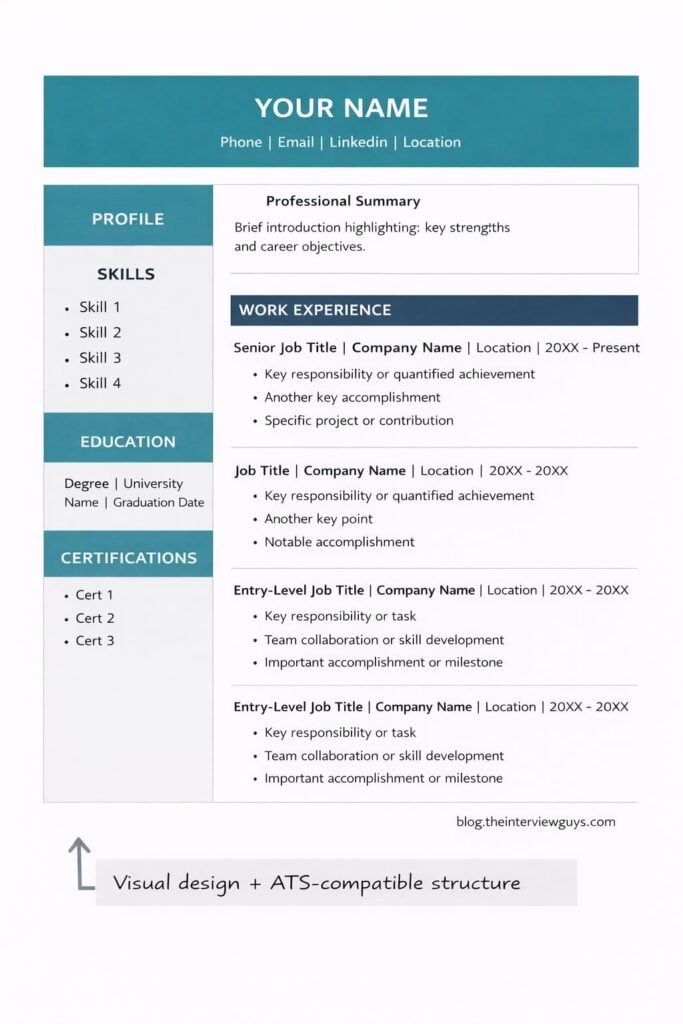
The Visual-Strategic Format represents the sweet spot between creative design and technical requirements, offering a visually distinctive presentation that still functions within ATS parameters.
What it is: A resume format that incorporates strategic visual elements while maintaining ATS compatibility through careful design choices.
Why it works: This format captures attention in industries where creativity and design sensibility matter, while avoiding the technical pitfalls that cause many visual resumes to fail AI screening.
Modern ATS systems in 2026 handle simple PDFs from professional resume builders much better than earlier systems, making this approach more viable than in previous years.
Who it’s best for: Professionals in creative industries, marketing, digital media, and forward-thinking companies where visual presentation is valued as an indicator of professional capability.
Key features:
- Strategic use of color and typography for emphasis
- Clean, intentional design that guides the eye
- Visual hierarchy that highlights key information
- ATS-compatible structure beneath the visual elements
- Single-column or light two-column layouts that parse correctly
Interview Guys Tip: Even with visual elements, language matters immensely. Use powerful, distinctive language to describe yourself and your accomplishments. Our collection of 250 Powerful Words to Describe Yourself can help you select terms that convey your unique value proposition and professional brand. Remember that in 2026, authenticity is crucial. Let your genuine voice shine through rather than relying on AI-generated descriptions that recruiters can easily spot.
Put your resume to the test. You just read the rules. Now find out if your resume follows them. Upload it below for a free score in 60 seconds.
The 3 Resume Formats Now Obsolete
While the formats above are proving highly effective in 2026’s job market, several once-popular approaches have become decidedly counterproductive. If you’re still using any of these formats, it’s time for an urgent update.
1. Pure Functional Format
The Pure Functional Format, which organizes information by skill categories rather than chronological work history, has fallen sharply out of favor with both ATS systems and human recruiters.
What it was: A resume organized entirely around skill categories, with minimal chronological work history information.
Why it’s obsolete: Modern AI screening systems struggle to properly parse and categorize information without a clear chronological structure. According to the latest ATS research, functional resumes are significantly more likely to be misinterpreted or incorrectly categorized by automated systems.
Even if a functional resume makes it past the AI screening, recruiters tend to view them with suspicion. According to insights from LinkedIn’s recruiting research, hiring managers often assume that candidates using this format are attempting to hide employment gaps, job-hopping, or lack of experience.
Important distinction: The Pure Functional format is NOT the same as the Skills-First format. Skills-First resumes prominently feature skills but also include clear chronological work history. The difference is critical in 2026.
Who still tries to use it: Career changers, those with significant employment gaps, and professionals returning to the workforce after extended absences.
What to use instead: The Skills-First Resume Format or Strategic Hybrid Format provide better alternatives, allowing you to highlight transferable skills while still providing the chronological structure that both AI systems and recruiters expect.
2. Text-Heavy Traditional Format
The dense, paragraph-laden resumes that were standard in the 1990s and early 2000s have become increasingly ineffective in an era of quick digital scanning.
What it was: A text-heavy resume format with detailed paragraphs describing responsibilities and experiences, minimal white space, and dense formatting.
Why it’s obsolete: Modern recruitment practices involve rapid initial screening. Recruiters now spend an average of just 6-8 seconds reviewing a resume on first pass. Dense text makes this quick assessment nearly impossible, leading to immediate rejection.
These formats also perform poorly with modern AI screening systems, which struggle to parse detailed paragraphs and extract relevant information efficiently. The lack of strategic white space and bullet points makes keyword identification more difficult for automated systems.
Who still tries to use it: Seasoned professionals who haven’t updated their resume format in years, particularly those in traditional industries like law, academia, and some government positions.
What to use instead: The Enhanced Chronological Format provides the same comprehensive information but in a much more scannable, digestible format that works for both human reviewers and automated systems.
3. One-Size-Fits-All Generic Format
The practice of creating a single “master resume” and using it for all applications has become dramatically less effective as hiring has become more specialized and competitive.
What it was: A single, static resume used for all job applications regardless of position, industry, or company.
Why it’s obsolete: Modern AI screening systems are increasingly sophisticated in matching candidates to specific job descriptions. Generic resumes lacking tailored keywords and specific role alignment typically rank in the bottom tier of applicants in ATS scoring.
Additionally, hiring managers can easily spot generic applications, which signal low investment in the specific opportunity. In 2026, with 70% of job seekers using AI tools to generate applications, recruiters have become expert at identifying generic, AI-generated content.
The authenticity gap is real. When recruiters review hundreds of applications where many sound AI-generated and generic, the ones with genuine voice and specific customization stand out dramatically.
Who still tries to use it: Job seekers conducting high-volume application campaigns, those new to professional job searching, and anyone taking a “spray and pray” approach to their job hunt.
What to use instead: The ATS-Optimized Format provides a template that can be efficiently customized for each application, ensuring targeted alignment with specific job descriptions while maintaining a consistent professional presentation. Better yet, use the Skills-First format and customize your skills emphasis based on each role’s requirements.
Want that tailoring done for you? Paste the job posting into our new app, Longbow, and it scores your resume against that exact job and shows you what the employer actually cares about.
How to Choose the Right 2026 Format for Your Situation
With five effective formats to choose from, how do you determine which is right for your specific situation? Consider these key factors:
Career Stage:
- Early career professionals typically benefit most from the Skills-First Format, which allows them to emphasize capabilities over limited experience.
- Mid-career professionals often find the Strategic Hybrid or Enhanced Chronological formats most effective, as they balance skill demonstration with work history.
- Senior executives might leverage either the Enhanced Chronological Format (to showcase progression) or the Visual-Strategic Format (to create a distinctive executive presence).
Industry Expectations:
- Technical fields like IT, engineering, and data science strongly favor the Skills-First Format in 2026.
- Creative industries typically value the Visual-Strategic Format.
- Traditional sectors like finance, law, and healthcare generally prefer the Enhanced Chronological Format.
- Fast-growing startups and innovative companies often appreciate the Skills-First or Strategic Hybrid Format.
Application Volume at Target Companies:
- Organizations receiving hundreds or thousands of applications typically rely heavily on ATS systems, making the ATS-Optimized Format essential.
- Smaller companies or specialized roles with fewer applicants may allow more flexibility for formats like the Visual-Strategic Format.
Skills vs. Credentials:
- If you learned your skills through non-traditional paths (bootcamps, self-teaching, side projects), the Skills-First Format is your best choice.
- If you have strong credentials from top schools or companies, the Enhanced Chronological Format can leverage that pedigree.
Remember that your resume doesn’t exist in isolation. A strong Digital Cover Letter works in concert with your resume to create a compelling application package that addresses both automated screening and human evaluation.
Implementation Tips: Putting These Formats into Action
Once you’ve selected the right format for your situation, consider these practical implementation tips:
Tools and Resources:
- Professional resume builders like Resume Genius, Canva, or Enhancv offer templates aligned with these modern formats.
- Microsoft Word provides ATS-friendly templates that can be customized to match these strategic approaches.
- Industry-specific resume examples can provide inspiration for adapting these formats to your field.
Key Metrics for Measuring Effectiveness:
- Interview invitation rate (number of interviews secured per applications submitted)
- ATS scoring (if available through services like Jobscan)
- Feedback from recruiters and hiring managers
- Time to first response after application submission
Authenticity Check for 2026:
In an age where 70% of job seekers use AI tools, your resume needs to sound genuinely like you. Here’s how to test:
- Read it aloud. Does it sound like something you’d actually say?
- Would a former colleague recognize your voice and style?
- Are the accomplishments specific enough that only you could have written them?
A/B Testing Your Resume:
- Create two versions using different formats
- Apply to similar positions with each version
- Track response rates to identify which performs better
- Refine the more successful version based on results
Converting Existing Resumes:
- Start with a clean template rather than trying to modify your existing document
- Extract and categorize your current content (skills, experience, education)
- Reorganize information according to your chosen format
- Add missing elements required by your new format (metrics, achievements, digital links)
- Optimize language for both ATS keywords and human impact
- Include clickable links to portfolios, projects, or proof of work
Interview Guys Tip: Don’t just list AI tools in your skills section. Show how you use them for real business impact. Instead of “Proficient in ChatGPT,” write “Leverage AI tools to streamline content creation workflows, reducing draft time by 40% while maintaining quality.” This demonstrates practical application rather than just familiarity.
Conclusion
As we navigate 2026’s competitive job market, your resume format is not just a matter of personal preference; it’s a strategic decision that directly impacts your career opportunities. The five formats highlighted in this article represent the most effective approaches based on current hiring practices and technologies.
The shift to skills-first hiring represents the most significant change in 2026. With 43% of businesses making it their top priority and 70% of recruiters struggling to find candidates with the right skills, leading with capabilities rather than credentials is no longer optional; it’s essential.
Meanwhile, the obsolete formats, Pure Functional, Text-Heavy Traditional, and One-Size-Fits-All Generic, now actively hinder your chances of success and should be immediately abandoned. In particular, generic applications are easily spotted in an era where AI generation is commonplace.
Remember that while format creates the foundation, content quality ultimately determines your resume’s effectiveness. Choose the format that best showcases your unique qualifications, then invest time in developing compelling, authentic, achievement-focused content that demonstrates your value to potential employers.
The authenticity factor cannot be overstated in 2026. With AI tools now widely used by job seekers, recruiters have become expert at spotting generic, AI-generated content. Your genuine voice, specific accomplishments, and verifiable proof of capabilities are what will set you apart.
In today’s rapidly evolving job market, your resume format can be the difference between getting noticed and getting overlooked. Make sure yours is working for you, not against you.
Advice like this is the general version. Longbow scores your actual resume against the actual job you want and shows you what's missing, before the filters decide for you. Here's why we built it.

ABOUT THE INTERVIEW GUYS (JEFF GILLIS & MIKE SIMPSON)
Mike Simpson: Co-founder of The Interview Guys and Longbow. He has been the voice behind our interview advice since 2013 — his work has reached over 100 million job seekers around the world. The strategic mind behind Longbow, our new career platform.
Jeff Gillis: Co-founder of The Interview Guys and Longbow. He built the systems that put our work in front of those readers, and he leads the engineering on Longbow, the cutting edge career platform built for today’s job seeker.