
10 Personal Website Examples to Inspire Your Own in 2026
Your LinkedIn profile blends in with thousands of others. Your resume gets filtered by robots before a human ever sees it. And when someone Googles your name, what do they find?
Having a personal website in 2026 isn’t about vanity. It’s about control. When a hiring manager, potential client, or collaborator searches for you, your website becomes the first impression that matters. It’s your chance to tell your story your way, showcase work that proves your capabilities, and make contact frictionless.
The best part? Modern website builders like Squarespace have eliminated the technical barriers that once made building a professional site complicated. You don’t need coding skills or a design degree. You need good examples to study and the willingness to launch something this week instead of waiting for perfection.
Let’s look at ten real personal websites from professionals across different industries who understand that in 2026, having no website means leaving opportunities on the table.
☑️ Key Takeaways
- Personal websites increase interview callbacks by 71% compared to candidates relying solely on LinkedIn profiles, according to hiring manager surveys
- Mobile optimization matters more than visual flair since over 65% of personal website traffic comes from phones where broken layouts kill credibility instantly
- Three quality project examples outperform ten mediocre ones every time, so ruthless curation beats comprehensive showcase approaches
- Clear calls to action drive results while beautiful designs without obvious next steps waste traffic and leave opportunities unrealized
Disclosure: This article contains affiliate links. If you purchase through these links, we may earn a commission at no additional cost to you.
Why Personal Websites Matter More Than Ever in 2026
Social media platforms are rented space where algorithms control visibility and platform owners change rules without warning. A personal website is digital real estate you own. You control the layout, the messaging, and what happens when someone wants to learn more about you or your work.
According to research from personal branding experts, professionals with personal websites get perceived as 71% more credible as industry experts compared to those who only maintain social profiles. When you apply for competitive positions, your website differentiates you from the 200 other candidates who only submitted resumes.
Building an effective portfolio website has become essential across industries from tech to creative fields to consulting. But the concept extends beyond traditional portfolios. Your personal website can showcase thought leadership, demonstrate technical skills, prove design capabilities, or simply make it ridiculously easy for people to contact you.
Think about what happens when someone Googles your name. Do they find your carefully crafted narrative or random social media posts from years ago? Your website ensures the right story wins.
In our experience helping over 100 million job seekers, the candidate with a professional website consistently stands out over equally qualified applicants who only submit a resume. That website is your unfair advantage…
200 Applicants Have Resumes. Only You Have a Website…
We recommend Squarespace because it gives you a professional online presence that makes you memorable. Choose from designer templates, customize without coding, and create a portfolio that actually gets you interviews. Free 14-day trial, and you can launch your site before other candidates finish tweaking their resume.
1. Alice Lee: Illustrator and Muralist
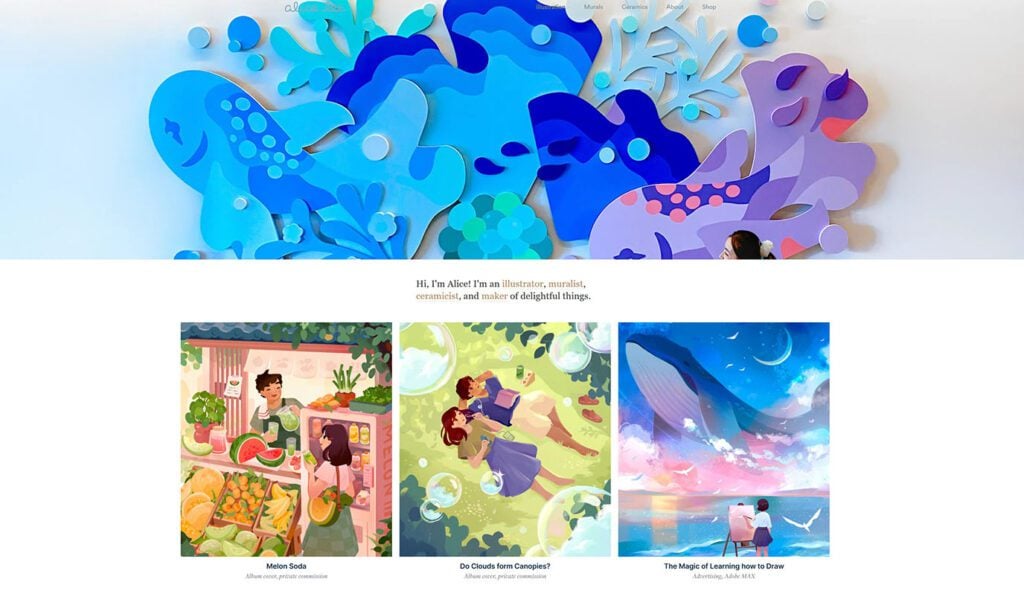
Alice Lee’s website demonstrates what happens when an artist lets their work speak loudly while keeping the design simple. As an illustrator, muralist, and ceramicist based in San Francisco, her site immediately draws you into her distinctive visual style.
Visit: https://www.byalicelee.com
What makes it work:
- Homepage functions as an extensive gallery showcasing work for major clients (Adobe, Dropbox, Google, The New York Times)
- Each piece paired with creation story, demonstrating both technical skill and creative process
- Thoughtful case studies go beyond simple image dumps
- Balances artistic expression with professional presentation
The result: Alice has worked with virtually every major tech company while maintaining a strong personal brand. Her website serves as both a portfolio and a business development tool, making it easy for potential clients to understand her style, see her range, and reach out for new projects. The site perfectly balances artistic expression with professional presentation.
Ready to showcase your creative work? Browse Squarespace’s portfolio templates designed specifically for visual professionals who need their work to shine.
Interview Guys Tip: When showcasing creative work, pair each project with brief context about the challenge, your approach, and the outcome. This transforms a portfolio from pretty pictures into proof of problem-solving ability.
2. Simon Daufresne: Minimalist Designer Portfolio
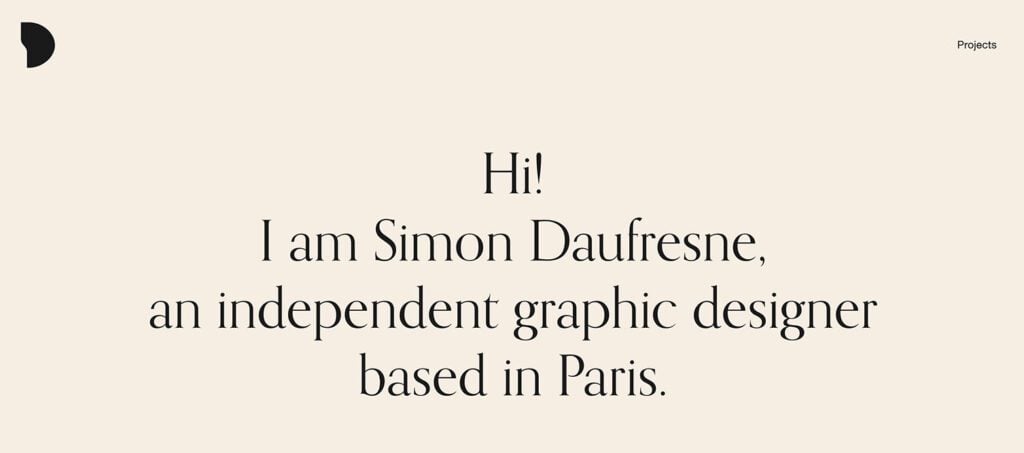
Paris-based designer Simon Daufresne built one of the most elegant minimalist portfolios you’ll find. His site proves you don’t need complexity to make an impact. The color palette stays modern and simple without looking dull, creating sophisticated visual hierarchy through restraint rather than excess.
Visit: https://simondaufresne.com
What makes it work:
- Every design decision serves a clear purpose
- Clean typography directs attention where it matters
- Generous white space lets the work breathe
- Demonstrates sophisticated taste through what’s excluded as much as what’s included
- Shows that simplicity requires more skill than decoration
The lesson: Minimalism isn’t about having less content. It’s about ruthless editing that ensures every element earns its place. This approach works particularly well for professionals in fields where taste and judgment matter more than quantity of output.
3. Kantwon Rogers: Fun and Vibrant Personal Brand
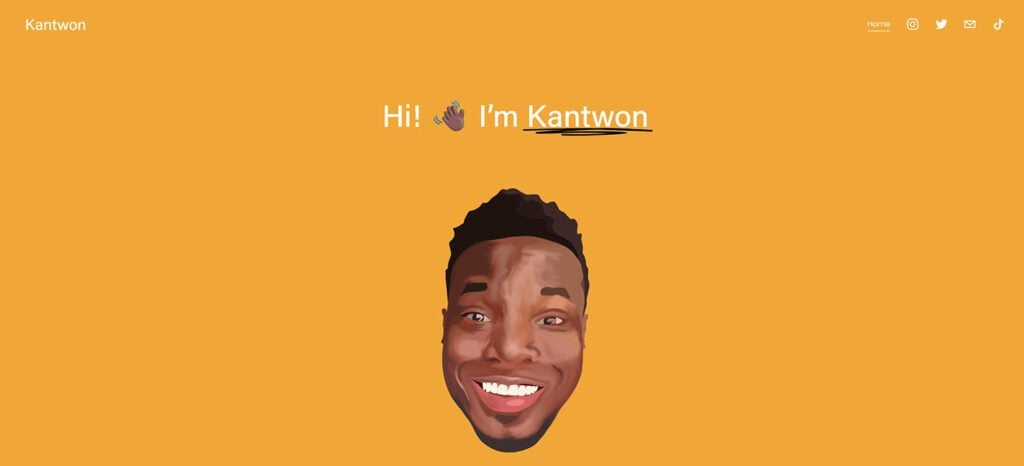
Kantwon Rogers broke every rule about professional websites and created something memorable in the process. His one-page site bursts with personality through vibrant colors, emoji usage, cool images, and a layout that stays engaging despite its length. The header and footer contain only social media icons with no traditional navigation.
Visit: https://www.kantwon.com
What makes it work:
- Breaks conventional wisdom by showing personality instead of playing it safe
- One-page site bursts with vibrant colors, emojis, and cool images
- Scrolling experience never feels boring despite page length
- Each section offers visual variety that keeps engagement high
- Differentiates from competitors in creative fields who use conservative approaches
The takeaway: Know your audience. If you’re targeting conservative industries like finance or law, this approach probably doesn’t work. But for creative fields, startups, or interesting jobs that pay well in emerging sectors, personality can be your competitive advantage.
4. Lin-Manuel Miranda: Image-Rich Celebrity Site
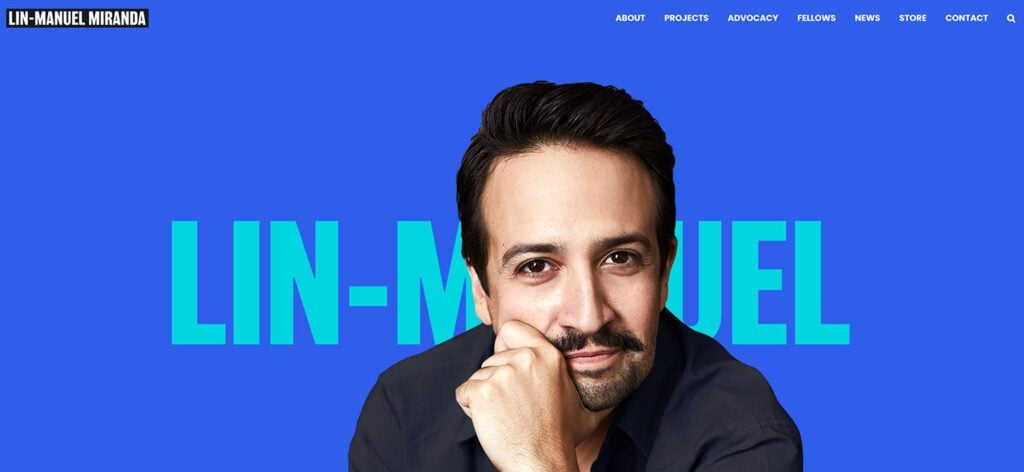
The creator of Hamilton demonstrates how public figures can use personal websites to control their narrative. Lin-Manuel Miranda’s site features significant image content including a full-screen hero image, slider elements, hover effects, animations, and a back-to-top button for seamless navigation.
Visit: https://www.linmanuel.com
What makes it work:
- Serves multiple purposes: media kit for journalists, hub for fans, professional showcase
- Full-screen hero image with slider elements and hover effects create visual interest
- Back-to-top button enables seamless navigation
- Balances accessibility with sophistication
- Makes information easy to find without overwhelming visitors
For regular professionals: You don’t need Miranda’s level of fame to benefit from this approach. If you speak at conferences, contribute to publications, or want to be seen as a thought leader in your field, an image-rich professional site builds credibility faster than any LinkedIn profile.
5. Peter McKinnon: Content Creator Portfolio
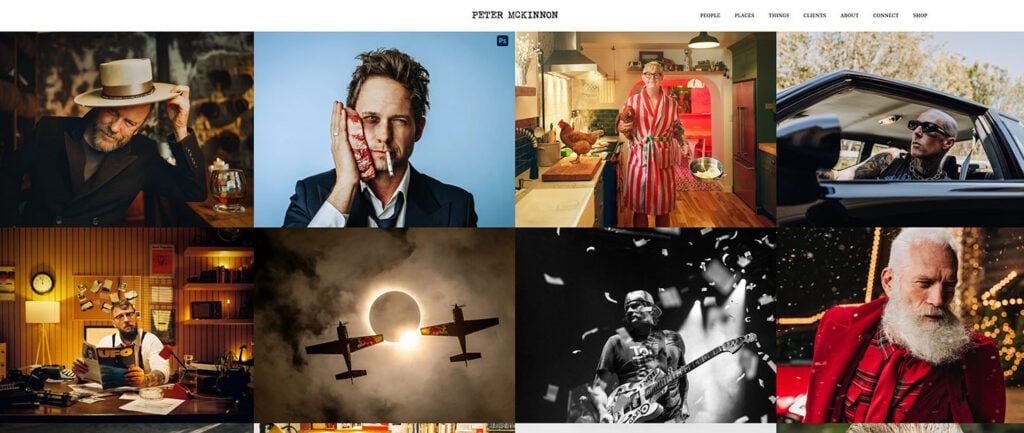
Photographer and filmmaker Peter McKinnon’s site takes minimalism even further than most. His entire homepage consists of a beautiful collage of images with parallax effects that enhance viewing experience. The clean footer contains only social icons, adhering strictly to minimalist formatting principles.
Visit: https://www.petermckinnon.com
What makes it work:
- Homepage is a beautiful collage of images with parallax effects
- Work speaks louder than any copy could
- Removes unnecessary elements to let high-quality visuals dominate
- Clean footer with only social icons maintains minimalist approach
- Creates immersive experience that demonstrates capability without explanation
Implementation for your site: If you’re a photographer, designer, or visual artist, consider whether words add value or create distraction. Sometimes the best portfolio is one where visitors immediately see your best work without scrolling past paragraphs of explanation. This works especially well when combined with effective personal branding strategies that establish your reputation before people visit your site.
Interview Guys Tip: Visual professionals should prioritize loading speed as much as image quality. A slow-loading portfolio loses potential clients before they see your work. Compress images appropriately and use lazy loading to maintain performance.
6. Aarron Walter: UX Designer and Author Portfolio
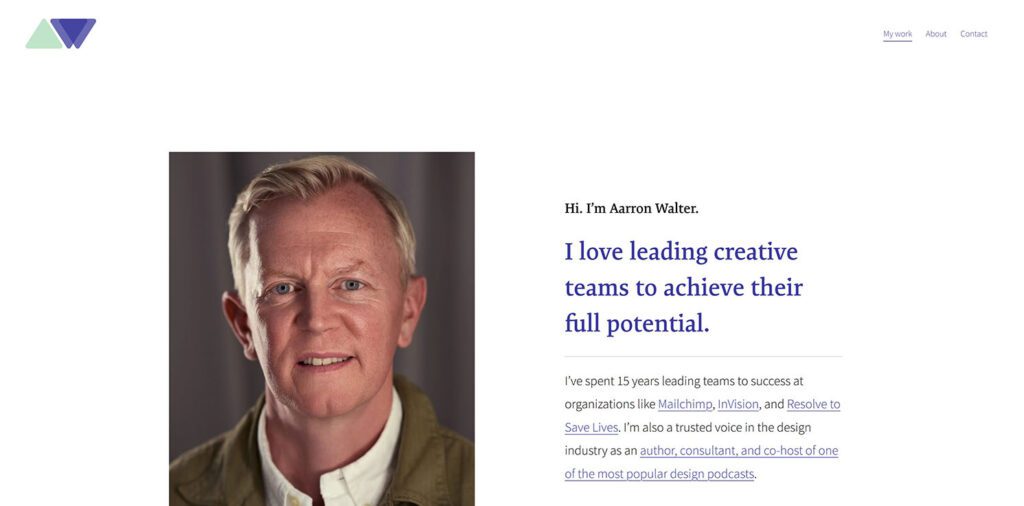
Aarron Walter’s site demonstrates how established professionals can showcase extensive experience without overwhelming visitors. As the former VP of Design at InVision and author of “Designing for Emotion,” his portfolio leads with clear project descriptions and obvious calls to action.
Visit: https://www.aarronwalter.com
What makes it work:
- Each case study includes role, process, and measurable results
- Testimonials from industry peers add social proof
- Clean design demonstrates expertise through example rather than decoration
- Serves multiple purposes: portfolio, thought leadership platform, business development tool
- Simplicity communicates confidence at the executive level
The lesson: Senior professionals don’t need flashy designs. They need clear communication of value and proof of impact. Walter’s approach shows how simplicity at the executive level communicates confidence rather than limitation.
7. Yukai Du: Animator with Explosive Color
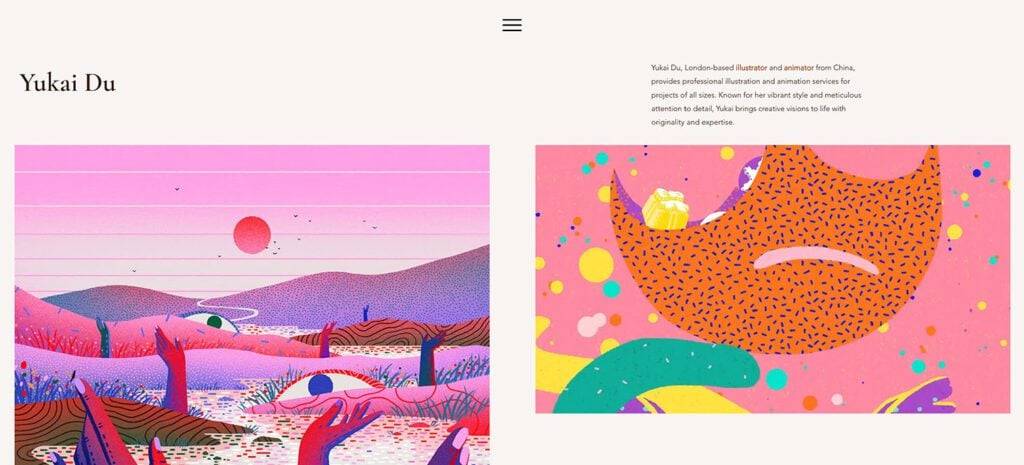
Illustrator and animator Yukai Du created a website that bursts with color, creativity, and life. Bold colors combine with intricate patterns and a mix of static and animated elements to create an experience that feels alive. The visual approach perfectly captures her talent while demonstrating technical capability.
Visit: https://www.yukaidu.com
What makes it work:
- Bold colors combine with intricate patterns for explosive visual impact
- Mix of static and animated elements creates experience that feels alive
- Website itself proves animation capability in real-time
- Potential clients experience her work through the interface, not just viewing it
- Visual approach perfectly captures talent while demonstrating technical capability
For technical professionals: This same principle applies beyond creative fields. If you’re a developer, your personal site’s code quality matters. If you’re a data analyst, embedded interactive visualizations prove capability. If you’re a writer, the copy on your site demonstrates your voice. Your website should be a working example of your best work.
Looking to build authority in your field? Start with professional templates at Squarespace that balance credibility with personality.
8. Brittany Chiang: Frontend Developer Portfolio
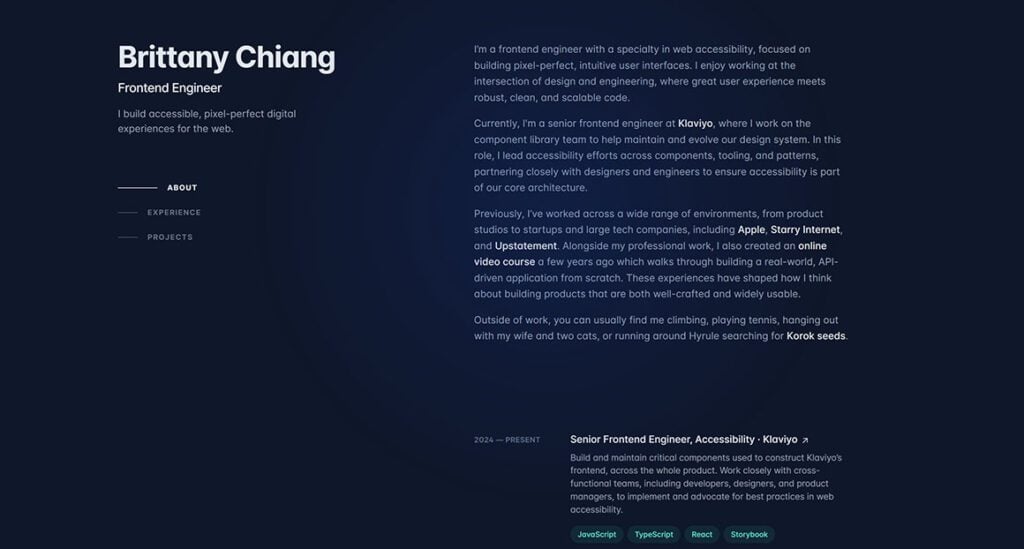
Brittany Chiang built one of the most referenced developer portfolios on the web. Her site combines clean design with interactive elements that immediately demonstrate her frontend capabilities, using a single-page layout with smooth scrolling that shows off her attention to user experience.
Visit: https://brittanychiang.com
What makes it work:
- Single-page layout with smooth scrolling shows off UX attention
- Sticky sidebar navigation and subtle hover effects demonstrate frontend skills
- Consistent teal accent color creates visual cohesion throughout
- Each project includes context: problem solved, technologies used, GitHub links
- Portfolio helped land top-tier tech positions (Apple Music, Klaviyo)
- GitHub repo has 8,200+ stars, proving it inspires other developers
The result: Her portfolio helped her land positions at top-tier tech companies and has been featured as an example of excellence in developer portfolio design. Her GitHub repo for the portfolio has over 8,200 stars, showing how many developers have used it as inspiration.
Interview Guys Tip: When showcasing projects from past employers, focus on what you learned and the problems you solved rather than sharing proprietary code. This demonstrates professionalism while still highlighting your capabilities.
9. Yan Holtz: Data Visualization Specialist
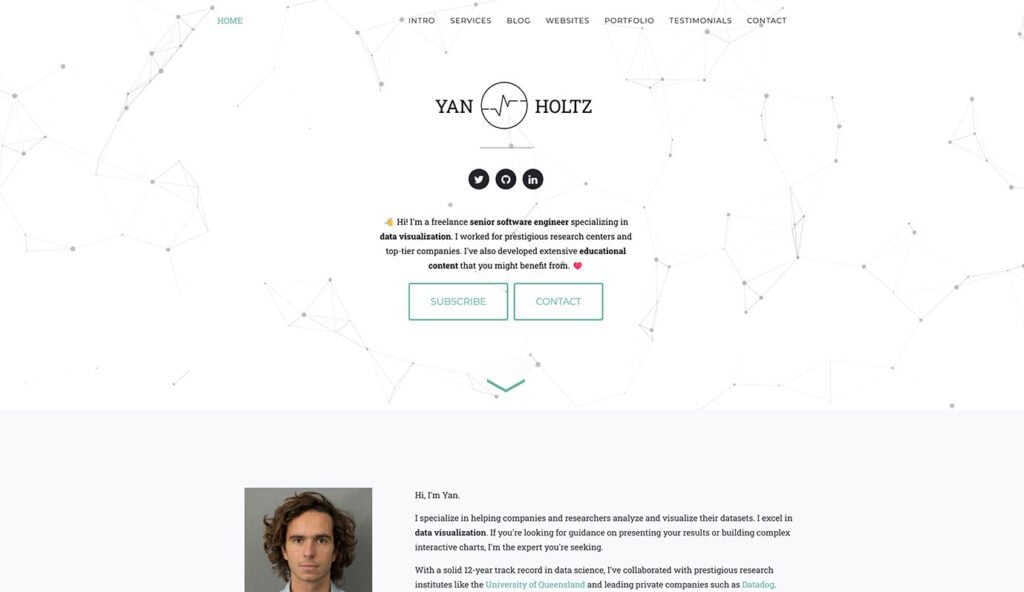
Data visualization specialist Yan Holtz works as a software engineer at Datadog, and his portfolio showcases something many data analysts miss: the power of beautiful data visualization combined with technical skill.
Visit: https://www.yan-holtz.com
What makes it work:
- Interactive designs immediately demonstrate technical capabilities
- Homepage features geometric shapes responding to mouse movement
- Shows both coding abilities and design sensibility in real-time
- Created and maintains R Graph Gallery and Python Graph Gallery (800,000+ visits/month)
- Combines beautiful data visualization with clear technical skill
- Proves ability to communicate complex insights visually
The takeaway: For data professionals aiming for senior roles, technical skills alone aren’t enough at higher levels. The ability to communicate complex insights through clear visualizations becomes increasingly valuable as you move up the career ladder. If you’re building relationships with industry leaders, your website should complement that networking strategy.
10. Lauren Hom: Designer with Strong Visual Brand
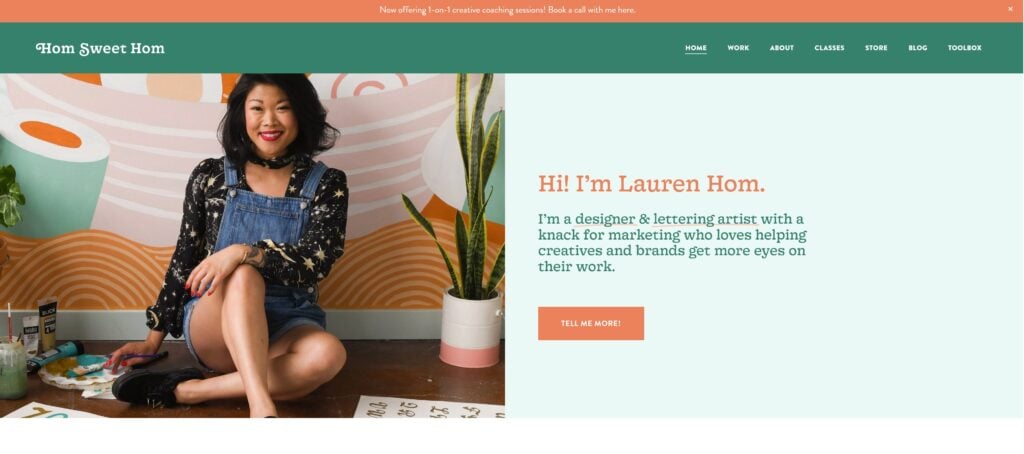
Lauren Hom’s “Hom Sweet Hom” portfolio website (nice twist on “Home Sweet Home”) showcases her work as a designer and lettering artist specializing in marketing, lettering, murals, and food art. The site offers both a creative portfolio and online courses, plus a blog sharing professional advice and personal stories.
Visit: https://homsweethom.com
What makes it work:
- Website structure supports multiple revenue streams (client work, courses, blog)
- Maintains cohesive creative identity that attracts both clients and students
- Intricate micro-animations and stunning typefaces showcase lettering expertise
- Well-organized layout with beautiful color palette and professional photography
- “Work” page displays artworks in mosaic of lively tiles for visual impact
- Demonstrates how one site can serve multiple purposes without feeling scattered
Implementation for your site: The lesson here is that your website can serve multiple purposes without feeling scattered. Lauren effectively showcases client work while promoting courses and building community through her blog. Consider how your site might support various income streams or career goals simultaneously. This works especially well when combined with turning side projects into career assets that demonstrate entrepreneurial thinking.
Inspired by these examples but not sure where to start? Explore Squarespace’s template library to find professional designs you can customize in hours instead of weeks.
What These Personal Websites Have in Common
After studying these ten examples, several patterns emerge that you can apply regardless of your industry:
- Mobile-first design is non-negotiable. Every single example works flawlessly on phones. With over 65% of web traffic coming from mobile devices, a site that looks broken on smartphones is worse than having no site at all. Test every page on your actual phone before considering your site finished.
- Clear value propositions appear immediately. Within seconds of landing on each site, visitors understand who this person is and what they do. You shouldn’t have to scroll or click around to figure out the person’s specialty or value proposition. Make it obvious.
- Strategic use of social proof builds trust. Client logos, testimonials, press mentions, or project outcomes appear prominently without overwhelming the design. This social proof answers the skepticism every visitor brings: “Can this person actually do what they claim?”
- Calls to action make next steps obvious. Whether it’s a contact form, portfolio download, newsletter signup, or booking link, every site makes the desired action clear. Don’t make visitors guess what you want them to do next.
- Loading speed wasn’t sacrificed for visual appeal. Despite impressive designs and rich media, these sites load quickly. Slow sites lose visitors before they see your content, making performance optimization as important as visual design.
How to Build Your Own Effective Personal Website
The examples above prove what’s possible, but knowing where to start can feel overwhelming. That’s exactly why we created our comprehensive guide on how to make a portfolio website that gets you hired.
That guide walks you through the entire process from choosing the right platform to writing copy that converts visitors into opportunities. It covers technical decisions most beginners get wrong, content strategies that actually work, and optimization tactics that separate amateur sites from professional ones. If you’re serious about building a website that drives real career results, start there.
Here’s the condensed version to get you thinking in the right direction:
- Start with clarity about your primary goal. Are you job hunting? Building a client base? Establishing thought leadership? Your website’s purpose determines everything else. Our complete portfolio website guide helps you define this clearly before you waste time building the wrong thing.
- Choose 3 to 5 of your absolute best work examples. Quality beats quantity every time. Each project should demonstrate different skills or approaches. If you don’t have professional work yet, create passion projects that solve real problems. Learn more about turning side projects into career assets that strengthen your professional narrative.
- Tell the story behind each project. Explain the context, the challenge, your approach, and the outcome. Use specific metrics where possible (improved performance by X%, increased engagement by Y%, completed ahead of schedule). Stories make your work memorable in ways that bullet points never achieve.
- Make contact ridiculously easy. Include your email prominently, link to your LinkedIn and relevant social profiles, and consider adding a contact form. Every extra step or hidden contact method loses half your potential opportunities. Don’t be mysterious about how people can reach you.
- Optimize ruthlessly for mobile. Test your site on actual phones, not just desktop browser resize. Check that buttons are easily tappable, text is readable without zooming, and images don’t break layouts. Use tools like Google PageSpeed Insights to verify fast loading across devices.
- Launch quickly, improve iteratively. Set a deadline to launch a basic version this week rather than perfecting every detail before going live. You can always refine based on visitor feedback. Better to have a simple, clean site live today than a complex, perfect site that never launches.
These are just the fundamentals. For the complete step-by-step process including platform comparisons, content templates, SEO basics, and common mistakes to avoid, read our full guide on building a portfolio website that actually gets you hired. You’ll also find additional inspiration in our collections of portfolio website examples and personal website ideas that go beyond traditional approaches.
Common Mistakes That Kill Personal Websites
Avoid these errors that immediately turn off potential employers, clients, or collaborators:
- Outdated content screams “I’ve moved on.” Nothing damages credibility like a portfolio that hasn’t been updated since 2023 or a blog with no posts in 18 months. If you won’t maintain something, don’t include it. Better to have a static site that’s current than a dynamic one that’s abandoned.
- Unclear calls to action create decision paralysis. Every page should make the next step obvious. Want people to hire you? Make the contact form prominent. Want them to read your work? Link to your best pieces up front. Don’t make visitors guess what you want from them.
- Too many pages create confusion. Most personal websites need 3 to 5 pages maximum: Home, About, Work or Portfolio, Contact, and maybe a Blog. More than that and you’re probably overcomplicating things while confusing visitors about what you actually want them to do.
- Generic stock photos undermine authenticity. If you’re using the same stock images that appear on thousands of other sites, you’re communicating that you don’t care enough to be original. Use actual photos of yourself, your work, or your results. Authentic always beats polished-but-generic.
- Slow loading times lose visitors immediately. People won’t wait for slow sites to load, especially on mobile. Compress images appropriately, minimize unnecessary scripts, and test loading speed across devices. Performance optimization matters as much as visual design.
Resources to Build Your Personal Website Right Now
You don’t need to code everything from scratch. Here are legitimate starting points that work in 2026:
- Our number one recommendation: Squarespace offers professionally designed templates specifically built for personal websites and portfolios. Their drag-and-drop editor gives you full design control while handling all the technical details like hosting, security, and mobile responsiveness automatically. Perfect for professionals who want to focus on showcasing work rather than fighting with code. Start your free trial here.
- Other solid options with higher learning curves: Webflow allows extensive design flexibility if you’re comfortable with visual development tools. WordPress with a portfolio theme offers flexibility and extensive customization options if you’re comfortable with that ecosystem. GitHub Pages provides free hosting for portfolios built with HTML, CSS, and JavaScript if you want complete control and enjoy coding.
Important: The platform matters less than the content. Focus your energy on curating exceptional work examples and telling compelling stories about your problem-solving approach. A simple site on any platform beats a complex site that never launches.
External resources that can help refine your approach include advice on effective web design from industry experts, personal branding strategies that complement your site, template inspiration galleries across different styles, professional design principles that elevate your presentation, and portfolio best practices from successful creatives.
For additional context on leveraging your personal website as part of a comprehensive career strategy, explore our guides on resume optimization and career change tactics that work in today’s job market.
Your Personal Website is Your Competitive Advantage
Creating a personal website isn’t about vanity. It’s about taking control of your professional narrative and ensuring that when someone wants to learn more about you, they find exactly what you want them to see.
The examples in this guide are starting points, not strict templates. Your site should reflect who you actually are and what you’re genuinely trying to accomplish. The best personal websites combine professional polish with authentic personality in ways that make you memorable without undermining credibility.
The web is full of identical LinkedIn profiles and cookie-cutter resume templates. Your personal website breaks that pattern by creating something distinctly yours. When hiring managers review 200 applications for a single position, the candidate with a professional website consistently stands out.
Don’t wait for the perfect design or the perfect idea. Pick an approach from these examples that resonates with your goals, grab a template that feels right, and launch something this week. You can refine it later based on actual feedback, but you can’t benefit from a website that doesn’t exist yet.
Your professional reputation deserves better than just a LinkedIn profile. In our experience helping millions of job seekers, the candidate with a professional website consistently gets more interview callbacks, better opportunities, and stronger negotiating leverage.
Start building your site today. The next great opportunity might come from someone who Googles your name tomorrow.
In our experience helping over 100 million job seekers, the candidate with a professional website consistently stands out over equally qualified applicants who only submit a resume. That website is your unfair advantage…
200 Applicants Have Resumes. Only You Have a Website…
We recommend Squarespace because it gives you a professional online presence that makes you memorable. Choose from designer templates, customize without coding, and create a portfolio that actually gets you interviews. Free 14-day trial, and you can launch your site before other candidates finish tweaking their resume.

BY THE INTERVIEW GUYS (JEFF GILLIS & MIKE SIMPSON)
Mike Simpson: The authoritative voice on job interviews and careers, providing practical advice to job seekers around the world for over 12 years.
Jeff Gillis: The technical expert behind The Interview Guys, developing innovative tools and conducting deep research on hiring trends and the job market as a whole.