
Meta Social Media Marketing Professional Certificate Review (2026): What You’ll Actually Learn, What You Won’t, and Who Should Skip It
We talk to hiring managers every day who tell us the same thing: they have plenty of social media marketing applicants, but almost no one can actually run a paid ad campaign from start to finish.
They get resumes stuffed with buzzwords. “Social media guru.” “Content creator.” “Passionate about building brand communities.” But when they ask “walk me through how you’d set up a Facebook campaign targeting women 25 to 34 in Austin who recently searched for yoga studios,” most candidates stare at the ceiling.
Does the Meta Social Media Marketing Professional Certificate fix that problem, or is it just another badge for your LinkedIn profile?
Here’s what we know. The U.S. Bureau of Labor Statistics projects advertising, promotions, and marketing manager roles will grow 8% through 2033, faster than average for all occupations. Social media management is one of the fastest-growing specializations within that field. The opportunity is real.
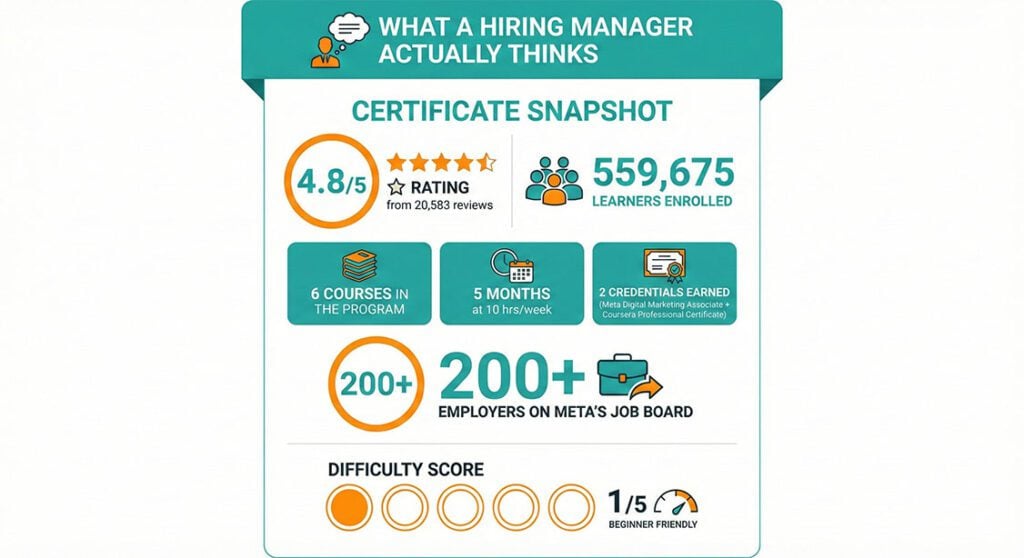
The Meta certificate has a difficulty score of 1 out of 5. Completely beginner-friendly. No degree or prior experience needed. About 5 months at 10 hours per week if you stay on track.
But accessibility doesn’t equal effectiveness. So we dug in. Here’s the hiring manager’s honest perspective.
☑️ Key Takeaways
- Meta’s brand recognition gives you instant credibility on resumes and LinkedIn profiles that generic social media certificates simply can’t match.
- You’ll earn two credentials in one program including Meta’s own Digital Marketing Associate Certification and a Coursera Professional Certificate.
- The curriculum leans heavily toward Meta’s ecosystem so you’ll need to supplement with TikTok, LinkedIn, and SEO skills to be fully competitive.
- At roughly $245 total, this is one of the lowest-cost entry points into a career path where entry-level roles start around $54,000 per year.
Disclosure: This article contains affiliate links. If you purchase through these links, we may earn a commission at no additional cost to you.
What a Hiring Manager Actually Thinks When They See This
First Thought: “They Actually Invested in Learning This”
When a hiring manager sees “Meta Social Media Marketing Professional Certificate” on a resume, they recognize the brand instantly. Meta owns Facebook, Instagram, WhatsApp, and Threads. The Meta name signals that you learned social media advertising from the company that literally invented the modern social media ad platform.
The numbers back this up. This certificate has a 4.8 out of 5 rating from over 20,500 reviews, with more than 559,000 learners enrolled. That’s not a niche credential. It’s an industry-recognized program that consistently triggers stronger responses from hiring managers than certificates from smaller, unknown providers.
Second Thought: “But Can They Actually Do the Work?”
Here’s the hiring manager’s biggest fear: hiring a “Social Media Enthusiast” who doesn’t understand business metrics.
Anyone can post a cute reel. The question is whether you can explain why you posted it, who it was targeting, and what the conversion rate was.
We love this certificate because Course 5 (Measure and Optimize Social Media Marketing Campaigns) forces you to think about ROI before you think about content. You learn A/B testing, attribution models, and how to present campaign results to stakeholders. That’s the stuff that gets you hired.
What you’ll actually learn well:
- Meta Ads Manager which is one of the most widely used ad platforms in the world
- Content calendar creation which every social media role requires on day one
- Campaign measurement and optimization including A/B testing and attribution
- Creative brief development which shows you understand the strategic side
- Audience targeting and persona development which is foundational for any marketing role
What you won’t master:
- TikTok advertising which is increasingly important for brands targeting Gen Z
- SEO and content marketing which most social media roles now require
- Advanced copywriting which separates good marketers from great ones
It’s not a degree. Don’t treat it like one. Treat it as a solid foundation that proves you understand the fundamentals and can operate professional-grade tools.
The Interview Red Flag This Certificate Helps You Avoid
The biggest interview killer we see from social media candidates? “I’m really passionate about creating engaging content.”
That’s code for “I don’t understand the business side of social media marketing.”
The capstone project fixes this. You complete a full end-to-end marketing campaign presentation where you analyze results, formulate recommendations, and present findings to a mock team of marketing professionals. That gives you something concrete to reference in interviews.
Instead of vague passion statements, you can say: “In my capstone project, I developed a campaign targeting millennial homeowners, set up A/B tests on ad creative, and identified that carousel ads drove 34% higher engagement than single image ads. Based on that data, I recommended reallocating 60% of the ad budget to carousel formats.”
That’s the kind of answer that gets second interviews.
Interview Guys Tip: When listing this certificate on your resume, don’t just write “Meta Social Media Marketing Professional Certificate.” Add a bullet underneath that highlights your capstone results. Something like “Developed and analyzed a complete social media campaign including paid advertising, content strategy, and ROI reporting.” Make the hiring manager see outcomes, not just credentials. For more on this, check out our guide on how to list certifications on a resume.
The 5 Interview Questions This Certification Prepares You to Crush
If you’re targeting entry-level social media marketing roles, these are five questions this certificate directly prepares you to answer.
1. “Walk me through how you’d create a social media strategy for a new product launch.”
Courses 1 and 2 cover this thoroughly. You’ll learn to define SMART goals, identify target audiences, build customer journey maps, and create content calendars. Use the SOAR method here: describe the Situation (new product, no existing social presence), the Obstacle (limited budget, unknown audience), the Action (your strategic framework), and the Result (measurable KPIs you’d track).
2. “How would you set up a Facebook ad campaign targeting a specific demographic?”
This is where Course 4 (Advertising with Meta) really shines. You’ll walk through Meta Ads Manager hands-on, learning audience segmentation, budget allocation, and ad placement. You can reference your actual coursework experience.
3. “How do you measure the success of a social media campaign?”
Course 5 is entirely dedicated to measurement and optimization. You’ll know how to discuss impressions versus engagement, click-through rates, conversion tracking, and attribution models. Most entry-level candidates can’t answer this with any specificity.
4. “Tell me about a time you used data to improve a campaign’s performance.”
This is a behavioral question where the SOAR method shines. Reference your capstone project. Walk through the Situation, the Obstacle you identified in the data, the Action you took (A/B testing, budget reallocation, creative changes), and the Result.
5. “What’s the difference between organic and paid social media strategy?”
Course 1 and Course 3 contrast these approaches clearly. You’ll understand when to invest in organic community building versus paid amplification, and how the two work together. This is a question that stumps candidates who’ve only ever managed personal accounts.
For a deeper dive into marketing interview questions and answers, we’ve got a complete guide that pairs well with this certification.
Here’s what most people don’t realize: employers now expect multiple technical competencies, not just one specialization. The days of being “just a marketer” or “just an analyst” are over. You need AI skills, project management, data literacy, and more. Building that skill stack one $49 course at a time is expensive and slow. That’s why unlimited access makes sense:
Your Resume Needs Multiple Certificates. Here’s How to Get Them All…
We recommend Coursera Plus because it gives you unlimited access to 7,000+ courses and certificates from Google, IBM, Meta, and top universities. Build AI, data, marketing, and management skills for one annual fee. Free trial to start, and you can complete multiple certificates while others finish one.
Curriculum Deep Dive: What You’ll Actually Learn
Rather than walking through all six courses one by one, let’s break this into the three phases that actually matter for your career.
Phase 1: Foundation Building (Courses 1-2)
What You’ll Master: The strategic thinking behind social media marketing, not just the posting.
Course 1 (Introduction to Social Media Marketing, 17 hours) gives you the big picture: the difference between traditional and social media marketing, how each platform fits a strategy, and how to create SMART goals with measurable KPIs.
Course 2 (Social Media Management, 18 hours) gets practical fast. You’ll build content calendars, develop brand voice, and learn to evaluate performance. This is the course that teaches you to think like a social media manager, not just a social media user.
Key skills you’ll develop: target audience and persona creation, content calendar planning, brand voice development, platform selection strategy, performance metrics analysis, and using generative AI for content creation.
Interview Tip: When discussing these foundational skills, always connect them to business outcomes. Don’t say “I learned how to create a content calendar.” Say “I learned to align content calendars with business objectives and seasonal trends, tracking how each content pillar contributes to monthly engagement goals.”
Phase 2: Paid Advertising Mastery (Courses 3-4)
What You’ll Master: How to spend money on social media advertising without wasting it.
This is where the certificate really earns its value. Course 3 (Fundamentals of Social Media Advertising, 11 hours) covers the principles of effective ad creation, compelling copy, and creative briefs.
Course 4 (Advertising with Meta) puts you inside Meta Ads Manager. You’ll build actual campaigns, set budgets, define audiences, and troubleshoot common issues. This is hands-on, practical experience with the same tool that agencies and in-house teams use every day.
Key skills you’ll develop: Meta Ads Manager navigation and campaign setup, audience targeting and custom audiences, ad creative development, budget management and bid strategies, and A/B testing for ads.
Interview Tip: Hiring managers love candidates who can discuss ad spend efficiency. After completing this phase, practice explaining how you’d allocate a $1,000 monthly ad budget across different campaign objectives. That specific, numbers-driven thinking is exactly what separates you from the “I’m passionate about social media” crowd.
Interview Guys Tip: The paid advertising skills from this certificate are among the most marketable you’ll learn. According to PayScale, social media marketing managers with paid advertising experience earn significantly more than those focused purely on organic content. When you interview, lead with your Meta Ads Manager experience. It’s your strongest card.
Phase 3: Analysis, Optimization, and Capstone (Courses 5-6)
What You’ll Master: How to prove your work is generating results and communicate that to leadership.
Course 5 (Measure and Optimize Social Media Marketing Campaigns) teaches you to read dashboards, evaluate ROI, run A/B tests, and understand attribution models. This is the course that transforms you from “content creator” to “marketing professional.”
Course 6 is the capstone. You’ll present complete campaign findings, take the Meta Digital Marketing Associate Certification Exam (proctored, with webcam), and walk away with two credentials.
Key skills you’ll develop: campaign performance analysis, A/B testing methodology, marketing attribution models, ROI calculation and reporting, and stakeholder presentation skills.
Interview Tip: The capstone presentation is portfolio gold. Save it, polish it, and bring it to interviews. Being able to open a laptop and walk a hiring manager through a real campaign analysis instantly puts you ahead of candidates who can only talk about what they’d theoretically do.
Who Should Skip This Certification
Honesty builds trust, so let’s be straight about who this isn’t for.
Skip this if you already manage paid social campaigns professionally. The material is designed for beginners and won’t push experienced marketers into new territory.
Skip this if you want a comprehensive digital marketing education. This certificate focuses on social media, and more specifically Meta’s ecosystem. It doesn’t meaningfully cover SEO, email marketing, Google Ads, or content marketing.
Skip this if you’re targeting senior marketing roles. This is an entry-level credential that helps you land your first social media marketing job or pivot from an adjacent role.
Skip this if you expect the certificate alone to get you hired. You still need a portfolio, networking skills, and a smart job search strategy.
The Career Math: What This Investment Actually Returns
Let’s talk numbers, because that’s what smart career decisions are built on.
Cost Breakdown:
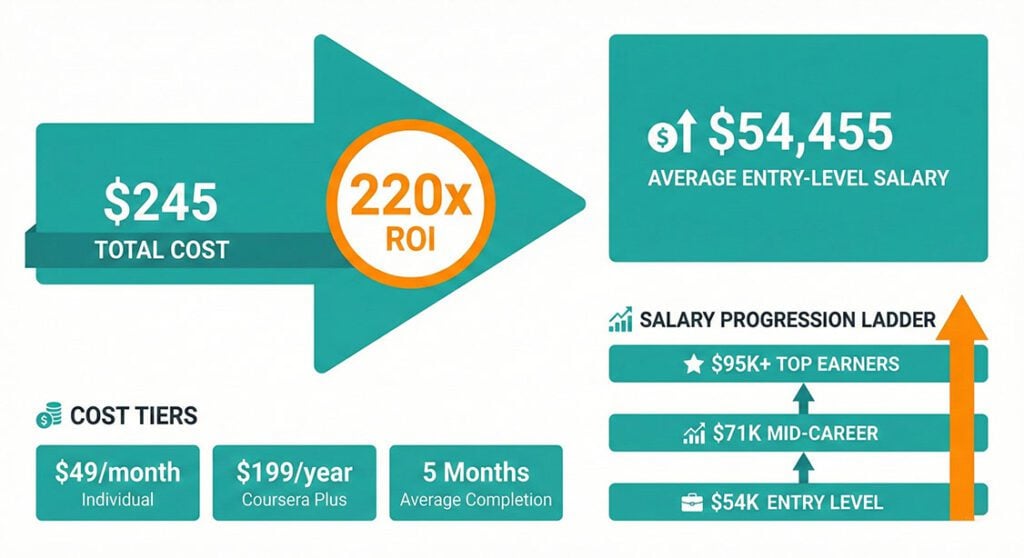
- Coursera subscription: $49/month
- Average completion time: 5 months
- Total cost: approximately $245
- Alternative: Coursera Plus annual subscription at $199 (currently on sale, regularly $399), which gives you access to this certificate plus thousands of other courses
Start your 7-day free trial on Coursera and see if this program fits your learning style before committing.
Salary Data for Target Roles:
The roles this certificate targets pay well, even at entry level. According to ZipRecruiter, entry-level social media marketing positions average $54,455 per year, with the top 25th percentile earning $62,000 or more.
As you gain experience, the numbers climb. Glassdoor reports the average social media manager salary at $71,584 per year, with top earners breaking $95,000. Industry matters too. According to Coursera’s salary research, social media managers in tech earn an average of $82,546 per year, while those in finance average $74,173.
Time Investment Reality Check:
Coursera estimates 5 months at 10 hours per week. Most motivated learners finish in 2 to 3 months. Some have completed it in 6 weeks going full-time. The faster you finish, the less you pay.
The ROI:
If this certificate helps you land an entry-level role at $54,000, that’s a 220x return on a $245 investment. The certificate alone doesn’t generate the return though. Your hustle, portfolio, and interview skills complete the equation. We’ve got resources on certifications that actually pay well if you want to compare options.
What This Certification Won’t Teach You (And What to Stack With It)
Every certification has gaps. Here are three specific ones and how to fill them.
Gap 1: TikTok and Emerging Platform Strategy
The certificate covers Facebook and Instagram deeply but gives other platforms surface-level treatment. Fix: Pair this with free resources from TikTok’s own business learning center, or explore additional Coursera courses on short-form video marketing.
Gap 2: SEO and Content Marketing Fundamentals
Most social media manager job postings now mention SEO. This certificate doesn’t cover it. Fix: Google’s Digital Marketing and E-Commerce Professional Certificate on Coursera covers SEO well. If you have Coursera Plus, you can access both certificates at no extra cost.
Gap 3: Advanced Copywriting and Storytelling
The certificate teaches functional ad copy, but it won’t make you a strong writer. Fix: Practice daily. Study brands that excel at social media (Wendy’s Twitter, Duolingo’s TikTok). Good copywriting is learned through practice, not coursework.
Building a stack of complementary skills is what turns a certificate into a career. For more on which marketing skills belong on your resume and how to present them, we’ve got a full breakdown.
Interview Guys Tip: When an interviewer asks about platforms not covered in your Meta certificate, don’t bluff. Say something like: “My Meta certification gave me deep expertise in Facebook and Instagram advertising and analytics. I’ve been supplementing that with self-study on TikTok and LinkedIn strategies, and I’ve run two test campaigns on TikTok for a local business as practice.” Honesty plus initiative always beats fake expertise.
The Honest Verdict
| Criterion | Score |
|---|---|
| Curriculum Quality | 8.0 / 10 |
| Hiring Impact | 7.0 / 10 |
| Skill-to-Job Match | 7.0 / 10 |
| Value for Money | 8.0 / 10 |
| Portfolio and Interview Prep | 9.0 / 10 |
| Accessibility | 9.0 / 10 |
| Interview Guys Rating | 7.8 / 10 for career changers and beginners |
| 8.0 / 10 for small business owners managing their own social presence |
Certificate: Meta Social Media Marketing Professional Certificate
Difficulty: 1/5 (Beginner-friendly — no prerequisites, though the proctored Meta certification exam requires preparation)
Time Investment: 5 months at 10 hours per week (2–3 months at an accelerated pace)
Cost: ~$245 total ($49/month) | Start your 7-day free trial
Best For: Career changers with no marketing background targeting entry-level social media marketing roles, recent graduates adding practical credentials to their resume, and small business owners or freelancers who want to run professional-grade Meta ad campaigns for their own brands
Not Right For: Experienced social media marketers who already manage paid campaigns (too foundational), candidates targeting comprehensive digital marketing roles that require SEO depth (the program doesn’t cover it), or senior marketing professionals whose target roles expect demonstrated campaign results over certifications
Key Hiring Advantage: The dual credential is the differentiator that most reviewers understate — you don’t just earn a Coursera certificate, you pass a proctored Meta Digital Marketing Associate Certification exam. That combination of program credential plus vendor certification signals a level of accountability that peer-reviewed certificates can’t match. The 200+ employer job board through Meta’s Career Programs is a direct pipeline that most certificates simply don’t offer. Meta’s brand carries genuine authority in social media marketing hiring — this is the company that built the ad platform your future employers use every day. When we run Meta-issued credentials through our Resume Analyzer, they consistently score above generic marketing certificates on brand authority in digital advertising contexts.
The Brutal Truth: Social media marketing is one of the most accessible fields to break into, which means it’s also one of the most competitive at the entry level. The Meta brand helps, but hiring managers see a lot of these resumes now. Your portfolio of actual campaign results will matter more than any credential in most interviews. The SEO gap is real — the majority of social media manager job postings now list SEO as a required or preferred skill, and this program doesn’t cover it. Plan to supplement before applying to roles that list it.
Our Recommendation: Strong yes for career changers and small business owners at this price point. The Meta brand, the proctored exam dual credential, and the employer job board create a package that’s hard to match under $300. Pair it with a real portfolio of actual campaigns — even for a local business or personal brand — and you’re competitive.
Interview Guys Rating: 7.8/10 for career changers and beginners | 8.0/10 for small business owners managing their own social presence
Small business owners score slightly higher because every skill maps directly to immediate daily use, and at $245 to learn professional-grade Meta Ads Manager, the ROI is exceptional for someone already running a business. Career changers score well but face a competitive field where demonstrated campaign results ultimately matter more than credentials alone.
Enroll and start your 7-day free trial on Coursera
FAQ
Is this certificate worth it without a relevant degree?
Yes. Social media marketing is one of the fields where demonstrated skills matter more than formal education. Many entry-level social media roles list “degree preferred” but accept relevant certifications and portfolio work. Pair this certificate with real campaign examples and you’re competitive against degree-holders.
How long does it really take to complete?
Coursera says 5 months at 10 hours per week. Focused learners regularly finish in 2 to 3 months, and full-time students can wrap up in 6 weeks. Don’t rush the capstone though. That’s your portfolio piece.
How does this compare to the Google Digital Marketing Certificate?
Google’s certificate is broader (SEO, email marketing, e-commerce). Meta goes deeper on social media specifically, particularly paid advertising. If you want social media focus, choose Meta. If you want breadth, choose Google. Best case: do both through Coursera Plus.
Do I really get access to a job board after completing this?
Yes. Graduates access Meta’s Career Programs Job Board, connecting you with 200+ employers who source talent through Meta’s programs. It’s not a guaranteed job, but it’s a direct pipeline most certificates can’t offer.
Bottom Line
The Meta Social Media Marketing Professional Certificate earns its spot as one of the better entry-level marketing credentials for 2026. It’s not perfect, and we’ve been transparent about the gaps. But for the price, the brand credibility, and the practical skills you walk away with, it delivers real value.
Here’s your action plan:
- Start the certificate and commit to finishing in 3 months or less to minimize cost
- Build a portfolio alongside it by offering free social media management to a local business, nonprofit, or your own personal brand
- Stack complementary skills in SEO, copywriting, and non-Meta platforms to round out your profile
- Prepare for interviews using your capstone project as your go-to example of real marketing work. Our marketing manager interview prep guide will help you practice
If you’re ready to turn your social media scrolling into an actual career skill, start your free 7-day trial today and take the first step toward your new career in social media marketing.
And once you’ve got that certificate in hand, make sure you know how to put certifications on your resume the right way so hiring managers actually notice.
Here’s what most people don’t realize: employers now expect multiple technical competencies, not just one specialization. The days of being “just a marketer” or “just an analyst” are over. You need AI skills, project management, data literacy, and more. Building that skill stack one $49 course at a time is expensive and slow. That’s why unlimited access makes sense:
Your Resume Needs Multiple Certificates. Here’s How to Get Them All…
We recommend Coursera Plus because it gives you unlimited access to 7,000+ courses and certificates from Google, IBM, Meta, and top universities. Build AI, data, marketing, and management skills for one annual fee. Free trial to start, and you can complete multiple certificates while others finish one.

BY THE INTERVIEW GUYS (JEFF GILLIS & MIKE SIMPSON)
Mike Simpson: The authoritative voice on job interviews and careers, providing practical advice to job seekers around the world for over 12 years.
Jeff Gillis: The technical expert behind The Interview Guys, developing innovative tools and conducting deep research on hiring trends and the job market as a whole.