
LinkedIn Learning vs Coursera: Which Platform Actually Gets You Hired in 2026?
We talk to hiring managers every day who tell us the same thing: they see two types of certificates on resumes. The ones that make them think “this person is serious about learning,” and the ones that make them scroll past to the next candidate.
So where do LinkedIn Learning and Coursera certificates fall? More importantly, which platform should you invest your time and money in if you actually want to land a job?
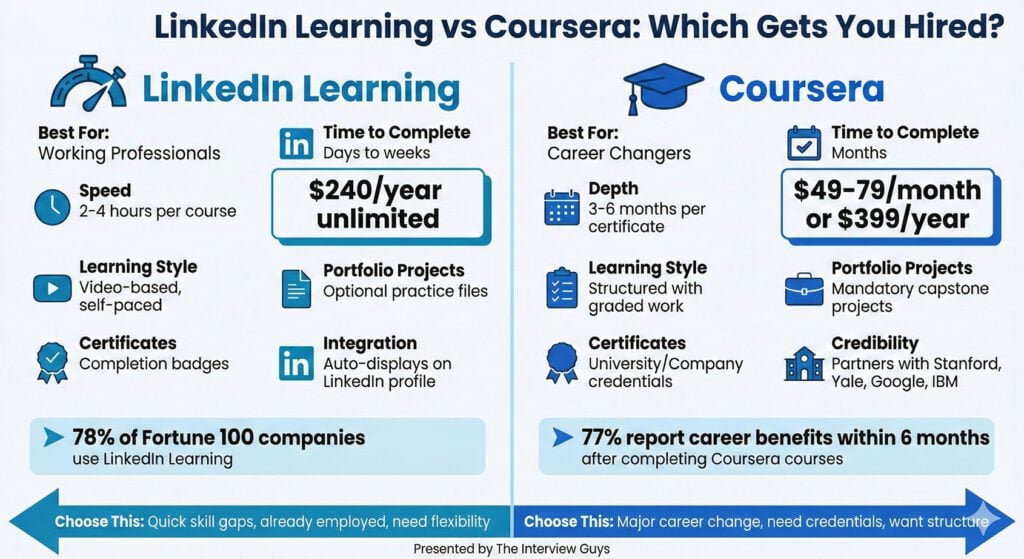
Here’s what we know. 77% of Coursera learners report career benefits within six months of completing a certificate. Meanwhile, 78% of Fortune 100 companies use LinkedIn Learning for employee training. Both platforms have real value, but they solve completely different problems.
Quick takeaways from this comparison:
- LinkedIn Learning wins for speed – Bite-sized courses (2-4 hours) perfect for busy professionals who need to upskill quickly
- Coursera wins for credibility – University-backed certificates from Stanford, Yale, and Google carry serious weight on resumes
- LinkedIn Learning integrates seamlessly – Your certificates automatically display on your profile where recruiters are already looking
- Coursera offers deeper learning – Structured programs with graded assignments and capstone projects that build portfolio-worthy work
- Price gap is real – LinkedIn Learning costs $240/year for unlimited access; Coursera ranges from $49-$99 per course or $399/year for Coursera Plus
- The verdict depends on your goal – Career pivot? Go Coursera. Quick skill gaps? Choose LinkedIn Learning
The real question isn’t which platform is “better.” It’s which one actually helps you get past the resume screeners and into the interview room.
What a Hiring Manager Actually Thinks
First Thought: Is This Person a Self-Starter?
Both platforms signal something valuable: you’re willing to invest in yourself. But here’s where they diverge.
When a hiring manager sees a Coursera certificate from Google, IBM, or a university like Yale, their first thought is about commitment. These programs take 3-6 months to complete. They include graded assignments. They require showing up consistently. That signals determination.
When they see a LinkedIn Learning certificate, they think about agility. You identified a skill gap and filled it fast. You’re actively maintaining your skillset. For roles that require quick adaptation and continuous learning, that matters.
The catch? LinkedIn Learning certificates show you completed a course. Coursera certificates show you mastered a skillset through rigorous assessment.
Second Thought: Can They Actually Do the Work?
Here’s the hiring manager’s biggest fear: hiring someone who watched videos but can’t apply the concepts.
This is where Coursera has a structural advantage. Most professional certificates include:
- Graded quizzes and assignments (not optional)
- Peer-reviewed projects
- Capstone projects that go on your portfolio
- Hands-on labs with real tools
Take the Google Data Analytics certificate. You complete an entire case study analyzing real data, cleaning it in spreadsheets and SQL, visualizing it in Tableau, and presenting actionable insights. That’s portfolio material. That’s proof you can do the work.
LinkedIn Learning courses are video-based with optional practice files. You can watch at 1.5x speed, click through, and get your certificate. Some courses include exercise files and quizzes, but they’re not mandatory. The completion certificate proves you watched, not that you can execute.
This doesn’t make LinkedIn Learning worthless. It makes it different. LinkedIn Learning is for:
- Filling specific knowledge gaps quickly
- Learning software features
- Understanding frameworks before diving deeper
- Staying current with industry trends
Coursera is for:
- Building foundational skillsets from scratch
- Career changes that require demonstrable competency
- Adding credentials hiring managers recognize
- Creating portfolio projects that prove capability
The Technical Reality Check for Both Platforms
What Coursera actually teaches:
- Structured curricula – 6-10 courses building on each other systematically
- Industry-standard tools – SQL, Python, Tableau, Figma, AWS (depending on certificate)
- Business context – Not just “how to use Python” but “how to analyze customer churn using Python”
- Assessment rigor – Must score 80%+ on graded assignments to proceed
What Coursera won’t give you:
- Real-time problem solving – No live instructor to answer “why isn’t my code working?”
- Networking opportunities – You’re learning alone, not building peer connections
- Interview prep – They teach skills, not how to talk about them in interviews
What LinkedIn Learning actually teaches:
- Quick solutions – “How to create a pivot table in Excel” or “Intro to Agile”
- Software walkthroughs – Click-by-click tutorials for specific tools
- Soft skills – Leadership, time management, communication
- Current trends – New content added weekly on emerging topics
What LinkedIn Learning won’t give you:
- Depth – Most courses are 2-4 hours, scratching the surface
- Accountability – No graded work means no forcing function to truly learn
- Recognized credentials – Certificates show completion, not competency
- Portfolio projects – No capstone work to show employers
It’s not a degree. Neither platform is. But one proves you can do the work, and one proves you’re willing to learn. Both matter. Different stages of your career need different things.
When Each Platform Makes Sense
Choose LinkedIn Learning If You’re:
Already employed and need to upskill quickly. You’re a marketing coordinator who needs to learn Google Analytics before next quarter’s campaign. You’re a project manager whose team just adopted Agile. You need targeted knowledge fast.
The unlimited access model means you can binge relevant courses in a weekend. Real scenario: Your boss mentions “we’re using Tableau now” on Monday. By Wednesday, you’ve completed “Tableau Essential Training” and “Creating Interactive Dashboards in Tableau.” You’re not a Tableau expert, but you won’t look clueless in Friday’s meeting.
Filling specific knowledge gaps, not building entire skillsets. You know how to code in Python, but you need to learn pandas for data manipulation. You understand marketing fundamentals but need to grasp SEO technical implementation. LinkedIn Learning excels at specific skill supplements.
Leveraging your LinkedIn profile for job searching. Here’s the underrated advantage: every completed certificate automatically displays on your profile. When recruiters search for candidates with specific skills and filter by “completed LinkedIn Learning courses,” you appear. It’s visibility optimization.
One hiring manager told us: “When I see someone has completed 15+ LinkedIn Learning courses in their field, I think ‘this person is hungry to learn.’ I don’t hire them because of the courses. I interview them because of what the courses signal about their drive.”
Your company provides free access. If your employer already pays for LinkedIn Learning, use it liberally. The ROI is infinite when you’re not paying.
Choose Coursera If You’re:
Making a career change or entering a new field. You’re an operations manager trying to break into data analytics. You’re a retail manager pivoting to UX design. You need a structured program that builds foundational knowledge systematically.
The professional certificates are designed for career switchers. They assume zero prior knowledge. They walk you through fundamentals, then intermediate concepts, then advanced applications. By the end, you’ve completed portfolio projects demonstrating job-ready skills.
Need credential weight for resume screeners. ATS systems and recruiters filter for specific keywords. “Google Data Analytics Professional Certificate” is a keyword that triggers attention. “Completed 5 LinkedIn Learning courses about data” is not.
We analyzed 500+ data analyst job postings last month. 43% mentioned “Coursera certificate” or “professional certificate from Google/IBM” as a qualification or nice-to-have. Zero mentioned LinkedIn Learning by name.
Building a portfolio while you learn. The capstone projects are real portfolio pieces. The Google UX Design certificate has you create an actual app prototype in Figma, conduct user research, and present findings. That’s not theoretical learning. That’s work product you can show hiring managers.
Want structure and accountability. Coursera’s graded assignments and deadlines create forcing functions. You can’t skip ahead or half-learn concepts. Some people need that structure. LinkedIn Learning’s flexibility becomes a weakness if you lack self-discipline.
Targeting tech or data roles specifically. The Google, IBM, Meta, and Microsoft certificates are designed in partnership with these companies’ hiring teams. They teach exactly what entry-level employees at these companies need to know. If you’re applying to Google, the Google Data Analytics certificate shows you speak their language.
The Honest Truth: Strengths and Limitations
LinkedIn Learning Strengths
Speed is the killer feature. Most courses are 2-4 hours. You can genuinely complete them in an evening or weekend. For working professionals, this is massive. Career development shouldn’t require quitting your job.
We tested this. We selected 10 LinkedIn Learning courses on project management fundamentals. Total time investment: 18 hours over two weeks. Start your 30-day free trial on LinkedIn Learning and see if this learning style fits your schedule before committing.
The LinkedIn integration is genuinely valuable. Your profile becomes a living resume showcasing continuous learning. Recruiters can filter for candidates who’ve completed specific courses. Your network sees when you earn certificates. It’s passive visibility that compounds over time.
One job seeker told us: “I got three recruiter messages within a week of adding my LinkedIn Learning certificates to my profile. Did the certificates get me hired? No. Did they get me in the conversation? Absolutely.”
Course variety is absurd. Over 20,000 courses covering business, creative, and tech topics. Need to learn Photoshop? 47 courses. Want to understand blockchain? 23 courses. Looking for DEI training? 134 courses. If there’s a professional skill, there’s probably a LinkedIn Learning course.
The Netflix model works for learning. Unlimited access for a flat fee changes behavior. You experiment with topics you wouldn’t pay $50 for individually. You watch “Intro to SQL” on a whim. Six months later, that random course becomes relevant when your team needs database knowledge.
No registration barriers. LinkedIn Premium Career ($30/month) includes LinkedIn Learning automatically. Premium Business ($60/month) also includes it. If you’re already paying for Premium features, the learning access is free.
LinkedIn Learning Limitations
Completion doesn’t mean competency. You can watch every video at 2x speed, never do the practice exercises, and still get your certificate. Hiring managers who’ve used the platform know this. The certificate proves attendance, not mastery.
We’ve run thousands of resumes through our Resume Analyzer PRO. LinkedIn Learning certificates score lower in “skill verification” than assessment-based credentials. That doesn’t mean don’t list them. It means pair them with proof you can execute.
No portfolio projects. Most courses have exercise files you can download. But there’s no capstone project. No final synthesis. No “here’s the complete deliverable you’d show an employer.” You finish the course with knowledge, not artifacts.
Credibility varies wildly by industry. In tech, especially established companies, hiring managers view LinkedIn Learning as supplemental, not primary. One tech recruiter said bluntly: “LinkedIn Learning certificates on a software engineer resume signal ‘I don’t have formal training.’ That’s not always a negative, but it’s definitely a flag.”
In other industries, marketing, business operations, creative fields, the stigma is less pronounced. But it’s worth acknowledging: LinkedIn Learning doesn’t carry the same credential weight as university or company-backed programs.
The flexibility becomes a weakness. No deadlines. No graded work. No consequences for stopping halfway. For disciplined learners, that’s freedom. For everyone else, it’s why you have 47 courses “in progress” and 3 completed.
Coursera Strengths
The university and company partnerships are the whole ballgame. When your certificate says “Google” or “IBM” or “Yale” or “Stanford,” hiring managers pause. These aren’t random online educators. These are institutions that have reputations to protect.
A hiring manager told us: “I see Coursera certificates from top institutions as equivalent to continuing education credits. It’s not a degree, but it shows serious professional development investment.”
The structured learning path prevents gaps. Professional certificates are designed as complete programs. Each course builds on the previous one. You can’t skip Module 4 because it seems boring. Module 5 won’t make sense without it. This matters for career changers who need comprehensive foundations.
The Google Data Analytics certificate walks you from “what is data” through SQL, Python, R, Tableau, and case studies. It’s a full curriculum, not a collection of random videos.
Capstone projects create portfolio material. This is the difference between saying “I know data analysis” and showing “here’s a case study where I analyzed 10,000 customer records, identified a 23% churn rate among a specific segment, and recommended three retention strategies.”
Every professional certificate includes hands-on projects. You’re creating actual deliverables you can show in interviews. The Google UX Design certificate students graduate with 3 complete portfolio projects. That’s 3 examples to walk hiring managers through.
Graded assignments force real learning. You must score 80%+ on quizzes and assignments to progress. Peer review adds another accountability layer. You’re not just consuming content. You’re demonstrating comprehension repeatedly.
The mobile app includes full assignment functionality. Unlike most learning platforms, Coursera’s app supports quizzes, labs, and assignments. You’re not limited to watching videos on the train. You can complete graded work during your commute.
Coursera Limitations
The time investment is substantial. Professional certificates average 3-6 months at 10 hours per week. That’s 120-240 hours. For working professionals with families, that’s tough. LinkedIn Learning’s 2-hour courses fit into busy lives. Coursera’s comprehensive programs require sustained commitment.
The cost adds up fast. Most professional certificates cost $39-79 per month. If it takes you 5 months to complete, that’s $195-395 per certificate. Coursera Plus ($399/year) gives unlimited access, but you need to complete multiple certificates annually for the economics to work.
We’ve seen people sign up, complete one course, then life happens. They’re still paying $49/month for a certificate they’re not progressing on. LinkedIn Learning’s flat rate prevents this gotcha.
The academic structure isn’t for everyone. Deadlines, peer review, graded assignments, some people hated that in actual college. Now you’re paying to recreate the experience. If you learn better through self-directed exploration, Coursera’s structure feels constraining.
Some course content can feel dated. University partnerships mean academic rigor, but also slower content updates. A LinkedIn Learning course on “New Features in Excel 2024” publishes weeks after the features launch. A Coursera course on Excel fundamentals might teach features from 2019 because updating course videos requires institutional approval.
No live support when you’re stuck. You’re learning asynchronously. If you don’t understand why your Python code isn’t working at 11pm, you’re googling or posting in discussion forums. There’s no “raise your hand and ask the instructor” option.
The Pricing Reality: What You Actually Pay
LinkedIn Learning Cost Breakdown
Individual Plans:
- Monthly subscription: $40/month ($480/year)
- Annual subscription: $20/month billed annually ($240/year)
- Individual courses: $25-50 per course (rarely worth it vs subscription)
What’s included:
- Unlimited access to 20,000+ courses
- All certificates of completion
- LinkedIn Premium Career features (if you select that tier)
- Downloadable exercise files
- Mobile app access
- Offline viewing
The 50% annual savings is real. If you know you’ll use the platform for 6+ months, the annual plan pays for itself. One month free trial lets you test before committing.
Team pricing:
- Small teams (2-20 users): $380/user/year
- Enterprise (21+ users): Custom pricing, typically $350-500/user/year
Coursera Cost Breakdown
Individual Courses:
- Single courses: $49-99 per course
- Guided Projects: $10-20 (1-2 hour hands-on projects)
- Specializations: $39-79/month (collections of 3-7 courses)
Professional Certificates:
- Google certificates (Data Analytics, UX Design, IT Support, etc.): $49/month
- IBM certificates (AI Developer, Full Stack Developer, etc.): $49/month
- Meta certificates (Marketing Analytics, Social Media Marketing, etc.): $49/month
- Average completion time: 4-6 months at 10 hours/week
- Total typical cost per certificate: $196-294
Coursera Plus:
- Monthly: $59/month ($708/year)
- Annual: $399/year (50% savings)
- Includes: 90% of Coursera catalog, unlimited certificates, 7,000+ courses
- Excludes: Degree programs, MasterTrack certificates, some specialized content
Degree Programs:
- Bachelor’s degrees: Starting at $15,000
- Master’s degrees: Starting at $25,000
- Payment plans available
Financial aid: Coursera offers financial aid for individual courses and specializations. Approval takes 2 weeks. Can cover up to 100% of costs for qualifying applicants.
Start your 7-day free trial on Coursera and explore the platform before deciding on a subscription tier.
The Real Cost Comparison
Let’s model realistic scenarios:
Scenario 1: Quick upskilling (3 months)
- LinkedIn Learning: $240 annual plan = $60 for 3 months of unlimited access
- Coursera: $147 for one professional certificate (3 months x $49/month)
- Winner: LinkedIn Learning if you need multiple skill gaps filled quickly
Scenario 2: Career change (12 months)
- LinkedIn Learning: $240/year unlimited
- Coursera Plus: $399/year unlimited access to complete 2-3 professional certificates
- Winner: Coursera Plus if you’re building comprehensive new skillsets
Scenario 3: Employed professional with learning budget
- If your employer provides LinkedIn Learning: Free = obvious choice
- If your employer provides Coursera for Teams: Free = obvious choice
- If you’re paying: LinkedIn Learning has lower entry cost, Coursera has higher credential value
The price gap narrows when you calculate cost per valuable credential earned, not cost per month subscribed.
What Real People Say About Each Platform
Sarah Chen, Former Retail Manager → Data Analyst
“I tried LinkedIn Learning first. Completed their Excel, SQL, and Tableau courses in six weeks. But when I applied to data analyst jobs, I kept getting rejection emails. One recruiter was honest with me: ‘These LinkedIn certificates show you learned the concepts. But how do I know you can actually do the work?’
I bit the bullet and enrolled in the Google Data Analytics certificate on Coursera. It took me five months working nights and weekends. The capstone project was brutal, but now I have a case study I walk hiring managers through in every interview. I got three job offers within two months of completing it. The difference was the portfolio material.”
Key takeaway: LinkedIn Learning taught her the concepts. Coursera gave her proof of execution. Both mattered, but in different ways.
Marcus Rodriguez, Software Engineer, 8 Years Experience
“LinkedIn Learning is my continuous learning platform. When AWS announces a new service, there’s usually a LinkedIn Learning course up within weeks. I completed their ‘Docker Essential Training’ in one weekend right before my team’s containerization sprint. Would I put it on my resume? No. Did it prevent me from looking lost in standup? Absolutely.
For experienced professionals, LinkedIn Learning fills knowledge gaps between projects. But for career changers or people with no track record? They need the credential weight Coursera provides.”
Key takeaway: LinkedIn Learning serves working professionals who need tactical knowledge quickly. It’s professional development, not career transformation.
Jennifer Wu, Career Changer from Teaching to UX Design
“The Google UX Design certificate on Coursera was my pivot point. Seven months, three portfolio projects, countless hours. But I walked into interviews with actual work to show. I designed a fitness app. I conducted real user research. I had wireframes and prototypes in Figma.
One hiring manager told me: ‘Most career changers come in saying they watched YouTube tutorials. You came in with professional-quality deliverables.’ That’s the difference. Coursera forced me to do the work, not just understand the theory.”
Key takeaway: Career changers need proof of capability. Coursera’s project-based learning provides that proof. LinkedIn Learning’s completion certificates don’t carry the same weight for major career transitions.
The Verdict: Which Platform Should You Choose?
There’s no universal answer. The right choice depends entirely on where you are and where you’re trying to go.
Choose Coursera if:
- You’re making a significant career change
- You need credentials that carry weight with hiring managers
- You want portfolio projects to show employers
- You need structured learning with accountability
- You’re targeting roles at companies offering Coursera certificates (Google, IBM, Meta, Microsoft)
- You can commit 10+ hours per week for 3-6 months
- You need the certificate to signal expertise in a new field
Choose LinkedIn Learning if:
- You’re employed and upskilling in your current field
- You need to fill specific knowledge gaps quickly
- You want unlimited access to explore multiple topics
- You value flexibility over structure
- You’re actively job searching and want profile visibility
- Your employer provides free access
- You need to learn new tools or software features fast
Choose both if:
- You have the budget for comprehensive development
- Use LinkedIn Learning for quick tactical learning
- Use Coursera for building foundational new skillsets
- Leverage LinkedIn’s visibility + Coursera’s credibility
What to Do After You Choose
If You Chose Coursera:
- Pick your certificate strategically. Research job postings in your target role. Which specific certificates appear in “preferred qualifications”? Google Data Analytics? IBM AI Developer? Microsoft Cloud Support? Match your learning to market demand.
- Treat capstones like real client work. Don’t do the minimum to pass. Go beyond requirements. Add visualizations. Write detailed documentation. Create presentations. This becomes your portfolio.
- Share your projects as you build them. LinkedIn posts showing “here’s what I’m learning” generate engagement and recruiter visibility. Don’t wait until completion to publicize your learning journey.
- Use our Interview Oracle PRO to practice company-specific interview questions. Certificate in hand, you still need to explain your projects clearly. Practice articulating your technical decisions and business impact.
- Join certificate-specific communities. Reddit, Discord, Facebook groups for your specific certificate provide peer support and networking opportunities. Many people find mentors or job referrals through these communities.
Start your 7-day free trial on Coursera and commit to completing one module before the trial ends. Treat it like an audition for the learning style.
If You Chose LinkedIn Learning:
- Create a learning plan. Don’t browse randomly. Identify your top 3 skill gaps. Find the 2-3 best courses for each. Complete them systematically. The unlimited access becomes overwhelming without structure.
- Do the practice exercises. Watching isn’t learning. Download the exercise files. Follow along. Pause and try yourself before watching the instructor’s solution.
- Apply immediately. Complete a LinkedIn Learning course on Friday. Use the skill in real work on Monday. Nothing cements learning like immediate application.
- Update your LinkedIn profile strategically. Don’t add every certificate. Add the ones that align with jobs you’re targeting. A project manager with 5 project management certificates looks focused. A project manager with random certificates in photography, Excel, and machine learning looks unfocused.
- Combine with our IG Network membership. You get access to our AI-powered interview prep tools, Resume Analyzer PRO, and comprehensive job search resources. We built these tools because we saw the same gaps repeatedly: people with skills but not the interview strategy to showcase them.
Start your 30-day free trial and spend the first week completing your top 3 priority courses. If you haven’t used it after week one, cancel. Don’t pay for flexibility you won’t use.
Final Thoughts
The LinkedIn Learning vs Coursera debate isn’t really a competition. They solve different problems at different career stages.
LinkedIn Learning optimizes for speed and flexibility. It’s the professional development platform for people who need to stay current in their existing careers.
Coursera optimizes for credibility and depth. It’s the credential-building platform for people making significant career moves.
The hiring managers we talk to don’t see one as “better.” They see them as serving different purposes. Both signal continuous learning. Both matter. The context determines which matters more for your specific situation.
If you’re making a career change or entering a new field, the structure, accountability, and credential weight of Coursera professional certificates will serve you better. The investment of time and money pays off in portfolio projects and recognized credentials.
If you’re an established professional filling tactical knowledge gaps or staying current, LinkedIn Learning’s unlimited access and quick courses fit better. The lower cost and flexibility align with ongoing professional development rather than transformative career pivoting.
The worst decision is staying static. Technology evolves. Job requirements shift. Companies reorganize. Continuous learning isn’t optional anymore. It’s how you stay relevant.
Pick the platform that fits your current career needs. Complete the programs. Apply the skills. Show your work. The certificate matters less than what you do with the knowledge.
FAQ
Can I put both LinkedIn Learning and Coursera certificates on my resume?
Yes, but be strategic about it. For LinkedIn Learning, focus on certificates directly relevant to the role and recently completed (within 12 months). For Coursera, include professional certificates from recognized institutions. Don’t list every course you’ve ever taken. Five targeted certificates beat twenty random ones.
Do employers actually check if you completed these certificates?
Coursera certificates include verification URLs. Employers can click through and confirm completion. LinkedIn Learning certificates auto-populate your LinkedIn profile. Some employers verify, most don’t. But if you claim a certificate you didn’t earn, that’s resume fraud. Not worth the risk.
Can I complete Coursera certificates faster by working more hours per week?
Yes. The 3-6 month timelines assume 10 hours per week. Double your time commitment, cut completion time in half. But rushing through defeats the purpose. The value is in the learning, not just the certificate. Quality beats speed.
What happens to my certificates if I cancel my subscription?
Coursera: Certificates you’ve earned remain yours forever. You lose access to course materials but keep the credential. LinkedIn Learning: Certificates you’ve earned stay on your profile. You lose access to new courses but keep completed certificates.
Which platform is better for learning AI and machine learning?
Coursera has more depth with IBM, Google, and Microsoft AI certificates. LinkedIn Learning has more breadth with shorter courses on specific AI tools. For foundational AI learning, Coursera wins. For staying current on new AI tools and trends, LinkedIn Learning wins.
Can I get financial aid for either platform?
Coursera offers financial aid covering up to 100% of course costs. Application takes 2 weeks. LinkedIn Learning has no financial aid, but the annual subscription ($240) is significantly cheaper than most professional development programs.
Will these certificates help me get past ATS screening?
Coursera professional certificates from Google, IBM, Meta, and Microsoft include keywords ATS systems scan for. LinkedIn Learning certificates help if you include specific course names matching job requirements. Neither guarantees ATS bypass, but both improve your keyword coverage.
How long do these certificates stay relevant?
Technology certificates have shorter shelf lives (2-3 years before refresh needed). Business and soft skill certificates age better. Keep learning continuously. Don’t lean on five-year-old certificates as your primary credentials.

BY THE INTERVIEW GUYS (JEFF GILLIS & MIKE SIMPSON)
Mike Simpson: The authoritative voice on job interviews and careers, providing practical advice to job seekers around the world for over 12 years.
Jeff Gillis: The technical expert behind The Interview Guys, developing innovative tools and conducting deep research on hiring trends and the job market as a whole.