
ISSA Nutrition Coach Certification Review 2026: Your Complete Career-Focused Guide
Want to break into nutrition coaching without a four-year degree? The ISSA Nutrition Coach Certification might be exactly what your career needs. But here’s what most reviews won’t tell you: this certification works best as a career multiplier, not a standalone credential.
After analyzing the program’s curriculum, job market data, and real-world applications, we’re giving you the honest breakdown. Whether you’re a personal trainer looking to double your income streams or someone pivoting into wellness coaching, this review cuts through the marketing noise to show you what this certification actually delivers.
By the end of this article, you’ll know exactly whether the ISSA Nutrition Coach Certification aligns with your career goals, how it stacks up against competitors, and the realistic salary expectations you can have after earning it.
☑️ Key Takeaways
- The ISSA Nutrition Coach Certification costs $799 and typically takes 3-4 months to complete, making it accessible for working professionals
- Nutrition coaches with certification earn between $55,000-$94,000 annually, with top earners exceeding $119,000 when combining multiple income streams
- The program excels at behavior change psychology and business skills, not just nutrition science, setting it apart from purely academic programs
- This certification works best paired with existing fitness credentials, amplifying earning potential by 30-50% for personal trainers
Disclosure: This article contains affiliate links. If you purchase through these links, we may earn a commission at no additional cost to you.
What Is the ISSA Nutrition Coach Certification?
The International Sports Sciences Association (ISSA) has been certifying fitness professionals since 1988, and their Nutrition Coach Certification represents their answer to the growing demand for evidence-based nutrition guidance.
Unlike traditional nutritionist programs that require years of academic study, this certification focuses on practical coaching skills you can apply immediately. You’re learning how to help clients make sustainable nutrition changes, not just memorizing biochemical pathways.
The program is 100% online and self-paced. You get lifetime access to course materials, which means you can revisit updated content as nutrition science evolves. For busy professionals juggling work and education, this flexibility is invaluable.
What sets ISSA apart is their integration of business training directly into the curriculum. You’re not just learning nutrition science. You’re learning how to build a nutrition coaching practice that generates actual income.
Interview Guys Tip: Before diving into any certification program, search job postings in your target market. Look for phrases like “nutrition coach certification required” versus “registered dietitian required.” This tells you whether the certification opens real doors or just adds a line to your resume.
Why Certifications Matter for Your Career
Let’s address the elephant in the room. In 2026, professional certifications aren’t optional extras. They’re essential career accelerators.
Here’s why: 60% of today’s workforce will need training before 2027 due to shifting market dynamics and rapid technological innovation. Employers estimate that 44% of workers’ skills will be disrupted in the next five years.
Certifications serve three critical functions in your career:
- First, they verify competency. When you put “ISSA Certified Nutrition Coach” on your resume, employers immediately understand you’ve mastered specific skills. Research shows that 87% of executives believe individuals with certifications bring more value to the workplace and are considered better performers than those without.
- Second, they accelerate career transitions. Career changers face a credibility gap. How do you prove you can do a job you’ve never done? Certifications bridge that gap by demonstrating you’ve invested in mastering relevant skills.
- Third, they boost earning potential. Professional certifications can increase your salary by 20-40% according to recent industry data. For nutrition coaches specifically, certified professionals earn 25-30% more than non-certified coaches doing similar work.
The nutrition coaching field is growing rapidly, with projected 11% employment growth through 2025. This growth creates opportunity, but it also creates competition. Having recognized certifications separates you from hobbyists who watched a few YouTube videos.
Think about it from an employer’s perspective. They’re choosing between two candidates. One has a certification from a respected organization with 35+ years of industry presence. The other has “self-taught nutrition knowledge.” Who gets the interview?
ISSA Curriculum Breakdown: What You’ll Actually Learn
The ISSA Nutrition Coach Certification covers 8 comprehensive units designed to make you job-ready from day one.
Macronutrients and Micronutrients
This foundation unit teaches you how nutrients actually work in the body. You’ll understand protein synthesis, carbohydrate metabolism, fat utilization, and the roles of vitamins and minerals.
More importantly, you’ll learn how to translate this science into practical recommendations. It’s the difference between knowing that protein supports muscle synthesis versus knowing how to calculate optimal protein intake for a client trying to lose weight while preserving muscle mass.
Lifestyle Changes and Strategies
Here’s where the program shines. Most nutrition education focuses on what to eat. ISSA focuses on how to help people actually change their eating habits.
You’re learning behavior change psychology, habit formation, and motivation strategies. This is the stuff that determines whether your clients succeed or become another dropout statistic.
The curriculum covers adherence strategies, how to work around common obstacles, and methods for making nutrition changes sustainable rather than temporary.
Client Assessments and Goal Setting
You can’t coach what you can’t measure. This unit teaches you professional assessment protocols including dietary analysis, body composition evaluation, and health history intake.
You’ll learn the SMART goal framework adapted specifically for nutrition coaching. This helps clients set realistic targets instead of vague aspirations like “eat healthier.”
Product Labels and Claims
The supplement industry is a minefield of misleading marketing and pseudoscience. This unit arms you with critical thinking skills to evaluate nutrition products.
You’ll learn how to read nutrition labels, understand ingredient lists, identify deceptive marketing claims, and guide clients toward evidence-based choices.
Dietary Guidelines and Applications
This section covers evidence-based nutrition recommendations from major health organizations. You’ll understand the science behind dietary guidelines and how to adapt them for individual client needs.
The curriculum includes special populations like athletes, pregnant women, older adults, and people managing chronic conditions.
Trending Diets and Myths
Keto. Paleo. Intermittent fasting. Your clients are asking about every trending diet they see on social media. This unit gives you the tools to evaluate any diet critically.
You’ll learn the actual science behind popular diets, understand when they might be appropriate versus harmful, and develop strategies for addressing nutrition misinformation.
Supplementation
The supplement section teaches you which supplements have strong evidence, which are overhyped, and which could be dangerous.
You’ll understand appropriate supplementation for different goals, how to spot quality issues, and when to refer clients to healthcare providers versus making recommendations yourself.
Business of Nutrition Coaching
This is where ISSA stands apart. Most certification programs ignore the business side entirely.
You’ll learn client acquisition strategies, pricing structures, service packages, legal considerations, and marketing fundamentals. The program includes templates for client forms, assessment tools, and contracts.
For anyone planning to work independently, this section alone justifies the investment.
Course Format and Study Experience
The ISSA Nutrition Coach Certification delivers content through multiple learning formats.
You get access to a comprehensive digital textbook broken into readable chapters. Each chapter includes embedded videos where industry experts explain key concepts in straightforward language.
Audio lectures are available for every section. This means you can study during your commute, at the gym, or while doing chores. The flexibility makes a huge difference for busy professionals.
After each chapter, you’ll complete practice quizzes. These aren’t just busywork. They help you identify knowledge gaps before the final exam, reducing test anxiety and improving pass rates.
ISSA offers guided study options with a weekly framework that keeps you on track. Follow their schedule and you can complete the certification in about 10 weeks. Or take six months if that fits your life better. There’s no strict deadline pressuring you.
You also get access to weekly live tutoring sessions where expert instructors answer questions, clarify confusing topics, and provide additional context. Can’t attend live? Recordings are available.
The program includes professional forms for client assessments and progress tracking. These aren’t generic templates you could find online. They’re industry-specific tools that make you look professional from day one.
The Exam: What to Expect
The ISSA Nutrition Coach certification exam contains 363 multiple-choice questions. Yes, that’s comprehensive. It’s testing your mastery across all eight curriculum units.
Here’s the good news: it’s open book and open note. You can reference your study materials during the exam. This format tests your ability to apply knowledge and find answers, not just memorize facts.
You have 12 months from enrollment to complete the exam. That’s plenty of time to study thoroughly. Most students complete it in 3-4 months working part-time.
The exam is computer-based and taken remotely. No need to travel to a testing center or work around specific scheduling windows. Take it when you’re ready.
If you don’t pass on your first attempt, you get one free retake. This removes significant pressure and reflects ISSA’s confidence in their preparation materials.
The practice exams included in your study materials closely mirror the final exam format. Students who score well on practice tests typically pass the certification exam without issues.
After passing, you receive your official certification credential and can immediately start marketing yourself as an ISSA Certified Nutrition Coach.
Real-World Career Applications
Let’s talk about what you can actually do with this certification.
Personal Training Enhancement
If you’re already a personal trainer, adding nutrition coaching can increase your income by 30-50%. Many trainers offer nutrition coaching as a premium add-on service.
Your existing clients already trust you with their fitness goals. They’re often asking for nutrition advice anyway. Having proper certification allows you to serve them comprehensively instead of referring them elsewhere.
According to salary data we analyzed, personal trainers who add nutrition coaching services charge $50-100 more per client per month. With a client base of just 20 people, that’s an additional $12,000-24,000 annually.
Corporate Wellness Programs
Companies increasingly invest in employee wellness programs. Certified nutrition coaches develop meal plans, lead lunch-and-learn sessions, and provide one-on-one consultations.
Corporate wellness positions often include benefits like health insurance and retirement contributions that independent coaches don’t get. Salaries range from $55,000-$80,000 depending on company size and location.
Online Coaching Businesses
The shift to digital coaching creates massive opportunity. You can build a nutrition coaching practice serving clients worldwide from your home office.
Online coaches typically work with 15-30 clients simultaneously, charging $150-300 per month per client. That’s potential monthly revenue of $2,250-9,000 for a full client load.
The key advantage: minimal overhead costs. No gym rent. No expensive equipment. Just you, your certification, and a computer.
Gym and Fitness Studio Positions
Many gyms and boutique fitness studios employ nutrition coaches to enhance their service offerings. These positions provide steady income plus client acquisition opportunities.
Gym-based nutrition coaches earn $40,000-$65,000 in salary, but the real value is access to an existing client base. Members who get results through your nutrition coaching often purchase personal training packages.
Healthcare Integration
Some primary care offices and integrative health practices employ certified nutrition coaches as part of their care teams. You’d work under physician supervision helping patients implement dietary recommendations.
These positions require understanding of medical nutrition therapy. The ISSA certification provides the foundation, though you’d need additional training for specific medical conditions.
According to health coach salary data, positions in healthcare settings offer $56,000-$75,000 annually plus comprehensive benefits.
Salary Expectations: The Real Numbers
Let’s cut through the marketing hype and look at actual earning potential.
The average nutrition coach earns $72,071 annually according to Glassdoor data from 2026. However, this number requires context because compensation varies dramatically based on several factors.
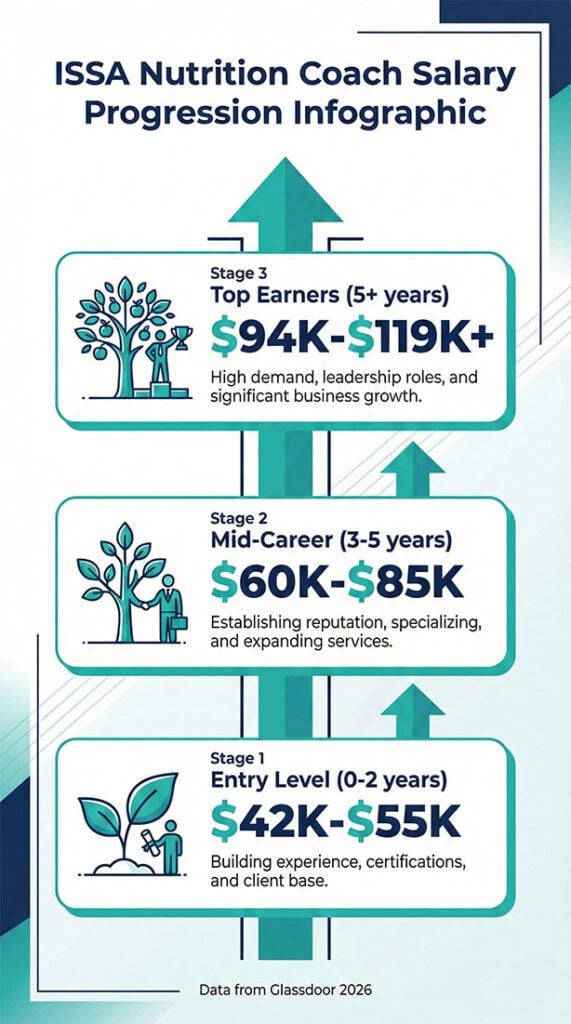
Entry-level certified nutrition coaches typically earn $42,000-$55,000 in their first two years. This includes both salaried positions and independent coaches building client bases.
Mid-career professionals with 3-5 years experience see salaries rise to $60,000-$85,000. At this stage, you’ve built reputation, refined your coaching methods, and developed a referral network.
Top earners (90th percentile) make $94,000-$119,000 or more. These coaches typically combine multiple income streams: one-on-one clients, group programs, online courses, corporate contracts, and affiliate partnerships.
Geography matters significantly. Nutrition coaches in high-cost areas like San Francisco, New York, and Washington DC earn 20-25% above national averages. However, the cost of living in these cities often negates the salary premium.
Self-employed coaches have the highest earning potential but also the most variability. You might earn $30,000 during your first year while building a client base, then jump to $90,000 in year three as your practice matures.
Salaried positions provide stability but cap earning potential. Corporate wellness coaches, gym employees, and healthcare-based positions offer predictable income plus benefits, but you’re trading upside for security.
The certification itself provides credential value that translates to 25-30% higher earnings compared to non-certified coaches doing similar work. That difference compounds over a career.
Interview Guys Tip: Most successful nutrition coaches don’t rely on a single income source. They combine in-person clients, online coaching, group programs, and affiliate income. Think of your certification as opening multiple revenue streams rather than a single salary number.
Comparing ISSA to Competitors
How does ISSA stack up against other nutrition certifications?
ISSA vs. NASM Certified Nutrition Coach
NASM (National Academy of Sports Medicine) offers excellent reputation in the fitness industry. Their nutrition certification focuses heavily on sports performance and athletic populations.
ISSA provides broader population coverage and includes more comprehensive business training. NASM’s curriculum is more technical and scientific.
Price-wise, they’re comparable at around $699-799 depending on promotions. Both offer self-paced online study.
Choose NASM if you’re working primarily with athletes. Choose ISSA if you want broader applicability across general populations.
ISSA vs. Precision Nutrition Level 1
Precision Nutrition is considered the gold standard of nutrition coaching education. Their program is more expensive ($999-1,299) but includes extensive coaching methodology.
The Precision Nutrition curriculum goes deeper into behavior change psychology and coaching techniques. It’s less focused on nutrition science details and more focused on client interaction skills.
ISSA provides better value for money and includes more practical business training. Precision Nutrition offers superior coaching pedagogy and a stronger professional community.
Many successful coaches earn both certifications over time, using ISSA as their entry point and Precision Nutrition for advanced coaching skills.
ISSA vs. ACE Fitness Nutrition Specialist
ACE (American Council on Exercise) offers similar pricing and accessibility as ISSA. Both are self-paced and 100% online.
ACE includes excellent content on special populations including older adults, pregnant women, and youth. ISSA provides stronger business and marketing training.
ACE’s exam is shorter (100 questions vs. 363 for ISSA) but more challenging according to student reviews. ISSA’s comprehensive exam actually helps you learn through the testing process.
Both certifications are widely recognized by employers. Your choice depends on whether you prioritize population-specific training (ACE) or business skills (ISSA).
Who Should (and Shouldn’t) Get This Certification
The ISSA Nutrition Coach Certification isn’t for everyone. Let’s be brutally honest about who benefits most.
Ideal Candidates
Personal trainers expanding services. If you’re already certified as a trainer, adding nutrition coaching is the obvious next step. Your clients are asking for it anyway.
Career changers entering health and wellness. The certification provides legitimate credentials without requiring you to go back for a four-year degree. You can complete it while maintaining your current job.
Health coaches building comprehensive practices. If you’re already coaching clients on wellness, fitness, or lifestyle changes, nutrition expertise fills a critical gap in your service offering.
Gym owners and fitness entrepreneurs. Adding certified nutrition coaching differentiates your business from competitors and creates an additional profit center.
Corporate wellness professionals. If you work in employee wellness programs, this certification enhances your credibility and allows you to expand program offerings.
Not the Best Fit For
People seeking clinical nutrition credentials. The ISSA certification qualifies you as a coach, not a clinical nutritionist or registered dietitian. You cannot provide medical nutrition therapy or diagnose nutrition-related diseases.
Those wanting to work in hospitals or clinical settings. Most healthcare facilities require Registered Dietitian credentials, which involve a bachelor’s degree, supervised practice, and a different certification exam.
Individuals with zero interest in coaching. If you love nutrition science but hate one-on-one interaction, this isn’t your path. The certification prepares you for direct client coaching.
Career starters with no fitness background. While the certification has no prerequisites, you’ll get exponentially more value if you already work in fitness, wellness, or health-related fields.
The Honest Drawbacks (Yes, There Are Some)
We promised an honest review, so let’s talk about limitations.
The ISSA certification doesn’t qualify you for insurance reimbursement. If clients want to use health insurance to pay for nutrition counseling, they need a Registered Dietitian. This limits your potential client base to those paying out-of-pocket.
The program lacks hands-on practice requirements. You’re learning theory and application, but you’re not required to complete supervised client sessions before certifying. This means your first real clients become your practice lab.
Business training is introductory, not comprehensive. While ISSA includes more business content than competitors, it’s not a substitute for dedicated business education. You’ll still need to learn marketing, sales, and operations through experience or additional courses.
The certification carries less weight in academic or research settings. If your goal is working in university nutrition departments or conducting nutrition research, you need academic credentials, not a coaching certification.
Continuing education is required. You must complete 20 continuing education credits every two years to maintain your certification. This requires ongoing time and money investment.
The exam format (open book) has pros and cons. While it reduces test anxiety, some employers view open-book exams as less rigorous than proctored, closed-book certifications.
These aren’t dealbreakers. They’re realities you should understand before investing.
Interview Guys Tip: The best nutrition coaches view their certification as the beginning of their education, not the end. Budget for ongoing learning through workshops, advanced certifications, and specialized courses in areas like sports nutrition or eating disorder recovery.
Maintaining Your Certification: What Happens After You Pass
Earning your certification is just step one. Maintaining it requires ongoing commitment.
ISSA requires 20 continuing education credits (CECs) every two years to keep your certification active. This isn’t busywork. It’s how you stay current as nutrition science evolves.
CECs can be earned through:
- ISSA’s own continuing education courses
- Approved third-party workshops and conferences
- Reading nutrition research and completing quizzes
- Teaching or presenting on nutrition topics
- Publishing articles or research
- Attending industry conferences
Most continuing education courses cost $30-100 each. Expect to invest $100-200 every two years in maintaining your certification.
The recertification requirement actually benefits your career. Employers and clients want to work with coaches who demonstrate ongoing learning. Your commitment to staying current builds trust and justifies premium pricing.
ISSA’s continuing education library includes specialized topics like:
- Sports nutrition for endurance athletes
- Nutrition for weight management
- Plant-based nutrition planning
- Supplementation protocols
- Eating psychology and disordered eating
- Nutrition for specific medical conditions
This allows you to develop specialized expertise over time, commanding higher fees and attracting ideal clients.
Integration with Other Credentials
The ISSA Nutrition Coach Certification works best as part of a broader credential stack.
If you’re already a certified personal trainer, adding nutrition coaching creates a complete package. You can offer comprehensive wellness programming rather than just workout plans.
If you’re starting from scratch, consider ISSA’s bundled packages. The CPT + Nutrition Coach combo provides both foundational certifications for building a fitness business.
Advanced progression options:
After establishing yourself as a nutrition coach, consider specialized certifications in:
- Sports nutrition for working with competitive athletes
- Eating psychology for clients with disordered eating patterns
- Weight management for comprehensive obesity treatment
- Pediatric nutrition for working with children and adolescents
These advanced credentials typically require 1-2 years of coaching experience before enrollment.
Complementary certifications that enhance your nutrition coaching:
Health coach certifications expand your ability to address lifestyle factors beyond just diet. You’ll learn to help clients with stress management, sleep optimization, and behavior change.
Wellness coaching certifications add another dimension to your practice. Many clients need support with work-life balance, relationships, and overall well-being in addition to nutrition guidance.
Group fitness certifications allow you to teach nutrition-focused cooking classes or meal prep workshops, creating additional income streams.
The strategic approach: build foundational credentials first (personal training and nutrition coaching), then add specialized certifications based on your ideal client needs.
The Bottom Line: Is It Worth It?
Here’s our honest assessment after analyzing everything.
The ISSA Nutrition Coach Certification is worth the investment if:
You’re already working in fitness, wellness, or health coaching and want to expand your service offerings. The certification provides immediate credibility and allows you to serve clients more comprehensively.
You’re making a career change into health and wellness coaching. The program provides legitimate credentials in 3-4 months without requiring a four-year degree.
You want to build an online nutrition coaching business. The combination of nutrition knowledge and business training gives you a complete foundation.
You’re willing to complement the certification with real-world practice and ongoing education. The program provides knowledge, but you build expertise through application.
The certification probably isn’t worth it if:
You want to work in clinical nutrition or hospital settings. Those careers require Registered Dietitian credentials, which involve a different educational path.
You’re looking for a magic ticket to instant income without building a business. The certification opens doors, but you still need to market yourself and acquire clients.
You expect the program to make you an expert nutrition scientist. The curriculum covers practical coaching applications, not PhD-level biochemistry research.
You’re not prepared for ongoing learning and professional development. Nutrition science evolves continuously. Successful coaches commit to lifelong education.
Our recommendation: The ISSA Nutrition Coach Certification delivers excellent value for career-minded professionals who want practical, applicable skills. The program won’t make you a research scientist, but it will make you a competent coach who can help clients achieve real results.
For personal trainers, this is a no-brainer investment that typically pays for itself within 3-6 months through increased client revenue. For career changers, it provides a legitimate entry point into wellness coaching without massive time and money investment.
The key is viewing this certification as the foundation of your nutrition coaching practice, not the entirety of your education. The best coaches continuously learn, refine their skills, and invest in advanced training.
Frequently Asked Questions
How long does the ISSA Nutrition Coach Certification take to complete?
Most students complete the program in 3-4 months studying 5-7 hours per week. You can accelerate to 6-8 weeks with dedicated study or extend to 6 months if you have limited time. The maximum deadline is 12 months from enrollment.
Can I become a nutritionist with just the ISSA certification?
The ISSA credential qualifies you as a nutrition coach, not a licensed nutritionist or registered dietitian. You can provide general nutrition guidance, meal planning, and wellness coaching. You cannot diagnose medical conditions, treat diseases, or provide medical nutrition therapy.
What’s the difference between a nutrition coach and a registered dietitian?
Registered Dietitians (RDs) require a bachelor’s degree, supervised practice hours, and must pass the CDR exam. RDs can work in clinical settings, diagnose nutrition-related diseases, and accept insurance reimbursement. Nutrition coaches focus on wellness guidance for healthy individuals and cannot provide medical nutrition therapy.
Is the ISSA certification recognized by employers?
Yes, ISSA has operated since 1988 and certifies professionals in 174 countries. Most gyms, wellness centers, and corporate wellness programs recognize ISSA credentials. However, clinical facilities typically require Registered Dietitian credentials.
How much can I realistically earn as a certified nutrition coach?
Entry-level nutrition coaches earn $42,000-$55,000 annually. Mid-career professionals with 3-5 years experience earn $60,000-$85,000. Top earners combining multiple income streams can exceed $100,000. Self-employed coaches have the highest earning potential but also the most variability.
Does ISSA offer payment plans?
Yes, ISSA provides interest-free financing over 11-12 months, making monthly payments around $67-78 for the standalone certification. Bundle deals that include multiple certifications also qualify for financing.
Can I take the exam multiple times if I fail?
Yes, ISSA includes one free exam retake with your enrollment. If you need additional attempts beyond the first retake, there’s a $100 fee per attempt.
Is the certification valid internationally?
Yes, ISSA operates in 174 countries and the certification is recognized internationally. However, local regulations regarding nutrition coaching vary by country. Research your specific region’s requirements.
What happens if I don’t complete the certification within 12 months?
The 12-month deadline is firm. If you don’t complete by then, you’ll need to re-enroll and pay again. Most students complete in 3-6 months, so the deadline provides ample flexibility.
Can I work with clients while studying for the certification?
Technically yes, but ethically you should wait until certified before charging clients for nutrition coaching services. Many students begin offering free coaching to friends or family to practice skills while studying.
Take Action on Your Nutrition Coaching Goals
Knowledge without action means nothing. If you’ve read this far, you’re serious about nutrition coaching as a career move.
The ISSA Nutrition Coach Certification represents a legitimate pathway into this growing field. It won’t make you a clinical nutritionist overnight, but it will give you the credentials and knowledge to start coaching clients effectively.
Your next steps:
- First, assess your current situation. Are you already working in fitness or wellness? Are you making a career change? Your starting point determines how you’ll use this certification.
- Second, calculate your ROI. If you’re a personal trainer, how many clients could you serve with nutrition coaching? What could you charge? Most trainers recoup their investment within 90-120 days.
- Third, explore ISSA’s bundle options. If you don’t have a personal training certification yet, the combined packages provide exceptional value and position you as a comprehensive fitness professional.
- Fourth, commit to ongoing education. Plan to invest in advanced certifications, workshops, and conferences after earning your base credential. The best coaches never stop learning.
The nutrition coaching field is growing rapidly. The question isn’t whether this career path offers opportunity (it does). The question is whether you’re willing to invest the time and effort to build expertise.
Explore ISSA Nutrition Coach Certification options and current promotions here. The sooner you start, the sooner you can begin helping clients transform their health through evidence-based nutrition guidance.
For more career-building resources, check out our guides on online certifications that pay well and quick certifications that pay well.
Remember: the certification opens doors, but you build the career. Your success depends on applying what you learn, continuously improving your skills, and genuinely caring about helping your clients achieve their goals.
The nutrition coaching field needs more qualified, competent professionals. Is that going to be you?

BY THE INTERVIEW GUYS (JEFF GILLIS & MIKE SIMPSON)
Mike Simpson: The authoritative voice on job interviews and careers, providing practical advice to job seekers around the world for over 12 years.
Jeff Gillis: The technical expert behind The Interview Guys, developing innovative tools and conducting deep research on hiring trends and the job market as a whole.