
ISSA Functional Aging Specialist Certification Review: Cashing In on the Senior Fitness Boom
The Demographic Reality No Fitness Professional Can Ignore
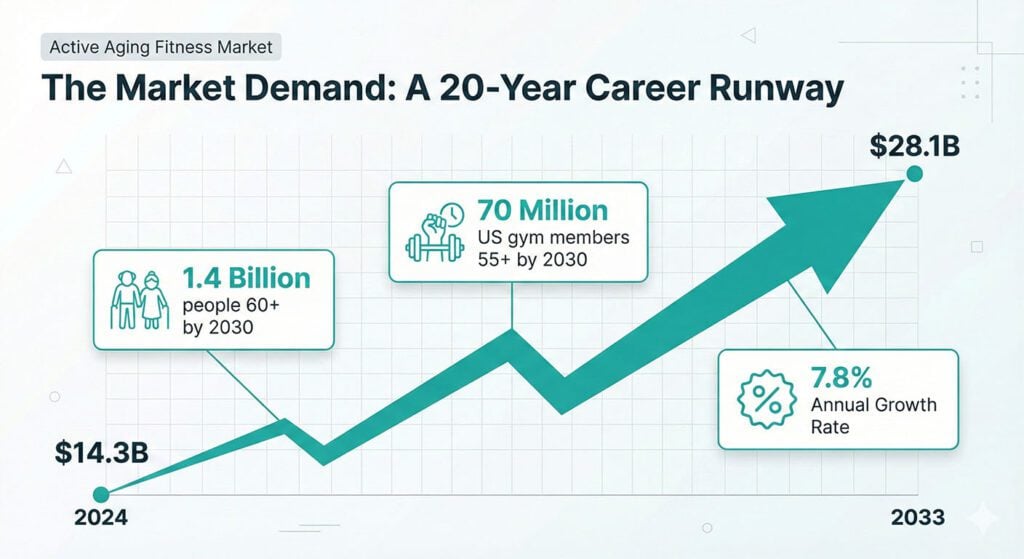
The numbers don’t lie. By 2030, 1 in 6 people worldwide will be aged 60 years or over, increasing from 1 billion in 2020 to 1.4 billion, according to the World Health Organization.
In the United States alone, 20% of consumers will be over 65 by that same year.
But here’s what makes this demographic shift a genuine career opportunity rather than just a statistic. These older adults aren’t just living longer. They’re living with money, time, and motivation to invest in their health.
Why Senior Clients Are Ideal
Baby boomers control over 50% of wealth in the United States. They’re retired, which means flexible schedules.
And unlike younger generations juggling career ambitions with fitness goals, seniors are emotionally invested in one clear priority: maintaining independence and quality of life for as long as possible.
This creates perfect conditions for fitness professionals who know how to serve this market:
- Financial capacity: They have disposable income for premium services
- Schedule flexibility: No work conflicts for training appointments
- Clear motivation: Health and independence drive consistent commitment
- Long-term loyalty: Once they trust you, they stay with you
The question isn’t whether you should specialize in senior fitness. It’s whether you can afford not to.
☑️ Key Takeaways
- Senior fitness specialists earn $93,575 annually, 37% more than general personal trainers as aging populations drive unprecedented demand
- The active aging fitness market is projected to reach $28.1 billion by 2033, growing at 7.8% annually while 1 in 6 people worldwide will be 60+ by 2030
- 25% of US health club members are already over age 55, and this segment will reach 70 million by 2030 as baby boomers prioritize healthy aging
- Functional aging certification positions you as the specialist hiring managers seek for senior living facilities, Medicare Advantage programs, and private practices targeting the wealthiest demographic
Disclosure: This article contains affiliate links. If you purchase through these links, we may earn a commission at no additional cost to you.
What Is the ISSA Functional Aging Specialist Certification?
The International Sports Sciences Association (ISSA) Functional Aging Specialist certification equips fitness professionals to design exercise programs specifically for the physiological realities of aging bodies.
This isn’t about teaching water aerobics to sweet grandmas. Functional aging training focuses on exercises that directly improve older adults’ ability to perform daily activities safely and independently.
Think: getting up from a chair without assistance, maintaining balance while reaching for items on high shelves, or recovering stability after a stumble.
What You’ll Learn
The certification covers:
- Age-related changes in musculoskeletal, cardiovascular, and neurological systems
- Fall prevention strategies and balance training protocols
- Modification techniques for common age-related conditions (arthritis, osteoporosis, heart disease)
- Functional movement patterns that translate to daily living activities
- Communication strategies for working with older adult clients
Research published in Geriatric Nursing (2024) found that functional exercise training significantly improved gait speed, balance, mobility, and the ability to perform daily activities in adults over 60.
The training you’ll learn to deliver doesn’t just make seniors feel better. It measurably extends their independence.
Interview Guys Tip: While competitors focus on generic senior fitness, the ISSA certification emphasizes functional aging, which is what hiring managers in senior living facilities actually need. This specific terminology makes you more searchable when facilities recruit specialized staff.
The Market Demand: A 20-Year Career Runway
Let’s talk about why this specialization represents one of the safest career bets in fitness.
The active aging fitness market was valued at $14.3 billion in 2024. It’s projected to reach $28.1 billion by 2033, growing at 7.8% annually, according to recent market research. Compare that to the overall fitness industry’s 8.4% growth rate, and you’ll see senior fitness isn’t just keeping pace. It’s becoming a core driver.
Why This Demand Won’t Fade
The real story is in the sustained demand curve. This isn’t a trend that will peak and fade. The global population aged 65 and older is projected to reach 2.2 billion by the late 2070s. You’re looking at a career runway that extends literally decades.
Here’s what that means practically. By 2030, an estimated 70 million Americans over 55 will hold health club memberships, up from 40.8 million today. That’s 25% of all US gym members right now, and that percentage is only increasing.
Compare this to other fitness specializations:
- AI-related jobs might pay well now, but they face automation risks
- Boot camp instructors compete in saturated markets
- Youth sports training depends on fickle parent spending during recessions
Senior fitness? The demographic wave is mathematically guaranteed. People don’t stop aging because the economy dips.
The Salary Premium: What Specialization Actually Pays
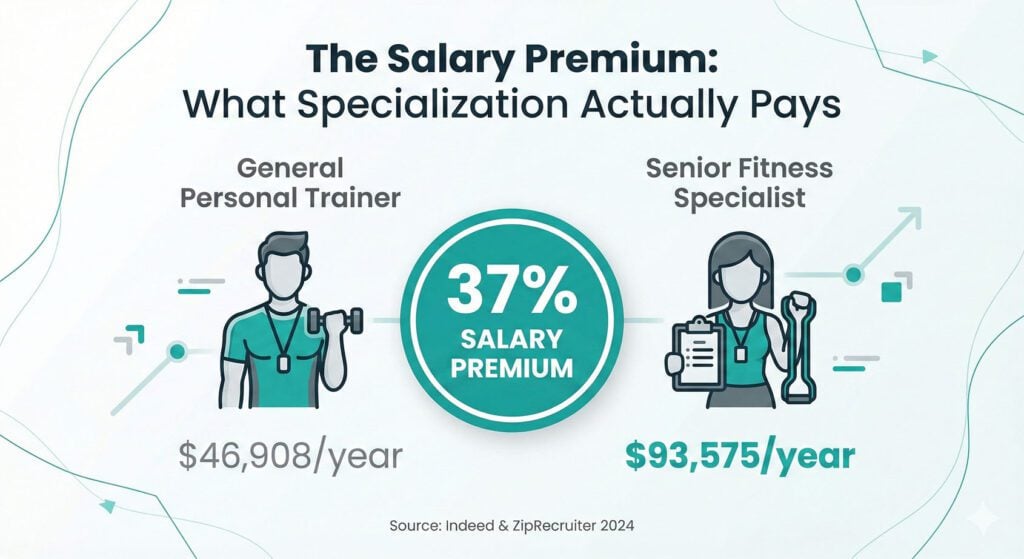
General fitness trainers earn an average of $46,908 annually, according to Indeed. That’s respectable, but it’s also crowded market competition.
Senior fitness specialists earn an average of $93,575 per year, according to ZipRecruiter data. That’s a 37% premium over general training. Some sources report senior fitness instructors earning $49 per hour, which translates to over $115,000 annually for full-time work.
Three Factors Behind the Premium
Specialized knowledge commands specialized rates. Older clients often have complex health histories. Multiple medications. Chronic conditions requiring modification. A trainer who confidently navigates these complications is worth more than one who doesn’t.
Lower client acquisition costs. Seniors tend to be loyal, long-term clients. They’re not jumping between trainers chasing the latest fitness trend. Once you establish trust with an older adult, you often work together for years. That stability means you spend less time and money constantly replacing churned clients.
Insurance and medical referrals. Some senior clients have insurance coverage or health savings accounts that reimburse fitness training prescribed by physicians. Having functional aging credentials makes you eligible for these referral channels that general trainers can’t access.
The health coach certifications space shows similar patterns. Specialized credentials consistently out-earn generalist qualifications because they solve specific problems hiring managers face.
Who Actually Hires Functional Aging Specialists?
Understanding your potential employers helps you evaluate whether this certification fits your career goals.
Senior Living Facilities
Assisted living communities, independent living facilities, and continuing care retirement communities increasingly offer fitness programs as amenities. They’re not hiring just any trainer. They need professionals who understand fall risk assessment, can work with residents using walkers or wheelchairs, and know how to modify exercises for various ability levels.
Facilities with on-site fitness programs report higher resident satisfaction and lower turnover. That makes hiring qualified functional aging specialists a priority, not a nice-to-have.
Medicare Advantage Programs
Medicare Advantage plans increasingly cover fitness programs through initiatives like SilverSneakers and Renew Active. These programs contract with certified fitness professionals to deliver specialized senior programming.
Having the ISSA Functional Aging Specialist certification often makes you eligible for these contract opportunities. Without it, you’re not even in consideration, regardless of your general training skills.
Private Practice and Boutique Studios
Many certified functional aging specialists build private practices serving affluent older adults willing to pay premium rates for in-home training. These clients value convenience and personalized attention, and they have the financial resources to support sustainable trainer incomes.
Some trainers develop group classes at boutique studios specifically targeting the 55+ demographic. These classes fill reliably because older adults value routine and community.
Additional Employment Options
Rehabilitation and Physical Therapy Clinics: While you won’t be doing physical therapy without appropriate licensing, many PT clinics employ fitness specialists to continue exercise programs after formal therapy ends.
Wellness Programs at Retirement Communities: Upscale retirement communities often feature comprehensive wellness centers with saunas, pools, and fitness facilities that rival commercial gyms. They staff these facilities with certified professionals who understand their residents’ specific needs.
Interview Guys Tip: When applying to senior living facilities, emphasize your understanding of activities of daily living (ADLs) in your cover letter. Hiring managers use this specific terminology when discussing functional fitness goals, and using it shows you speak their language.
How Certification Becomes Your Career Accelerator
Let’s be direct about what a certification actually does for your career versus what it doesn’t.
What It Won’t Do
The ISSA Functional Aging Specialist certification won’t automatically make clients appear. It won’t eliminate the need to develop business skills. It won’t replace the importance of being good with people.
What It Will Do
It makes you eligible for opportunities you currently aren’t qualified to pursue.
Think about it this way. A senior living facility posts a position for a fitness coordinator. They receive 50 applications from certified personal trainers.
Forty-seven have general certifications. Three have functional aging specializations.
Who gets the interview? The ones who match the specific job requirements, which almost always include senior fitness expertise.
Liability Protection
The certification also provides crucial protection. Older adults have higher injury risks. When something goes wrong (and eventually something will, because training involves physical activity), having documented specialized training in senior fitness provides crucial protection.
You can demonstrate you followed appropriate protocols and exercised reasonable care given your training.
This matters both for your own professional liability insurance rates and for employers’ risk management concerns.
Better Client Outcomes
Beyond the immediate career benefits, the certification builds your knowledge base in ways that improve client outcomes.
Research from the European Review of Aging and Physical Activity shows that functional training produces significantly better results in balance, mobility, and activities of daily living compared to traditional resistance training alone.
You’re not just getting a credential to put on business cards. You’re learning methodologies that deliver measurably better results for a specific population.
Competitive Positioning: Standing Out in the Senior Fitness Space
Multiple organizations offer senior fitness certifications. How does ISSA compare?
The Main Competitors
NASM Senior Fitness Specialist is probably ISSA’s main competitor. Both are well-recognized, reputable organizations.
NASM’s program tends to be more expensive but includes more comprehensive study materials. ISSA’s is typically more affordable and includes online access to resources.
From an employer perspective, both certifications check the “has specialized senior training” box. Your choice between them often comes down to which program’s teaching style matches your learning preferences and which fits your budget.
ACE Senior Fitness Specialist represents another option. ACE has strong brand recognition in the fitness industry. Their senior certification follows a similar curriculum to ISSA and NASM, covering functional fitness for aging populations.
What Actually Matters
The honest truth is that for most employers, any of these three certifications demonstrates adequate specialized knowledge.
What differentiates you isn’t which organization you chose. It’s what you do with the training.
Can you clearly articulate how functional aging training reduces fall risk? Can you design exercise progressions that accommodate arthritic joints while still building strength? Can you communicate effectively with older adults who might be intimidated by gyms?
Those practical skills matter more than the logo on your certificate.
ISSA’s Pricing Advantage
That said, ISSA offers one strategic advantage: their Functional Aging Specialist certification often bundles with other specializations for package pricing. If you’re building multiple credentials, their pricing structure makes sense.
The Strategic Combination: Functional Aging Plus Health Coaching
Here’s where specialization gets interesting from a business perspective.
The most successful senior fitness specialists don’t just do exercise programming. They combine functional aging expertise with broader health coaching to address the complete picture of healthy aging.
Why the Combination Works
The clients who can pay premium rates for specialized senior fitness often have complex health goals that extend beyond just physical exercise.
They’re managing chronic conditions. They’re navigating nutrition concerns. They’re dealing with medications that affect exercise capacity.
Pairing the ISSA Functional Aging Specialist certification with health coaching credentials creates a comprehensive offering that commands higher rates and attracts more committed clients.
A Real-World Example
Consider working with a 68-year-old client with Type 2 diabetes, osteoarthritis, and cardiovascular concerns:
- Pure fitness training addresses some of their needs.
- Functional aging expertise helps you modify exercises appropriately for their arthritis and design balance work to reduce fall risk.
- But health coaching allows you to help them understand how their nutrition affects their diabetes management, how their medications impact their exercise capacity, and how stress management strategies support their cardiovascular health.
You become their single source for comprehensive healthy aging support rather than just the person who supervises their exercises twice a week.
Business Benefits
This combination approach is exactly what emerging certification paths emphasize. The market increasingly rewards professionals who can address multifaceted problems, not just narrow technical skills.
From a practical standpoint, you’re also building business resilience. Clients who view you as a comprehensive health resource stick around longer and refer more people than clients who see you as an interchangeable exercise instructor.
Interview Guys Tip: When marketing yourself with combined functional aging and health coaching credentials, emphasize “physician-referred” services. Doctors increasingly recommend exercise for older patients but don’t know which trainers to trust with complex cases. Positioning yourself as the trainer their doctor can confidently refer to opens a valuable client acquisition channel.
Real-World Applications: What You’ll Actually Do
Let’s get specific about what functional aging training looks like in practice, because this helps you evaluate whether this career path actually fits your interests.
The Day-to-Day Work
You’ll spend significant time on balance training. Not glamorous gym Instagram content, but critically important work. You might have a 73-year-old client practice weight shifts, single-leg stands, and controlled stepping patterns. These exercises literally prevent hip fractures that could end their independence.
You’ll design strength programs using functional movement patterns rather than isolated muscle exercises. Instead of bicep curls on a machine, you might have clients practice lifting a weighted basket from the floor to a high shelf, mimicking how they’ll put away groceries at home.
You’ll work with movement modifications constantly. A standard squat might need to become a sit-to-stand from a chair for someone with knee arthritis. A plank might become a wall push-up for someone rebuilding core strength after surgery.
The Educational Component
You’ll do a lot of education. Older clients often come with misinformation about aging and exercise. Part of your role involves helping them understand that strength training won’t make them bulky, that moderate intensity exercise is safe with their heart condition (when properly prescribed), and that balance training isn’t admission of weakness but smart prevention.
The Meaningful Moments
You’ll also spend time on simple activities that younger trainers might find boring but that are genuinely meaningful. Helping an 81-year-old regain the ability to get up from the floor without assistance might not look impressive in a workout montage. But for that client, it’s the difference between feeling confident that they could recover if they fell versus living in fear of falling.
This work requires patience, empathy, and genuine enjoyment of older adults’ company. If you’re energized by high-intensity boot camps and PR chasing, senior fitness might not match your temperament even if the career economics make sense.
But if you find satisfaction in measurable functional improvements and building long-term client relationships, this specialization offers rewards beyond the salary premium.
The Honest Drawbacks: What to Consider Before You Commit
Let’s address the limitations and challenges, because pretending they don’t exist doesn’t help you make informed decisions.
Initial Investment Required
Certification cost and study time requirements. The ISSA Functional Aging Specialist certification requires both financial investment and study time.
If you’re already working full-time as a general trainer, adding certification study to your schedule takes discipline.
The cost is reasonable compared to other professional development investments, but it’s still an upfront expense before you’ve earned the salary premium.
Slower Visible Progress
Client progression takes longer. Older adults typically progress more slowly than younger clients.
If you derive professional satisfaction from rapidly transforming clients’ physiques or performance metrics, the pace of senior fitness might frustrate you.
Marketing Challenges
Limited “wow factor” in your portfolio. If you’re building a fitness business around social media marketing, functional aging work doesn’t generate the viral transformation photos or impressive PR videos that younger demographics do.
An 80-year-old successfully standing from a chair without using their hands is legitimately impressive given their starting point. But it doesn’t look impressive to Instagram scrollers unfamiliar with functional aging metrics.
Work Environment Considerations
Facility-based employment constraints. Many senior fitness jobs are at specific facilities rather than independent practice.
If you value absolute schedule flexibility and location independence, facility-based roles have more constraints than fully independent training.
That said, many facilities offer benefits packages that independent trainers don’t receive. Health insurance, retirement contributions, and paid time off have real value that offsets some flexibility trade-offs.
Ongoing Education Needs
Medical complexity requires continuous learning. Older clients often have multiple chronic conditions and medication regimens that affect their exercise capacity.
Staying current on how to safely work with clients managing diabetes, cardiovascular disease, osteoporosis, and other common age-related conditions requires ongoing professional development beyond the initial certification.
These limitations aren’t deal-breakers. They’re factors to consider honestly as you evaluate whether this specialization aligns with your skills, interests, and career goals.
Making the Numbers Work: Your ROI Timeline
Let’s do the math on what certification investment actually returns.
The Initial Investment
The ISSA Functional Aging Specialist certification typically runs between $500 and $800 depending on promotional pricing and bundle options.
Study time varies, but most fitness professionals complete the program in 2-4 months while working.
The Salary Gap
Compare that cost to the $46,681 difference between average personal trainer salary ($46,908) and average senior fitness specialist salary ($93,575).
If you capture even a fraction of that salary premium, you’ll recover your certification investment in the first few months of specialized work.
Realistic Expectations
More realistically, you probably won’t immediately jump from general training income to full senior specialist income. You’ll transition gradually as you build your senior client base and reputation.
But even a modest increase, say earning an additional $10,000 in your first year from senior-focused work, means you’ve recovered your investment five times over after recouping the initial certification cost.
The Long-Term Advantage
The ROI becomes even more compelling when you consider career longevity.
General personal training is physically demanding work. Many trainers burn out or physically can’t continue full-time training as they age into their 40s, 50s, and beyond.
Senior fitness specialization often becomes more sustainable over time. You’re not doing high-intensity boot camps that wreck your joints. You’re teaching functional movements at moderate intensities.
Many senior fitness specialists work well into their 60s because the physical demands are manageable.
That extended career runway amplifies the total return on your certification investment dramatically.
How to Actually Use This Certification
Getting certified is step one. Converting that credential into career advancement requires strategy.
Build Your Professional Presence
Update your resume and LinkedIn immediately. Add the certification to your credentials section. More importantly, revise your professional summary to emphasize senior fitness expertise rather than general training capabilities.
Hiring managers searching for qualified candidates use specific keywords. Make sure “functional aging,” “senior fitness,” “fall prevention,” and “activities of daily living” appear in your profile.
Develop specific case studies. As you work with older adult clients, document their progress. “Helped 72-year-old client reduce fall risk by improving balance scores by 40%” is more compelling than “certified in senior fitness.”
Network Strategically
Connect with healthcare providers. Make appointments to meet with local physicians, physical therapists, and occupational therapists who work with older adults. Explain your specialized training and how you can support their patients’ recovery and ongoing wellness.
Many healthcare providers want to refer patients to qualified fitness professionals but don’t know who to trust. Make yourself known.
Target the Right Opportunities
Focus your job search. Don’t just apply to general health club openings. Specifically target senior living facilities, Medicare Advantage program contractors, and wellness positions at retirement communities.
These employers actively seek functional aging credentials, which makes you a better fit for their specific needs than generally certified trainers.
Diversify Your Income
Consider pursuing additional revenue streams. Many senior fitness specialists generate income from multiple sources: facility-based employment, private clients, group classes, and educational workshops for senior organizations.
This diversification creates income stability and professional variety that pure private practice or pure facility work might lack.
The Bottom Line: Is ISSA Functional Aging Specialist Worth It?
Here’s the straightforward assessment from a hiring-edge perspective.
This Certification Makes Sense If:
- You enjoy working with older adults and find functional improvement work satisfying
- You want career stability in a reliably growing market
- You’re willing to do patient, incremental work that produces meaningful but not flashy results
- You’re building a long-term career rather than short-term income maximization
This Certification Probably Isn’t Right If:
- You’re primarily motivated by social media fitness marketing
- You prefer high-intensity training and rapid client transformation
- You’re looking for the absolute highest-paying fitness specialization (sports performance and celebrity training can pay more but are much harder to break into)
- You’re uncomfortable with the medical complexity involved in training older adults with chronic conditions
The Market Case
The market fundamentals are undeniably strong:
- The demographic trends are mathematically certain
- The salary premium is well-documented
- The career runway extends decades
But market opportunity doesn’t equal personal fit. The best career moves align market demand with your actual interests and capabilities.
Your Next Step
If you’ve read this far and feel genuinely excited about helping older adults maintain independence and quality of life, that’s probably the signal you need. The business case supports the emotional appeal.
Ready to start? The ISSA Functional Aging Specialist certification represents a strategically sound investment in a career specialization that will only become more valuable as demographic trends accelerate.
The senior fitness boom isn’t coming. It’s already here. The question is whether you’ll be positioned to benefit from it.
Looking for more certification options that pay well? Check out our guides to online certifications that pay well and quick certifications for career changers.

BY THE INTERVIEW GUYS (JEFF GILLIS & MIKE SIMPSON)
Mike Simpson: The authoritative voice on job interviews and careers, providing practical advice to job seekers around the world for over 12 years.
Jeff Gillis: The technical expert behind The Interview Guys, developing innovative tools and conducting deep research on hiring trends and the job market as a whole.