
Google Project Management Professional Certificate Review (2026): Honest Pros, Cons, and Career Impact
We talk to hiring managers every day who tell us the same thing: they have stacks of project management applicants, but almost no one can explain how they’d actually rescue a project that’s gone sideways.
They see resumes loaded with buzzwords. “Cross-functional leader.” “Stakeholder engagement expert.” “Results-oriented team player.” But when they ask “how would you handle a project that’s three weeks behind schedule with a fixed deadline,” most candidates stare blankly.
Does the Google Project Management Professional Certificate fix that problem, or is it just another line on your LinkedIn profile?
Here’s what we know. The Bureau of Labor Statistics projects project management specialist roles will grow 6% from 2024 to 2034, faster than the average for all occupations. There are over 464,000 open project management jobs in the U.S. right now, with a median entry-level salary of $87,000. The Project Management Institute estimates the global economy will need to fill 2.3 million new project-oriented roles every year through 2030. The opportunity is real.
The Google certificate has a difficulty score of 1 out of 5. Completely beginner-friendly. No degree required. No previous PM experience needed. About 6 months at 10 hours per week. And with a 4.9 rating from over 126,000 reviews and more than 2.4 million learners enrolled, it’s one of the most popular professional certificates on Coursera.
But popularity doesn’t equal hiring power. Let’s dig into what actually matters.
☑️ Key Takeaways
- Google’s PM certificate carries real brand weight with hiring managers and qualifies you for over 100 hours of PMI-recognized education toward the CAPM credential.
- The $294 average cost makes this one of the highest-ROI career investments for anyone targeting entry-level project management roles paying a median of $87,000.
- Agile and Scrum training is the certificate’s biggest differentiator, covering the exact frameworks that appear in the majority of PM job postings today.
- This certificate alone won’t get you hired but combined with networking and a strong capstone portfolio, 75% of graduates report positive career outcomes within six months.
Disclosure: This article contains affiliate links. If you purchase through these links, we may earn a commission at no additional cost to you.
What a Hiring Manager Actually Thinks When They See This Certificate
The Brand Signal
When a hiring manager spots “Google Project Management Professional Certificate” on your resume, two things happen immediately.
First, they recognize the name. Not Harvard. Not PMP. But Google carries serious weight in the professional world. It signals that you chose a structured, industry-backed program over a random Udemy course or a weekend bootcamp nobody’s ever heard of.
Second, the PMI accreditation matters more than most people realize. This certificate qualifies you for over 100 hours of project management education that counts directly toward the Certified Associate in Project Management (CAPM) credential. That’s a pathway signal. It tells hiring managers you’re not just dabbling in project management. You’re building a career.
Can They Actually Do the Work?
Here’s the hiring manager’s biggest concern: hiring a “Methodology Memorizer” who can define Agile and Scrum but can’t actually run a sprint planning meeting.
We love this certificate because the capstone project forces you to manage a realistic project from start to finish. You don’t just learn what a risk register is. You build one. You don’t just read about stakeholder communication plans. You create them, get feedback, and iterate.
That said, here’s the reality check you need to hear.
It’s not a degree. Don’t treat it like one.
If you walk into an interview acting like this certificate makes you a seasoned project manager, you’ll lose credibility fast. Instead, position it as evidence that you’ve built foundational skills and you’re ready to apply them. That’s what hiring managers want to hear.
The certificate teaches you the frameworks, tools, and vocabulary of project management. What it doesn’t give you is years of experience navigating office politics, managing difficult team members, or handling a client who changes scope every week. And that’s okay. Entry-level roles exist precisely because companies expect to train you on the messy, human side of project management.
Interview Guys Tip: When an interviewer asks about your project management experience, don’t apologize for being new. Instead, walk them through your capstone project like it was a real engagement. “I managed a project with a defined scope, identified three key risks, created mitigation strategies, and delivered a stakeholder presentation with measurable outcomes.” That’s the language of someone who can do the work.
Here’s what most people don’t realize: employers now expect multiple technical competencies, not just one specialization. The days of being “just a marketer” or “just an analyst” are over. You need AI skills, project management, data literacy, and more. Building that skill stack one $49 course at a time is expensive and slow. That’s why unlimited access makes sense:
Your Resume Needs Multiple Certificates. Here’s How to Get Them All…
We recommend Coursera Plus because it gives you unlimited access to 7,000+ courses and certificates from Google, IBM, Meta, and top universities. Build AI, data, marketing, and management skills for one annual fee. Free trial to start, and you can complete multiple certificates while others finish one.
The 5 Interview Questions This Certificate Prepares You to Crush
One of the biggest advantages of this certificate is that it doesn’t just teach you project management. It gives you stories to tell in interviews. Here are five questions you’ll be ready for.
1. “How would you handle a project that’s behind schedule?”
The Project Execution course (Course 4) covers exactly this. You’ll learn about escalation paths, scope negotiation, and how to communicate delays to stakeholders without causing panic. Use the SOAR Method here: describe the Situation (the project timeline), the Obstacle (the delay and its root cause), the Action (your specific recovery plan), and the Result (how you got things back on track or renegotiated deliverables).
2. “Describe your experience with Agile methodology.”
Course 5 is dedicated entirely to Agile project management. You’ll learn Scrum events, sprint planning, retrospectives, and backlog management. You can speak confidently about user stories, velocity, and iterative delivery because you’ve practiced all of it.
3. “How do you prioritize competing stakeholder demands?”
The Project Initiation course (Course 2) walks you through stakeholder analysis and influence mapping. You’ll learn to identify who holds decision-making power, who’s an influencer, and who needs to be kept informed. That’s a concrete framework you can reference in any interview.
4. “Tell me about a time you managed risk on a project.”
The Planning course (Course 3) covers risk identification, assessment, and mitigation planning. You’ll actually create a risk register and develop contingency plans. When an interviewer asks this question, you can pull directly from your coursework and capstone.
5. “What project management tools are you comfortable with?”
You’ll get hands-on experience with Asana, Google Sheets for project tracking, and various project documentation templates. While the certificate won’t make you an expert in every PM tool on the market, you’ll understand the core concepts that transfer across any platform, whether it’s Monday.com, Jira, or Microsoft Project.
Curriculum Deep Dive: What You’ll Actually Learn
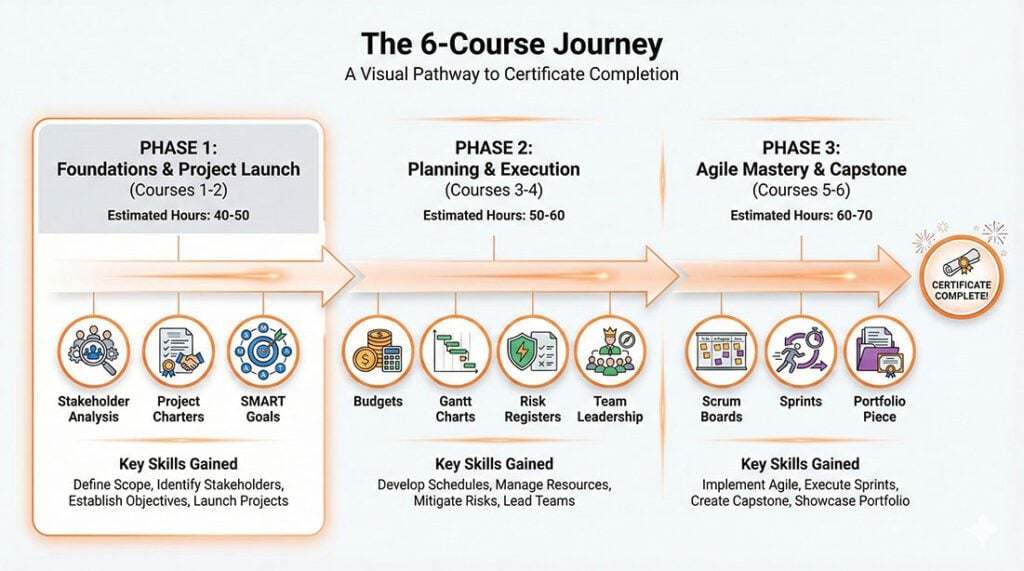
Rather than walking through all six courses one by one, here’s how the curriculum breaks down into three practical phases.
Phase 1: Foundations and Project Launch (Courses 1-2)
What You’ll Master: The fundamentals of what project management actually is, how organizations structure projects, and how to kick off a new project the right way.
Course 1 covers the project management life cycle, different methodologies (Waterfall, Agile, Lean, Six Sigma), and how organizational culture impacts project success. Course 2 dives into project initiation, including defining project scope, identifying stakeholders, setting measurable goals, and creating project charters.
Key skills you’ll develop:
- Defining project scope and objectives using SMART goals
- Conducting stakeholder analysis and building communication plans
- Creating project charters that get buy-in from leadership
- Understanding how to evaluate whether a project is worth pursuing
- Navigating different organizational structures as a PM
This phase is where career changers get the most value. You’ll learn the vocabulary and frameworks that instantly signal “I understand how projects work” in an interview.
Interview Tip: When discussing your project management approach, reference the project charter. Saying “I always start by defining the project charter to align stakeholders on scope, timeline, and success metrics” immediately tells a hiring manager you think structurally, not reactively.
Phase 2: Planning, Execution, and the Messy Middle (Courses 3-4)
What You’ll Master: How to build a comprehensive project plan, manage budgets, track progress, handle problems, and lead teams through execution.
Course 3 is the meat of the program. You’ll learn to create work breakdown structures, build project schedules, estimate costs, develop budgets, and create risk management plans. Course 4 covers quality management, data-driven decision making, team leadership, and effective communication during project execution.
Key skills you’ll develop:
- Building Gantt charts and project timelines
- Creating and managing project budgets
- Risk identification, assessment, and mitigation planning
- Running effective team meetings and status updates
- Managing scope creep and handling change requests
- Using data to track project health and make decisions
This is where the certificate goes from “theoretical knowledge” to “I can actually do this job.” The planning and execution courses mirror the daily work of an entry-level project manager.
Interview Tip: Bring a printed copy of your project plan from the coursework to interviews. Not all of it, just the summary. A visual artifact demonstrates preparation and gives you something concrete to discuss. Hiring managers love seeing that you can organize your work in a professional format.
Interview Guys Tip: The budget and risk management sections of Phase 2 are interview gold. Most entry-level candidates can’t speak intelligently about project finances. If you can say “I built a project budget with a 10% contingency reserve for identified risks,” you’ll stand out from 90% of applicants who only talk about timelines and task lists.
Phase 3: Agile Mastery and Capstone (Courses 5-6)
What You’ll Master: Agile and Scrum frameworks in depth, plus a hands-on capstone project that ties everything together.
Course 5 is entirely focused on Agile project management with an emphasis on Scrum. You’ll learn about sprints, daily standups, sprint reviews, retrospectives, product backlogs, and the roles of Scrum Master, Product Owner, and Development Team. Course 6 is the capstone, where you apply everything you’ve learned to a realistic project scenario.
Key skills you’ll develop:
- Facilitating Scrum ceremonies (sprint planning, daily standups, retrospectives)
- Building and prioritizing product backlogs
- Coaching teams through Agile adoption
- Completing a full project lifecycle from initiation to closure
- Creating professional project documentation and presentations
The capstone is your portfolio piece. Treat it like your first real consulting engagement. Go beyond the minimum requirements. Add a “business impact” section that quantifies your recommendations. Numbers sell. Always include numbers.
Interview Tip: If you’re applying for roles at companies that use Agile (most tech companies, startups, and increasingly, traditional enterprises), the Scrum knowledge from Course 5 is your biggest differentiator. Be ready to explain the difference between a sprint review and a sprint retrospective, and why both matter.
Who Should Skip This Certification
Honesty builds trust, so let’s be direct about who this certificate is not for.
Experienced project managers looking to advance. If you already have 3+ years of PM experience, this certificate covers material you likely already know. Your time and money are better spent on the PMP certification, which carries significantly more weight for mid-career professionals.
Anyone expecting a job guarantee. The certificate opens doors. It doesn’t walk you through them. You’ll still need to network, tailor your resume, practice interviewing, and possibly start with a coordinator or assistant PM role before moving into full project manager positions.
People who want deep technical tool training. This certificate teaches project management concepts and methodologies. It introduces tools like Asana, but it won’t make you a power user of Jira, Microsoft Project, or Smartsheet. If you need specific tool proficiency, look for supplemental courses after completing this program.
Senior professionals who need the PMP. If the job postings you’re targeting specifically require PMP certification, this Google certificate won’t satisfy that requirement. However, it does count toward the education hours needed for the CAPM, which can be a stepping stone to the PMP.
The Career Math: What This Investment Actually Returns
Let’s break down the real numbers.
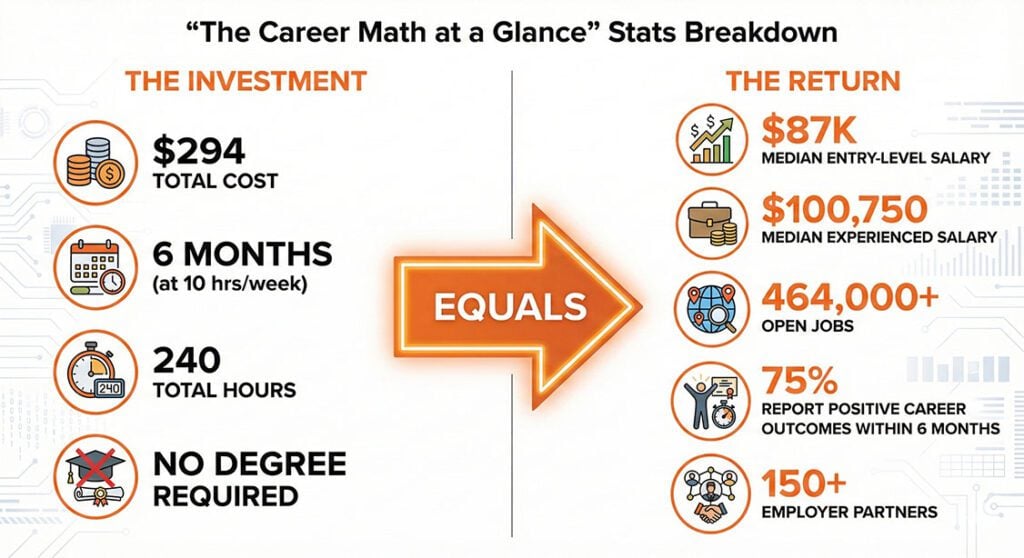
Cost: Coursera charges $49 per month. At the recommended pace of 6 months, your total investment is approximately $294. If you’re motivated and study full-time, you can finish in as little as 3 months for around $147. Start your 7-day free trial on Coursera and see if the learning style works for you before committing.
Alternatively, a Coursera Plus annual subscription at $59/month gives you unlimited access to this certificate plus thousands of other courses, which makes sense if you plan to stack additional certifications.
Salary potential: According to the Bureau of Labor Statistics, the median annual wage for project management specialists was $100,750 in May 2024. Entry-level positions have a median salary of $87,000 according to Lightcast data. Even at the entry level, you’re looking at a career that pays well above the national average.
Time investment reality check: The program estimates 6 months at 10 hours per week, which equals roughly 240 total hours. That’s real time. Some learners push through faster, but rushing through the material and missing the deeper concepts defeats the purpose. The capstone project alone requires significant effort to do well.
The ROI calculation: If this certificate helps you land a $70,000 entry-level PM role (conservatively below the median), your $294 investment returns over 200x in first-year salary alone. Even factoring in the opportunity cost of 240 study hours, the math is overwhelmingly in your favor. And with demand for project professionals accelerating globally, the long-term career trajectory looks strong.
Interview Guys Tip: Don’t just list this certificate on your resume and call it done. Mention that it’s PMI-accredited and qualifies for CAPM eligibility. Add your capstone project to a portfolio. List the specific skills (Agile, Scrum, risk management, stakeholder analysis) in your resume skills section. The certificate is only as powerful as how strategically you present it.
What This Certificate Won’t Teach You (And What to Stack With It)
No certificate covers everything. Here are three specific gaps and how to fill them.
1. Advanced PM Software Proficiency
The certificate introduces Asana and Google Workspace tools, but most PM job postings mention Jira, Microsoft Project, Monday.com, or Smartsheet. After completing the Google certificate, take a dedicated course on whichever tool appears most in your target job postings. Many of these are available through Coursera Plus, which gives you a natural reason to keep your subscription active.
2. Industry-Specific Project Management
The Google certificate teaches universal PM principles, which is great for flexibility but means you won’t learn the specifics of managing software development projects, construction timelines, or healthcare implementations. Once you know your target industry, seek out specialized knowledge through industry associations, mentorship, or additional coursework.
3. Advanced Data Analysis and Reporting
Modern project managers are expected to use data for more than just tracking tasks. Executive stakeholders want dashboards, trend analysis, and predictive insights. Consider supplementing with Google’s Data Analytics Certificate or a dedicated course in Excel/Google Sheets for advanced reporting. A Coursera Plus subscription gives you access to both the PM and Data Analytics certificates, making this an efficient way to build complementary skills.
The Honest Verdict
| Criterion | Score |
|---|---|
| Curriculum Quality | 8.0 / 10 |
| Hiring Impact | 7.0 / 10 |
| Skill-to-Job Match | 8.0 / 10 |
| Value for Money | 9.0 / 10 |
| Portfolio and Interview Prep | 8.0 / 10 |
| Accessibility | 10.0 / 10 |
| Interview Guys Rating | 8.1 / 10 for career changers entering project management |
| 8.8 / 10 for professionals formalizing existing informal PM experience |
Certificate: Google Project Management Professional Certificate
Difficulty: 1/5 (Most beginner-accessible cert in the Google lineup — zero prerequisites, self-paced, 4.9/5 rating from 126,000+ learners)
Time Investment: 6 months at 10 hours per week (or 3 months at 20 hours per week)
Cost: $49/month | Typically $147–$294 total | Start your 7-day free trial
Best For: Career changers with zero PM background targeting project coordinator or junior PM roles, and professionals from adjacent fields (operations, admin, marketing, customer success) who already manage projects informally and want formal credentials and vocabulary to make that experience legible to hiring managers
Not Right For: Experienced PMs with 3+ years in the field (material is too foundational, PMP is the right next credential), anyone whose target roles explicitly require PMP certification, or candidates who need deep proficiency in specific tools like Jira or Microsoft Project
Key Hiring Advantage: The PMI accreditation is the hidden gem here — it’s not just a Google certificate, it’s 100+ hours of PMI-recognized education that counts toward the CAPM credential. That dual-pathway signal (Google brand now, CAPM pathway later) tells hiring managers you’re building a career in PM, not dabbling in it. The capstone produces real project documentation — charter, risk register, stakeholder plan, budget — that you can bring to interviews as a concrete artifact. When we look at PM-focused resumes through our Resume Analyzer, candidates who list both the Google cert and specific skills (Agile, Scrum, risk management, stakeholder analysis) consistently score higher than those who list the cert alone.
The Brutal Truth: Project management is a field where experience ultimately matters more than credentials, even at the entry level. This certificate gets you in the door, but you’ll still compete against candidates who have informally managed projects for years and can tell better stories. The tool gaps are real — Jira, Microsoft Project, and Smartsheet appear in job postings constantly, and this program only introduces Asana and Google Workspace. Plan to add at least one tool-specific course after completing this program.
Our Recommendation: Strong yes for career changers and adjacent professionals. At under $300 with PMI accreditation, an Agile/Scrum course, and a portfolio capstone, it’s one of the strongest entry-level investments in a field with an $87,000 entry-level median salary. For professionals already managing projects informally, it’s close to a no-brainer — the cert simply makes visible what you’re already doing.
Interview Guys Rating: 8.1/10 for career changers entering project management | 8.8/10 for professionals formalizing existing informal PM experience
Professionals with informal PM experience score significantly higher because the certificate directly translates their existing work into recognized frameworks, making their hiring case dramatically stronger. Career changers score well but face more competition and need to lean harder on the capstone portfolio and CAPM pathway signal to stand out.
Enroll and start your 7-day free trial on Coursera
FAQ
Is this certificate worth it without a relevant degree?
Yes. The certificate was specifically designed for people without degrees or prior PM experience. Google built it as an alternative path into project management. Many employers in the 150+ company consortium (including Google itself) accept it in place of traditional education for entry-level roles. That said, pairing it with practical experience through volunteering or freelance PM work strengthens your candidacy significantly.
How long does it really take to complete?
Most learners finish in 4 to 6 months studying 10 hours per week. If you’re motivated and can dedicate full-time hours, 2 to 3 months is realistic. The capstone project in Course 6 is the most time-intensive part. Don’t rush it, because that project becomes your portfolio piece and interview talking point.
Will this help me get the PMP certification later?
Absolutely. The certificate qualifies you for over 100 hours of project management education that count toward PMI credentials, including the CAPM certification. The CAPM is a stepping stone to the PMP, which requires additional work experience. Many successful PMs use this exact path: Google Certificate, then CAPM, then accumulate experience, then PMP.
How does this compare to an MBA or traditional PM degree?
It’s not a replacement for a graduate degree, and it doesn’t pretend to be. An MBA costs $50,000 to $150,000 and takes 1 to 2 years. This certificate costs under $300 and takes 6 months. For entry-level PM roles, the Google certificate often provides sufficient credentials at a fraction of the cost. As you advance in your career, you can always pursue additional education if higher-level roles require it.
What jobs can I get with this certificate?
Common entry-level titles include Project Coordinator, Junior Project Manager, Project Analyst, Scrum Master, Operations Associate, and Program Coordinator. According to Coursera, over 464,000 open project management jobs exist in the U.S., and the median entry-level salary is $87,000. The employer consortium gives you direct application access to companies actively hiring certificate graduates.
Bottom Line
Here’s your action plan.
- Start the certificate today and commit to a consistent study schedule. Even 1 to 2 hours a day adds up quickly over a few months.
- Treat the capstone project like a paid engagement. Go beyond the minimum. Add quantified business impact. This becomes your interview portfolio piece.
- Begin networking before you finish the certificate. Join PMI local chapters, attend virtual PM meetups, and connect with project managers on LinkedIn. Many PM roles are filled through referrals, not job boards.
- Stack your credentials strategically. After completing the Google certificate, consider pursuing the CAPM to further strengthen your resume. Explore complementary skills in data analytics or Agile coaching to differentiate yourself.
The project management field is growing, the salaries are strong, and this certificate gives you a legitimate entry point backed by one of the most recognized brands in the world.
If you’re ready to put in the work, start your free 7-day trial today and take the first step toward your new career in project management.
Here’s what most people don’t realize: employers now expect multiple technical competencies, not just one specialization. The days of being “just a marketer” or “just an analyst” are over. You need AI skills, project management, data literacy, and more. Building that skill stack one $49 course at a time is expensive and slow. That’s why unlimited access makes sense:
Your Resume Needs Multiple Certificates. Here’s How to Get Them All…
We recommend Coursera Plus because it gives you unlimited access to 7,000+ courses and certificates from Google, IBM, Meta, and top universities. Build AI, data, marketing, and management skills for one annual fee. Free trial to start, and you can complete multiple certificates while others finish one.

BY THE INTERVIEW GUYS (JEFF GILLIS & MIKE SIMPSON)
Mike Simpson: The authoritative voice on job interviews and careers, providing practical advice to job seekers around the world for over 12 years.
Jeff Gillis: The technical expert behind The Interview Guys, developing innovative tools and conducting deep research on hiring trends and the job market as a whole.