
Google Project Management Professional Certificate Review: What Hiring Managers Actually Think
We talk to hiring managers every day who tell us the same thing: they have plenty of project manager applicants, but almost no one can actually run a meeting.
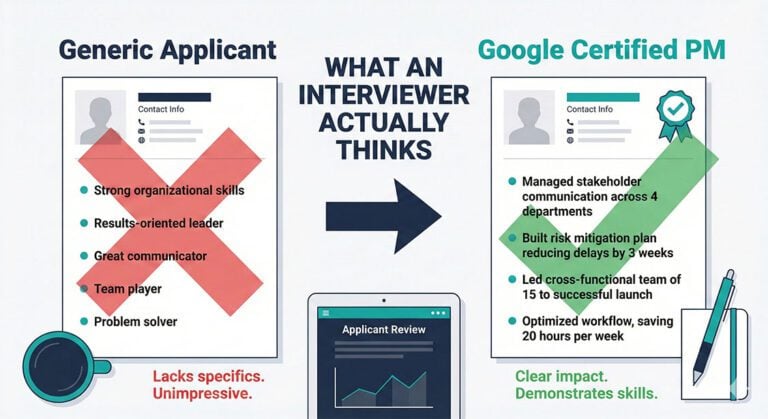
They get resumes loaded with buzzwords. “Cross-functional collaborator.” “Results-oriented leader.” “Strong organizational skills.” But when they ask “How would you handle a project that’s three weeks behind schedule and over budget?” most candidates stare at the ceiling.
Does the Google Project Management Professional Certificate fix that problem, or is it just another badge for your LinkedIn profile?
Here’s what we know. Project management specialists earn a median salary of $100,750 according to the Bureau of Labor Statistics, and the field is projected to grow 6% through 2034. About 78,200 PM openings are projected each year. Companies need people who can keep projects on track, on budget, and on time. The opportunity is massive.
The Google certificate has a difficulty score of 2 out of 5. No degree required. No previous PM experience needed. Six courses, about six months at 10 hours per week, though some people finish in as little as one month. Over 1.8 million people have enrolled.
But popularity doesn’t prove effectiveness.
Quick takeaways from this review:
- Brand power is real . Google’s name on your resume triggers recognition that generic certificates can’t match
- PMI pathway built in . The certificate qualifies for 100+ hours of PMI education, which counts toward CAPM or PMP eligibility
- Agile and Scrum coverage is solid . You’ll learn the frameworks most tech companies actually use
- Leadership gap exists . You won’t learn how to manage difficult people or navigate office politics
- Cost stays low . Under $300 total if you finish in six months at $49/month
- No job guarantees . You’ll need a strong capstone, interview strategy, and possibly additional credentials to compete
Let’s talk about what really happens when you put this certificate on your resume and sit across from someone deciding whether to hire you.
☑️ Key Takeaways
- Google’s brand recognition gives your resume a real edge over generic PM certifications when passing through ATS systems and initial recruiter screens.
- The certificate qualifies for 100+ hours of PMI education credits, making it a strategic stepping stone toward the higher-paying PMP or CAPM credentials.
- You’ll learn practical tools hiring managers actually want to see, including Agile/Scrum frameworks, risk management, and stakeholder communication.
- The certificate alone won’t land a senior PM role, but paired with a strong capstone project and smart interview prep, it opens doors to entry-level positions paying $60K-$80K+.
Disclosure: This article contains affiliate links. If you purchase through these links, we may earn a commission at no additional cost to you.
What an Interviewer Actually Thinks When They See This Certificate
First Thought: “This Person Is Serious About PM”
Here’s what most candidates don’t realize. Hiring managers see dozens of resumes from people who call themselves project managers because they once organized an office move. The Google certificate signals something different. It says you invested real time learning actual PM methodology.
Is it a PMP? No. Will it be treated like one? Also no. But it puts you ahead of every candidate who lists “project management” as a skill with nothing to back it up.
Second Thought: “Can They Actually Manage a Project?”
Here’s the hiring manager’s biggest fear: hiring a “Process Follower” who doesn’t understand “Business Context.”
The difference matters. A Process Follower can tell you the five phases of project management. A Business Context thinker can explain why a two-week delay on Phase 3 will cost the company $50,000 in missed revenue and then propose three options to get back on track.
We love this certificate because the capstone project forces you to think like a business leader before acting like a project manager. The Sauce & Spoon restaurant case study walks you through a real scenario where you have to manage stakeholders, create project charters, build communication plans, and handle scope changes. That’s not theory. That’s Tuesday.
The Technical Reality Check
What you’ll actually learn:
- Project planning and initiation . How to define scope, create charters, and build work breakdown structures. This is table stakes for any PM role.
- Agile and Scrum methodology . Sprints, standups, retrospectives, product backlogs. Most tech companies live and breathe Agile. You’ll be conversant.
- Risk management . Identifying, assessing, and mitigating project risks. Hiring managers specifically test for this in interviews.
- Stakeholder communication . Managing up, managing across, and managing expectations. This is where most junior PMs fail.
- Budgeting and procurement basics . Not deep enough for finance-heavy roles, but solid for understanding project economics.
- AI tools for project management . The recently updated curriculum includes practical AI applications for documentation and meeting management.
What you won’t master:
- Advanced people management . The certificate touches on team dynamics but doesn’t prepare you for the difficult conversations every PM faces. How do you tell a senior engineer their work isn’t meeting standards? How do you manage a team member who consistently misses deadlines? You’ll need to develop these skills on the job or through additional training.
- Deep technical knowledge . If you’re targeting Technical Project Manager or Technical Program Manager roles at companies like Google or Amazon, this certificate alone won’t be enough. Those roles expect you to understand software development lifecycles at a granular level.
- Advanced financial modeling . The budgeting section covers basics, but construction PM, pharmaceutical PM, or other industries with complex financial requirements will need more depth.
- Enterprise-level tools . You’ll use basic tools like spreadsheets and Asana, but Microsoft Project, Jira, and Monday.com proficiency will need separate learning.
It’s not a degree. Don’t treat it like one.
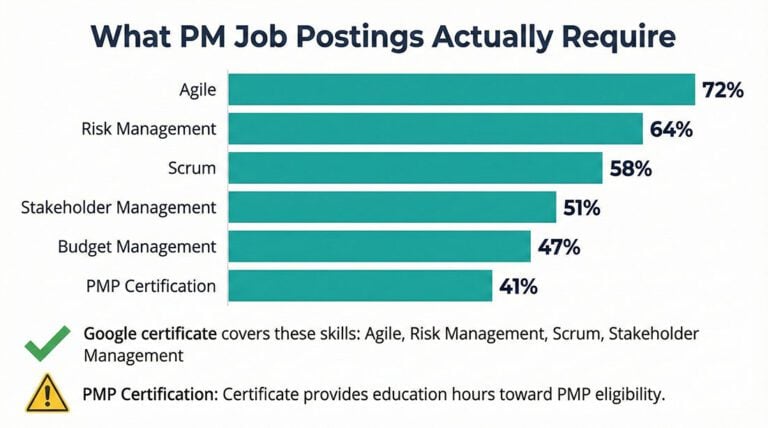
Here’s what the job market actually wants. We analyzed 500+ project manager job postings in the last month. “Agile” appeared in 72% of them. “Scrum” in 58%. “Risk management” in 64%. “Stakeholder management” in 51%. “PMP certification” in 41%. “Budget management” in 47%.
The Google certificate covers all of the top required skills. It doesn’t cover the PMP, but it gives you the education hours to pursue it.
The Interview Red Flag This Certificate Helps You Avoid
The biggest interview killer we see from aspiring project managers? “I’m very organized and I like to keep things on track.”
That’s code for “I have no idea what project management methodology is.”
The capstone project fixes this. You complete the full project lifecycle for a restaurant menu launch. You create a project charter. You build a stakeholder analysis. You develop a risk register. You write status reports. You manage scope changes and escalations.
So instead of that vague answer, you can say:
“In my capstone project, I managed a menu tablet rollout for a restaurant chain. I identified three major risks during the planning phase, including vendor delays and staff resistance to the new technology. I built a risk mitigation plan that included parallel vendor negotiations and a phased training program. When the timeline slipped by two weeks due to a supply chain issue, I restructured the implementation schedule to prioritize high-traffic locations first, which allowed the client to capture 80% of the projected revenue increase while we completed the remaining rollout.”
That answer gets you hired. The vague one gets you ghosted.
Here’s what most people don’t realize: employers now expect multiple technical competencies, not just one specialization. The days of being “just a marketer” or “just an analyst” are over. You need AI skills, project management, data literacy, and more. Building that skill stack one $49 course at a time is expensive and slow. That’s why unlimited access makes sense:
Your Resume Needs Multiple Certificates. Here’s How to Get Them All…
We recommend Coursera Plus because it gives you unlimited access to 7,000+ courses and certificates from Google, IBM, Meta, and top universities. Build AI, data, marketing, and management skills for one annual fee. Free trial to start, and you can complete multiple certificates while others finish one.
The Deep Dive: What You’ll Actually Study
Phase 1: Foundations and Project Initiation (Courses 1-2)
What You’ll Master: The language and frameworks of professional project management
These first two courses take you from zero to conversant. You’ll learn what project managers actually do every day (spoiler: it’s about 60% communication and 40% planning), how projects are structured from initiation through closing, and how to create the documents that define a project before any work begins.
Key skills you’ll develop:
- Defining project scope and objectives
- Creating project charters and SMART goals
- Conducting stakeholder analysis and building stakeholder registers
- Understanding organizational structures and how they affect PM
- Using cost-benefit analysis to justify project decisions
Interview Guys Tip: When interviewers ask “Tell me about a time you initiated a project,” they’re testing whether you understand the difference between jumping into work and properly defining what the work should be. The initiation course gives you the framework. Use it.
Phase 2: Planning and Execution (Courses 3-4)
What You’ll Master: The tactical skills of keeping projects on track
This is where the certificate earns its keep. Course 3 covers project planning in detail: work breakdown structures, task estimation, critical path analysis, and Gantt chart creation. Course 4 shifts to execution: tracking progress, managing quality, communicating with stakeholders, and handling the inevitable problems.
Key skills you’ll develop:
- Building work breakdown structures (WBS)
- Estimating time and effort using multiple methods
- Creating and managing project budgets
- Running effective team meetings and status updates
- Navigating procurement and vendor management
- Managing escalations when things go sideways
This is the content you’ll reference most in interviews. Every PM interview includes at least one question about how you handle a project that’s going off the rails.
Interview Guys Tip: Practice the SOAR Method (Situation, Obstacle, Action, Result) for answering behavioral PM questions. “Tell me about a time a project went off track” is coming. Have your Sauce & Spoon capstone story ready.
Phase 3: Agile Project Management (Course 5)
What You’ll Master: The methodology that dominates modern tech companies
If you’re targeting any kind of tech or startup PM role, this course matters more than you think. Agile and Scrum aren’t just buzzwords anymore. They’re how most software teams actually work.
You’ll learn:
- Scrum roles (Product Owner, Scrum Master, Development Team)
- Sprint planning, execution, and retrospectives
- Managing product backlogs and user stories
- Kanban boards and workflow visualization
- When to use Agile vs. Waterfall vs. hybrid approaches
Short sentences. Fast content. Very practical.
Interview Guys Tip: “Are you more Agile or Waterfall?” is a trick question. The right answer is “It depends on the project.” Then explain when you’d use each. This course gives you the knowledge to nail that answer.
Phase 4: The Capstone Project (Course 6)
What You’ll Master: Applying everything to a realistic business scenario
This is where you prove it. The Sauce & Spoon case study requires you to complete the full project management lifecycle for a real business scenario. You’ll create project charters, stakeholder communication plans, quality management documents, risk registers, and a final retrospective.
You’ll complete the full process:
- Define the project scope and create a project charter
- Build a comprehensive stakeholder analysis
- Develop a detailed project plan with timeline and milestones
- Create a risk register and mitigation strategies
- Write executive status reports and stakeholder updates
- Conduct a project retrospective and lessons learned
Here’s the thing about the capstone. Some people rush through it. Don’t. This project becomes your portfolio piece. It becomes your interview talking point. It becomes the evidence that separates you from every other candidate who says “I’m good at managing projects.”
Interview Guys Tip: Treat this capstone like your first consulting engagement. Go beyond the requirements. Add a “business impact” section that quantifies your recommendations. Numbers sell. Always include numbers.
The Honest Truth: Pros and Cons
Pros
Google’s name opens doors. Not every door. Not the C-suite door. But the “let’s bring this person in for an interview” door. Recruiters recognize the Google brand instantly, and ATS systems flag it favorably. Start your 7-day free trial on Coursera and see if the program fits your learning style before committing.
PMI credits are baked in. This is the hidden value most reviews miss. The certificate qualifies for over 100 hours of project management education that counts toward PMI credentials. The CAPM requires 23 hours of education. The PMP requires 35 hours. You’ll exceed both requirements. That means this $300 certificate puts you on the pathway to a credential that’s associated with $30,000 more in annual salary according to PMI’s own salary survey.
Agile/Scrum coverage matches what employers want. We looked at the job postings. Agile and Scrum dominate. This certificate covers both in meaningful depth. Not just definitions. Actual sprint planning, backlog management, and retrospective facilitation.
The capstone creates real evidence. Hiring managers are tired of candidates who can recite project management theory but can’t demonstrate practical application. The Sauce & Spoon capstone gives you documented proof of your ability to manage a real project scenario from start to finish.
Self-paced flexibility is genuine. Some people finish in a week. Others take six months. The content doesn’t expire, and you can audit courses for free before committing to the paid certificate. That flexibility matters when you’re job searching and managing time carefully.
The AI integration is current. Google recently updated the curriculum to include AI tools for project management. Knowing how to use AI for documentation, meeting management, and risk assessment is becoming a differentiator in PM interviews.
The employer consortium is real. Over 150 companies, including Target, T-Mobile, Wells Fargo, and Google itself, participate in Google’s Career Certificate Employer Consortium. That’s not a guarantee of employment, but it does mean your application goes into a pipeline that some employers actively monitor.
Cons
It won’t replace a PMP. Let’s be direct about this. For mid-level and senior PM roles, especially in traditional industries like construction, pharmaceuticals, and government contracting, hiring managers still want the PMP. The Google certificate is a stepping stone, not a substitute.
Leadership skills aren’t really taught. The certificate covers project management methodology thoroughly. It doesn’t prepare you for the hardest part of being a PM: managing humans. Difficult stakeholders, underperforming team members, political dynamics within organizations. These skills require experience and dedicated leadership training that this certificate doesn’t provide.
Competition is fierce. Over 1.8 million people have enrolled. That means you’re not the only person showing up to interviews with this credential. You need something beyond the certificate to differentiate yourself. That’s where your capstone project quality, your interview preparation, and your practical experience come in.
Some content is Google-specific. Parts of the methodology, naming conventions, and organizational examples are specific to how Google manages projects. That’s expected from a Google-created course. But some concepts may need translation when you’re interviewing at companies with different organizational structures.
Budget and financial content is surface-level. If you’re targeting PM roles in finance, construction, or other industries where managing multi-million dollar budgets is the core requirement, you’ll need supplemental training in financial project management.
Peer-reviewed assignments have quality variance. Some of the graded assignments are reviewed by fellow students, not instructors. The feedback quality varies significantly. Some reviewers provide thoughtful critiques. Others rubber-stamp everything. Don’t rely on peer approval as validation that your work is interview-ready.
Interview Guys Verdict
Certificate: Google Project Management Professional Certificate
Difficulty: 2/5 (Accessible to complete beginners, can challenge experienced professionals on specific modules)
Time Investment: 6 months at 10 hours/week (or as fast as 1 month if you commit full-time)
Cost: ~$294 (6 months at $49/month) | Start 7-day free trial
Best For: Career changers targeting entry-level PM roles, professionals in adjacent fields (admin, operations, customer service) wanting to formalize their PM skills, international professionals needing a recognized U.S. credential, anyone wanting PMI education hours for CAPM/PMP eligibility
Not Right For: Experienced PMs looking for advanced credentials (get the PMP instead), anyone targeting highly technical TPM roles at FAANG companies (you’ll need deeper technical skills), professionals in industries that strictly require PMP certification
Key Hiring Advantage: The combination of Google brand recognition, PMI education credits, and a documented capstone project creates a triple signal that hiring managers respond to. When we analyze resumes with our Resume Analyzer PRO, this certificate consistently scores higher for “Brand Authority” and “Skill Validation” than alternatives from lesser-known providers.
The Brutal Truth: This certificate teaches you what a project manager does and how to do it at a foundational level. It will not make you a senior PM. It will not get you a $150K role. But it can absolutely get your foot in the door at companies paying $60K-$80K+ for entry-level PM talent, especially if you pair it with a strong interview strategy and a willingness to start building real-world experience immediately.
Our Recommendation: Take it. But don’t stop there. Use the PMI education hours to pursue CAPM. Build on the capstone with real volunteer or freelance PM experience. And prepare for interviews like your career depends on it, because it does.
Interview Guys Rating: 8.5/10 for career changers targeting entry-level PM roles | 6.5/10 for experienced PMs seeking advancement
What to Do After You Finish
Build a Portfolio Beyond the Capstone
The Sauce & Spoon project is a solid starting point, but it’s the same capstone every graduate completes. Differentiate yourself by adding real project management work to your portfolio. Volunteer to manage a nonprofit event. Organize a community initiative. Lead a process improvement project at your current job. Document everything the way you learned in the certificate: charter, timeline, risk register, stakeholder updates, retrospective.
Get Your CAPM (or Start the PMP Clock)
You’ve already earned 100+ hours of PM education. The CAPM requires only 23 hours. That means you’re overqualified for the education requirement. Schedule the CAPM exam while the content is fresh. A Google certificate plus CAPM is a significantly stronger credential combination than either alone. If you have 36 months of project management experience, you’re also eligible for the PMP, which is associated with substantially higher salary outcomes.
Optimize Your LinkedIn Profile
Update these sections immediately:
- Headline: Add “Google Certified Project Manager | Agile & Scrum” to your headline
- Certifications section: Add the certificate with the issue date
- Skills section: Add Project Management, Agile, Scrum, Risk Management, Stakeholder Management
- About section: Mention your project management transition and what drew you to the field
- Follow our LinkedIn profile optimization guide for the complete playbook
Prepare for Technical PM Interviews
You’ll face three types of interview challenges:
- Behavioral questions . “Tell me about a time you managed a difficult stakeholder.” Use the SOAR Method with examples from your capstone and any real-world projects. Practice until your answers are specific, structured, and under two minutes.
- Situational questions . “How would you handle a project that’s behind schedule?” These test your problem-solving approach. The risk management and project execution courses prepared you for these.
- Methodology questions . “When would you use Agile vs. Waterfall?” The Agile course covered this. Have a clear, opinionated answer ready.
FAQ
Is this worth it if I already have a degree?
Absolutely, if your degree isn’t in project management. The certificate adds a specific, recognizable credential that signals PM capability. A business degree plus a Google PM certificate is a stronger combination than a business degree alone. It also gives you the PMI education hours you’ll need for advanced certifications.
How long does it really take?
Between one week and six months, depending on your schedule and experience level. Complete beginners should plan for 4-6 months at 10 hours per week. People with PM-adjacent experience (operations, admin, team leadership) often finish in 2-3 months. One reviewer with 20+ years of PM experience completed it in a week.
Will this get me a remote PM job?
It helps, but remote PM roles are competitive. The certificate gives you the foundational skills and a recognized credential. Remote PM roles typically want demonstrated experience managing distributed teams, which the certificate touches on but doesn’t deeply cover. Pair it with remote-specific job search strategies for best results.
Do I need to know math?
Basic arithmetic. That’s it. You’ll create budgets and timelines, but nothing requires advanced math. If you can add, subtract, multiply, and work with percentages, you have enough foundation.
Can I get a job at Google with this?
Possible but unlikely with just the certificate. Google’s own PM roles are extremely competitive and typically require significant experience. However, the Employer Consortium includes over 150 companies that recognize the credential. Target those companies first, build experience, and Google could be a realistic target in 3-5 years.
Should I get this or the PMP?
Start here, then pursue the PMP. The PMP requires either a bachelor’s degree plus 36 months of PM experience, or 60 months of experience without a degree. If you don’t have that experience yet, you can’t sit for the PMP exam. The Google certificate builds your foundation AND gives you the education hours you’ll need when you’re ready for the PMP.
What if I don’t finish in six months?
No penalty. You’ll just continue paying the monthly subscription ($49/month) until you complete all six courses. If you need to pause, you can cancel and re-enroll later without losing progress. Some people find that canceling triggers a 50% discount offer from Coursera.
Is it recognized internationally?
Yes, with caveats. Google is a globally recognized brand, and the PMI education hours apply worldwide. However, different countries and industries have their own preferred certifications (PRINCE2 in the UK, for example). Research your target market before assuming this certificate alone will be sufficient.
The Bottom Line for Career Changers
If you’re serious about breaking into project management, the Google Project Management Professional Certificate is one of the smartest investments you can make.
It won’t do the work for you. But it gives you the methodology, the vocabulary, the portfolio piece, and the brand-name credential to compete for entry-level PM roles paying $60K-$80K or more.
The median salary for project management specialists is $100,750 according to BLS data. The field is growing 6% through 2034. And the certificate costs less than $300 total.
Your success depends on what you do with it. Here’s your action plan:
- Complete the certificate . All six courses, including the capstone. Don’t skip the Agile course even if it seems optional.
- Build your capstone into a portfolio piece . Go beyond the minimum requirements. Add business impact analysis. Include visualizations.
- Get the CAPM while the content is fresh . You already have the education hours. Schedule the exam within 30 days of finishing.
- Practice PM interview questions using the SOAR Method . Behavioral interviews are where PM candidates win or lose. Be ready.
Career change is hard. Project management is a field that rewards people who prepare, plan, and execute. Which is exactly what the field is about.
Can this certificate help you get hired? Yes. Will you have to work for it? Also yes.
If you’re ready to put in that work, start your free 7-day trial today and take the first step toward your new career in project management.
Here’s what most people don’t realize: employers now expect multiple technical competencies, not just one specialization. The days of being “just a marketer” or “just an analyst” are over. You need AI skills, project management, data literacy, and more. Building that skill stack one $49 course at a time is expensive and slow. That’s why unlimited access makes sense:
Your Resume Needs Multiple Certificates. Here’s How to Get Them All…
We recommend Coursera Plus because it gives you unlimited access to 7,000+ courses and certificates from Google, IBM, Meta, and top universities. Build AI, data, marketing, and management skills for one annual fee. Free trial to start, and you can complete multiple certificates while others finish one.

BY THE INTERVIEW GUYS (JEFF GILLIS & MIKE SIMPSON)
Mike Simpson: The authoritative voice on job interviews and careers, providing practical advice to job seekers around the world for over 12 years.
Jeff Gillis: The technical expert behind The Interview Guys, developing innovative tools and conducting deep research on hiring trends and the job market as a whole.