
Google Cybersecurity Certificate Review 2026: The Hiring Manager’s Perspective
If you’re considering breaking into cybersecurity, you’ve probably stumbled across the Google Cybersecurity Professional Certificate. It’s everywhere online, marketed as your ticket to a six-figure career in one of tech’s hottest fields. But here’s what matters more than Google’s marketing: what do hiring managers actually think when they see this certificate on your resume?
The cybersecurity field is experiencing explosive growth. According to the U.S. Bureau of Labor Statistics, employment for cybersecurity analysts is projected to grow 35% through 2034, which is seven times faster than the average for all occupations. With approximately 3.5 million unfilled cybersecurity positions globally, there’s genuine opportunity here.
But opportunity doesn’t equal guaranteed employment. The Google certificate can be a powerful tool in your arsenal, but only if you understand exactly what it offers, what it doesn’t, and how to position it strategically in your career transition.
By the end of this article, you’ll know whether the Google Cybersecurity Certificate makes sense for your specific situation, how much you can realistically expect to earn, and the strategic moves you need to make this credential actually work for you in the job market.
☑️ Key Takeaways
- 75% of graduates report positive career outcomes within six months, including new jobs, promotions, or raises
- Entry-level cybersecurity analysts earn $70,000 to $99,400 annually, with significant room for growth as you gain experience
- The certificate costs $294 total if completed in six months at $49/month, or access it through Coursera Plus for unlimited learning
- No prerequisites required but the certificate alone won’t land you a job without additional effort and strategic positioning
What Is the Google Cybersecurity Professional Certificate?
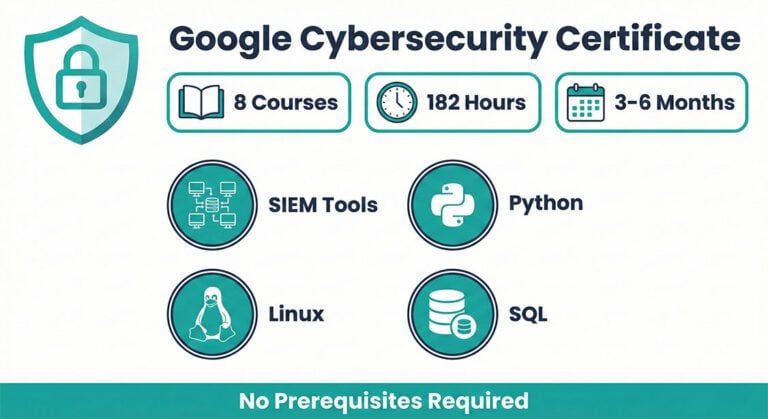
The Google Cybersecurity Professional Certificate is an eight-course program designed and taught by Google cybersecurity professionals. It’s delivered entirely online through Coursera and requires no previous experience in cybersecurity or IT.
The program covers foundational cybersecurity concepts including:
- Network security fundamentals and architecture
- Security Information and Event Management (SIEM) tools like Splunk and Chronicle
- Linux command line and file permissions
- Python programming for automation
- SQL for database security
- Incident detection and response procedures
- Risk management and threat assessment
The program takes approximately 182 hours to complete. Most learners finish in 3-6 months by dedicating 7-10 hours per week. The self-paced format means you can accelerate if you’re motivated or slow down if life gets busy.
What makes this certificate different from traditional cybersecurity education is its practical focus. You’re not just reading about security concepts. You’re actually working with industry-standard tools, completing hands-on labs, and building a portfolio of projects that demonstrate your skills to potential employers.
The Strategic Value of Professional Certifications in 2026
Before we dive deeper into the Google certificate specifically, let’s address the bigger question: why do certifications matter for your career?
In 2026’s job market, professional certifications serve as proof of commitment and baseline competency. When you’re competing against candidates with computer science degrees and years of experience, certifications provide tangible evidence that you’ve invested time and effort into learning specific, job-relevant skills.
Certifications accelerate career transitions. They give hiring managers a standardized framework for evaluating candidates who come from non-traditional backgrounds. A certificate from Google carries weight because it’s associated with a company that employers recognize and respect.
Here’s what certifications actually do for you:
- Signal serious intent. Anyone can say they’re interested in cybersecurity. A completed certification proves you’ve put in the work.
- Fill knowledge gaps systematically. Self-teaching is valuable, but structured programs ensure you’re not missing critical foundational concepts.
- Provide a common language. Certifications teach you the terminology and frameworks that professionals use daily.
- Create networking opportunities. Many certification programs connect you with communities of learners and professionals.
The strategic advantage of pursuing online certifications that pay well is that they offer a faster, more affordable path than traditional four-year degrees while still providing market-recognized credentials.
Consider a Coursera Plus Membership for Maximum Value
Here’s a insider tip that most reviews won’t tell you: if you’re serious about career development, a Coursera Plus subscription makes significantly more financial sense than paying month-by-month for individual certificates.
Coursera Plus costs $59 per month or $399 per year and gives you unlimited access to over 7,000 courses and professional certificates. This includes not just the Google Cybersecurity Certificate, but also:
- Google Data Analytics Professional Certificate
- Google IT Support Professional Certificate
- IBM Cybersecurity Analyst Professional Certificate
- Meta Front-End Developer Certificate
- Hundreds of university courses from institutions like Stanford, Yale, and Duke
Why does this matter? Because the Google Cybersecurity Certificate alone isn’t enough to be competitive. Smart candidates stack multiple credentials to demonstrate broader capabilities. With Coursera Plus, you can complete the cybersecurity certificate, then immediately start the Google IT Support certificate or pursue complementary skills in data analytics or cloud computing without paying extra.
If you’re planning to complete the cybersecurity certificate in 3-6 months anyway, you’re already looking at $147-$294. For just $399 annually, you get unlimited access to build a much more impressive credential portfolio. The math is straightforward: more credentials equal more interview opportunities.
What You’ll Actually Learn: Course Breakdown
Let’s get specific about what the eight courses cover and how they prepare you for real work.
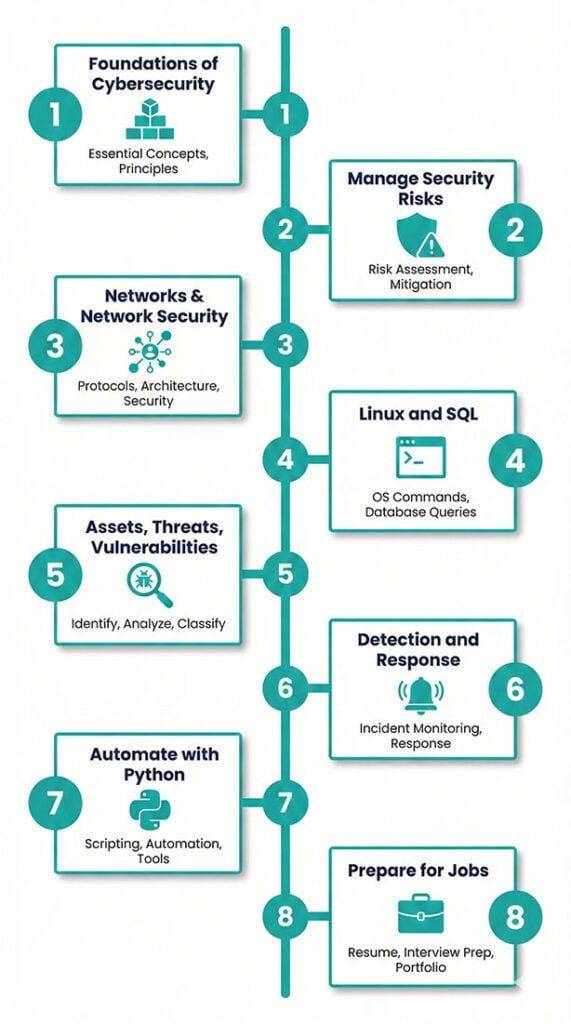
Course 1: Foundations of Cybersecurity
This introduces core security concepts, the CIA triad (Confidentiality, Integrity, Availability), common security frameworks like NIST, and the eight CISSP security domains. You’ll learn what cybersecurity analysts actually do day-to-day and understand different career paths within the field.
Course 2: Play It Safe: Manage Security Risks
Risk management is where you learn to think like a security professional. The course covers OWASP security principles, how to conduct security audits, and frameworks for identifying and mitigating threats. You’ll complete your first portfolio project performing a controls assessment for a fictional company.
Course 3: Connect and Protect: Networks and Network Security
Understanding network architecture is fundamental to security work. This course teaches network protocols, common network attacks, security hardening techniques, and how to use tools like Wireshark for packet analysis.
Course 4: Tools of the Trade: Linux and SQL
You’ll get hands-on experience with the Linux command line, file permissions, and basic SQL queries. These are essential skills because most enterprise security systems run on Linux, and you’ll frequently need to query databases to investigate security incidents.
Course 5: Assets, Threats, and Vulnerabilities
This dives into vulnerability assessment, threat modeling, and how different attack vectors work. You’ll learn to think like an attacker to better defend systems.
Course 6: Sound the Alarm: Detection and Response
Here’s where SIEM tools come into play. You’ll work with Splunk and Google Chronicle to monitor security events, create detection rules, and respond to incidents. This is the most directly job-applicable content in the entire program.
Course 7: Automate Cybersecurity Tasks with Python
Python automation is increasingly valuable in security operations. The course teaches you to write scripts that automate repetitive tasks, parse log files, and interact with security tools programmatically.
Course 8: Put It to Work: Prepare for Cybersecurity Jobs
The final course focuses on career preparation. You’ll polish your resume, practice interview responses using the SOAR method, build your portfolio, and learn how to present yourself to hiring managers.
Real Career Outcomes: What the Data Actually Shows
Marketing claims are one thing. Employment data is another. Let’s look at what actually happens to people who complete this certificate.
According to Google’s internal data, 75% of certificate graduates in the United States report a positive career outcome within six months. This includes landing new jobs, receiving promotions, or securing raises. That’s a compelling statistic, but it requires context.
“Positive career outcome” is broad. It includes someone transitioning from retail to an entry-level SOC analyst role (major win) as well as someone in IT who gets a modest raise after adding the certification (incremental improvement). Not everyone who completes the certificate lands a cybersecurity analyst position immediately.
Salary expectations need to be realistic. Entry-level cybersecurity analyst positions typically pay between $70,000 and $99,400 annually according to recent market data. The wide range reflects geographic location, company size, and specific role requirements.
In high-cost tech hubs like San Francisco, Seattle, or New York, entry-level positions can push toward $115,000. In smaller markets or government contractor roles, you might start closer to $65,000. Mid-career cybersecurity professionals with 3-5 years of experience typically earn $105,000 to $127,000.
The career trajectory is strong. Cybersecurity is one of the few fields where consistent skill development can double your salary within five years. Senior security analysts, architects, and engineers routinely earn $160,000 to $220,000 in competitive markets.
The Honest Drawbacks: What This Certificate Doesn’t Do
Every review should include honest limitations. Here’s what you need to know about what the Google Cybersecurity Certificate doesn’t provide.
The certificate alone won’t land you a job. This is perhaps the most important point. Employers don’t hire based solely on certificates. They hire based on demonstrated capability, which requires:
- A portfolio showcasing practical projects beyond the course assignments
- Understanding of how to discuss security concepts in interviews
- Ability to demonstrate problem-solving skills through technical scenarios
- Evidence of continuous learning beyond just one certificate
The quizzes are open-book and not proctored. Unlike the CompTIA Security+ exam which is a rigorous, proctored test, the Google certificate assessments allow you to reference materials. This means the certificate proves completion, not necessarily mastery. Some hiring managers are aware of this distinction.
Windows coverage is minimal. The program focuses heavily on Linux systems and Google’s security tools. While Linux knowledge is valuable, most enterprise environments run Windows infrastructure. You’ll need to supplement with Windows security knowledge on your own.
No live instruction or mentorship. Everything is pre-recorded. If you struggle with concepts, you’re relying on discussion forums where response times vary. There’s no instructor providing real-time feedback or guidance.
Career services are automated. The resume reviews are templates. The interview practice tools are AI-driven without human feedback. American graduates get access to CareerCircle for employer connections, but international learners have fewer resources.
These aren’t dealbreakers. They’re realities to plan around. Understanding these limitations helps you strategize how to supplement the certificate with additional learning and networking.
Google Cybersecurity Certificate vs. CompTIA Security+
You’ll inevitably face this comparison, so let’s address it directly.
CompTIA Security+ is the industry-standard entry-level certification. It’s been around since 2002, has over one million certified professionals, and is required by many government and defense contractors. The certification requires passing a rigorous, proctored exam that tests comprehensive security knowledge.
The exam costs approximately $392 (though Google certificate graduates get a 30% discount, bringing it down to about $274). Study time typically requires 2-4 months of dedicated preparation using multiple resources beyond just one course.
The Google Cybersecurity Certificate is completion-based, not exam-based. This makes it more accessible but also less universally recognized as proof of competency. It’s newer, launched in 2023, so it hasn’t built the same employer recognition that Security+ has over two decades.
Here’s the strategic approach many successful candidates take: Complete the Google certificate first, then pursue Security+. The Google program provides strong foundational knowledge that prepares you for the Security+ exam. You’ll understand the concepts and have hands-on experience, making Security+ study significantly easier.
This combination strategy gives you both the practical skills from Google and the industry-recognized credential from CompTIA. It positions you more competitively than having either alone.
For more guidance on what certification you should get based on your career goals, consider your timeline, budget, and target job market.
How to List This Certificate on Your Resume
Knowing how to list certifications on a resume strategically makes a significant difference in whether recruiters and hiring managers take you seriously.
Create a dedicated Certifications section on your resume. List it as:
Google Cybersecurity Professional Certificate | Coursera | 2026
- Completed 182-hour program covering network security, SIEM tools, Python automation, and incident response
- Built portfolio of security projects including vulnerability assessments and incident response scenarios
- Gained hands-on experience with Splunk, Chronicle, Linux, Python, and SQL
Don’t oversell it. Calling yourself a “Google Certified Cybersecurity Professional” without additional context can backfire with knowledgeable hiring managers. Be accurate about what the certificate represents: foundational training and portfolio projects, not years of hands-on security work.
Emphasize the skills and tools. Hiring managers care more about what you can do with Splunk or Python than about Google’s brand name. List specific competencies gained.
Link to your portfolio. The certificate program has you create portfolio projects. Host these on GitHub and include the link on your resume. Actual project work speaks louder than certificate titles.
Who Should Get This Certificate (and Who Shouldn’t)
This certificate makes sense if you’re:
- Transitioning from a completely different field and need structured, beginner-friendly training to break into cybersecurity
- Currently in IT support or helpdesk roles looking to specialize in security
- A recent graduate without specific cybersecurity coursework looking to demonstrate focused learning
- Exploring whether cybersecurity interests you before committing to a degree program or bootcamp
This certificate probably isn’t the best fit if you’re:
- Already working in cybersecurity with hands-on experience (you’d benefit more from intermediate certifications)
- Looking for advanced technical training in areas like penetration testing or malware analysis
- Required to meet specific certification requirements for government or contractor roles (go straight for Security+ or CISSP)
The best candidates for this certificate are those who understand it’s a starting point, not a destination. If you’re willing to supplement it with additional learning, networking, and portfolio development, it can be a valuable accelerator for changing careers in 2025.
Cost Analysis: Is It Worth the Investment?
Let’s break down the actual costs versus potential return:
Direct costs:
- Coursera subscription: $49/month
- Average completion time: 3-6 months
- Total cost: $147-$294
Optional but recommended costs:
- CompTIA Security+ exam: $274 (with Google graduate discount)
- Additional study materials: $50-100
- Total initial investment: $471-$668
Expected return:
- Entry-level cybersecurity analyst salary: $70,000-$99,400
- Career switcher’s previous salary (average): $45,000-$55,000
- Potential annual increase: $15,000-$44,400
Even at the lower end of salary expectations, you’re looking at recouping your investment within the first few months of employment. The ROI is strong if you actually secure a position.
The real investment is time, not money. You’ll spend 180+ hours on the certificate, plus additional time on job applications, networking, and building portfolio projects. That’s the true cost to consider.
Strategic Next Steps After Completing the Certificate
Finishing the Google certificate is step one. Here’s what successful career changers do next:
- Build an expanded portfolio. Take the projects from the course and elevate them. Add more complex scenarios. Document your thought process. Create GitHub repositories showing your work. Employers want to see evidence you can apply knowledge independently.
- Pursue CompTIA Security+. The knowledge overlap between Google’s certificate and Security+ makes this a natural progression. Many employers specifically list Security+ as a requirement.
- Network strategically. Join local cybersecurity meetups, participate in CTF (Capture the Flag) competitions, and engage with the security community on LinkedIn and Twitter. Relationships matter as much as credentials.
- Apply for entry-level SOC analyst positions. Security Operations Center roles are the most common entry points. They involve monitoring security events, investigating alerts, and escalating incidents. The Google certificate prepares you specifically for this type of work.
- Consider related certifications in AI and cybersecurity to stay ahead of emerging trends in the field.
The Bottom Line: Should You Get This Certificate?
After reviewing the program comprehensively, here’s the honest assessment:
The Google Cybersecurity Professional Certificate is a solid foundational program for complete beginners looking to break into cybersecurity. It won’t single-handedly land you a job, but it provides legitimate skills and knowledge that, when combined with strategic portfolio development and networking, can accelerate your career transition.
The 75% positive career outcome statistic is real, but it represents people who went beyond just completing the certificate. They built portfolios, pursued additional certifications, networked actively, and positioned themselves strategically in the job market.
At $294 for six months of access (or $399/year for Coursera Plus with unlimited certificates), the price point is reasonable. The content quality is high. The career resources are basic but functional. The industry recognition is growing but not yet at CompTIA Security+ levels.
If you’re serious about entering cybersecurity, approach this certificate as the first step in a longer journey. Complete it, then immediately pursue Security+. Build a portfolio. Network strategically. Apply persistently.
The Google Cybersecurity Certificate can work for you, but success requires treating it as a foundation to build on rather than a magic credential that opens doors automatically.
Ready to get started? Enroll in the Google Cybersecurity Professional Certificate through Coursera, or maximize your learning potential with a Coursera Plus membership to access this certificate plus thousands of other courses that can accelerate your career transition.
The cybersecurity field needs talented professionals. With the right strategy and commitment, you can be one of them.
Here’s what most people don’t realize: employers now expect multiple technical competencies, not just one specialization. The days of being “just a marketer” or “just an analyst” are over. You need AI skills, project management, data literacy, and more. Building that skill stack one $49 course at a time is expensive and slow. That’s why unlimited access makes sense:
Your Resume Needs Multiple Certificates. Here’s How to Get Them All…
We recommend Coursera Plus because it gives you unlimited access to 7,000+ courses and certificates from Google, IBM, Meta, and top universities. Build AI, data, marketing, and management skills for one annual fee. Free trial to start, and you can complete multiple certificates while others finish one.

BY THE INTERVIEW GUYS (JEFF GILLIS & MIKE SIMPSON)
Mike Simpson: The authoritative voice on job interviews and careers, providing practical advice to job seekers around the world for over 12 years.
Jeff Gillis: The technical expert behind The Interview Guys, developing innovative tools and conducting deep research on hiring trends and the job market as a whole.