
Gen Z Government Job Applications Surged 100%: Why the Most Digital Generation Chose the Most Traditional Path
Something remarkable is happening in the American job market. The generation that grew up with smartphones in hand, who idolized tech entrepreneurs and dreamed of Silicon Valley success, is now flooding into the most traditional employment sector imaginable: government jobs.
The numbers tell a story that would have seemed impossible just a few years ago. Government job applications from Gen Z have doubled compared to previous years, with federal positions becoming especially attractive to new graduates. This isn’t a small blip or temporary trend. It’s a fundamental shift in how the most digitally native generation thinks about their careers.
What changed? Everything. And nothing that previous generations would recognize.
☑️ Key Takeaways
- Government job applications from Gen Z doubled in 2025, with federal positions seeing the highest surge as young workers reject volatile tech careers for stable public sector roles
- 76% of Gen Z prioritizes work-life balance over salary, and government jobs deliver structured schedules, generous time-off policies, and boundaries that tech companies increasingly fail to provide
- 75% of state and local government workers have access to defined benefit pension plans, compared to just 14% in private industry, giving Gen Z the retirement security they crave
- Federal employers increased job postings by 22% while applications per opening surged 55%, outpacing the 38% increase across all industries as Gen Z recognizes government’s competitive edge
The Tech Dream Died (And Gen Z Watched It Happen)

Gen Z’s relationship with the tech industry started like a fairytale and ended like a cautionary tale.
As the first generation to grow up alongside the burgeoning tech community, Gen Z witnessed companies rapidly scale, innovate, and introduce products that transformed their daily lives. The tech world had a “special allure” that shaped their early career goals, making Silicon Valley seem like the promised land of innovation, purpose, and unlimited potential.
Then reality hit. Hard.
Between 2023 and 2024, job applications to tech companies from college students dropped from 23% to 21%. That might seem like a small shift, but it represents hundreds of thousands of students choosing different paths. Location interest tells an even starker story: searches for jobs in California and Texas tech hubs have significantly decreased, while interest in Washington, D.C. has spiked.
The upheaval of layoffs, hiring freezes, and the collapse of Silicon Valley’s laid-back culture pushed Gen Z toward more stable fields. When your formative professional years coincide with watching tech workers get pink-slipped via Zoom calls and LinkedIn posts about “difficult decisions,” you start reconsidering what career success really means.
Interview Guys Tip: The tech industry’s volatility isn’t just about job cuts. It’s about watching companies eliminate entire departments, rescind job offers, and freeze hiring for months or years. Gen Z saw this happen during their college years and internships, the exact time when career impressions solidify. That timing matters more than most career advisors realize.
The reality is that most resume templates weren’t built with ATS systems or AI screening in mind, which means they might be getting filtered out before a human ever sees them. That’s why we created these free ATS and AI proof resume templates:
Still Using An Old Resume Template?
Hiring tools have changed — and most resumes just don’t cut it anymore. We just released a fresh set of ATS – and AI-proof resume templates designed for how hiring actually works in 2026 all for FREE.
Why Government Jobs Suddenly Look Better Than Google
Here’s what makes the government surge so fascinating: Gen Z isn’t settling for stability. They’re actively choosing it.
Total applications to federal employers have more than doubled over the past year, and the average number of applications per open job has increased by 55%, compared to a 38% increase across all industries. Federal employers responded by increasing job postings by 22%, creating a rare moment where both supply and demand are surging simultaneously.
The appeal isn’t mysterious. It’s methodical.
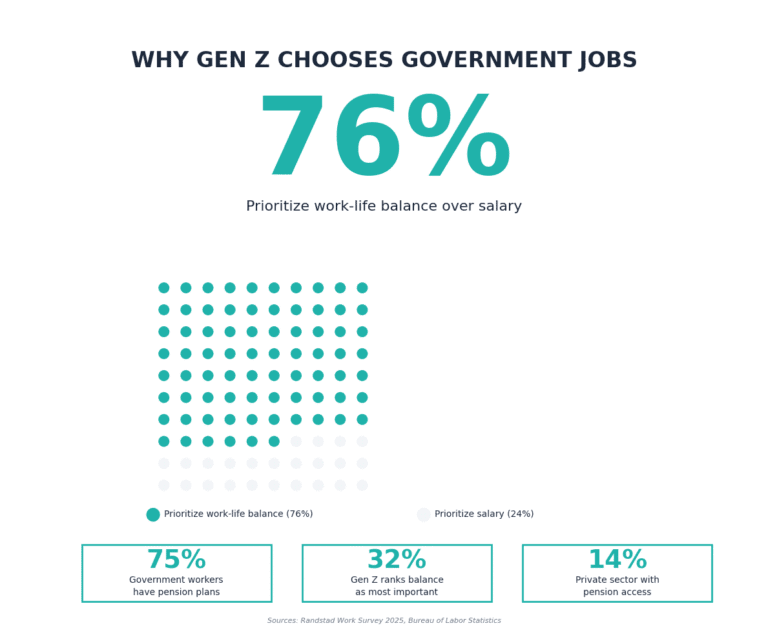
32% of Gen Z respondents ranked work-life balance as the most important aspect of a job, compared to 28% of millennials and 25% of Gen X. Government roles deliver on this priority with structured schedules, generous time-off policies, and actual respect for personal time boundaries. No “hustle culture.” No expectation that you’ll answer Slack messages at 11 PM. No pressure to prove your commitment by working weekends.
For a generation that prioritizes work-life balance over pay (76% versus 63% who valued the reverse), government jobs aren’t a compromise. They’re exactly what Gen Z has been demanding that private companies provide and consistently failing to deliver.
The benefits package tells the rest of the story. 75% of state and local government workers participated in defined benefit pension plans in 2016, compared to just 14% of private industry workers who have access to such plans today. Government healthcare coverage is comprehensive, often including mental health services that Gen Z explicitly seeks. Job security exists beyond empty corporate promises.
These aren’t the “golden handcuffs” of previous generations. They’re the foundation of a sustainable life that allows Gen Z to have careers without sacrificing everything else that matters to them.
Discover Your Top 8 Perfect Career Matches in 60 Seconds
Take our quick “Career Code” Assessment and get your top 8 career matches. We rank these based on your unique combination of strengths, energy patterns, and motivations
The Diversity Factor: Who’s Applying and Why It Matters
The government’s recruitment success goes deeper than aggregate numbers. It’s fundamentally changing who sees public service as a viable career path.
Total applications to federal roles from students at minority-serving institutions have doubled year over year, with applications from students at historically Black colleges and universities up 110%. Applications from students at Hispanic-serving institutions increased by 87%.
This isn’t accidental. The federal government made a strong commitment to diversifying its workforce, and the results show that Gen Z responds to authentic efforts rather than performative diversity statements. When organizations back up their values with actual recruiting investment, application numbers prove whether those efforts work.
The share of total applications matters as much as raw numbers. Between 2022 and 2023, 7.1% of all applications submitted by HBCU students went to federal roles, compared to 3.2% the prior year. Students at minority-serving institutions increased their federal application share from 1.9% to 3.3%, while Hispanic-serving institution students went from 2% to 3.1%.
These shifts represent major reallocation of career aspirations. Students aren’t just adding government to their list. They’re prioritizing it over options they would have chosen first just two years ago.
Interview Guys Tip: The federal government’s recruitment reach expanded to more than 2,000 schools, with employers messaging about 24% more students through platforms like Handshake. This isn’t passive recruiting. It’s active, broad-based outreach that treats college students like the competitive talent they are rather than waiting for applications to arrive.
What Government Jobs Actually Offer (Beyond Stability)
The stereotype of government work as boring, bureaucratic, and stuck in the 20th century dies hard. Gen Z is discovering the reality is far more nuanced.
Jobs in the federal government appeal to students with diverse skill sets. Business, computer science, and civics and government majors account for a large share of applicants, and students in niche in-demand majors such as cybersecurity and epidemiology submit a significant share of their applications to federal roles.
Computer science students, in particular, are driving the shift. Computer science students submitted only about half of their applications to roles with technology companies in 2024, spreading the remainder over industries such as manufacturing, financial services, healthcare, and government. They’re not abandoning tech skills. They’re applying them in contexts with more stability and arguably more impact.
The financial reality also defies expectations. While private sector salaries can exceed government pay at the top end, total compensation tells a different story. Government positions offer pension plans, comprehensive healthcare, education debt reduction programs (up to $200,000 for some roles), and retention bonuses that narrow or eliminate the salary gap when calculated properly.
For Gen Z workers burdened by student loans, worried about affording basic necessities post-graduation, and watching private sector colleagues lose jobs during economic downturns, this total package represents genuine financial security rather than just a bigger starting number on a paycheck.
Work location flexibility matters too. Federal jobs exist nationwide, not just in Washington, D.C. Opportunities for early talent span across the country, including in cities like Chicago, New York, Atlanta, and San Francisco. State and local government positions offer even more geographic diversity, allowing Gen Z to build careers without forcing moves to expensive coastal cities.
The Age Gap Crisis That Created This Opportunity
Here’s the uncomfortable truth driving government recruitment: the public sector is aging out rapidly, and Gen Z arrived at exactly the right moment to benefit.
A third of federal employees are over age 55, which means they’re nearing retirement, and only 8% are under age 30. This demographic cliff creates both crisis and opportunity. Governments need young talent desperately, which translates to aggressive recruiting, better entry-level opportunities, and faster advancement paths than existed for previous generations.
The urgency extends beyond federal employment. State and local government hiring has stagnated despite significant increases in job openings, with several hundred thousand positions going unfilled. The public sector lags far behind private employers in recruitment effectiveness, but Gen Z’s shifting priorities give government an unprecedented advantage to close that gap.
This isn’t just about filling positions. It’s about transferring institutional knowledge before it walks out the door. The federal government is building a pipeline of future leaders, and Gen Z represents the generation that will inherit substantial responsibility far earlier than they would in private sector careers with more stable age distributions.
The federal Office of Personnel Management issued new guidance encouraging all federal agencies to increase pathways for Gen Z to enter the workforce, launching a centralized portal for students exploring internships and careers. This isn’t reactive scrambling. It’s strategic preparation for the largest generational workforce transfer in government history.
Interview Guys Tip: The age gap creates mentorship opportunities that don’t exist in younger, flatter organizations. Government jobs pair Gen Z workers with experienced professionals who have decades of institutional knowledge and are actively looking to transfer it before retirement. This matters more than most young professionals realize when they’re making career decisions.
What This Means for Your Career Path
If you’re part of Gen Z and reading this, you’re probably wondering whether government work is right for you. The answer isn’t universal, but the considerations are clearer than most career advice admits.
Government jobs deliver what Gen Z says it wants: work-life balance, comprehensive benefits, job security, geographic flexibility, and the ability to have a career without sacrificing personal life. The trade-offs exist (potentially lower starting salaries in some roles, bureaucratic processes, slower pace of change) but they’re trade-offs, not dealbreakers.
The competitive reality matters too. As more Gen Z workers recognize government’s advantages, the application surge will continue. That makes timing relevant. Early movers benefit from less competition, more mentorship from retiring workers, and faster advancement as organizations prioritize building their talent pipelines.
For those with tech skills, government offers something unique: the ability to apply cutting-edge capabilities to problems that genuinely matter at scale. Federal agencies are desperate for digital talent, cybersecurity expertise, and data science capabilities. The work involves real stakes, not just optimizing ad clicks or engagement metrics.
The values alignment component shouldn’t be underestimated either. Roughly nine in 10 Gen Zs (89%) and millennials (92%) consider a sense of purpose to be important to their job satisfaction and well-being. Government work, whatever its frustrations, connects directly to serving communities and solving public problems. That sense of mission resonates differently than maximizing shareholder value or growing user bases.
The Broader Career Market Context
Understanding Gen Z’s government surge requires seeing it within the larger job market chaos this generation is navigating.
The unemployment rate for college degree holders aged 22-27 has been hovering at rates last seen during the 2010s, excluding pandemic data. Young workers without degrees face even worse prospects, with overall unemployment for everyone aged 22-27 at 7.4% in recent quarters. The share of unemployed workers who’ve been without a job for 27 weeks or longer is up sharply.
This is the market context Gen Z is evaluating. Tech layoffs, hiring freezes, and longer job searches make government’s consistency look less like settling and more like strategic thinking. When private sector hiring becomes a numbers game with hundreds of applicants per position and months-long processes that often end in ghosting, government’s structured hiring (however slow) at least provides clarity.
The financial insecurity compounds everything. 48% of Gen Zs and 46% of millennials say they do not feel financially secure in 2025, compared to 30% of Gen Zs and 32% of millennials in 2024. When financial anxiety is rising, pension plans and comprehensive healthcare stop looking like old-fashioned perks and start looking like essential foundations.
What Comes Next
The Gen Z government surge isn’t a temporary reaction to tech industry turbulence. It’s a fundamental recalibration of how the most diverse, digitally native, and values-driven generation thinks about career success.
Government employers are responding by increasing outreach, improving hiring processes, offering financial incentives like student loan repayment, and emphasizing mission-driven work. These efforts will intensify as the retirement wave accelerates and the talent pipeline becomes even more critical.
For private sector employers, particularly in tech, this represents a wake-up call. The assumption that young talent will always aspire to work for high-growth startups or established tech giants is crumbling. Companies that can’t offer work-life balance, comprehensive benefits, and genuine stability will find themselves competing against government jobs that deliver all three plus a sense of public purpose.
The implications extend beyond individual career choices. As Gen Z increasingly chooses government careers, it will reshape what public service looks like, how government operates, and what expectations citizens have for government services. A generation that grew up with seamless digital experiences and expects technology to just work will bring those expectations into bureaucracies that desperately need digital transformation.
The tech dream didn’t die. It just found a new home. Instead of disrupting industries for venture capital returns, Gen Z’s tech skills are flowing into government agencies trying to modernize systems that affect millions of people’s daily lives. That’s not settling. That’s redirecting ambition toward impact that matters.
Government careers will never be right for everyone. But for Gen Z workers prioritizing stability, balance, benefits, and purpose over ping pong tables and free snacks, the most traditional career path is suddenly looking like the smartest choice available.
The reality is that most resume templates weren’t built with ATS systems or AI screening in mind, which means they might be getting filtered out before a human ever sees them. That’s why we created these free ATS and AI proof resume templates:
Still Using An Old Resume Template?
Hiring tools have changed — and most resumes just don’t cut it anymore. We just released a fresh set of ATS – and AI-proof resume templates designed for how hiring actually works in 2026 all for FREE.
Further Reading
Looking to explore more career strategies and workplace trends? Check out these related articles:
- The Gen Z Workplace Revolution
- The State of Gen Z in the Workplace 2025
- Gen Z Would Reject Jobs Without Flexibility
- Why Job Security Became More Valuable Than Salary in 2025
- The Skills-Based Hiring Playbook
- Best Entry-Level Jobs 2025

BY THE INTERVIEW GUYS (JEFF GILLIS & MIKE SIMPSON)
Mike Simpson: The authoritative voice on job interviews and careers, providing practical advice to job seekers around the world for over 12 years.
Jeff Gillis: The technical expert behind The Interview Guys, developing innovative tools and conducting deep research on hiring trends and the job market as a whole.