
Free Nursing Resume Template 2025: Examples & ATS-Optimized Guide
Getting your nursing resume noticed in 2025 isn’t just about listing your credentials. With hospital systems using increasingly sophisticated applicant tracking software, even the most qualified nurses are getting filtered out before recruiters see their applications.
You’ve spent years mastering patient care, earning your certifications, and building your clinical skills. But if your resume doesn’t speak the language of both ATS systems and hiring managers, those hard-earned qualifications might never get the attention they deserve.
Here’s the good news: you don’t need to be a professional resume writer to create a standout nursing resume. By the end of this article, you’ll have access to free, professionally-designed nursing resume templates and the exact strategies you need to showcase your experience effectively. Whether you’re a new graduate or a seasoned RN looking for your next opportunity, this guide will help you land more interviews.
Interview Guys Tip: Before diving into template creation, spend 10 minutes reading through 30 best skills to put on a resume to identify which clinical and soft skills will make your application shine in the competitive nursing market.
☑️ Key Takeaways
- ATS systems reject 75% of nursing resumes before human recruiters see them, making proper formatting critical for getting interviews
- Quantified achievements are essential because hiring managers prioritize measurable impact over generic duties and responsibilities
- The optimal section order for nursing resumes is: Contact Info, Professional Summary, Core Skills, Professional Experience, Education, and Licenses/Certifications
- Free downloadable templates save hours of formatting time while ensuring your resume meets 2025 industry standards and ATS requirements
What Makes a Nursing Resume Different from Other Healthcare Resumes?
Nursing resumes require a unique balance between clinical expertise and compassionate patient care. Unlike physician resumes that emphasize diagnostic capabilities or administrative healthcare resumes focused on operations, nursing resumes need to demonstrate hands-on clinical skills, patient outcomes, and the ability to work in fast-paced, high-pressure environments.
Healthcare facilities receive hundreds of applications for each nursing position. According to the U.S. Bureau of Labor Statistics, registered nurse positions are expected to grow 6% through 2033, creating approximately 194,500 job openings annually. This growth is excellent news for job seekers, but it also means competition remains fierce for the best positions.
Your nursing resume needs to immediately communicate three things: your credentials are current and valid, your experience matches the position requirements, and you can deliver measurable results. Generic statements like “responsible for patient care” won’t cut it anymore. Hiring managers want to see specific numbers, improved outcomes, and clear evidence of your impact.
Nursing Resume Example
Here’s a professional nursing resume example. This example gives you an idea of what type of content fits in a good ATS friendly resume.
Example Resume:
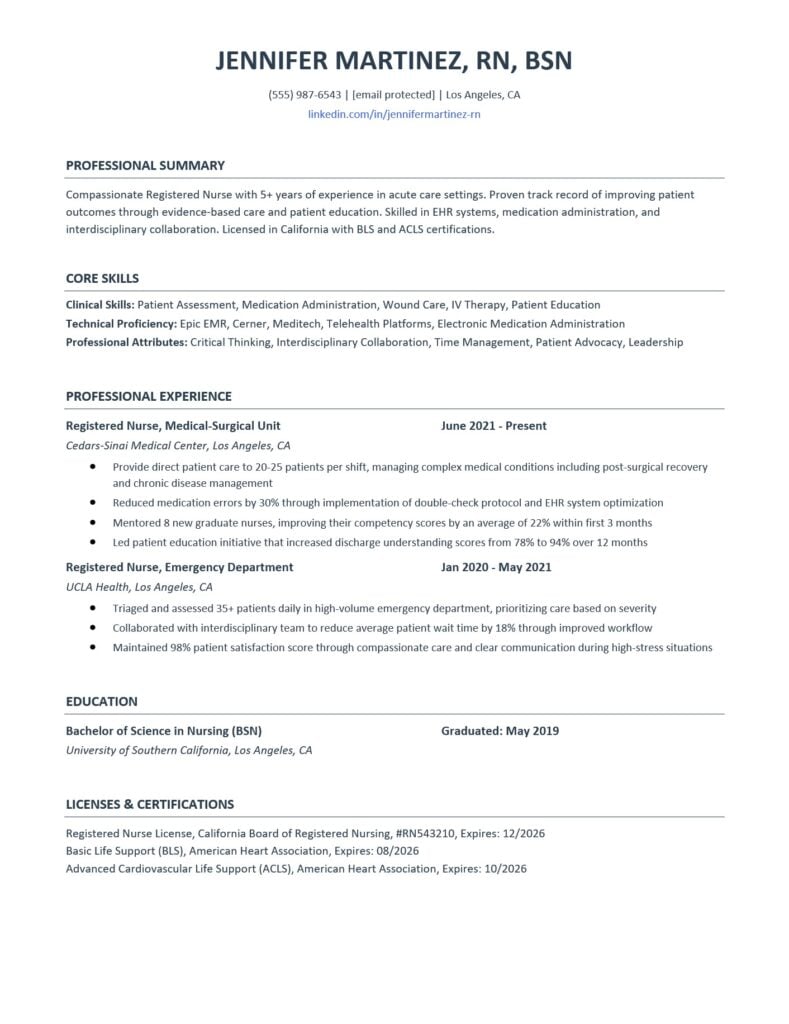
Here’s a professional nursing resume template you can download and customize. This template is designed to be both visually appealing and ATS-friendly, with clean formatting that highlights your strengths.
Blank Customizable Template
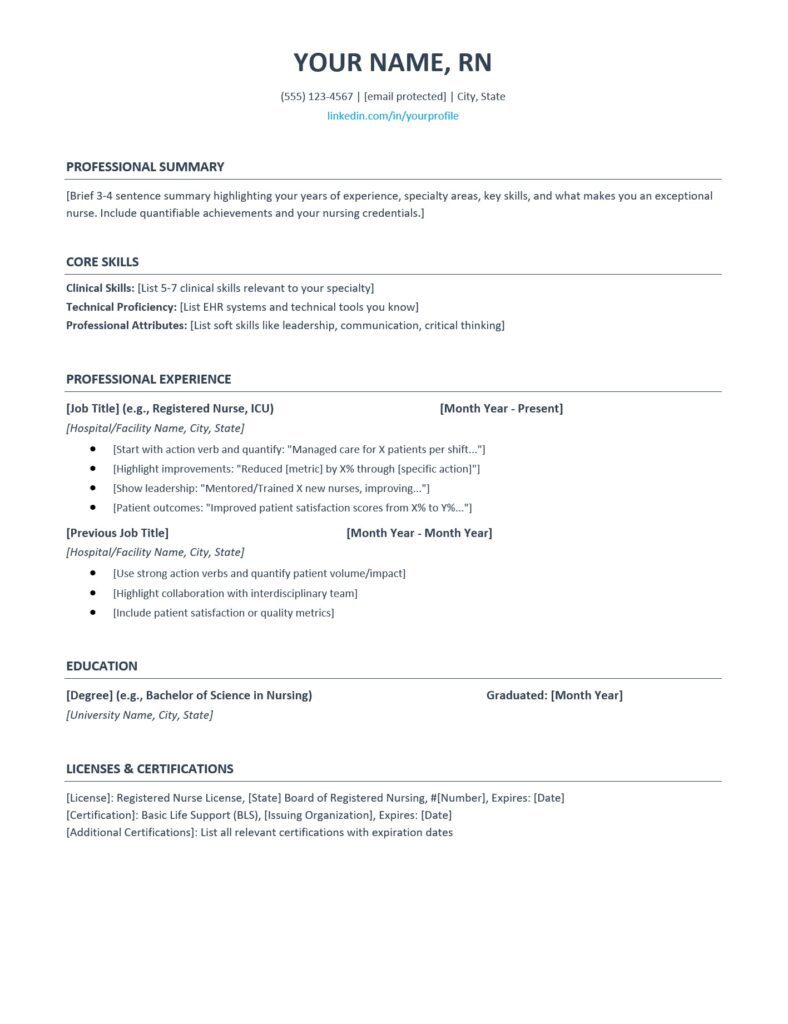
Download Your Free Template:
- Download DOCX Template (fully editable in Microsoft Word)
Interview Guys Tip: The DOCX template is fully editable, allowing you to adjust fonts, colors, and spacing to match your personal brand while maintaining professional formatting. Just replace the placeholder text with your own information.
Here’s what most people don’t realize: employers now expect multiple technical competencies, not just one specialization. The days of being “just a marketer” or “just an analyst” are over. You need AI skills, project management, data literacy, and more. Building that skill stack one $49 course at a time is expensive and slow. That’s why unlimited access makes sense:
Your Resume Needs Multiple Certificates. Here’s How to Get Them All…
We recommend Coursera Plus because it gives you unlimited access to 7,000+ courses and certificates from Google, IBM, Meta, and top universities. Build AI, data, marketing, and management skills for one annual fee. Free trial to start, and you can complete multiple certificates while others finish one.
Essential Components Every Nursing Resume Must Include
Modern nursing resumes follow a specific structure optimized for both ATS scanning and human review. Each component serves a strategic purpose in your application.
Contact Information and Professional Header
Your header is the first thing recruiters see. Include your full name with credentials (like RN, BSN), phone number, professional email address, city and state, and a LinkedIn profile URL. Make your name the largest text on the page using 18-22 point font.
List credentials in the proper order according to the American Nurses Credentialing Center: educational degrees, state license, national certifications, honors and awards. For example: Jennifer Martinez, RN, BSN, CCRN.
Professional Summary
This 3-4 sentence section sits directly below your contact information and provides a snapshot of your career. Focus on your years of experience, specialty areas, key achievements, and what makes you unique. Strong professional summaries use numbers to demonstrate impact.
Instead of writing “Experienced nurse with strong patient care skills,” try something like: “Compassionate Registered Nurse with 5+ years in acute care settings. Reduced medication errors by 30% through protocol improvements while maintaining 98% patient satisfaction scores. Skilled in Epic EMR, critical care, and new nurse mentorship.”
Core Skills Section
Place this section near the top of your resume to ensure ATS systems can quickly identify your qualifications. Divide your skills into three categories: Clinical Skills, Technical Proficiency, and Professional Attributes.
Clinical skills should include specific procedures and interventions relevant to your specialty. Examples include patient assessment, IV therapy, wound care, medication administration, and patient education. Technical proficiency should list EHR systems you know, such as Epic, Cerner, or Meditech, along with any specialized equipment.
Professional attributes cover soft skills that make you an effective nurse. Include items like critical thinking, interdisciplinary collaboration, time management, patient advocacy, and leadership abilities.
Interview Guys Tip: Don’t just list skills in isolation. When you write about your experience in the Professional Experience section, reference these skills with specific examples and quantifiable results. This reinforcement helps both ATS systems and human readers understand the depth of your capabilities.
How to Write Each Resume Section for Maximum Impact
Crafting Your Professional Experience Section
Your experience section carries the most weight in your application. List positions in reverse chronological order, starting with your most recent role. For each position, include your job title, employer name, location, and dates of employment.
The key to standing out lies in your bullet points. Each accomplishment should start with a strong action verb and include specific, quantifiable results whenever possible. Recent industry research shows that hiring managers prioritize measurable contributions when evaluating nursing candidates.
Instead of vague statements, use this formula: Action Verb + Specific Task + Quantified Result. For example:
- Weak: “Responsible for patient care in busy medical-surgical unit”
- Strong: “Managed care for 20-25 patients per shift in 36-bed medical-surgical unit, achieving 94% patient satisfaction scores”
- Weak: “Trained new nurses on hospital procedures”
- Strong: “Mentored 8 new graduate nurses, improving their competency assessment scores by an average of 22% within first 3 months”
Highlighting Your Education Effectively
For most RNs, place your Education section after your Professional Experience. List your degree, major, university name, and graduation date. Recent graduates can include relevant coursework, clinical rotations, or academic honors.
According to a 2023 American Association of Colleges of Nursing survey, 25% of hospitals now require a BSN for new hires, and nearly 70% prefer it. If you have an Associate Degree in Nursing but are working toward your BSN, include that information: “Bachelor of Science in Nursing (BSN) – In Progress, Expected Completion: May 2026.”
Licenses and Certifications Section
This section is critical for nursing positions. List your state RN license with the full name spelled out, issuing state, license number, and expiration date. Never use abbreviations that ATS systems might not recognize.
Follow with certifications in order of relevance to the position. Include the full certification name, issuing organization, and expiration date. Common certifications include BLS, ACLS, PALS, and specialty certifications like CCRN or CEN.
For those interested in continuing education opportunities, check out our guide on how to prepare for a job interview which covers how to discuss your professional development during the interview process.
Common Mistakes That Get Nursing Resumes Rejected
Formatting Errors That Confuse ATS Systems
Industry data shows that 75% of applications get rejected by applicant tracking software before reaching human recruiters, making formatting mistakes devastating to your job search. Avoid using tables, text boxes, headers, footers, or graphics in your resume body. These elements confuse ATS parsers and can cause your information to be scrambled or lost entirely.
Stick with standard fonts like Calibri, Arial, or Times New Roman in 10-11 point size. Use conventional section headings that ATS systems recognize: “Professional Experience” rather than creative alternatives like “My Nursing Journey.”
Save your resume as a .docx file unless the application specifically requests PDF format. Some older ATS systems struggle with PDF parsing, potentially causing your carefully crafted resume to appear as gibberish.
Generic Content That Fails to Differentiate
Many nurses make the mistake of using the same resume for every application. Healthcare facilities use ATS to filter resumes based on keywords from the job description. If your resume doesn’t include the specific terms, skills, and qualifications mentioned in the posting, you’ll likely be filtered out automatically.
Read each job description carefully and customize your resume accordingly. If the posting emphasizes “pediatric emergency care” and “trauma certification,” make sure those exact phrases appear in your resume if you have that experience.
Missing Quantification and Metrics
The most common weakness in nursing resumes is failing to quantify achievements. Hiring managers want evidence that you can deliver results, not just fulfill duties.
Track and include metrics in these areas: patient care volume, efficiency improvements, training and mentorship impact, quality and safety initiatives, and process optimization. Every major accomplishment in your Professional Experience section should include a number, percentage, or measurable outcome.
ATS Optimization and Keywords for Nursing Resumes
Understanding how applicant tracking systems work is essential for modern nursing job searches. These systems scan your resume for keywords that match the job description, then rank candidates based on how well they align with requirements.
Interview Guys Tip: Before you submit another application, run your resume through an ATS scanner. Most job seekers skip this step and wonder why they never hear back. Check out the free ATS checker we use and recommend →
Start by creating a master resume that includes all your skills, experiences, and achievements. For each new application, make a copy and customize it to match the specific job posting. Look for keywords in the job description and naturally incorporate them into your Professional Summary, Core Skills, and Professional Experience sections.
Pay special attention to certification names and technical terms. If a posting mentions “Epic electronic health records,” use that exact phrase rather than “Epic EMR” or “electronic medical records system.” ATS systems are becoming more sophisticated, but they still perform best with exact keyword matches.
Don’t keyword stuff or add skills you don’t actually possess. ATS optimization should enhance your legitimate qualifications, not misrepresent your background. Once you pass the ATS screening, human recruiters will quickly spot inflated or false claims during phone screens and interviews.
For more insights on navigating modern hiring technology, read our analysis of how AI analyzes your interview to understand the full spectrum of automated screening tools you’ll encounter.
Interview Guys Tip: Create a skills inventory spreadsheet listing all your clinical competencies, certifications, software systems, and technical skills. Update it after each position or training. When applying for jobs, reference this master list to quickly identify which qualifications to emphasize for each specific opportunity.
Frequently Asked Questions About Nursing Resumes
How long should a nursing resume be in 2025?
For most nurses with 10 years or less experience, keep your resume to one page. Nurses with extensive experience, multiple specialties, or advanced practice roles can extend to two pages if needed. Never sacrifice readability for length. If you’re struggling to fit everything on one page, focus on your most recent and relevant experiences.
Should I include my nursing school clinical rotations?
New graduates should absolutely include relevant clinical rotations, especially if they align with the position you’re seeking. List them under a “Clinical Experience” section, formatted similarly to your professional experience. Include the rotation type, facility, and 2-3 bullet points about your responsibilities and learning outcomes.
Experienced nurses with paid positions don’t need to include clinical rotations unless they demonstrate specialized experience in a new area you’re targeting.
Do I need a different resume for different types of nursing positions?
Yes, absolutely. The experience and skills emphasized on an ICU nursing resume should differ from a school nurse or home health nurse application. While your core qualifications remain the same, the Professional Summary, Core Skills, and even bullet points in your Professional Experience should be tailored to highlight the most relevant aspects of your background for each specific role.
How do I address employment gaps in my nursing resume?
Be honest and strategic. If you took time off for family care, additional education, or health reasons, you can briefly explain the gap in your resume or cover letter. Focus on any professional development, volunteering, or skills maintenance you did during that period.
If the gap is significant, consider using a combination resume format that emphasizes skills over strict chronology. Our career gap strategies guide provides detailed approaches for addressing this common concern.
What’s the difference between a resume objective and professional summary for nurses?
A resume objective states what you hope to achieve (“Seeking a challenging position in pediatric nursing”), while a professional summary highlights what you bring to the employer (“Pediatric RN with 4+ years in Level 1 trauma center, certified in PALS and pediatric emergency care”). Modern nursing resumes always use professional summaries because they demonstrate value rather than just expressing desire.
Taking Action: Using Your Free Nursing Resume Template
You now have access to two professionally-designed nursing resume templates: a completed example showing best practices in action, and a blank template you can customize with your own information. Both templates are ATS-optimized and formatted according to 2025 industry standards.
The example template demonstrates proper structure, effective bullet point writing, and strategic keyword placement. Use it as a reference while creating your own resume. The blank template includes helpful placeholder text guiding you through each section, making it easy to plug in your specific qualifications.
Remember that your resume is a living document. Update it after each new position, certification, or significant achievement. Maintain multiple versions tailored to different types of nursing positions you might pursue.
Your next nursing opportunity is waiting. With these templates and strategies, you’re equipped to create a resume that showcases your skills, passes ATS screening, and catches the attention of hiring managers. Download your free templates and start building the resume that will land you that interview.
Here’s what most people don’t realize: employers now expect multiple technical competencies, not just one specialization. The days of being “just a marketer” or “just an analyst” are over. You need AI skills, project management, data literacy, and more. Building that skill stack one $49 course at a time is expensive and slow. That’s why unlimited access makes sense:
Your Resume Needs Multiple Certificates. Here’s How to Get Them All…
We recommend Coursera Plus because it gives you unlimited access to 7,000+ courses and certificates from Google, IBM, Meta, and top universities. Build AI, data, marketing, and management skills for one annual fee. Free trial to start, and you can complete multiple certificates while others finish one.

BY THE INTERVIEW GUYS (JEFF GILLIS & MIKE SIMPSON)
Mike Simpson: The authoritative voice on job interviews and careers, providing practical advice to job seekers around the world for over 12 years.
Jeff Gillis: The technical expert behind The Interview Guys, developing innovative tools and conducting deep research on hiring trends and the job market as a whole.