
Do You Need a Portfolio Website? (What Hiring Managers Actually Think)
You’ve seen the advice everywhere. “Build a portfolio website.” “Show, don’t tell.” “Stand out from other candidates.”
But here’s what nobody tells you: does anyone actually look at these things? More importantly, do hiring managers care?
The answer isn’t as simple as yes or no. We analyzed recent hiring data, surveyed industry research, and examined what actually happens when candidates include portfolio links on their applications. What we found might surprise you.
☑️ Key Takeaways
- 86% of employers will visit your portfolio website if you include the link, and 71% say the quality directly influences their hiring decision
- Portfolio websites work differently for different professions: developers and designers see dramatic advantages, while traditional roles need careful strategy
- Quality matters more than having one at all: A poorly designed portfolio can actually hurt your chances more than having no portfolio
- The right platform makes or breaks success: Squarespace’s portfolio-focused templates help non-designers create professional sites that impress hiring managers
Disclosure: This article contains affiliate links. If you purchase through these links, we may earn a commission at no additional cost to you.
The Data: What Hiring Managers Actually Say About Portfolio Websites
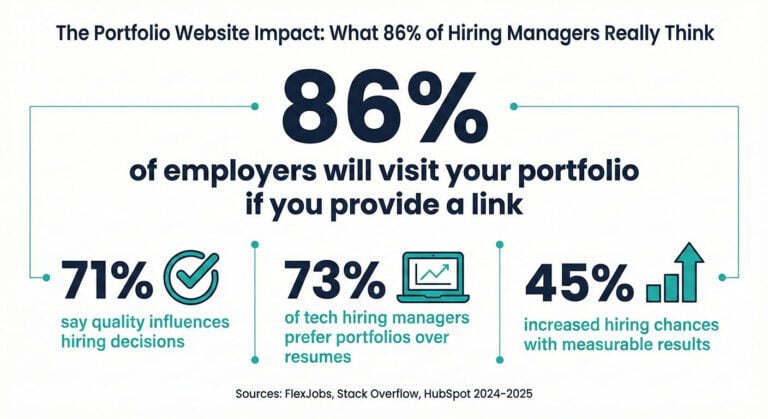
Let’s start with the numbers that matter most.
According to FlexJobs research, 86% of employers will visit a portfolio website if given the option in application materials. Even better? 71% say that the quality of your portfolio will directly influence their hiring decision.
That’s not just “nice to have” territory. That’s game-changing.
But wait, there’s more context you need. The same research shows something equally important: quality matters significantly more than simply having a portfolio. A poorly designed or outdated portfolio can actually damage your chances more than having nothing at all.
Additional survey data from Hover confirms this pattern. Among 121 hiring professionals, from coordinators to CEOs, 71% agreed or strongly agreed that portfolio quality influences hiring decisions. The emphasis again falls on “quality,” not just existence.
For developers specifically, the numbers get even more compelling. According to the Stack Overflow Developer Survey 2024, 73% of hiring managers consider a strong portfolio more important than a perfect resume for developer roles. That’s a dramatic shift from traditional hiring practices.
The verdict? If you’re in a field where portfolios are expected, not having one puts you at a serious disadvantage. But having a mediocre one might be worse than having none at all.
Here’s what most people don’t realize: employers now Google you before they interview you. Having just a resume and LinkedIn isn’t enough anymore. Having a professional website proves you can do the work, not just claim it.…
Your Resume Says You Have Skills. Your Website Proves It…
We recommend Squarespace because it lets you build a professional portfolio website in one weekend with zero coding skills. Showcase your work, host your portfolio, and give employers a reason to choose you over the 200+ other applicants. Free trial to start, and templates designed specifically for job seekers…
“But I’m Not a Designer”: Why Every Profession Benefits Differently
Here’s where things get interesting. The portfolio website advantage isn’t distributed equally across all professions.
Who Should Definitely Have a Portfolio Website
Creative and Design Professionals
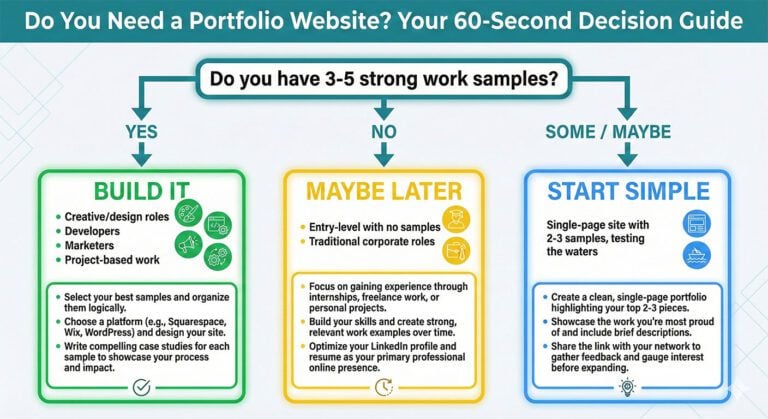
If you’re a designer, photographer, writer, or any creative professional, this isn’t even a question. Your portfolio is your resume. According to Huntr’s Q3 2025 research, projects and portfolio links appear on 58-61% of resumes in Creative & Design roles, making them standard practice rather than optional extras.
Developers and Tech Professionals
The tech industry has fully embraced portfolio culture. Recent hiring data shows that 84% of employers want to see working applications and live demos, not just code repositories. Your GitHub profile helps, but a portfolio website that showcases your best work with context and explanation dramatically improves your interview chances.
Marketers and Content Creators
If you claim to understand digital marketing, your portfolio website becomes proof of concept. Can you drive traffic? Optimize for search? Create compelling copy? Your own site demonstrates these skills better than any resume bullet point ever could.
Who Might Not Need One (Yet)
Traditional Corporate Roles
If you’re in finance, accounting, human resources, or similar fields, portfolio websites offer less clear advantage. These roles typically evaluate candidates through traditional metrics: experience, education, certifications, and interview performance.
That doesn’t mean a portfolio website can’t help. But the return on investment may be lower compared to other career development activities. Focus first on perfecting your resume and building your LinkedIn presence.
Entry-Level Candidates Without Work Samples
If you’re just starting out and don’t have substantial work to showcase, creating a portfolio website might put the cart before the horse. Build your skills first, create compelling work samples, then invest in the portfolio infrastructure.
One exception: if you’re completing significant academic projects, student portfolios can demonstrate potential even without professional experience.
What a Portfolio Looks Like for Non-Creative Professionals
The biggest misconception about portfolio websites is that they’re only for designers and developers. That’s simply not true anymore.
For Project Managers
Your portfolio showcases completed projects with clear metrics. Think case studies: What was the challenge? How did you approach it? What were the measurable results? Include anonymized project plans, stakeholder communication examples, and outcome data.
For Data Analysts
Display your best visualizations, explain your analytical process, and show how your insights drove business decisions. Tools like Tableau Public make this straightforward, and embedding these visualizations on your portfolio site demonstrates both technical skills and communication ability.
For Teachers and Educators
Showcase your curriculum design, student success stories (anonymized), teaching philosophy, and innovative lesson plans. Education portfolios have become increasingly common, especially for positions requiring demonstrated pedagogical expertise.
For Sales Professionals
While you can’t share confidential client information, you can display your approach to prospecting, sample pitch decks, your personal brand, and thought leadership content. A well-crafted portfolio demonstrates the same skills you’ll use to win clients: persuasion, presentation, and professional polish.
For Finance and Accounting Professionals
Create anonymized case studies showing how you’ve improved processes, reduced costs, or identified financial opportunities. Include your approach to complex problems and the frameworks you use for financial analysis.
The key pattern? Your portfolio translates your experience into tangible proof of capability. It answers the question every hiring manager has: “Can this person actually do what their resume claims?”
If you want to see some concrete examples, check out our portfolio website examples across different professions.
The Cost-Benefit Analysis: Is It Worth Your Time and Money?
Let’s talk about the real investment required.
Time Investment
- Planning and organizing content: 4-6 hours
- Creating or refining work samples: 8-12 hours
- Building the actual site: 6-10 hours with templates
- Ongoing maintenance: 2-3 hours quarterly
Total initial investment: Roughly 18-28 hours, or about one busy weekend if you’re focused.
Financial Investment
Using a platform like Squarespace, you’re looking at:
- $16-$23 per month for a personal site
- Custom domain: $20-30 annually
- Total first year: $200-$300
Potential Return on Investment
Here’s where it gets interesting. According to HubSpot’s 2024 research, portfolios with measurable results increase hiring chances by 45%. That’s not a small bump. That’s nearly half again as likely to land an interview.
If your target salary is $75,000, and a portfolio website increases your chances of getting hired by even 10% (conservative estimate), the value of landing that job one month sooner is $6,250. Your $300 investment suddenly looks pretty smart.
Even better: 86% of employers will actually look at your portfolio if you provide the link. That’s engagement most marketing campaigns would kill for.
The math works out even more favorably for higher salary positions or competitive fields where differentiation matters most.
How to Get Started Today: Your Action Plan
Ready to build a portfolio website? Here’s your strategic roadmap.
Step 1: Audit Your Work Samples
Before touching any website builder, gather your best work. You need:
- 3-5 strong examples that showcase different skills
- Measurable results or clear impact from each project
- Permission to share (or anonymized versions)
- High-quality images, screenshots, or documentation
Quality beats quantity every time. Five excellent pieces outperform 20 mediocre ones.
Step 2: Choose Your Platform Strategically
This decision matters more than most people realize. You need a platform that:
- Makes you look professional without design skills
- Loads quickly on mobile devices
- Doesn’t scream “template” to discerning eyes
- Provides portfolio-specific features
After reviewing dozens of options, Squarespace consistently rises to the top for portfolio websites. Here’s why:
Their portfolio templates are specifically designed to showcase work, not just host a blog. You get galleries, project pages, and layouts that actually make sense for displaying your accomplishments. More importantly, their templates don’t look like everyone else’s portfolio.
The platform handles the technical complexity. No coding required. No wrestling with plugins or dealing with security updates. You focus on content; they handle everything else.
Most compelling? You can start with a free trial and see if it works before committing any money. Test drive the platform, build your site, and make sure you’re happy before paying a cent.
Step 3: Follow the Proven Structure
Your portfolio needs these elements in this order:
Homepage:
- Professional photo and your name
- One-sentence description of what you do
- Clear navigation to your work
About Page:
- Brief professional background (200 words max)
- Your unique value proposition
- Contact information
Portfolio/Work Section:
- 3-5 projects with detailed case studies
- For each: challenge, approach, result
- Visual elements that support your story
Optional but Powerful:
- Testimonials from clients or colleagues
- Certifications and credentials
- Blog or thought leadership content
Need inspiration? Check out our portfolio website examples across different professions.
Step 4: Optimize for Your Audience
Remember those hiring managers who will actually look at your site? Make it easy for them:
- Load time under 3 seconds (Squarespace handles this automatically)
- Mobile-responsive design (also handled by Squarespace)
- Clear navigation (use their portfolio templates’ proven structure)
- Professional domain name (yourname.com, not yourname.squarespace.com)
Browse Squarespace’s portfolio templates to see how professionals across industries are structuring their sites. You’ll notice patterns that work: clean layouts, generous white space, and content that tells a story rather than just listing achievements.
The Portfolio Website Maintenance Question
Here’s something most articles skip: what happens after you build it?
Quarterly Updates (Minimum)
- Add new projects as you complete them
- Remove older work that no longer represents your best
- Update metrics and results as projects mature
- Check all links still work
Annual Refresh
- Evaluate if your template still serves your goals
- Update your bio and professional photo
- Review analytics to see what hiring managers actually view
- Adjust content based on which projects get the most attention
The good news? With Squarespace’s straightforward interface, updates take minutes, not hours. You’re not fighting with code or plugins. You’re just editing content.
The Real Cost of Not Maintaining
Research specifically warns that outdated portfolios can actively hurt your chances. Hiring managers interpret stale content as disengagement or lack of recent work. An unmaintained portfolio signals you’re not taking your career seriously.
Set a recurring calendar reminder. Make updates part of your professional routine, like updating your resume or refreshing your LinkedIn.
Common Portfolio Website Mistakes to Avoid
Let’s talk about what kills portfolio effectiveness.
The “Everything But the Kitchen Sink” Approach
Showing 30 projects doesn’t make you look more qualified. It makes hiring managers’ eyes glaze over. They’ll spend maybe 60 seconds on your portfolio. Make those 60 seconds count with your absolute best work only.
Forgetting Mobile Users
Over 60% of initial portfolio views happen on mobile devices. If your site doesn’t work perfectly on phones, you’re losing more than half your audience. Squarespace templates handle this automatically, but if you’re building custom, test obsessively on mobile.
No Context for Your Work
Screenshots without explanation mean nothing. Hiring managers need to understand:
- What problem were you solving?
- What was your specific role?
- What were the measurable results?
Outdated or Broken Work Samples
Nothing says “I don’t update my work” like broken links or projects from five years ago. If you can’t keep your portfolio current, don’t have one. Seriously.
Overdesigned Sites That Slow Load Times
Fancy animations and heavy graphics might look cool to you, but hiring managers have dozens of applications to review. A slow-loading portfolio gets abandoned. Google reports that 53% of mobile users leave sites that take longer than 3 seconds to load.
Your Portfolio in the Larger Job Search Strategy
A portfolio website isn’t a magic bullet. It’s one tool in your job search arsenal.
Integration Points
Your portfolio should appear:
- On your resume (in the header with your contact info)
- On your LinkedIn profile (prominently featured)
- In your cover letters (when relevant)
- In your email signature during the job search
When to Send It
- Include the link in your initial application
- Mention it during phone screens
- Reference specific projects during interviews
- Share it during follow-up communications
How It Supports Other Materials
Think of your job search materials as a coordinated campaign:
- Resume: Summary of qualifications
- Cover letter: Why you’re interested and qualified
- Portfolio: Proof that you can deliver results
- Interview: Opportunity to discuss your process
Each piece reinforces the others. Your portfolio transforms resume bullet points from claims into evidence.
The Verdict: Should You Build a Portfolio Website?
After analyzing the research, here’s our clear recommendation:
Build a portfolio website if:
- You’re in a creative, technical, or highly skilled profession
- You have strong work samples that demonstrate clear results
- You’re willing to invest the time to do it well
- You can commit to keeping it updated quarterly
- Your target roles involve tangible deliverables or projects
Hold off on a portfolio website if:
- You’re in a traditional corporate role where portfolios are rare
- You don’t yet have work samples worth showcasing
- You can’t maintain it (better to have none than an outdated one)
- Other job search activities would provide better ROI
For everyone else: Consider a middle ground. A single-page site on Squarespace with your bio, contact info, and best 2-3 work samples. It’s less maintenance than a full portfolio but still provides that 86% of hiring managers what they want: a deeper look at your capabilities.
Getting Started: Your Next Steps
Remember those numbers from the beginning? 86% of employers will look at your portfolio if you provide it. 71% say quality influences their hiring decision. That’s significant impact for a weekend’s work.
The question isn’t whether portfolios matter. The data proves they do.
The question is whether you’re ready to invest the time to do it right.
If you are, start here:
- Gather your 3-5 best work samples this week
- Start a free Squarespace trial to test the platform
- Spend next weekend building your site using their portfolio templates
- Get feedback from trusted colleagues before going live
- Add the link to your resume and LinkedIn immediately
Ready to dive deeper into building your portfolio? Check out our complete guide to creating a portfolio website that actually gets you hired, where we walk through the entire process step-by-step.
Your competition already has portfolios. The ones who get interviews? They have great ones. Which group do you want to be in?
Here’s what most people don’t realize: employers now Google you before they interview you. Having just a resume and LinkedIn isn’t enough anymore. Having a professional website proves you can do the work, not just claim it.…
Your Resume Says You Have Skills. Your Website Proves It…
We recommend Squarespace because it lets you build a professional portfolio website in one weekend with zero coding skills. Showcase your work, host your portfolio, and give employers a reason to choose you over the 200+ other applicants. Free trial to start, and templates designed specifically for job seekers…

BY THE INTERVIEW GUYS (JEFF GILLIS & MIKE SIMPSON)
Mike Simpson: The authoritative voice on job interviews and careers, providing practical advice to job seekers around the world for over 12 years.
Jeff Gillis: The technical expert behind The Interview Guys, developing innovative tools and conducting deep research on hiring trends and the job market as a whole.