
Career Change at 40: Your Complete Guide to Starting Fresh and Thriving
You’re staring at your computer screen on a Monday morning, wondering how you ended up here. Twenty years into a career that once felt promising, but now feels… wrong. The thought keeps creeping in: Is it too late to start over at 40?
Here’s the truth that might surprise you. Nearly half of professionals aged 40 to 45 are actively exploring new career paths right now, and many are finding success. Your 40s aren’t too late for a fresh start. In fact, they might be the perfect time to combine decades of experience with a clear vision of what you actually want.
By the end of this article, you’ll understand why changing careers at 40 is becoming the norm, discover which fields welcome career changers, and learn the exact steps to make your transition successful without starting from scratch financially or professionally.
☑️ Key Takeaways
- Career changes at 40 are increasingly common, with nearly half of professionals in their 40s actively exploring new opportunities for better pay, work-life balance, and meaningful work.
- Your two decades of experience provide transferable skills like leadership, problem-solving, and emotional intelligence that younger candidates simply cannot match, making you valuable to employers despite changing industries.
- Professional certifications from platforms like Coursera can bridge skills gaps in months instead of years, allowing you to gain credentials in data analysis, project management, digital marketing, or tech without going back to school full-time.
- Financial planning with 6-12 months of savings, strategic networking, and starting with side projects can minimize the risk of career transitions while you build experience and connections in your target field.
Disclosure: This article contains affiliate links. If you purchase through these links, we may earn a commission at no additional cost to you.
Why Career Change at 40 Makes Strategic Sense
The average American worker changes jobs 12 times during their career, and the statistics around mid-life career transitions might surprise you. According to recent research, 33% of professionals aged 40 and older regularly change occupations. This isn’t people running from failure. These are strategic moves toward better pay, improved work-life balance, and meaningful work.
You’re not starting over. You’re starting with experience.
Think about what you bring to the table at 40 that you didn’t have at 25. You’ve developed emotional intelligence from managing difficult coworkers and clients. You’ve honed decision-making skills through years of real-world consequences. You’ve built professional networks that younger candidates can’t match.
Research shows that workers who changed jobs mid-career are significantly more likely to be employed at age 60, and those who change jobs voluntarily tend to see wage increases compared to those who don’t switch. The data supports what you’re feeling: sometimes the smartest career move is a complete pivot.
Your 40s also come with clarity that’s impossible to have in your 20s. You know yourself better. You understand your non-negotiables for work-life balance. You’ve seen enough toxic workplace cultures to know exactly what to avoid. This self-awareness is a competitive advantage that younger job seekers simply don’t have.
The Biggest Advantages You Have at 40
Let’s address the elephant in the room. You might worry that younger candidates have the edge. But here’s what hiring managers actually value about career changers in their 40s:
- Leadership presence. You’ve been in enough meetings to command a room. You know how to disagree professionally, navigate office politics, and build consensus. These soft skills take years to develop and can’t be taught in a certification program.
- Problem-solving instincts. After two decades in the workforce, you’ve seen enough challenges to recognize patterns quickly. You don’t panic when things go wrong. You’ve developed what researchers call “professional judgment” that only comes with experience.
- Reliability and work ethic. Employers know that professionals in their 40s tend to have lower turnover rates. You’re not job-hopping every 18 months. When you commit, you tend to stay, making you a safer long-term investment for companies.
- Emotional maturity. You don’t need hand-holding. You can give and receive feedback without drama. You understand that not every disagreement is personal. This emotional regulation is incredibly valuable in high-stress work environments.
According to workplace surveys, 83% of workers now rank work-life balance above compensation. If you’re making a career change partly motivated by better quality of life, you’re in good company. The modern job market increasingly values what you’re seeking.
Fields That Welcome Career Changers
Some industries actively seek the experience and maturity that 40-something professionals bring. Here are career paths where your age is an asset, not a liability:
Project Management
Companies need people who can herd cats, manage budgets, and deliver results on deadline. Sound familiar? Your years of coordinating people and resources in your current role translate directly.
The median salary for project managers is around $98,000, and demand continues growing as organizations tackle increasingly complex initiatives. Many successful project managers come from completely unrelated backgrounds because the core skills are so transferable.
Healthcare Administration
The healthcare industry is booming, and not just for doctors and nurses. Healthcare administrators oversee operations, manage staff, handle budgets, and ensure regulatory compliance. If you’ve got organizational skills and attention to detail, this field offers both stability and meaning.
Roles like medical receptionist and healthcare coordinator provide entry points that can lead to administrative positions. The Bureau of Labor Statistics projects strong growth in healthcare support roles through 2031.
Tech-Adjacent Roles
You don’t need to become a software developer to work in tech. Companies desperately need people who can bridge the gap between technical teams and business stakeholders. Roles like technical writer, product manager, UX researcher, and business analyst all value your communication skills and industry knowledge.
Web development is expected to grow 23% through the decade, and increasingly, employers are hiring certificate-holders over those with traditional four-year degrees. Your ability to understand user needs and translate technical concepts for non-technical audiences is incredibly valuable.
Digital Marketing
If you understand consumer behavior and can tell a compelling story, digital marketing offers multiple entry points. Content marketing, email marketing, social media management, and SEO all rely more on strategic thinking than technical wizardry.
The digital marketing field is projected to add thousands of jobs annually, with median salaries ranging from $60,000 to over $100,000 depending on specialization and experience level.
Consulting and Coaching
After 20 years in an industry, you’re likely an expert even if you don’t feel like one. Career coaching, business consulting, and specialized advisory roles allow you to monetize that deep knowledge. Many consultants start part-time while transitioning, building a client base before going all-in.
For inspiration on making bold career moves, check out these stories of people who ditched their dead-end jobs and found success in unexpected places.
Your Transferable Skills Are More Valuable Than You Think
Here’s a critical mindset shift: you’re not starting from zero.
Every job you’ve held has equipped you with transferable skills that apply across industries. The key is identifying these skills and articulating them in terms your target industry understands.
Start by making a list of everything you do regularly in your current role. Include the mundane stuff. Can you handle difficult customers with grace? That’s conflict resolution and customer service excellence. Do you regularly manage budgets or track expenses? That’s financial management and attention to detail. Have you trained new employees? That’s instructional design and leadership development.
Many recruiters follow the principle: “Hire for attitude, train for skill.” Your soft skills, work ethic, and willingness to learn often matter more than specific technical proficiencies. Companies can teach you their software systems. They can’t teach you two decades of professional judgment.
Communication skills transfer to virtually every role. Whether you’re writing reports, presenting to stakeholders, or negotiating with vendors, you’re demonstrating abilities that employers desperately need.
Leadership and teamwork show up in countless ways. Leading a project team, mentoring junior colleagues, or coordinating cross-functional initiatives all prove you can work effectively with others toward common goals.
Problem-solving and adaptability are increasingly crucial as industries face rapid technological change. Your ability to learn new systems, adapt to shifting priorities, and find creative solutions demonstrates the agility employers value.
The skills-based hiring movement is making it easier for career changers to highlight these transferable abilities over traditional credentials. Companies are finally recognizing that skills matter more than where or what you studied 20 years ago.
How Certifications Can Fast-Track Your Career Change
Here’s where strategy becomes crucial. While you have valuable transferable skills, you may have gaps in technical knowledge for your target field. Professional certifications are the fastest way to bridge those gaps without spending four years back in school.
Certifications serve two critical purposes. First, they give you the actual skills you need to perform in a new role. Second, they signal to employers that you’re serious about this transition. When a hiring manager sees a relevant certification on your resume, it proves you’ve invested time and money in preparing for this career change.
The good news? Many high-value certifications can be completed in weeks or months, not years. And with platforms offering flexible, online learning, you can upskill while still working your current job.
Coursera Plus: Your All-Access Pass to Career Transformation
One of the smartest investments you can make is a Coursera Plus subscription. For a single annual fee, you get unlimited access to over 7,000 courses and professional certificates from top universities and companies like Google, Meta, IBM, and Microsoft.
This means you can explore different career paths, take multiple certifications, and continuously upskill without worrying about per-course costs. The flexibility is perfect for working professionals who need to learn on their own schedule.
Interview Guys Tip: Don’t just collect certifications. Focus on completing 1-2 highly relevant ones that directly align with your target role. Hiring managers value depth and follow-through over a scattered resume full of half-finished courses.
High-Impact Certifications for Career Changers
Depending on your target field, here are some of the most respected professional certificates that can accelerate your career change:
For Data-Driven Roles:
The Google Data Analytics Professional Certificate teaches you to clean, analyze, and visualize data using tools like SQL, R, and Tableau. Data skills are in demand across virtually every industry, from healthcare to marketing to finance.
If you want to go deeper, the Meta Data Analyst Professional Certificate covers Python programming, statistics, and data visualization. This certification prepares you for roles that command salaries well into six figures.
For Business and Management:
The Google Project Management Professional Certificate is one of the most popular certifications for career changers. It covers agile methodology, risk management, and stakeholder communication. Project management roles exist in every industry and leverage many of the organizational skills you already have.
For strategic business roles, the Microsoft Business Analyst Professional Certificate teaches data-driven decision making, process modeling, and change management. These skills are crucial for anyone wanting to move into business intelligence or operations roles.
For Marketing and Creative Fields:
The Google Digital Marketing & E-Commerce Professional Certificate covers SEO, social media marketing, email campaigns, and analytics. Digital marketing is perfect for career changers because it values creativity and strategic thinking over formal credentials.
For visual communicators, the Google UX Design Professional Certificate teaches user research, wireframing, prototyping, and usability testing. UX roles command median salaries over $90,000 and exist across industries from finance to gaming.
For Tech Careers:
You don’t need a computer science degree to break into tech. The Google IT Support Professional Certificate prepares you for help desk roles that can lead to systems administration or network engineering positions.
For those interested in emerging tech, the IBM AI Developer Professional Certificate teaches you to build AI-powered applications and chatbots using Python and generative AI models. AI skills are increasingly valuable across all industries.
Ready to start learning? Get unlimited access to 7,000+ courses with Coursera Plus and begin building the skills you need for your next career.
The certification landscape is rapidly evolving to meet the needs of career changers. Unlike traditional degrees that take years and cost tens of thousands of dollars, professional certificates can be completed in months for a fraction of the cost. Many can be completed entirely online, on your schedule, while you’re still employed.
The Financial Reality of Career Change
Let’s talk money. Career changes at 40 come with financial considerations you didn’t have at 25. You might have a mortgage, kids, retirement accounts to protect. The last thing you want is to derail your financial security.
First, the good news. Research shows that voluntary career changers often see wage increases compared to those who stay put. The average salary increase when changing jobs is 14.8%, compared to just 3-5% for those who stay with the same company.
That said, you need a financial cushion. Most career advisors recommend having 6-12 months of expenses saved before making a major career transition. This gives you breathing room to find the right opportunity rather than desperately accepting the first offer.
Consider these strategies to minimize financial risk:
- Start a side hustle in your target field before leaving your current job. This allows you to build skills, test whether you actually enjoy the work, and create some income while you transition. Many successful career changers spent 6-12 months building their new career part-time.
- Explore part-time or contract work in your new field. This provides income while you establish yourself and can lead to full-time opportunities. Contract roles also let you try out a company before committing.
- Network aggressively. Many of the best opportunities never get posted publicly. By connecting with people in your target industry, you’ll hear about openings before they’re advertised and get insider referrals that dramatically improve your chances.
For practical tips on positioning yourself for better opportunities, read our guide on how to change careers in 2025. It covers everything from updating your resume to negotiating salary when you’re pivoting industries.
Overcoming the Mental Barriers
The biggest obstacles to career change at 40 are often psychological, not practical. Let’s address the thoughts that might be holding you back:
“I’m too old.” Not true, and increasingly, illegal for employers to consider. Your age brings wisdom, reliability, and institutional knowledge that companies value. Frame your experience as an advantage, not a liability.
“I’ll have to start at the bottom.” Not necessarily. Your transferable skills and professional maturity often allow you to enter at mid-level positions, especially if you’ve gained relevant certifications. You’re not a fresh college grad; you’re a seasoned professional entering a new field.
“What if I fail?” What if you succeed? The real question is: can you afford to spend the next 25 years in a career that drains you? The cost of staying in the wrong career often exceeds the risk of changing.
“It’s selfish to upend everything.” Actually, research shows that unhappy, burned-out workers are worse parents, partners, and community members. Taking care of your career satisfaction isn’t selfish. It’s responsible.
One effective strategy is to treat your career change like any other major project. Break it into manageable steps. “Get a new job” feels overwhelming. “Update my LinkedIn profile this weekend” or “Complete one certification course this month” feels achievable.
For insights on navigating workplace transitions, check out our analysis of why 47% of workers have revenge quit. Understanding what drives people to leave jobs can help you make a more intentional decision about your own move.
Your Step-by-Step Career Change Roadmap
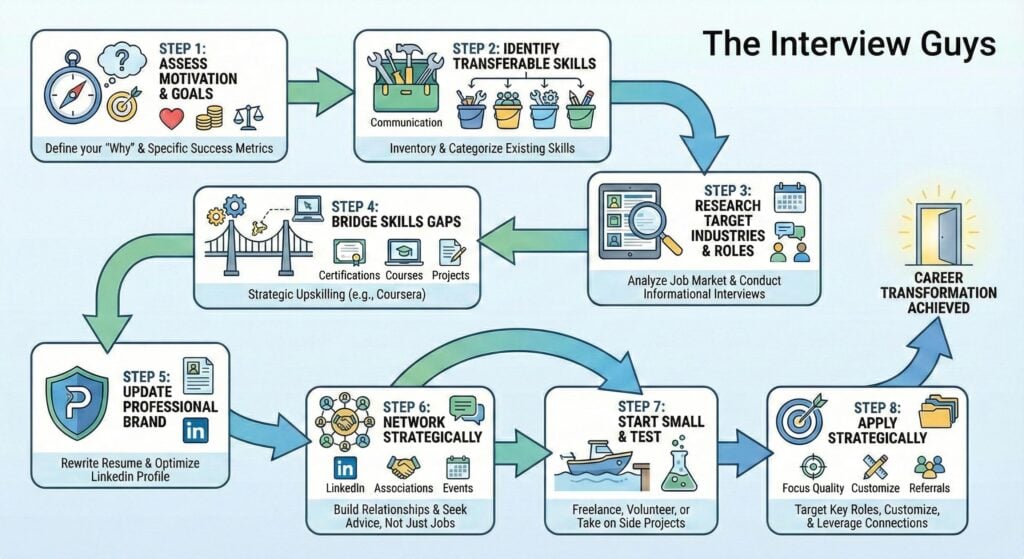
Ready to make this happen? Here’s your practical action plan:
Step 1: Assess Your Motivation and Goals
Get crystal clear on why you’re changing careers. Is it money? Work-life balance? Meaning? Toxic culture? Your “why” will sustain you through challenging moments in the transition.
Write down what success looks like in specific, measurable terms. “More fulfilling work” is vague. “A role where I directly help people solve problems, with flexible hours and a salary of at least $X” gives you a clear target.
Step 2: Identify Your Transferable Skills
Create a comprehensive inventory of your skills. Look at your current job description, performance reviews, and major accomplishments. For each responsibility or achievement, ask: “What skill does this demonstrate?”
Group your skills into categories: communication, leadership, technical, analytical, creative. This organization will help you articulate your value to employers in different industries.
Step 3: Research Target Industries and Roles
Don’t just guess what might be a good fit. Research thoroughly. Look at job postings in your target field. What qualifications keep appearing? What salary ranges are realistic? What’s the growth outlook?
Schedule informational interviews with people currently working in roles you’re considering. Ask about their day-to-day reality, what they love about the work, and what surprised them after starting. These conversations provide insights you can’t get from online research alone.
Step 4: Bridge Your Skills Gaps
Based on your research, identify the gaps between your current skills and what employers want. Then get strategic about filling those gaps through certifications, online courses, volunteer work, or freelance projects.
This is where platforms like Coursera become invaluable. You can build new technical skills while maintaining your current job, preparing yourself for the transition without financial risk.
Step 5: Update Your Professional Brand
Your resume needs to tell a coherent story about why you’re making this change and why you’re qualified. Focus on transferable skills and accomplishments that align with your target role. Use the language and keywords from job postings in your target field.
Your LinkedIn profile is equally important. Update your headline to reflect your target role, not your current one. Write a summary that explains your transition and highlights relevant experience. Engage with content in your target industry to signal your serious interest.
Step 6: Network Strategically
Connect with people in your target industry through LinkedIn, professional associations, and industry events. Don’t immediately ask for jobs. Instead, seek advice and information. Most people are happy to share their expertise and may think of you when opportunities arise.
Consider joining online communities related to your target field. Active participation demonstrates your engagement and helps you stay current on industry trends and terminology.
Step 7: Start Small and Test
Before making a dramatic leap, test the waters. Can you take on a project at your current company that involves skills from your target field? Can you freelance on weekends? Can you volunteer in a relevant role?
These smaller commitments let you build experience, create portfolio pieces, and confirm that you actually enjoy the work before fully committing.
Step 8: Apply Strategically
Quality over quantity. Rather than blasting your resume to 100 companies, focus on 10-15 organizations where you’d genuinely want to work. Research each company thoroughly, customize your application materials, and try to get a personal referral or introduction.
When you apply, acknowledge your career change directly. Explain briefly why you’re making the transition and how your unique background will benefit them. Don’t apologize for your path; frame it as an advantage.
Making Your Resume Work Harder
Your resume is your first chance to tell your career change story effectively. Here’s how to make it work for you, not against you:
- Lead with a strong summary that clearly states what you’re seeking and why your background makes you valuable. For example: “Accomplished retail manager with 15 years of team leadership experience seeking to transition into human resources. Proven track record of hiring, training, and developing high-performing teams of 20+ employees.”
- Reorganize your experience to highlight transferable skills. Instead of listing every job duty chronologically, create a skills-based resume that groups your experience by relevant categories like “Team Leadership,” “Budget Management,” or “Process Improvement.”
- Quantify everything possible. Numbers grab attention and prove impact. “Managed a team” is weak. “Led team of 12 that improved customer satisfaction scores by 23% while reducing employee turnover by 35%” tells a compelling story.
- Include relevant volunteer work and side projects. If you’ve been building a blog about your target industry or volunteering with a relevant nonprofit, include it. These experiences demonstrate genuine interest and can provide portfolio pieces.
- Don’t hide your age, but don’t emphasize it. You don’t need to list your graduation year or include irrelevant jobs from decades ago. Focus on the last 10-15 years of experience that’s most relevant to your target role.
For specific guidance on resume writing for career transitions, our article on how to write a skills-based resume provides detailed templates and examples.
The Truth About Age Discrimination
Let’s address the concern directly. Age discrimination exists. Some employers harbor biases about older workers being less adaptable, more expensive, or technologically challenged.
But here’s the flip side: age discrimination is illegal, and smart companies know that diverse teams perform better. Many organizations actively seek professionals with the maturity and stability that mid-career workers bring.
You can’t control bias, but you can control how you present yourself:
- Stay current with technology. Make sure your LinkedIn profile is active and polished. Demonstrate familiarity with modern tools and platforms relevant to your target field. Mention specific software or systems you’ve mastered recently.
- Emphasize adaptability and learning. Share examples of times you’ve had to learn new skills or adapt to major changes. Your ongoing education through certifications proves you’re committed to growth.
- Highlight recent achievements. Don’t dwell on accomplishments from the 1990s. Focus on what you’ve done in the last 5-10 years that demonstrates current relevance.
- Bring energy and enthusiasm. In interviews, show genuine excitement about the opportunity and the field. Enthusiasm is contagious and combats any stereotypes about older workers being set in their ways.
The labor market is tight, and employers are struggling to find qualified candidates. Your experience, reliability, and professional network make you an attractive hire if you position yourself strategically.
Real Success Stories
You’re not alone in making this transition. Career changes at 40 are increasingly common, and many find their second career more rewarding than their first.
Consider Julia Child, who didn’t start cooking professionally until her late 30s and published her first cookbook at 39. By her early 40s, she was revolutionizing American cooking through her television show.
Or Vera Wang, who worked as a fashion editor until 40 before entering design. She launched her bridal line at 40 and built a fashion empire that continues decades later.
These aren’t anomalies. They’re examples of people who recognized that decades of experience in one field could inform and elevate their work in another. Your professional maturity is an asset, not a limitation.
According to the World Economic Forum, 44% of workers’ skills will be disrupted in the next five years. The ability to adapt and learn throughout your career isn’t just valuable for career changers; it’s becoming essential for everyone.
Common Mistakes to Avoid
Having watched countless career transitions, here are the pitfalls to avoid:
- Waiting for the perfect moment. There’s never a perfect time. Life is always messy. Kids will always need things. Bills will always exist. Start preparing now, even if the full transition happens later.
- Undervaluing your experience. Don’t apologize for your background or accept below-market salaries because you’re “new” to the field. Your transferable skills and professional maturity have real value. Negotiate accordingly.
- Failing to network. The hidden job market is real. Many positions get filled through referrals before they’re ever posted. If you’re not actively building relationships in your target industry, you’re missing opportunities.
- Choosing the wrong certifications. Not all certifications are equally valuable. Research which credentials actually matter to employers in your target field. Some certifications are universally respected; others are meaningless outside specific contexts.
- Giving up too quickly. Career transitions take time. You might send 50 applications before landing interviews. You might interview multiple times before getting offers. Persistence is essential. Every “no” brings you closer to the right “yes.”
Your Next Move
Making a career change at 40 isn’t easy, but it’s far from impossible. Thousands of professionals are doing it successfully right now, and the labor market is more open to career changers than ever before.
The question isn’t whether you can do this. The question is whether you’re ready to start.
Start small. Pick one action from this guide and complete it this week. Update your LinkedIn profile. Schedule one informational interview. Research one certification program. Each small step builds momentum toward the career you actually want.
Twenty years from now, you’ll look back at this moment. Will you remember it as the time you found the courage to change course? Or will you wonder what might have been?
Your 40s aren’t too late for a fresh start. They’re exactly the right time to combine everything you’ve learned with a clear vision of what you want next. The tools, resources, and opportunities exist. All that’s missing is your decision to begin.
Ready to take the first step? Start building the skills you need with Coursera Plus and explore thousands of professional certificates designed for working adults making career transitions just like you.

BY THE INTERVIEW GUYS (JEFF GILLIS & MIKE SIMPSON)
Mike Simpson: The authoritative voice on job interviews and careers, providing practical advice to job seekers around the world for over 12 years.
Jeff Gillis: The technical expert behind The Interview Guys, developing innovative tools and conducting deep research on hiring trends and the job market as a whole.