
The Application Paradox: Why Some Job Seekers Need 10 Apps and Others Need 100+

The Most Confusing Data Point in Job Search Research
Here’s a stat that breaks everyone’s brain: according to Huntr’s Q2 2025 Job Search Trends Report, the largest group of successful job seekers (20.8%) landed their jobs after submitting just 10-20 applications.
Sounds encouraging, right?
But here’s where it gets weird. The second-largest group (14.3%) needed over 100 applications to get the same result. Not 30 or 40 or even 60. Over 100.
This isn’t a normal distribution. Most job search metrics follow predictable patterns, but application volume creates a bizarre split. Some people apply strategically and succeed quickly. Others spray applications everywhere and eventually break through by sheer volume.
The question that keeps career coaches up at night is this: which strategy actually works? And more importantly, which one will work for you?
☑️ Key Takeaways
- The application volume paradox is real: 20.8% of successful job seekers land offers with just 10-20 applications, while 14.3% need over 100 applications for the same outcome
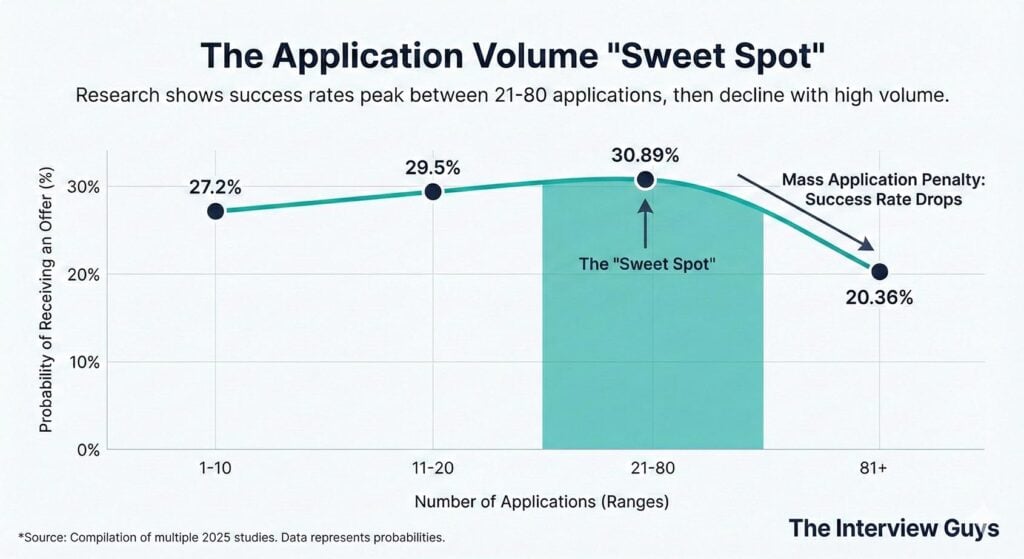
- More isn’t always better: Job seekers who submitted 21-80 applications had a 30.89% offer rate compared to just 20.36% for those who applied to 81+ positions
- Quality beats quantity at scale: Strategic, targeted applications convert at 3x higher rates than mass “spray and pray” approaches, yet desperation drives many to apply everywhere
- The busiest 10% aren’t the most successful: These high-volume applicants fire off 19-83 applications per week but often see diminishing returns as personalization drops
What the Data Actually Shows About Application Volume
Let’s dig into what happens when you analyze hundreds of thousands of real job applications. The numbers reveal some uncomfortable truths about the modern job search.
The Sweet Spot Exists, But It’s Narrow
Research compiled from multiple 2025 studies shows that most successful job seekers land offers after 32-200+ applications. That’s a massive range, and it reflects the reality that job searches vary wildly based on your situation.
But here’s what’s interesting. When you break down the data by application count, a pattern emerges:
- 1-10 applications: 27.2% probability of receiving an offer
- 11-20 applications: 29.5% probability of receiving an offer
- 21-80 applications: 30.89% probability of receiving an offer
- 81+ applications: 20.36% probability of receiving an offer
Notice what happens after 80 applications? Your success rate actually drops.
This suggests that mass application strategies create their own problems. You’re either rushing through applications without proper targeting, or you’re applying to roles where you’re not truly competitive.
The High-Volume Trap
The busiest 10% of job seekers in Q2 2025 submitted an average of 19 applications per week. By Q3, that number had jumped to a staggering 83 applications per week for the most aggressive applicants.
Think about what that means practically. At 83 applications per week, you’re submitting nearly 12 applications every single day. There’s simply no way to properly research companies, tailor your resume, or write meaningful cover letters at that pace.
Interview Guys Tip: If you’re applying to more than 30 positions without landing interviews, the problem isn’t volume. It’s your targeting, materials, or approach that needs adjustment. Stop sending more applications and start sending better ones.
You end up in what career experts call the “spray and pray” cycle. Generic resume, quick submit, hope for the best. Repeat 83 times per week.
The data suggests this strategy works for some people, but only through brute force. You’re essentially playing a numbers game until someone, somewhere decides you’re close enough to what they need.
Why The Same Strategy Produces Wildly Different Results
So why does Person A land a job with 15 applications while Person B needs 150? Several factors create this massive variation.
Your Industry Makes or Breaks Volume Strategy
According to CareerPlug’s 2025 recruiting metrics, the automotive industry sees roughly 234 applicants per hire. That’s the worst odds in their analysis.
Compare that to education and childcare, which averages just 57 applicants per hire. If you’re in education, a targeted approach makes sense. If you’re in automotive, you’re fighting through hundreds of other candidates, which might push you toward higher volume.
Tech roles have declined significantly in the past year. Computer Science postings fell 18.81% despite maintaining the highest overall volume. Data Science dropped 28.44%. When fewer jobs exist, each posting attracts more desperate candidates, which means higher application volumes become necessary.
Experience Level Changes Everything
Entry-level candidates face brutal odds. Research shows that only 30% of 2025 graduates find jobs in their field, and 33% of 2025 graduates remain unemployed despite actively searching.
When you’re fresh out of college with limited experience, you simply need more at-bats. Your resume doesn’t have the accomplishments that make you instantly stand out, so volume becomes a survival strategy.
Mid-career professionals with specialized skills often succeed with far fewer applications. If you’re a senior software engineer with expertise in a niche technology, companies are actively searching for you. You don’t need 100 applications because recruiters are already reaching out.
The Quality of Your Materials Creates Compound Effects
Here’s where the paradox becomes clearest. A perfectly tailored resume might land interviews at a 10% rate. A generic resume might convert at 2%.
With a 10% conversion rate, you only need 10 applications to get an interview. With a 2% conversion rate, you need 50 applications for the same result.
The problem is that creating tailored resumes takes time. This is where job seekers make a critical decision point. Do you spend 2 hours perfecting each application and send 5 per week? Or do you spend 20 minutes per application and send 25 per week?
According to Indeed’s research on targeted applications, people with the highest number of applications are 39% less likely to receive positive responses from employers.
The Hidden Costs of High-Volume Strategies
Let’s do some uncomfortable math. If you’re applying to 100 jobs at 45 minutes per application, that’s 75 hours of work. That’s nearly two full work weeks of unpaid labor just filling out forms.
But the costs go deeper than time.
Mental Health Takes a Direct Hit
According to multiple 2025 studies, 72% of job seekers report that the search process negatively impacts their mental health. When you’re sending out dozens of applications weekly and hearing nothing back, it’s psychologically devastating.
You start questioning everything. Is my resume terrible? Am I not qualified for anything? Is there something fundamentally wrong with me?
The silence becomes deafening. You’ve applied to 80 companies and received maybe 3 responses. The rejection (or more often, complete radio silence) chips away at your confidence.
Quality Inevitably Suffers
There’s a reason the data shows declining success rates after 80 applications. When you’re churning out that many applications, shortcuts become necessary.
You start using the same resume for everything. Your cover letters become templates with company names swapped out. You stop researching companies because who has time to learn about 80+ different organizations?
Hiring managers can spot generic applications immediately. They see hundreds of them. When everyone else is sending customized materials and you’re sending form letters, you’ve already lost.
Interview Guys Tip: Track your application-to-interview ratio weekly. A healthy ratio varies by field, but generally you should see at least 1-2 interviews per 20 targeted applications. If your ratio is much lower, stop applying and fix your approach first.
What Actually Works: The Hybrid Strategy
The most successful job seekers in 2025 aren’t choosing between targeted and high-volume approaches. They’re doing both, but strategically.
Career experts call this the “barbell strategy.” You focus intense effort on a small number of perfect-fit opportunities (one end of the barbell) while using smart automation for broader market coverage (the other end).
The Targeted End: Your A-List Applications
Identify 10-15 companies where you genuinely want to work. These are roles where you meet 80%+ of the requirements, the company mission aligns with your values, and the position represents a real career move.
For these applications, go all in:
- Research the company thoroughly. Read recent news, understand their challenges, identify how your skills solve their problems.
- Customize everything. Your resume should highlight the exact experience they need. Your cover letter should reference specific company initiatives. Your LinkedIn outreach should mention concrete details.
- Network your way in. According to LinkedIn research, 85% of jobs are filled through networking and referrals. For your A-list companies, find someone who works there and request an informational interview.
One referred application is worth 40 cold submissions. When someone internally vouches for you, you’re not competing against 249 other applicants anymore.
The Volume End: Smart Coverage
For broader market coverage, use efficiency tools without sacrificing too much quality:
- Create a master resume that’s easily customizable. Have different versions emphasizing different skill sets, so you’re not starting from scratch each time.
- Use job description keywords to quickly tailor each application. Tools like Huntr can help identify which keywords to emphasize based on the posting.
Apply to realistic stretch positions. If a job requires 5 years of experience and you have 3, that’s a reasonable stretch. If it requires 10 and you have 2, you’re wasting everyone’s time.
Focus on underutilized job boards. Everyone applies through LinkedIn (which captures 76-80% of all saved jobs according to Huntr data). But Google Jobs delivers 3x the callback rate because it directs you to company career pages, and direct applications perform 14x better than job board submissions.
When High Volume Actually Makes Sense
Look, there are scenarios where firing off large numbers of applications is the right move. The data shows some people succeed this way.
You’re Unemployed and Need Income Fast
When you have no income and bills to pay, you can’t afford to spend a week perfecting 5 applications. You need to cast a wide net and take whatever lands first.
In this situation, aim for 20-30 applications per week across a range of roles. Don’t be picky about perfect fits. Get employed first, then search for better opportunities while you have a paycheck.
You’re Making a Major Career Change
Career changers face tough odds. You’re competing against people with direct industry experience, so you need more attempts to find companies willing to take a chance.
Our research on career changes shows that career switchers need 40-60% more applications than people staying in their field. Plan accordingly and don’t get discouraged by early rejections.
Your Skills Are Highly Transferable
If you’re in sales, customer service, project management, or other roles with universal skills, volume strategies can work well. These skills apply across industries, so you have a broader range of legitimate targets.
Just make sure you’re actually tailoring your materials to show how your experience translates to each new context.
The Real Solution: Application Quality Metrics
Instead of obsessing over how many applications to send, focus on tracking the right metrics.
Application-to-interview ratio tells you if your materials are working. Aim for at least 5-10% conversion. If you’re below that, your resume or targeting needs work.
Interview-to-offer ratio reveals whether you’re competitive for the roles you’re pursuing. If you’re landing interviews but no offers, your interview skills need development, not more applications.
Response time shows if you’re targeting active positions. If companies take weeks to respond (or never respond), they may not be actively hiring despite the posted job.
Source effectiveness helps you understand which job boards actually work. Track where each application comes from and which sources lead to interviews. Double down on what works.
The Bottom Line: Context Determines Strategy
The application volume paradox exists because there is no one-size-fits-all answer. The person who succeeds with 10 applications is in a fundamentally different situation than the person who needs 100.
Your success depends on:
- Industry competitiveness and hiring cycles
- Your experience level and skill specialization
- Quality of your application materials and targeting
- Effectiveness of your networking and referral strategy
- Urgency of your financial situation
The research is clear on one point: beyond about 80 applications, your success rate starts declining. That’s your signal that volume isn’t the answer.
Instead, focus on these proven strategies:
- Spend 70% of your time on networking and referrals, not application forms. One referral is worth 40 cold applications, and 44% of hires come from candidates already in company databases.
- Target companies, not just jobs. Identify organizations where you want to work, then apply to any reasonable opening at those companies. You’re building relationships and name recognition, not just submitting applications.
- Use data to refine your approach. Track which application strategies generate responses and double down on what works for your specific situation.
Interview Guys Tip: The median time to first offer in 2025 is 68.5 days. That’s over two months of sustained effort. Pace yourself accordingly and maintain both quality and consistency throughout your search, not just in the first enthusiastic week.
What Happens Next
The job market won’t get easier in 2026. AI screening tools now handle 88% of initial application reviews, and competition remains fierce across most industries.
But understanding the application volume paradox gives you a strategic advantage. You know that mindless application spam doesn’t work beyond a certain point. You know that quality targeting produces better results per application.
Most importantly, you know that your strategy needs to match your specific circumstances. New grad with no network? You might need that higher volume. Mid-career professional with strong connections? Targeted applications will serve you better.
The paradox isn’t really a paradox at all. It’s just different paths to the same destination, with each person’s journey shaped by their unique starting point.
Your job is to figure out which path makes sense for you, then commit to it fully. Whether that’s 15 applications or 150, success comes from executing your chosen strategy with intention and intelligence.
Because in the end, you only need one application to work. The question is how many attempts it takes you to find it.
Related Resources
For more strategies on navigating today’s job market:
- How Many Applications Does It Take to Get Hired in 2025
- State of Job Search 2025 Research Report
- How to Change Careers in 2025
- The Best AI Resume Checker That Actually Works
- How to Update Your Resume for 2025
- Top 10 Resume Tips for 2025
External Resources:
- Huntr Q2 2025 Job Search Trends Report
- CareerPlug 2025 Recruiting Metrics Benchmarks
- Indeed: Why Employers Prefer Targeted Job Applications
- LifeShack: How Many Applications Does It Take to Find a Job in 2025
This article is the general version. Longbow is the tool we built to do this for the specific job you're interviewing for: it reads the posting, predicts the questions, and coaches your answers from your real background. Here's the full story of why we built it.

ABOUT THE INTERVIEW GUYS (JEFF GILLIS & MIKE SIMPSON)
Mike Simpson: Co-founder of The Interview Guys and Longbow. He has been the voice behind our interview advice since 2013 — his work has reached over 100 million job seekers around the world. The strategic mind behind Longbow, our new career platform.
Jeff Gillis: Co-founder of The Interview Guys and Longbow. He built the systems that put our work in front of those readers, and he leads the engineering on Longbow, the cutting edge career platform built for today’s job seeker.