
Free EMT Resume Template 2026: Download, Customize, and Land More Interviews

Landing an EMT job in 2026 requires more than solid clinical skills and a valid certification. You need a resume that communicates your qualifications instantly to both automated screening systems and busy hiring managers who spend mere seconds on each application.
The emergency medical services field continues to grow. According to the Bureau of Labor Statistics, EMT and paramedic employment is projected to increase by 5% through 2034, with approximately 9,200 job openings expected annually. That growth creates opportunities, but it also means more competition for every position.
Here’s the challenge most EMT candidates face. Your resume might highlight years of experience responding to cardiac emergencies and trauma cases, but if it doesn’t display your certifications prominently or use the right keywords, it could get overlooked before a human ever reviews it. Research shows that over 90% of large organizations use technology to rank and filter candidates, making proper formatting essential.
By the end of this article, you’ll have access to two free downloadable EMT resume templates, understand exactly what makes an emergency medical resume effective, and know how to customize your document for maximum impact. Whether you’re a newly certified EMT-Basic or an experienced professional looking to advance, these templates will help you present your qualifications in the best possible light.
☑️ Key Takeaways
- Certifications belong at the top of your EMT resume since hiring managers scan for NREMT credentials and state licenses before anything else
- Quantify your emergency response experience with specific numbers like calls per shift, patient volumes, and accuracy rates to stand out
- Include both clinical and soft skills because EMT roles require technical competence and the ability to communicate under pressure
- Use reverse-chronological format to showcase your most recent emergency medical experience first and satisfy ATS requirements
What Makes an EMT Resume Different from Other Healthcare Resumes?
EMT resumes require a unique approach because your job involves split-second decisions in life-threatening situations. Unlike administrative healthcare roles where you might emphasize project management or communication skills, your resume needs to prove you can perform under extreme pressure.
Certifications take priority. In most healthcare fields, education appears toward the bottom of a resume. For EMTs, your NREMT certification and state license should appear near the top because they’re the first thing employers verify. A hiring manager at an ambulance service or fire department will immediately scan for your certification level and expiration date.
The emergency medical field also values specific metrics more than general descriptions. Saying you “provided patient care” tells a hiring manager nothing. Stating you “responded to 15-20 emergency calls per shift, providing rapid assessment and treatment for trauma and cardiac emergencies” demonstrates real capability.
Interview Guys Tip: Your EMT resume should read like an incident report rather than a narrative. Focus on concrete actions, specific numbers, and measurable outcomes. Hiring managers in EMS understand that every second counts, so your resume should communicate efficiency and precision.
Before you send that resume: most EMT resumes get filtered out by ATS before a human ever sees them. Upload yours and find out your score. It takes 60 seconds and it’s free.
EMT Resume Example
Here’s a professional EMT resume example. This example gives you an idea of what type of content fits in a good ATS friendly resume.
Example Resume:
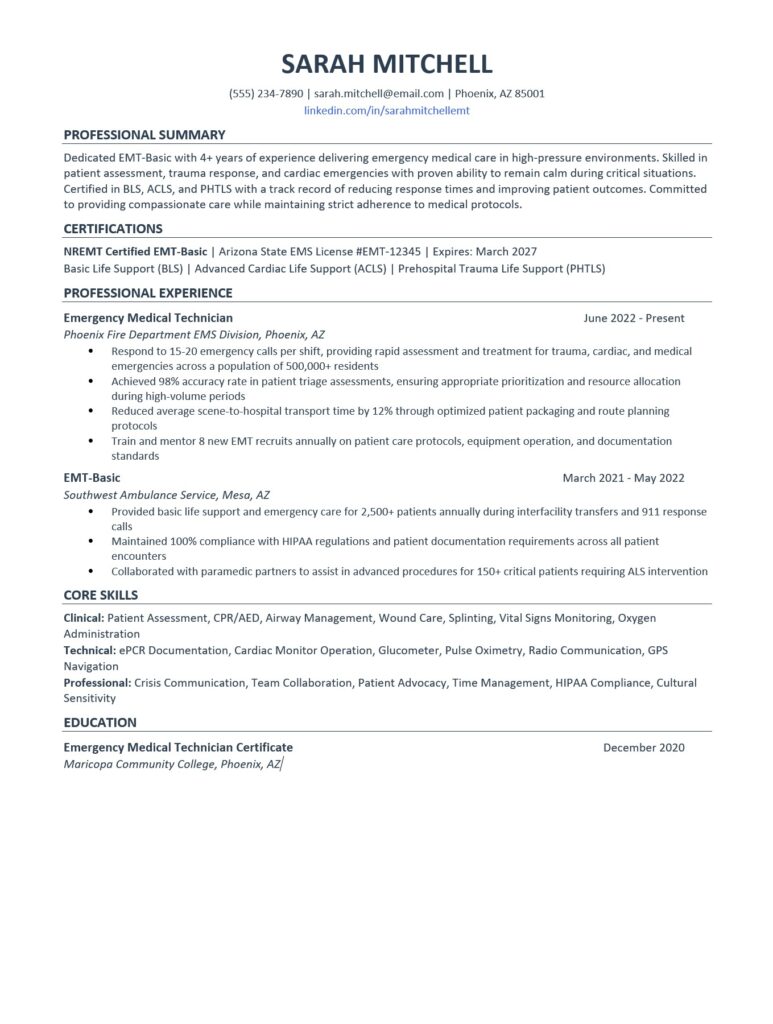
Here’s a professional EMT resume template you can download and customize. This template is designed to be both visually appealing and ATS-friendly, with clean formatting that highlights your strengths.
Blank Customizable Template

Download Your Free Template:
- Download DOCX Template (fully editable in Microsoft Word)
Interview Guys Tip: The DOCX template is fully editable, allowing you to adjust fonts, colors, and spacing to match your personal brand while maintaining professional formatting. Just replace the placeholder text with your own information.
Essential Components of an Effective EMT Resume
Contact Information and Header
Start with your name prominently displayed, followed by phone number, professional email, city and state, and a LinkedIn profile URL. Keep this section clean and easy to scan. Avoid using unprofessional email addresses since research shows that approximately 3 in 10 resumes get dismissed for this reason alone.
Professional Summary
Your summary should pack your most impressive qualifications into 3-4 sentences. Include your certification level, years of experience, primary specializations, and what makes you valuable to an employer.
Strong example: “Dedicated EMT-Basic with 4+ years of experience delivering emergency medical care in high-pressure environments. Skilled in patient assessment, trauma response, and cardiac emergencies with proven ability to remain calm during critical situations. Certified in BLS, ACLS, and PHTLS with a track record of reducing response times and improving patient outcomes.”
This summary works because it immediately establishes experience level, highlights specific competencies, and mentions relevant certifications. For more guidance on crafting effective openings, check out our resume summary examples.
Certifications Section
This section deserves prominent placement on any EMT resume. List your primary certification first with the full credential name, registry number, and expiration date. Follow with additional certifications relevant to your target position.
Common EMT certifications to include:
- NREMT-Basic, NREMT-Intermediate, or Paramedic certification
- State EMS License with number and expiration
- Basic Life Support (BLS)
- Advanced Cardiac Life Support (ACLS)
- Prehospital Trauma Life Support (PHTLS)
- Pediatric Advanced Life Support (PALS)
- CPR/AED certification
The National Registry of EMTs requires recertification every two years, so always ensure your credentials are current before applying.
Professional Experience
Use reverse-chronological order, starting with your most recent position. For each role, include the job title, employer name, location, and employment dates on the first two lines. Follow with 3-4 bullet points highlighting your achievements and responsibilities.
Each bullet point should follow this formula: Action verb + what you did + for how many patients/over what time period + with what result.
- Weak bullet: “Responsible for patient care during emergencies”
- Strong bullet: “Provided rapid assessment and treatment for 20-25 patients per shift in high-volume Level II trauma center, achieving 98% accuracy in triage assessments”
Numbers make your experience tangible. Think about calls per shift, patients treated annually, compliance rates, training responsibilities, or efficiency improvements you contributed to.
Interview Guys Tip: Keep a running log of your metrics throughout your career. Track your average calls per shift, notable saves, training hours completed, and any commendations received. This data becomes invaluable when updating your resume or preparing for interviews. Speaking of interviews, once your resume lands you opportunities, prepare with our guide to EMT interview questions and answers.
Core Skills Section
Organize your skills into logical categories rather than listing them randomly. This helps both ATS systems and human reviewers quickly identify your capabilities.
Clinical Skills: Patient Assessment, CPR/AED, Airway Management, Wound Care, Splinting, Vital Signs Monitoring, Oxygen Administration, Bleeding Control
Technical Skills: ePCR Documentation, Cardiac Monitor Operation, Glucometer, Pulse Oximetry, Radio Communication, Ambulance Operation, GPS Navigation
Professional Skills: Crisis Communication, Team Collaboration, Patient Advocacy, Stress Management, HIPAA Compliance, Cultural Sensitivity
Education
For EMTs, education typically appears after experience since certifications and field experience carry more weight. Include your EMT certificate or degree, institution name, location, and completion date. If you’re pursuing paramedic certification or additional education, note that as well.
How to Write Each Section for Maximum Impact
Crafting Your Professional Summary
Your summary functions as an elevator pitch. In the time it takes someone to read those 3-4 sentences, they should understand your experience level, key strengths, and what you bring to their organization.
Start by identifying your standout qualifications. Are you known for exceptional patient rapport? Do you have specialized experience with pediatric emergencies or mass casualty incidents? Have you mentored new EMTs? These differentiators belong in your summary.
Avoid generic phrases like “hardworking professional” or “team player” that could apply to anyone. Instead, use specific language that demonstrates EMS expertise. For additional examples, review our guide on how to write a resume summary.
Making Your Experience Section Shine
The experience section determines whether you advance to an interview or your application gets passed over. Focus on accomplishments rather than job duties.
Every EMT transports patients and provides basic life support. What sets you apart? Maybe you implemented a new patient handoff protocol that improved communication with emergency department staff. Perhaps you trained new recruits or achieved perfect scores on quality assurance reviews.
Use strong action verbs specific to emergency medicine: Assessed, Administered, Stabilized, Monitored, Transported, Collaborated, Documented, Communicated, Responded, Treated, Triaged, Trained.
Common EMT Resume Mistakes to Avoid
Burying your certifications. Your NREMT credential and state license belong near the top of your resume, not hidden at the bottom. Hiring managers need to verify your qualifications immediately.
Using vague descriptions. “Provided patient care” tells employers nothing. Replace generic statements with specific, quantified achievements.
Neglecting soft skills. Technical competence matters, but so does bedside manner. EMTs interact with patients during their worst moments. Include skills like crisis communication, cultural sensitivity, and patient advocacy.
Ignoring format consistency. Inconsistent date formats, spacing issues, or mixed bullet styles create a sloppy impression. Proofread carefully and maintain uniform formatting throughout.
Including irrelevant information. Your high school job at a retail store probably doesn’t belong on your EMT resume unless you gained transferable skills. Focus on relevant healthcare, emergency response, or customer service experience.
Forgetting volunteer experience. Many EMTs start as volunteers. This experience absolutely belongs on your resume, especially if you’re early in your career. Volunteer shifts demonstrate commitment and provide legitimate patient care hours.
ATS Optimization and Keywords for EMT Resumes
Applicant tracking systems scan resumes for specific keywords before forwarding applications to human reviewers. Understanding how these systems work helps you format your resume effectively.
- Use exact terminology from job descriptions. If a posting requests “BLS certification,” include those exact words rather than just “CPR certified.” Mirror the language employers use.
- Include full terms and acronyms. Write “Basic Life Support (BLS)” the first time you mention a certification, then use the acronym afterward. This covers both search variations.
- Stick to standard section headings. Creative labels like “Where I’ve Made a Difference” confuse ATS software. Use recognizable headings: Professional Summary, Certifications, Professional Experience, Core Skills, Education.
- Essential EMT keywords to include: Emergency Medical Technician, EMT-Basic, EMT-B, Patient Assessment, Trauma Care, Basic Life Support, BLS, CPR, AED, Patient Transport, Emergency Response, Vital Signs, Oxygen Administration, Wound Care, Splinting, Medical Documentation, HIPAA, EMS Protocols
Frequently Asked Questions
How long should my EMT resume be?
One page is ideal for most EMT candidates. If you have 10+ years of relevant experience or significant additional training and certifications, two pages may be appropriate. Focus on quality over quantity. Every line should add value.
Should I include my EMT certification number on my resume?
Yes. Including your NREMT registry number and state license number allows employers to quickly verify your credentials. This transparency demonstrates professionalism and speeds up the hiring process.
What if I’m a newly certified EMT with no professional experience?
Lead with your certifications and education, then highlight clinical rotations, ride-along hours, and any relevant volunteer experience. Include transferable skills from previous jobs, such as customer service abilities, stress management, or physical demands you’ve handled. Everyone starts somewhere. Our resume tips for career changers offers additional guidance.
How do I handle gaps in my employment history?
Be honest and brief. If you took time off for additional training, family responsibilities, or other reasons, a short explanation suffices. Focus your resume on demonstrating current competency and readiness to work.
What file format should I use when submitting my EMT resume?
DOCX format works well for online applications submitted through applicant tracking systems. Keep a PDF version for direct email submissions or printing. Our templates are provided in DOCX specifically for ATS compatibility.
Putting It All Together
Your EMT resume represents your first opportunity to demonstrate the same qualities that make you effective in the field: precision, clarity, and the ability to communicate critical information quickly. Take the time to customize these templates for each application, incorporating keywords from job descriptions and highlighting experiences most relevant to each specific role.
Remember that your resume opens doors, but your certifications, skills, and interview performance close the deal. Download your templates, customize them thoughtfully, and approach your job search with the same dedication you bring to patient care.
Ready to build your perfect EMT resume? Download our templates above and start customizing today. For more resume templates across different industries and career levels, explore our complete free resume template library.
Before you send that resume: most EMT resumes get filtered out by ATS before a human ever sees them. Upload yours and find out your score. It takes 60 seconds and it’s free.
Advice like this is the general version. Longbow scores your actual resume against the actual job you want and shows you what's missing, before the filters decide for you. Here's why we built it.

ABOUT THE INTERVIEW GUYS (JEFF GILLIS & MIKE SIMPSON)
Mike Simpson: Co-founder of The Interview Guys and Longbow. He has been the voice behind our interview advice since 2013 — his work has reached over 100 million job seekers around the world. The strategic mind behind Longbow, our new career platform.
Jeff Gillis: Co-founder of The Interview Guys and Longbow. He built the systems that put our work in front of those readers, and he leads the engineering on Longbow, the cutting edge career platform built for today’s job seeker.