
Welcome to the Jobless Boom: When GDP Up Doesn’t Mean Hiring Up

You’re doing everything right. Your resume is polished. Your interview skills are sharp. You’re applying to jobs that match your qualifications perfectly.
And yet… nothing.
If your job search feels impossibly difficult right now, you’re not imagining things. The economy is playing a cruel trick on job seekers in late 2025: GDP is growing, layoffs remain relatively low, and economic headlines sound fine. But behind those numbers, hiring has essentially frozen at the lowest levels in over a decade.
Welcome to the jobless boom.
This isn’t a recession in the traditional sense. It’s something weirder. Companies are investing in technology and productivity gains instead of people. The Federal Reserve’s November Beige Book confirmed what job seekers already suspected: businesses are using AI, hiring freezes, and reduced hours to avoid expanding their workforce.
If you’re feeling frustrated by your current job search, understanding what’s actually happening in the labor market will help you adjust your strategy. By the end of this article, you’ll know exactly why the market feels broken, which sectors still offer real opportunities, and how to position yourself for success in this strange new economy.
☑️ Key Takeaways
- The U.S. is experiencing a “jobless boom” where GDP growth remains strong (around 3%) while hiring has essentially frozen at the lowest rates since 2013.
- Employers are using AI, hiring freezes, and reduced hours instead of laying people off, making the job market feel broken without triggering recession headlines.
- Healthcare and a few other sectors are carrying almost all job growth, while tech, media, and professional services have pulled back dramatically.
- Where you live and what you do will matter as much as national trends in 2026, with smaller cities often outperforming major metros for job opportunities.
What Is the Jobless Boom (And Why Should You Care)?
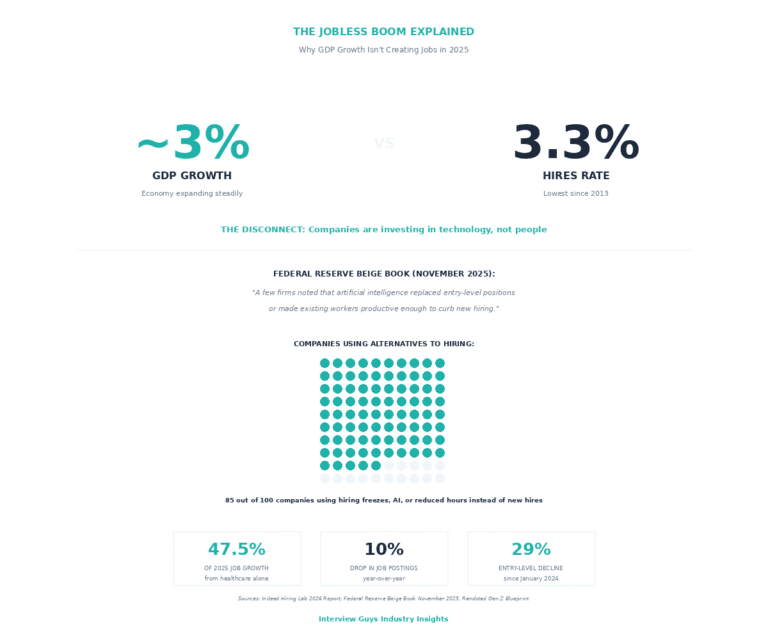
The jobless boom describes an economy where GDP grows steadily while job creation stalls. It’s the disconnect between what economists see on paper and what job seekers experience in reality.
Here’s what makes this moment so unusual. According to Indeed’s 2026 Jobs and Hiring Trends Report, the hires rate dropped to 3.3% in 2025, the lowest since 2013. Meanwhile, GDP growth remained surprisingly strong at nearly 3%.
How can the economy grow without creating jobs? The answer lies in how that growth is being generated. Companies are investing heavily in automation, AI tools, and productivity improvements. They’re squeezing more output from their existing workforce rather than expanding headcount.
The Fed’s Beige Book put it bluntly: “A few firms noted that artificial intelligence replaced entry-level positions or made existing workers productive enough to curb new hiring.”
Interview Guys Tip: When employers say they’re “not hiring right now,” they often mean it literally. This isn’t personal rejection. It’s a fundamental shift in how companies are choosing to grow. Understanding this can help you stay motivated and strategic rather than taking every silence as a sign you’re doing something wrong.
The reality is that firing off more applications rarely lands more interviews — applying to the right ones, the right way, does. That’s why we built Robin: a free tool that reads the exact job you’re applying to and tells you what they want and how you match, before you hit submit:
Turn More Applications Into Interviews
Volume isn’t the answer — precision is. We built Robin to make every application count: it reads the exact posting and tells you what they actually want, how strong your match is, and the gaps to fix before you hit submit — so you stop spraying and start landing. Free, right in your browser.
The Numbers Behind the “Low-Hire, Low-Fire” Economy
Let’s break down what’s actually happening with some concrete data that explains why your job search feels so difficult.
Hiring Has Frozen, Not Crashed
The Indeed Job Postings Index started 2025 more than 10% above pre-pandemic levels. By the end of October, it had fallen to less than 2% above those levels. That’s a significant drop in available opportunities over just 10 months.
But here’s the twist. Layoffs remain historically low. Companies aren’t firing people. They’re just not hiring new ones. This creates what economists call the “low-hire, low-fire” environment where:
- Workers feel secure enough to stay in their current jobs
- Employers feel uncertain enough to avoid new hires
- Job seekers get squeezed out of an increasingly selective market
The Consumer Spending Paradox
GDP growth has been propped up largely by consumer spending from high-income households. According to Bank of America Institute data cited in the Indeed report, spending by high-income earners grew 2.6% year-over-year in September 2025. Middle-income spending? Just 1.6%. Low-income spending? A meager 0.6%.
This matters for job seekers because economic growth that only benefits the top earners doesn’t translate into broad-based job creation. The spending that would normally flow through the economy and create jobs across sectors is concentrated at the top.
Wage Growth Has Stalled
The Indeed Wage Tracker shows advertised wages in job postings grew just 2.5% year-over-year by September 2025, down from 3.4% at the start of the year. Here’s the kicker: that’s now running behind inflation.
For job seekers, this means you might find that new roles don’t pay significantly more than what you’re earning now. The leverage that workers enjoyed during the post-pandemic hiring boom has largely evaporated.
Where the Jobs Actually Are (And Where They’re Not)
Not all sectors are experiencing the jobless boom equally. Understanding which industries are still hiring aggressively can help you target your search more effectively.
The Healthcare Exception
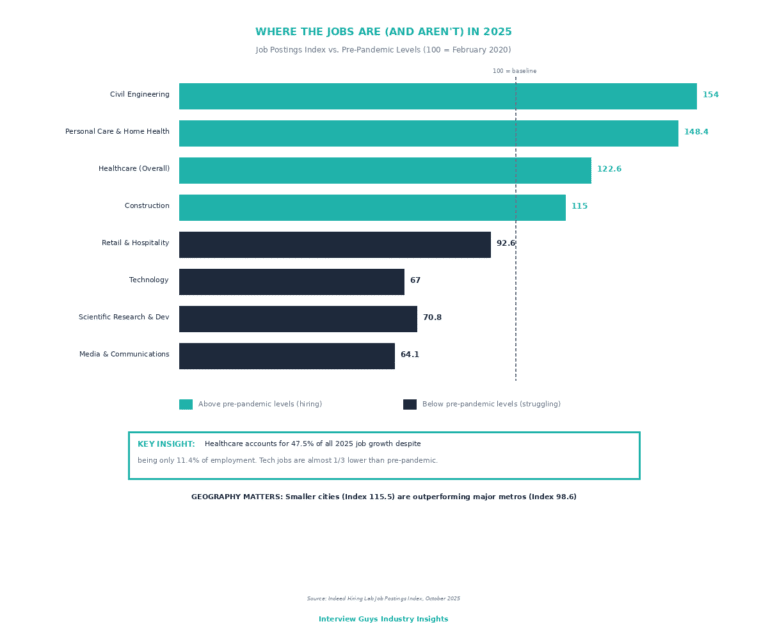
Healthcare has become the lone bright spot in an otherwise frozen job market. According to Indeed’s data, healthcare job postings ended October 2025 at 22.6% above pre-pandemic levels, while overall postings barely exceeded pre-pandemic norms.
Healthcare accounted for 47.5% of all job growth recorded so far in 2025, despite representing only 11.4% of total employment. If you have skills that translate to healthcare roles, now is the time to explore those opportunities.
Other sectors with relatively strong demand include:
- Civil engineering (Job Postings Index at 154.0)
- Personal care and home health (Job Postings Index at 148.4)
- Construction (still elevated above pre-pandemic levels)
The Tech and White-Collar Collapse
On the opposite end, several professional sectors have experienced dramatic pullbacks. The white-collar recession that began in 2023 has only intensified:
- Media and communications: Job Postings Index at 64.1 (36% below pre-pandemic)
- Scientific research and development: Job Postings Index at 70.8 (29% below pre-pandemic)
- Technology: Job postings are almost one-third lower than in early 2020
If you’re in one of these harder-hit fields, you’ll need to be especially strategic. Consider whether your skills could transfer to healthcare, construction, or other growing sectors.
Interview Guys Tip: The job market is now two markets. In healthcare and a few other sectors, workers still have leverage. Everywhere else, it’s an employer’s market. Tailor your expectations and strategy accordingly. If you’re in a struggling sector, consider how your skills might translate to industries that are still hiring.
Why AI Is Making This Worse for Entry-Level Workers
The Fed’s Beige Book confirmation that AI is “replacing entry-level positions” validates what many younger workers have experienced firsthand. This isn’t just theoretical anymore.
Companies are no longer hiring junior employees to handle tasks that AI tools can manage. Instead, they’re expecting existing workers to become more productive by using AI as an assistant. The result is fewer opportunities at the entry-level.
Randstad’s recent Gen Z Workplace Blueprint report found that entry-level job postings have declined by 29% since January 2024. Junior tech roles specifically dropped 35%, logistics by 25%, and finance by 24%.
This creates a brutal catch-22 for new graduates and career changers. You need experience to get hired, but companies aren’t creating the entry-level positions where you’d gain that experience.
What You Can Do About It
If you’re trying to break into a field with limited entry-level openings:
- Focus on skills over titles. Emphasize transferable skills and any hands-on experience, including projects, freelance work, or volunteer roles.
- Consider adjacent paths. If junior marketing roles are scarce, look at customer success or sales development positions that could eventually lead to marketing.
- Build AI fluency. Ironically, the technology reducing entry-level jobs could be your ticket in. Show employers you can work with AI tools productively.
- Target smaller companies. The Indeed data shows that job postings in smaller metros and mid-size companies have held up better than in major cities and large corporations.
The Geography Factor: Location Matters More Than Ever
One of the most striking findings from Indeed’s analysis is how differently the job market is performing across different regions. Where you live now matters as much as what you do.
Big Cities Are Struggling
Major metro areas with heavy concentrations of tech, finance, and professional services are seeing some of the weakest job markets. Washington, D.C., for example, has a Job Postings Index of just 65.0, meaning postings are 35% below pre-pandemic levels.
California’s job postings are down around 17% compared to pre-COVID levels, while population growth has been essentially flat. That means fierce competition for fewer opportunities.
Smaller Cities Are Outperforming
Meanwhile, smaller and mid-size metros, particularly in the Sunbelt and Mountain West, show more resilient labor demand. In Georgia, for instance, while Atlanta’s Job Postings Index sits at 110, smaller metros like Valdosta and Macon exceed 130.
The pattern holds nationwide. As of October 2025:
- Large MSAs (population over 1 million): Average Job Postings Index of 98.6
- Mid-size MSAs (250,000 to 999,999): Average of 112.0
- Small MSAs (under 250,000): Average of 115.5
If you’re open to relocation, you might find significantly better opportunities by looking beyond the traditional job market hubs. Check out our analysis of cities where people are actually getting hired for specific recommendations.
How to Adjust Your Job Search Strategy
Understanding the jobless boom helps explain why your search feels so difficult. But what should you actually do differently? Here are concrete adjustments based on the data.
Accept That Volume Won’t Save You
In a frozen market, applying to 100 jobs that aren’t really hiring produces the same result as applying to 10. The typical job seeker applies to over 30 positions before landing an offer, but in harder-hit sectors, that number can climb much higher.
Focus on quality over quantity. Research companies showing genuine hiring activity. Look for roles that have been posted recently and companies that are expanding, not just maintaining headcount.
Leverage Your Network More Aggressively
When companies do hire in a low-hire environment, they often fill positions through internal referrals rather than public job postings. Indeed’s data shows that sourced candidates are significantly more likely to get hired than those who simply apply online.
This means:
- Reaching out to connections at target companies
- Attending industry events and meetups
- Engaging meaningfully on LinkedIn with people in your field
- Asking for informational interviews, not job leads
Interview Guys Tip: In a frozen job market, the roles that get filled are often never posted publicly. Companies prefer to hire someone vouched for by a trusted employee rather than sift through hundreds of applications. Make networking a central part of your strategy, not an afterthought.
Consider Contract and Freelance Work
Many companies that have frozen full-time hiring are still bringing on contractors and freelancers. This lets them stay flexible while accessing specialized skills.
If you’re struggling to land a permanent role, contract work can:
- Get your foot in the door at target companies
- Keep your skills current during a prolonged search
- Generate income while you continue looking
- Sometimes convert to full-time positions when hiring resumes
Stay Patient, But Stay Active
The good news is that analysts expect conditions to improve in 2026. Deutsche Bank’s outlook predicts the labor market will “stabilize and show signs of retightening over the course of the year.”
But improvement will be gradual. Don’t wait for the market to come to you. Keep building skills, expanding your network, and refining your materials so you’re ready when opportunities emerge.
What 2026 Might Bring
The forecast for next year isn’t dramatic in either direction. According to Indeed’s scenario analysis, unemployment could range from 4.1% to 4.8% by the end of 2026, with job openings between 6.8 and 7.4 million.
The most likely scenario is more of the same. The “low-hire, low-fire” environment will probably continue, with gradual improvement possible if economic uncertainty clears.
Several factors could push things in a better direction:
- Interest rate cuts making business expansion cheaper
- Clarity on tariff and immigration policy
- Continued strength in consumer spending
- Healthcare continuing to drive job creation
But risks remain. If layoffs begin increasing meaningfully, the frozen market could quickly turn into a contracting one. The current equilibrium is fragile.
Putting It All Together
The jobless boom explains why your job search feels so disconnected from what you hear about the economy. GDP is growing, but that growth isn’t translating into the hiring activity that would benefit most job seekers.
Here’s what you need to remember:
- The market isn’t broken because of you. Companies are choosing technology and productivity over headcount. Understanding this shift can help you stay resilient.
- Sector and location matter enormously. Healthcare and smaller metro areas offer better odds than tech jobs in major cities.
- Networking beats volume. When companies do hire, they often fill roles through referrals. Make personal connections central to your strategy.
- Patience is required, but so is action. The market will eventually improve, but you can’t just wait for it. Keep building skills, making connections, and applying strategically.
The economy may be growing without creating jobs, but opportunities still exist for those who know where to look. Stay informed, stay strategic, and stay persistent. The job search in 2025 is harder than it should be, but it’s not impossible.
For more guidance on navigating this challenging market, check out our complete 2025 job search guide and learn how to find a job fast even when hiring has slowed.
The reality is that firing off more applications rarely lands more interviews — applying to the right ones, the right way, does. That’s why we built Robin: a free tool that reads the exact job you’re applying to and tells you what they want and how you match, before you hit submit:
Turn More Applications Into Interviews
Volume isn’t the answer — precision is. We built Robin to make every application count: it reads the exact posting and tells you what they actually want, how strong your match is, and the gaps to fix before you hit submit — so you stop spraying and start landing. Free, right in your browser.
This is the general advice. Longbow applies it to your actual search: real match scores, ghost-job checks, and prep for the jobs worth your time. Here's the full story.

ABOUT THE INTERVIEW GUYS (JEFF GILLIS & MIKE SIMPSON)
Mike Simpson: Co-founder of The Interview Guys and Longbow. He has been the voice behind our interview advice since 2013 — his work has reached over 100 million job seekers around the world. The strategic mind behind Longbow, our new career platform.
Jeff Gillis: Co-founder of The Interview Guys and Longbow. He built the systems that put our work in front of those readers, and he leads the engineering on Longbow, the cutting edge career platform built for today’s job seeker.