
The ‘Iceberg Index’: Why 12% of Jobs Are Already on Borrowed Time

MIT just dropped a bombshell on the American workforce.
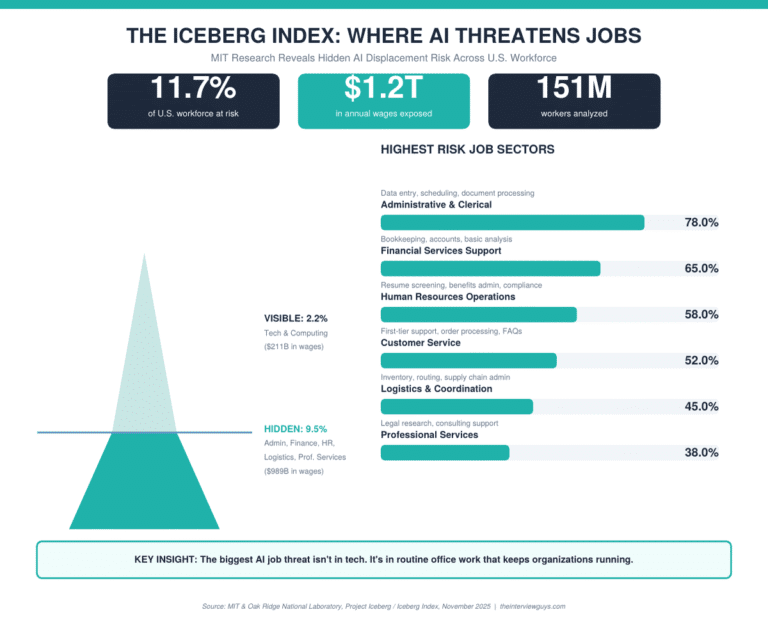
Their new research, released this week in partnership with Oak Ridge National Laboratory, reveals that artificial intelligence can already replace nearly 12% of U.S. jobs. Not in five years. Not when the technology “matures.” Right now.
The price tag? A staggering $1.2 trillion in annual wages.
But here’s what makes this study different from the dozens of “AI is coming for your job” predictions you’ve probably ignored. The researchers didn’t just estimate which jobs could be automated. They built what they call a “digital twin” of the entire American workforce, simulating how 151 million workers interact with AI capabilities across 32,000 skills and 923 occupations.
The result is the Iceberg Index, a tool that maps AI displacement risk down to your specific zip code. And the findings challenge almost everything you thought you knew about which jobs AI threatens most.
By the end of this article, you’ll understand exactly where the hidden risks are, why tech workers aren’t actually the most vulnerable, and what you can do right now to position yourself on the right side of this transformation.
☑️ Key Takeaways
- AI can already perform tasks tied to 11.7% of the U.S. labor market, representing approximately $1.2 trillion in annual wages according to new MIT research.
- The biggest threat isn’t to programmers, it’s to administrative, HR, finance, and logistics roles that most people don’t associate with automation.
- Every state is affected, not just coastal tech hubs, with Rust Belt states showing particularly high exposure in cognitive and professional services work.
- The research maps AI risk down to zip code level, giving job seekers unprecedented visibility into which skills and locations face the greatest displacement pressure.
What Is the Iceberg Index and Why Should You Care?
The Iceberg Index is a labor simulation tool created by MIT and Oak Ridge National Laboratory (ORNL), home to the Frontier supercomputer, one of the world’s most powerful computing systems.
According to Prasanna Balaprakash, ORNL director and co-leader of the research, “Basically, we are creating a digital twin for the U.S. labor market.”
Here’s how it works. The index treats each of America’s 151 million workers as an individual “agent,” tagged with their skills, tasks, occupation, and location. It then maps more than 32,000 skills across 923 occupations in 3,000 counties, measuring where current AI systems can already perform those skills at a cost that’s competitive with human labor.
The “iceberg” metaphor is intentional and revealing. What most people see when they think about AI job disruption is the “visible tip” of the iceberg, the tech layoffs, the headlines about ChatGPT replacing programmers, the obvious automation in computing and technology roles.
That visible tip represents only about 2.2% of wage value, roughly $211 billion. It’s concerning, sure, but manageable.
The real danger lies beneath the surface. When researchers factored in AI’s potential for automation in administrative, financial, and professional services, the exposure jumped to 11.7% of the workforce and $1.2 trillion in wages.
Interview Guys Tip: The Iceberg Index isn’t a prediction of when layoffs will happen. It’s a map of where AI can already do the work. Think of it as an early warning system that gives you time to adapt before displacement actually occurs. Smart job seekers use this kind of data to make strategic career moves, not to panic.
The reality is that firing off more applications rarely lands more interviews — applying to the right ones, the right way, does. That’s why we built Robin: a free tool that reads the exact job you’re applying to and tells you what they want and how you match, before you hit submit:
Turn More Applications Into Interviews
Volume isn’t the answer — precision is. We built Robin to make every application count: it reads the exact posting and tells you what they actually want, how strong your match is, and the gaps to fix before you hit submit — so you stop spraying and start landing. Free, right in your browser.
The $1.2 Trillion Threat Hiding in Plain Sight
Here’s the part that should grab your attention if you work in an office.
The largest AI exposure isn’t in Silicon Valley. It’s not concentrated among software developers or data scientists. According to the MIT research, the bigger impact lies in routine office and support roles such as human resources, logistics, finance, and administration.
These are jobs that most people don’t associate with AI risk at all. And that’s precisely why they’re so vulnerable.
Think about it. When companies invest in AI screening tools for resumes, they’re automating HR work. When they implement AI-powered financial analysis, they’re automating accounting and finance work. When they deploy chatbots and virtual assistants, they’re automating administrative work.
The MIT study found that AI systems now generate more than a billion lines of code each day. This is prompting companies to restructure their hiring pipelines and reduce demand for entry-level programmers. But that’s just the visible automation. The invisible automation is happening in meeting scheduling, expense reporting, data entry, customer service, and dozens of other “cognitive work” tasks that white-collar workers perform every day.
The Geography of AI Risk
One of the most surprising findings from the Iceberg Index is where AI exposure is concentrated geographically.
The common assumption is that AI-related job disruption will stay mostly in coastal, tech-heavy regions. The data shows something very different.
Rust Belt states such as Ohio, Michigan, and Tennessee register modest “Surface Index” values (the visible tip) but substantial “Iceberg Index” values driven by cognitive work. This includes financial analysis, administrative coordination, and professional services that support manufacturing operations.
In other words, the factory floor might be safe, but the office that runs the factory is not.
This matters because workers in these regions may not see the threat coming. They’re watching for robots on the assembly line while AI quietly takes over the tasks in the back office.
Interview Guys Tip: If you work in a “support” role at a manufacturing, logistics, or industrial company, pay close attention to this research. Your job title might not include “technology,” but the tasks you perform every day may be highly automatable. Now is the time to develop AI skills that make you the person who implements these systems rather than the person replaced by them.
Which Jobs Face the Highest Risk?
Based on the MIT research and related studies, here are the job categories facing the most significant AI exposure:
High-Risk Categories
Administrative and Clerical Work
- Executive assistants and administrative coordinators
- Data entry specialists
- Scheduling and calendar management roles
- Document processing and filing positions
Financial Services Support
- Junior financial analysts
- Accounts payable and receivable specialists
- Basic bookkeeping and accounting tasks
- Routine financial reporting roles
Human Resources Operations
- Resume screening and initial candidate evaluation
- Benefits administration
- Routine employee inquiries and documentation
- Onboarding paperwork and compliance tracking
Customer Service and Support
- First-tier customer service representatives
- Basic technical support positions
- Order processing and tracking roles
- FAQ and information request handling
The Entry-Level Problem
The research also highlights a troubling trend for new graduates entering the job market. Entry-level positions are particularly vulnerable because they often involve the routine, trainable tasks that AI handles best.
The MIT study notes that companies are already restructuring their hiring pipelines, reducing demand for junior programmers, analysts, and administrative staff. This creates a challenging catch-22 for early career professionals. The traditional “entry ramp” into many careers is being automated before they can climb it.
What This Means for Your Job Search
If you’re currently looking for work or planning a career move, the Iceberg Index should inform your strategy. Here’s how to use this information:
Assess Your Current Risk
Look honestly at the tasks that make up your daily work. Ask yourself:
- How much of my job involves routine, repeatable processes?
- Could someone explain my core tasks clearly enough for a computer to follow?
- Am I primarily executing defined procedures or making complex judgment calls?
- Does my work require human relationships, creativity, or physical presence?
If your answers suggest high routine and low complexity, you may be in the automation danger zone.
Shift Toward AI-Resistant Skills
The skills that AI struggles to replicate fall into several categories:
Complex Problem Solving
- Situations with ambiguous information
- Problems requiring creative solutions
- Decisions involving multiple stakeholders with competing interests
Human Connection
- Relationship building and trust development
- Emotional intelligence and empathy
- Persuasion and negotiation
- Mentoring and coaching
Physical Presence
- Hands-on trades and skilled labor
- Healthcare that requires physical assessment and treatment
- Roles requiring site visits and in-person evaluation
Strategic Thinking
- Long-term planning and vision setting
- Cross-functional leadership
- Ethical judgment and values-based decisions
Interview Guys Tip: When tailoring your resume for 2025 and beyond, emphasize the uniquely human aspects of your experience. Instead of listing tasks you completed, highlight complex problems you solved, relationships you built, and judgment calls you made. These are the skills that justify human employment when AI can handle the routine work.
Consider Location Strategy
The Iceberg Index reveals significant geographic variation in AI exposure. If you have flexibility in where you work, consider:
- States with lower cognitive-work concentration in their economies
- Regions investing heavily in AI workforce adaptation (Tennessee, Utah, and North Carolina are already using the Iceberg Index to plan their workforce strategies)
- Industries where physical presence and human judgment remain essential
How States Are Preparing (And What You Can Learn From Them)
Three states, Tennessee, North Carolina, and Utah, collaborated with MIT and ORNL to validate the Iceberg Index model using their own labor data. They’re now using the tool to inform policy and spending decisions.
Tennessee moved first, citing the Iceberg Index in its official AI Workforce Action Plan released this month. The state is using the data to identify exposure hotspots, prioritize training investments, and test different policy interventions before committing resources.
According to the MIT report, “Project Iceberg enables policymakers and business leaders to identify exposure hotspots, prioritize training and infrastructure investments, and test interventions before committing billions to implementation.”
This is smart governance. But it’s also a model for individual career planning.
Apply the Same Logic to Your Career
Think of your career as a mini-economy that needs its own AI adaptation plan:
- Identify your exposure hotspots: Which of your current skills and tasks are most vulnerable to automation?
- Prioritize your training investments: Where should you spend time and money developing new capabilities?
- Test interventions before committing: Before making a major career pivot, can you gain experience or training in the new area while maintaining your current income?
- Monitor and adjust: The AI landscape changes rapidly. Build habits of continuous learning and regular career assessment.
The Silver Lining: Why This Research Helps You
Here’s the good news buried in the Iceberg Index data.
This is the first time we’ve had a granular, skills-based map of AI exposure that goes down to the county level. Previous studies offered broad predictions. This research offers actionable intelligence.
The researchers emphasize that the Iceberg Index is not “a countdown clock to layoffs.” It’s an early warning map that shows where AI can already perform work, giving individuals and organizations time to adapt before actual displacement occurs.
For job seekers, this is a gift. You now have better information than most people about where the job market is heading and which skills will matter most.
The workers who thrive through this transition won’t be the ones who ignored the warnings. They’ll be the ones who used the information to get ahead of the curve.
Putting It All Together
MIT’s Iceberg Index reveals an uncomfortable truth. AI can already perform work representing 11.7% of the U.S. labor market and $1.2 trillion in wages. The biggest risks aren’t where most people expect them, in technology roles, but in the administrative, HR, finance, and logistics positions that keep organizations running.
The visible 2.2% is just the tip. The real transformation is happening beneath the surface.
But knowledge is power. By understanding which skills and roles face the greatest exposure, you can make strategic decisions about your career that position you for success rather than displacement.
The states using this data are planning ahead. The companies implementing AI are moving fast. The question is whether you’ll use this information to adapt before the disruption arrives or scramble to catch up after it does.
Start by honestly assessing your current role’s automation risk. Invest in developing AI collaboration skills that make you the person implementing these systems rather than being replaced by them. Focus on uniquely human capabilities that AI struggles to replicate.
The iceberg is already there. Now you can see what’s beneath the surface.
The reality is that firing off more applications rarely lands more interviews — applying to the right ones, the right way, does. That’s why we built Robin: a free tool that reads the exact job you’re applying to and tells you what they want and how you match, before you hit submit:
Turn More Applications Into Interviews
Volume isn’t the answer — precision is. We built Robin to make every application count: it reads the exact posting and tells you what they actually want, how strong your match is, and the gaps to fix before you hit submit — so you stop spraying and start landing. Free, right in your browser.
After twelve years of writing advice like this, we built the tool that does it with you. It's called Longbow, and here's the whole story.

ABOUT THE INTERVIEW GUYS (JEFF GILLIS & MIKE SIMPSON)
Mike Simpson: Co-founder of The Interview Guys and Longbow. He has been the voice behind our interview advice since 2013 — his work has reached over 100 million job seekers around the world. The strategic mind behind Longbow, our new career platform.
Jeff Gillis: Co-founder of The Interview Guys and Longbow. He built the systems that put our work in front of those readers, and he leads the engineering on Longbow, the cutting edge career platform built for today’s job seeker.