
The AI Doom Loop: Why Your Job Applications Keep Vanishing Into the Void

You’ve applied to 50 jobs this month. Maybe 100. Your resume is polished, your cover letters are tailored, and you’ve done everything the career experts told you to do. Yet you hear nothing back. Not a rejection. Not an interview request. Just silence.
You’re not imagining things. Your applications really are vanishing into a void, and a new report reveals exactly why.
The Greenhouse 2025 AI in Hiring Report, which surveyed over 4,100 job seekers, recruiters, and hiring managers, exposes what Greenhouse CEO Daniel Chait calls an “AI doom loop.” Job seekers use AI to mass-apply to positions. Employers use AI to filter those applications right back out. The result? More applications than ever, fewer actual connections, and trust at an all-time low on both sides.
If you’re struggling to land interviews despite constant applications, this report explains exactly what’s happening behind the scenes. By the end of this article, you’ll understand the forces working against you and, more importantly, how to break free from the doom loop and actually get noticed.
☑️ Key Takeaways
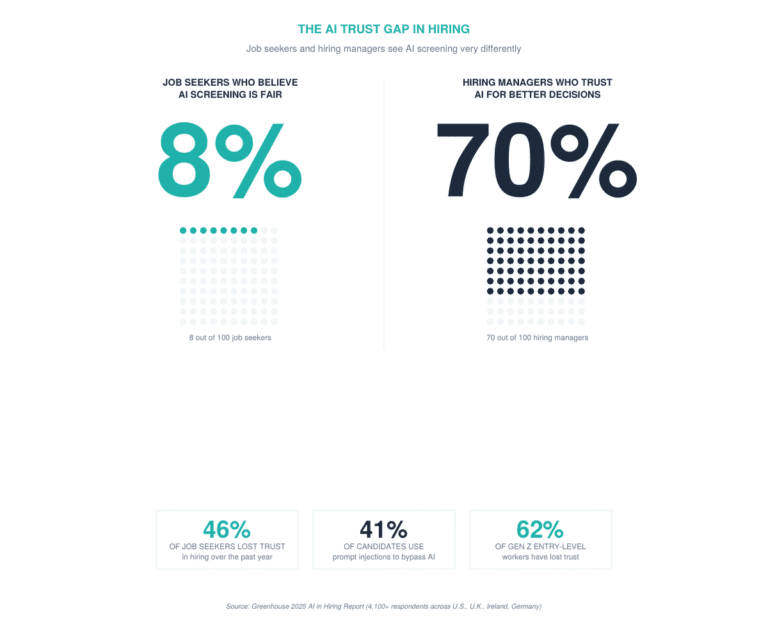
- Only 8% of job seekers believe AI screening makes hiring fairer, while 70% of hiring managers trust AI to make better decisions, creating a massive trust gap.
- 41% of candidates admit to using “prompt injections” to hack AI filters, and 52% of those who haven’t are considering it.
- Trust in hiring has collapsed, with 46% of job seekers losing faith over the past year and 62% of Gen Z entry-level workers reporting decreased trust.
- The solution isn’t gaming the system harder but standing out through authenticity, demonstrable skills, and human connections that bypass the AI arms race.
What Exactly Is the “AI Doom Loop”?
The AI doom loop is a vicious cycle that’s making hiring worse for everyone involved. Here’s how it works:
- Step 1: Candidates use AI to apply faster. Facing a brutal job market where only 7% of candidates believe conditions favor them, job seekers turn to AI tools to write resumes, generate cover letters, and even auto-apply to positions. Applications skyrocket.
- Step 2: Employers use AI to filter the flood. Drowning in applications (some recruiters report 350% increases), companies deploy AI screening tools to sort through the noise. Algorithms scan for keywords, reject resumes in seconds, and eliminate candidates before a human ever sees their name.
- Step 3: Candidates adapt by gaming the AI. Realizing they’re being filtered out by machines, candidates start stuffing keywords into resumes, hiding “prompt injections” in white text, and using tricks designed to fool the algorithms.
- Step 4: Employers tighten their AI filters. Catching on to the gaming, companies add more sophisticated screening. The bar rises. More legitimate candidates get filtered out alongside the gamers.
- Step 5: The cycle repeats, trust collapses. Each side escalates. Applications become less authentic. Screening becomes more aggressive. Nobody wins.
“Job seekers use AI to apply to more and more jobs, while employers use it to filter candidates back out again,” Chait explained. “It’s an AI doom loop that’s getting worse, not better.”
Interview Guys Tip: The doom loop exists because both sides are optimizing for speed over connection. The way to escape isn’t to game the system harder. It’s to find pathways that bypass the AI altogether, like referrals, networking, and direct outreach to hiring managers.
The reality is that firing off more applications rarely lands more interviews — applying to the right ones, the right way, does. That’s why we built Robin: a free tool that reads the exact job you’re applying to and tells you what they want and how you match, before you hit submit:
Turn More Applications Into Interviews
Volume isn’t the answer — precision is. We built Robin to make every application count: it reads the exact posting and tells you what they actually want, how strong your match is, and the gaps to fix before you hit submit — so you stop spraying and start landing. Free, right in your browser.
The Trust Crisis by the Numbers
The Greenhouse report paints a stark picture of how badly trust has eroded in the hiring process.
Job Seekers Have Lost Faith
The numbers tell a devastating story about candidate confidence:
- 46% of U.S. job seekers say their trust in hiring has decreased over the past year
- 42% blame AI directly for their loss of trust
- Only 8% of candidates believe AI makes hiring fairer
- 35% think AI has shifted bias from humans to algorithms
- 62% of Gen Z entry-level workers have lost trust in the hiring process
Job seekers aren’t just frustrated. They’re actively losing faith that the system can work for them at all. When nearly half of candidates trust the process less than they did a year ago, something fundamental has broken.
Employers Are Drowning Too
It’s not just candidates who are struggling. Recruiters are overwhelmed:
- 91% of recruiters have spotted candidate deception
- 34% spend up to half their week filtering spam and junk applications
- 65% of hiring managers have caught applicants using AI deceptively
- 74% of hiring managers are more concerned about fraud than they were a year ago
The flood of AI-generated applications has made recruiters’ jobs nearly impossible. When they can’t tell authentic applications from generated ones, they’re forced to be more aggressive with filtering, which catches legitimate candidates in the crossfire.
The Disconnect Between Sides
Perhaps most troubling is how differently employers and candidates view AI in hiring:
- 70% of hiring managers say AI helps them make faster, better decisions
- Only 8% of candidates think AI screening is fair
This gap is enormous. Employers genuinely believe their AI tools are working. Candidates experience those same tools as opaque, unfair, and discriminatory. Both can’t be right, and this disconnect fuels the doom loop’s acceleration.
How Candidates Are Fighting Back (And Why It’s Not Working)
Desperate times call for desperate measures, and job seekers are getting creative in ways that would have seemed unthinkable a few years ago.
The Rise of Resume Hacking
The Greenhouse report reveals that candidates are increasingly trying to beat AI at its own game:
- 41% of U.S. job seekers admit to using prompt injections (hidden text designed to bypass AI filters)
- 52% of those who haven’t tried prompt injections are considering it
- 22% use bots to auto-apply to roles (31% among Gen Z)
- 36% have used AI to alter their appearance, voice, or background during video interviews
These tactics might sound extreme, but they reflect how broken the system feels to candidates. When you’ve applied to hundreds of jobs with no response, gaming the algorithm starts to feel like the only option.
The Fraud Escalation
Some candidates are crossing lines that were once clear:
- 28% admit to using AI to generate fake work samples
- 32% have claimed AI skills they don’t actually have
- 18% of hiring managers have encountered deepfakes in interviews
- 32% have caught candidates reading from AI-generated scripts
The normalization of deception is troubling. When job seekers see the system as rigged against them, some conclude that playing by the rules is a losing strategy.
Why Gaming the System Backfires
Here’s the uncomfortable truth: these tactics are making things worse for everyone, including the people using them.
When 91% of recruiters are spotting deception, your clever hack probably isn’t as invisible as you think. Companies are responding by conducting more in-person interviews (39% of hiring managers are doing more of these specifically to verify authenticity), adding verification steps, and being more skeptical of every application.
The arms race is escalating, and the candidates getting hurt most are those who play fair. Your application strategy needs to account for this new reality.
Interview Guys Tip: Prompt injections and resume tricks might get you past the first filter, but they won’t help you in the interview. Companies are increasingly using structured interviews and skills assessments to verify what candidates claim. If you’ve gamed your way to an interview you’re not qualified for, you’re wasting everyone’s time, including your own.
The Ghost Job Problem
The doom loop gets even worse when you factor in ghost jobs, positions that companies post with no intention of filling.
According to the Greenhouse report, 69% of U.S. job seekers have encountered fake job postings. These aren’t all scams from bad actors. Many are legitimate companies posting roles to build talent pipelines, test market interest, or simply because they forgot to take down old listings.
For job seekers, this means a significant percentage of the jobs you’re applying to don’t actually exist. You’re competing in a race with no finish line.
This compounds the trust problem. When you can’t tell which jobs are real, you apply to everything. When you apply to everything, you use AI to scale. When everyone uses AI to scale, employers filter more aggressively. The doom loop accelerates.
We’ve covered ghost jobs extensively, and the problem is only getting worse as the AI arms race intensifies.
What Actually Works: Escaping the Doom Loop
If gaming the AI isn’t the answer and mass-applying is just feeding the doom loop, what should you actually do? The solution lies in strategies that bypass the algorithmic battlefield entirely.
Prioritize Human Connections Over Application Volume
The most effective job search strategy in 2025 is also the oldest: networking. When a hiring manager already knows your name, you skip the AI filter entirely.
Focus your energy on:
- Building genuine relationships in your target industry before you need a job
- Reaching out directly to hiring managers with personalized messages that demonstrate specific interest in their company
- Asking for informational interviews to learn about roles before they’re posted
- Leveraging your existing network for warm introductions and referrals
The hidden job market, positions filled through referrals before they’re ever posted, has always existed. In the age of AI screening, it’s become more valuable than ever. Learning to access it is essential.
Apply Selectively and Strategically
Instead of blasting out hundreds of AI-generated applications, focus on fewer, higher-quality submissions. For each role:
- Research the company thoroughly and reference specific details in your materials
- Customize your resume to match the job description (legitimately, not through keyword stuffing)
- Write a cover letter that demonstrates genuine understanding of the role
- Find a connection at the company and reach out before or after applying
Ten thoughtful applications will likely generate more results than 100 automated ones. Quality signals authenticity, and authenticity is what breaks through the noise.
Demonstrate Skills, Don’t Just Claim Them
In a world where 32% of candidates are claiming skills they don’t have, proof matters more than ever. Build a portfolio that shows what you can do:
- Create projects that demonstrate relevant skills
- Document your work with case studies and results
- Build a professional website or LinkedIn presence that showcases your capabilities
- Contribute to open-source projects, write industry content, or do volunteer work in your field
When you can point to tangible evidence of your abilities, you stand out from candidates who can only list skills on a resume.
Interview Guys Tip: Think about your job search from the hiring manager’s perspective. They’re exhausted from filtering fake applications and interviewing candidates who can’t back up their claims. If you can make their job easier by clearly demonstrating your qualifications upfront, you become the obvious choice.
Prepare for Enhanced Verification
Companies are fighting back against AI-generated candidates with more rigorous verification. Expect:
- More in-person interviews (39% of hiring managers are doing more of these)
- Skills assessments and work samples to verify claimed abilities
- Structured interview processes with consistent questions
- Reference checks that go beyond your provided list
This is actually good news for authentic candidates. If you can walk the walk, these verification steps work in your favor. Prepare for your interviews with the expectation that you’ll need to prove everything you claim.
The Bigger Picture: Where Hiring Goes From Here
The AI doom loop can’t continue indefinitely. Something will have to give.
Greenhouse CEO Chait suggests the solution won’t come from better AI but from “re-establishing transparency, introducing ‘good friction’ like identity verification, and improving the quality of hiring signals.”
What might this look like in practice?
- For employers: More transparent communication about AI use in hiring, clearer job postings that include salary ranges and actual requirements, faster response times even for rejected candidates, and processes that verify skills rather than just screen for keywords.
- For job seekers: A shift from volume-based strategies to quality-focused approaches, investment in skill-building and portfolio development, and recognition that networking remains the most effective path to employment.
- For the industry: New tools that help match candidates to roles based on genuine fit rather than keyword density, better verification systems that make deception harder, and potentially regulation around AI use in hiring decisions.
The current system is breaking down, but that breakdown creates opportunity for job seekers willing to adapt.
Putting It All Together
The AI doom loop is real, and it’s making job searching miserable for nearly everyone. Candidates can’t get through AI filters. Employers can’t find authentic applicants. Trust has collapsed on both sides.
But understanding the problem is the first step to solving it. The candidates who will succeed in this environment are those who stop trying to out-game the machines and instead focus on what AI can’t replicate: genuine human connection, demonstrable skills, and authentic professional relationships.
Your job applications don’t have to vanish into the void. They just need to take a different path, one that leads to actual humans rather than algorithmic gatekeepers.
Stop feeding the doom loop. Start building real connections. The job market is brutal right now, but the candidates who adapt to its new realities will find their way through.
Good luck!
The reality is that firing off more applications rarely lands more interviews — applying to the right ones, the right way, does. That’s why we built Robin: a free tool that reads the exact job you’re applying to and tells you what they want and how you match, before you hit submit:
Turn More Applications Into Interviews
Volume isn’t the answer — precision is. We built Robin to make every application count: it reads the exact posting and tells you what they actually want, how strong your match is, and the gaps to fix before you hit submit — so you stop spraying and start landing. Free, right in your browser.
This article is the general version. Longbow is the tool we built to do this for the specific job you're interviewing for: it reads the posting, predicts the questions, and coaches your answers from your real background. Here's the full story of why we built it.

ABOUT THE INTERVIEW GUYS (JEFF GILLIS & MIKE SIMPSON)
Mike Simpson: Co-founder of The Interview Guys and Longbow. He has been the voice behind our interview advice since 2013 — his work has reached over 100 million job seekers around the world. The strategic mind behind Longbow, our new career platform.
Jeff Gillis: Co-founder of The Interview Guys and Longbow. He built the systems that put our work in front of those readers, and he leads the engineering on Longbow, the cutting edge career platform built for today’s job seeker.