
The AI Layoff Boomerang: Why 55% of Companies Regret Cutting Jobs for AI (And What That Means for You)

Marc Benioff just bragged about cutting 4,000 customer support jobs at Salesforce and replacing them with AI agents. He called it “the most exciting thing” to happen at the company in years. The billionaire CEO couldn’t contain his enthusiasm about “needing less heads” as artificial intelligence took over half of all customer conversations.
But here’s the part that didn’t make the headline: over half of companies that made similar AI-driven cuts now admit they made a mistake.
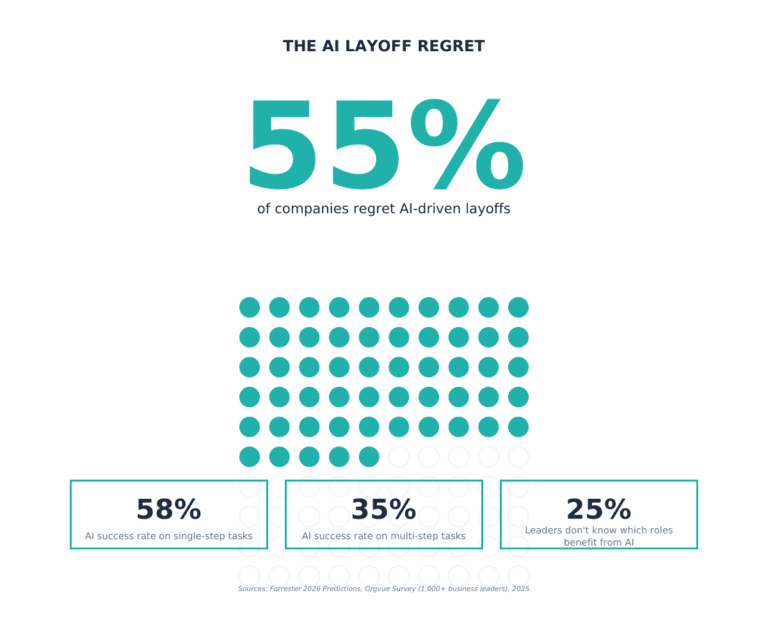
According to research from Forrester, 55% of employers who laid off workers because of AI now regret that decision. A separate study by Orgvue found nearly identical results, with 55% of business leaders admitting they made the wrong call when eliminating jobs to implement AI technology.
These aren’t minor regrets about timing or communication. Companies are discovering that the AI they bet on can’t actually do the work they thought it could. As CNBC recently reported, organizations that eliminated jobs without proper planning are creating what experts call a “talent doom cycle” that will cost them far more in the long run.
If you were laid off due to “AI efficiencies,” this massive regret wave changes everything about your job search strategy and negotiating power. Here’s what you need to know.
☑️ Key Takeaways
- 55% of employers regret AI-driven layoffs, with companies discovering automation can’t handle complex tasks requiring judgment, relationships, or institutional knowledge
- AI agents achieve only 58% success on single-step tasks and just 35% on multi-step work, falling dramatically short of replacing the human expertise companies eliminated
- Companies that cut junior positions create a “talent doom cycle” that forces expensive external hiring at premium rates 12-24 months later when leadership pipelines dry up
- Laid-off workers hold more negotiating power than they realize when companies quietly seek to rebuild capabilities, especially if they can demonstrate expertise in the 65% of tasks where AI consistently fails
The Numbers Don’t Lie: AI Isn’t Ready to Replace Complex Work
When Executive Promises Collide With Technical Reality
The AI hype cycle promised companies they could slash headcount while maintaining or even boosting productivity. The reality delivered something completely different, and the data reveals exactly why these layoffs are backfiring.
Research cited by Forrester shows that even advanced AI agents currently achieve only a 58% success rate on single-step tasks. For multi-step tasks requiring critical thinking, nuanced judgment, or contextual understanding? That success rate plummets to approximately 35%. Yet companies made massive workforce cuts based on promises that AI could seamlessly handle complex human roles.
Let’s examine what actually happened when major companies went all-in on AI automation.
Salesforce cut 4,000 customer support roles, shrinking their team from 9,000 to 5,000 employees. CEO Marc Benioff admitted in a September interview that AI now handles 50% of customer conversations while humans still handle the other 50%. Despite the triumphant layoff announcement, they still need humans for half the work they thought AI could completely take over.
Amazon announced 14,000 corporate job cuts in October 2025, explicitly citing AI investments as justification for reducing their workforce. But buried in their internal memo was a telling caveat: they’ll “continue hiring in key strategic areas.” Translation: the technology can’t actually handle everything executives promised it would.
According to research tracked by HR Dive, the reasons for regret are remarkably consistent across industries. A quarter of business leaders admit they don’t even know which roles in their organization can benefit most from AI. Another third don’t know which positions are most at risk for automation. Yet somehow, these same leaders confidently eliminated thousands of jobs based on that incomplete understanding.
The pattern is clear. Companies discovered that AI excels at handling routine, repetitive tasks but fails dramatically when situations require institutional knowledge, relationship management, emotional intelligence, or human judgment. The gap between what AI can do and what companies need done is far wider than anyone anticipated.
Interview Guys Tip: If you were laid off due to “AI automation,” document every complex decision, client relationship, and judgment call you made in your previous role. When companies realize their mistake and need experienced workers again, you’ll have concrete proof of the irreplaceable value you bring. This becomes powerful leverage during salary negotiations.
Understanding essential AI skills can actually work in your favor, positioning you as someone who complements the technology rather than competes with it.
What “Regret” Actually Means (And Why It Matters to Your Job Search)
The Gap Between Admitting Mistakes and Fixing Them
Here’s the critical question: if 55% of companies regret their AI-driven layoffs, does that mean they’re actively rehiring those positions? The answer is more complex than you might expect, and understanding that complexity is key to your strategy.
What we know for certain is that companies are experiencing real operational pain from their hasty cuts. The Orgvue study found that 34% of companies also saw employees quit as a direct result of AI implementation, compounding their talent loss. Customer satisfaction scores have declined. Projects are stalling. The institutional knowledge they casually discarded is proving impossible to replace quickly.
Forrester predicts that by the end of 2026, roughly half of these AI-attributed layoffs will be reversed in some form. But here’s the uncomfortable reality: many of those jobs may return offshore, as contract positions, or at significantly reduced salaries. Companies rarely admit mistakes publicly by simply rehiring the exact same roles at the same compensation.
What does this mean practically? Companies need the work done, they regret eliminating the expertise, but they’re trying to solve the problem without admitting they were wrong. You’ll see this play out in several ways.
Some organizations are quietly posting new positions with slightly different titles but essentially identical responsibilities. Others are bringing people back as contractors or consultants rather than employees. Some are hiring offshore teams at lower cost. And a few are actually reaching out to former employees with genuine rehiring offers, though usually after exhausting other options first.
The Salesforce example illustrates this perfectly. They cut 4,000 support roles but claim they “successfully redeployed hundreds of employees into other areas like professional services, sales, and customer success.” That’s not reversing the layoffs. That’s shuffling people around internally because they realized they still need human expertise, just maybe in different departments.
The real opportunity isn’t necessarily getting your exact old job back. The opportunity is understanding that these companies desperately need experienced workers who can deliver results AI can’t match. That need creates leverage you didn’t have before the layoffs.
Interview Guys Tip: Don’t wait for companies to announce they’re rehiring. Start applying to organizations that made AI-driven cuts 6-9 months ago. They’re past the initial “AI will solve everything” honeymoon phase and deep into the “we actually need humans for this” reality phase. Position yourself as the solution to problems they’re only now admitting they have.
For workers navigating the job market after a layoff, this timing strategy can significantly accelerate your return to employment at better compensation than your previous role.
The Talent Doom Cycle: Why Today’s Regret Becomes Tomorrow’s Crisis
The Long-Term Consequences Companies Are Just Starting to Understand
Oxford Internet Institute’s Fabian Stephany has a term for what’s happening: the “talent doom cycle.” When companies eliminate positions without maintaining their capability to do the work, they create a cascading series of problems that get progressively more expensive to solve.
Chris Eldridge, CEO of recruitment firm Robert Walters, explains the mechanism: “If a company doesn’t have enough young talent, it will be forced to hire from the outside in the future and will create a ‘talent doom cycle’ which will result in increased costs, salary inflation, and a dependency on the external talent market.”
Here’s how this cycle actually plays out in organizations.
In the short term, companies celebrate apparent cost savings from AI automation and reduced headcount. CFOs present impressive numbers to the board showing decreased labor costs. Executives congratulate themselves on their forward-thinking efficiency measures. Everything looks great on spreadsheets.
Six to twelve months later, the operational reality becomes impossible to ignore. AI fails to handle complex tasks that eliminated employees previously managed smoothly. Customer satisfaction scores decline because the AI can’t navigate nuanced situations. Projects miss critical deadlines because there’s nobody available who understands the subtle details of how work actually flows through the organization.
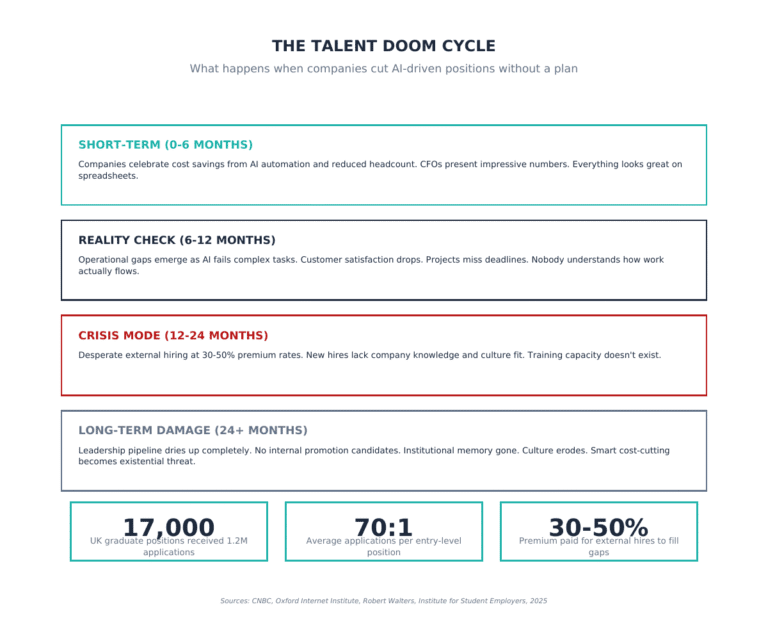
Twelve to twenty-four months out, the panic begins. Companies start desperate external hiring at premium rates to fill capability gaps their layoffs created. These new hires lack company-specific knowledge and don’t fit the culture. They require extensive onboarding that the organization no longer has capacity to provide properly. And they’re expensive, often commanding 30-50% more than the employees who were laid off.
Two years and beyond, the senior leadership pipeline completely dries up. There are no internal candidates ready for promotion because the company stopped developing talent. Institutional memory walks out the door. What seemed like smart cost-cutting transforms into an existential threat to competitive advantage.
The data reveals just how severe this is becoming. In the UK, just under 17,000 graduate vacancies received 1.2 million applications. That’s roughly 70 applications per single entry-level position. Companies that eliminated junior roles thinking AI could bridge the gap are discovering they’ve cut off their own talent pipeline. In a few years, they’ll have no one ready to step into middle management or senior roles.
What does this mean for experienced workers? Companies that cut aggressively in 2024 and 2025 will face severe talent shortages by late 2026 and into 2027. They’ll pay premium rates for professionals who can step in and immediately contribute. If you have 3-7 years of experience in a field currently experiencing AI-driven layoffs, your negotiating leverage is building every month.
The regret companies feel now is about immediate operational problems. The real crisis is still coming, and it will create unprecedented opportunities for workers who position themselves strategically.
Our State of Job Search 2025 research report explores these trends in depth, revealing how the job market is shifting dramatically in favor of workers with proven expertise.
Red Flags That Signal a Company Made Hasty AI Cuts
How to Identify Organizations That Will Need Your Expertise Soon
Not every company that implemented AI and reduced headcount is facing regret and operational problems. Some organizations approached automation thoughtfully, with clear plans and realistic expectations. Others made catastrophic mistakes they’re now desperately trying to fix.
Learning to distinguish between these two categories gives you a massive strategic advantage. Here are the warning signs that indicate a company rushed into AI-driven cuts without proper planning.
Vague justification in the initial announcement is your first clue. If the press release mentioned “AI transformation” or “leveraging emerging technologies” without any specifics about which processes were actually automated or what measurable outcomes they expected, that’s a red flag. Generic corporate-speak usually means they had no concrete plan beyond “AI is the future, so let’s cut costs.”
Leadership contradiction tells you everything you need to know about decision-making quality. Watch for executives who previously assured employees that “AI won’t replace jobs” suddenly announcing mass layoffs explicitly citing AI as the reason. Marc Benioff at Salesforce exemplifies this pattern, having downplayed AI’s impact on employment before eliminating 4,000 positions with enthusiasm.
The timeline between AI deployment and layoffs reveals whether cuts were strategic or reactive. Companies that announced workforce reductions within 3-6 months of implementing AI tools didn’t give their systems time to prove effectiveness. They made emotional, hype-driven decisions based on promises rather than performance data. Those organizations are most likely experiencing serious regret now.
Customer complaints on social media provide real-time feedback about whether the cuts actually worked. Check the company’s Twitter replies, Reddit discussions about them, and review sites like Glassdoor for patterns. Increased wait times, declining service quality, frustrated customers, and complaints about “talking to robots that don’t understand” all indicate that eliminating human workers created problems the AI cannot solve.
Quiet job postings become obvious when you monitor systematically. If similar roles appear 6-12 months after layoffs, often with slightly different titles but essentially identical responsibilities, the company is backfilling positions they shouldn’t have eliminated. They’re hoping candidates won’t notice the connection between the layoff announcement and the current hiring push.
Executive turnover shortly after major AI-driven layoffs signals internal acknowledgment that the strategy failed. When HR leaders, operations executives, or department heads leave within 6-9 months of implementing aggressive automation, they’re often jumping ship before the full consequences become publicly visible. They know what’s coming.
Interview Guys Tip: Create a spreadsheet tracking companies in your industry that announced AI-driven layoffs. Include columns for announcement date, number of positions eliminated, executive quotes, and your assessment of red flags. Set Google Alerts for each company name plus terms like “hiring,” “job openings,” and your specific role type. You’ll get immediate notifications when they start rebuilding, giving you first-mover advantage over candidates who aren’t paying attention.
Your Strategic Advantage: Turning Their Regret Into Your Opportunity
How to Position Yourself When Companies Realize They Need You
The 55% regret rate fundamentally changes the power dynamic between laid-off workers and the companies that eliminated their positions. Even if organizations aren’t openly admitting mistakes or formally reversing layoffs, they’re experiencing real pain from the capabilities they lost. That pain creates opportunity.
Here’s how to position yourself strategically right now.
First, understand what companies actually regret losing. According to the research, it’s not just task completion. Organizations are struggling with lost institutional knowledge, broken client relationships, declined customer satisfaction, missed project deadlines, and the inability to handle complex situations that require human judgment. Document how you specifically delivered value in all these areas.
Create a portfolio that proves your irreplaceable contributions. Include examples of times you solved problems AI fundamentally cannot handle: navigating office politics to get projects approved, managing upset clients who needed empathy and creative solutions, making judgment calls in ambiguous situations, or training junior employees who then became top performers.
Build visibility in your industry while companies are still in their “AI will solve everything” phase. Post thoughtfully on LinkedIn about your expertise. Engage with industry discussions. Make it clear you understand both the capabilities and limitations of AI. Position yourself as someone who works effectively WITH automation tools rather than someone who fears being replaced BY them.
Target your applications strategically based on the AI regret timeline. Companies that announced AI-driven cuts 6-9 months ago are hitting the peak regret phase right now. They’re past the initial excitement, deep into operational problems, but not yet desperate enough to publicly reverse course. That’s your sweet spot for outreach.
When you do connect with these organizations, frame your value around solving the specific problems AI can’t handle. Don’t just list your previous responsibilities. Explain how you navigated complex situations, built relationships that drove revenue, or made judgment calls that prevented disasters. Make it obvious that you bring capabilities their AI agents will never develop.
For negotiation leverage, remember that you’re not just another candidate. You potentially represent the solution to an expensive mistake they’re reluctant to admit publicly. If they’re reaching out to you specifically, they’ve already acknowledged internally that they need human expertise they eliminated. That’s tremendous leverage if you use it correctly.
Research from Forrester indicates that 57% of decision-makers responsible for AI investments now believe the technology will increase rather than decrease headcount over the next year. That’s a stunning reversal from 18 months ago. It means demand for experienced workers is about to surge across industries that went heavy on AI automation.
Interview Guys Tip: When applying to companies that made AI-driven cuts, address it directly in your cover letter. Try something like: “I notice your team recently restructured around AI capabilities. I’ve spent the last [X] years developing expertise in the complex problem-solving, relationship management, and strategic decision-making that complements automated systems perfectly.” You’re acknowledging their approach while positioning yourself as the human element they’re discovering they still need.
For detailed tactics on salary discussions with companies that need you more than they’re willing to admit, check out our guide on what to say when asked about salary expectations, which includes strategies specifically designed for situations where you hold more power than typical negotiations.
What This Means for Your Career Strategy Going Forward
Playing the Long Game in an AI-Disrupted Job Market
The widespread regret about AI-driven layoffs reveals something critical about the future of work: companies will continue experimenting with automation, many will make mistakes, and workers who understand this pattern will have sustained career advantages.
Your strategy shouldn’t be preventing companies from trying AI. That’s impossible and ultimately counterproductive. Your strategy should be positioning yourself as indispensable when their experiments don’t deliver promised results.
Here’s your action plan, organized by timeline.
For immediate actions over the next three months, start systematically documenting expertise that AI fundamentally cannot replicate. Focus on client relationships where trust took years to build, judgment calls you made in ambiguous situations where there was no clear “right answer,” and crisis management where you improvised creative solutions under pressure. Create specific examples with measurable outcomes.
Build your network aggressively at companies that haven’t yet made AI-driven cuts. They’re watching what happens at organizations that moved first, and they’ll be more thoughtful about implementation. They’ll also need experienced workers who can help them avoid the mistakes their competitors made. Reach out to former colleagues, engage strategically on LinkedIn, and make yourself visible to recruiters specializing in your field.
Get intentionally visible on LinkedIn with posts about your expertise and thoughtful takes on your industry. Companies hunting for experienced talent after their AI experiments underdeliver will be searching LinkedIn extensively. Make sure they find you, and make sure your profile demonstrates you understand how to work alongside AI rather than compete against it.
For medium-term positioning over the next 3-12 months, track which companies in your industry announce AI-driven workforce reductions. Create a systematic monitoring system. These organizations will likely need experienced workers in 6-18 months when operational reality collides with their optimistic projections. Time your outreach strategically.
Develop skills that complement AI rather than compete with it directly. Learn to work alongside automation tools as a force multiplier for your human capabilities. The future belongs to professionals who leverage AI to enhance their expertise, not those who try to prove they’re better than algorithms at routine tasks.
Consider contract or consulting work at premium rates while the job market adjusts. Many organizations want experienced expertise without committing to full-time headcount after their automation mistakes. You can command 50-100% higher hourly rates than salaried positions while maintaining flexibility to choose your projects.
For long-term career protection, cultivate capabilities in areas where AI consistently fails. Complex problem-solving in ambiguous situations, relationship building that requires empathy and years of trust, strategic decision-making with incomplete information, and creative innovation that requires understanding human needs all represent domains where AI struggles fundamentally.
Build a reputation as someone who achieves exceptional results by combining human judgment with AI tools. Write about your approach. Share case studies. Make it clear you’re not threatened by automation because you understand how to make it work for you rather than against you.
Maintain strong relationships with former colleagues who were laid off alongside you or who left companies that made aggressive AI-driven cuts. They’re your intelligence network. They’ll hear about operational problems before those issues become public. They’ll know when companies start quietly rebuilding capabilities. That information gives you timing advantages worth thousands of dollars in negotiations.
The companies experiencing regret right now made decisions based on hype rather than realistic assessment of what AI can actually do. Those same companies, and others watching them, will be hiring experienced professionals over the next 18-24 months. Your job is ensuring you’re positioned as the obvious solution when they finally admit they need human expertise after all.
Understanding how AI is revolutionizing the job search process helps you stay ahead of both threats and opportunities in this rapidly evolving landscape.
The Bottom Line
More than half of companies that eliminated jobs due to AI now admit they made a mistake. That’s not a small sample or an outlier finding. Multiple research studies from Forrester, Orgvue, and other organizations tracking workforce trends found remarkably consistent results: companies rushed into AI-driven cuts without understanding what the technology could actually do, and they’re regretting those decisions.
The regret is real. The operational problems are real. The need for experienced human workers is real.
What’s less certain is how quickly and openly companies will reverse course. Some will quietly rehire. Others will bring people back as contractors. Many will simply start hiring for “new” roles that look suspiciously similar to the positions they eliminated. The specific path varies, but the underlying need for human expertise remains constant.
If you were laid off due to “AI efficiencies,” you’re not the problem. The hasty, hype-driven decision-making was the problem. The unrealistic expectations about what AI could handle was the problem. The failure to properly plan and test before eliminating institutional knowledge was the problem.
Your job now is positioning yourself to benefit when companies finally acknowledge those problems and start looking for solutions. Document your irreplaceable value. Build your visibility. Time your outreach strategically. And remember that you’re negotiating from a stronger position than you might initially realize.
The AI experiment didn’t work as planned for most companies. Their expensive lesson can absolutely become your career advantage, if you approach the situation strategically and refuse to undervalue expertise that AI will never truly replicate.
The reality is that firing off more applications rarely lands more interviews — applying to the right ones, the right way, does. That’s why we built Robin: a free tool that reads the exact job you’re applying to and tells you what they want and how you match, before you hit submit:
Turn More Applications Into Interviews
Volume isn’t the answer — precision is. We built Robin to make every application count: it reads the exact posting and tells you what they actually want, how strong your match is, and the gaps to fix before you hit submit — so you stop spraying and start landing. Free, right in your browser.
This is the general advice. Longbow applies it to your actual search: real match scores, ghost-job checks, and prep for the jobs worth your time. Here's the full story.

ABOUT THE INTERVIEW GUYS (JEFF GILLIS & MIKE SIMPSON)
Mike Simpson: Co-founder of The Interview Guys and Longbow. He has been the voice behind our interview advice since 2013 — his work has reached over 100 million job seekers around the world. The strategic mind behind Longbow, our new career platform.
Jeff Gillis: Co-founder of The Interview Guys and Longbow. He built the systems that put our work in front of those readers, and he leads the engineering on Longbow, the cutting edge career platform built for today’s job seeker.