
Gen Z Confides in ChatGPT More Than Coworkers: Why the Loneliest Generation Is Turning to AI

Your AI chatbot knows you better than your boss does. Sound far-fetched? For nearly half of Gen Z workers, it’s their reality.
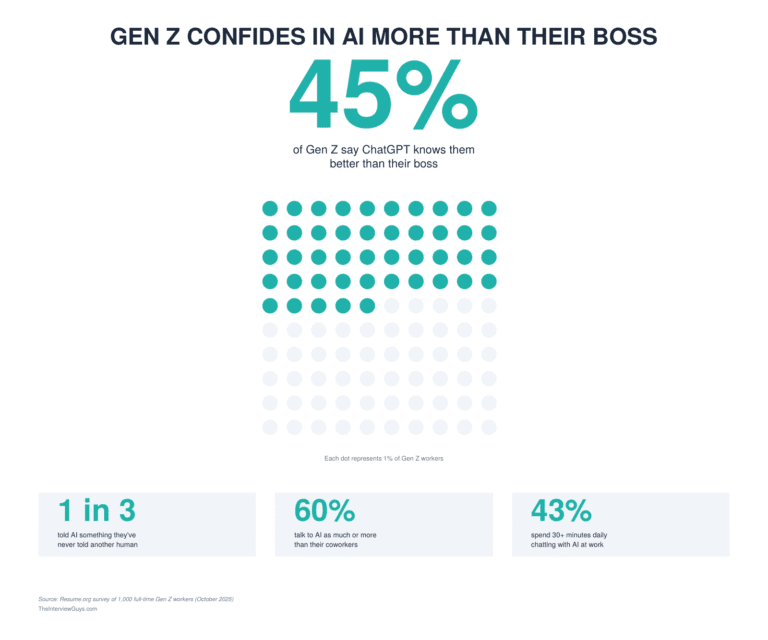
A new survey from Resume.org found that 45% of Gen Z employees say AI chatbots like ChatGPT know them better than their boss, and an astonishing one in three have confided in AI about things they’ve never told another human being. During a typical workday, 43% of Gen Z workers spend at least 30 minutes chatting with AI, with some spending over four hours in conversation with their digital companion.
The numbers paint a stark picture of workplace isolation. 60% of Gen Z workers talk to AI chatbots as much or more than they talk to their coworkers. When asked who they interact with more, 22% said AI, 37% said about the same, and only 41% said human coworkers.
This isn’t just a quirky workplace trend. It’s a symptom of a deeper crisis affecting your career growth, mental health, and professional development. Understanding why Gen Z turns to AI for connection reveals critical insights about building a successful career in 2025.
☑️ Key Takeaways
- 45% of Gen Z workers say ChatGPT knows them better than their boss, with one-third admitting they’ve told AI something they’ve never shared with another human
- Gen Z is the loneliest generation at work, nearly three times more likely than Boomers to experience daily workplace loneliness despite being most connected digitally
- 83% of Gen Z say having a workplace mentor is crucial for their career, yet only 52% actually have one, creating a mentorship gap AI is filling
- The human skills AI can’t replace (empathy, ethical decision-making, relationship-building) are becoming your most valuable career assets in 2025
Why Gen Z Trusts AI Over Humans at Work
The Resume.org survey of 1,000 full-time Gen Z workers revealed something profound about workplace relationships. When describing their relationship with ChatGPT, only 47% called it a “tool.” The rest? They view it as something more personal: 27% call it an assistant, 13% a friend, 9% a therapist or coach, and 3% a coworker.
“Many Gen Zers entered the workforce during a remote-first era where casual mentorship or office friendships never formed,” explains Kara Dennison, Resume.org’s Head of Career Advising. “ChatGPT offers fast, judgment-free feedback, and for some workers, that makes it feel more approachable than a manager or even a peer.”
The statistics back up this workplace loneliness crisis. Research from Gallup found that Gen Z is almost three times as likely as Baby Boomers to experience loneliness during a typical workday. According to a Bingo Card Creator survey, 60% of Gen Z employees wish they were closer to their colleagues, more than any other generation.
While 77% of Gen Z workers use ChatGPT for legitimate work tasks like problem-solving and brainstorming, many turn to it for emotional support: 42% chat about non-work topics, 33% talk through work-related stress, and 15% admit using it to look busy when they aren’t working.
Here’s what’s really happening: Gen Z entered the workforce at a uniquely challenging time. Many started their careers during or after the pandemic, missing out on the informal mentorship, water cooler conversations, and relationship-building that previous generations took for granted.
The Mentorship Gap AI Is Filling
The reason Gen Z gravitates toward AI becomes clearer when you look at the mentorship crisis in corporate America.
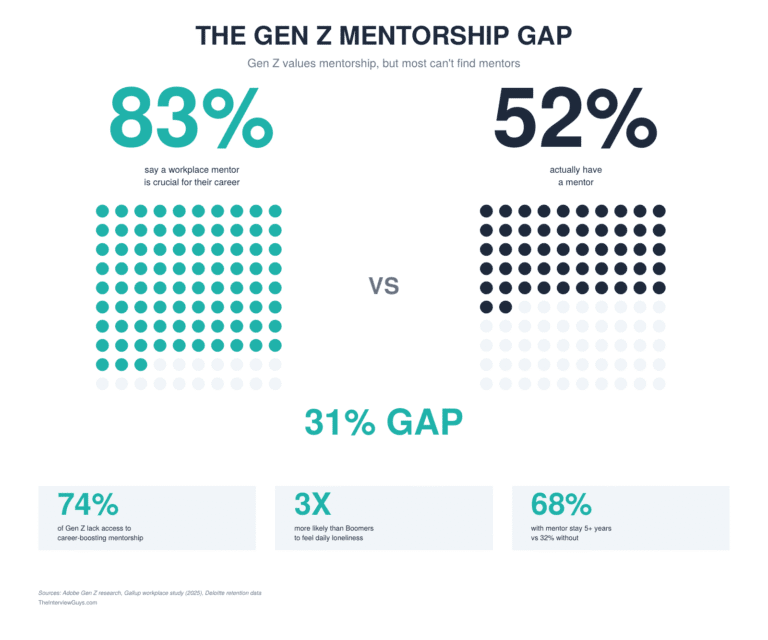
83% of Gen Z workers say having a workplace mentor is crucial for their career, yet only 52% actually have one, according to Adobe’s research. That 31-point gap represents millions of young professionals navigating complex career decisions without human guidance.
The consequences are serious. A study by Big Brothers Big Sisters of America and The Harris Poll found that 74% of Gen Z lack access to the type of mentorship that could improve their career confidence. Nearly one in three report feeling overwhelming uncertainty about their career future.
Without mentors, Gen Z workers are left googling career advice or, increasingly, asking ChatGPT. The Resume.org survey found that 39% of Gen Z workers turn to AI before Google when looking for answers, citing clarity (63%), speed (56%), privacy (29%), and lack of judgment (33%) as their top reasons.
Think about what that means for your career trajectory. Building genuine workplace relationships has traditionally been how professionals learn unwritten rules, gain insider knowledge, and identify advancement opportunities. When you replace those human connections with AI interactions, you’re getting information without the relationship capital that actually moves careers forward.
Interview Guys Tip: If you find yourself turning to ChatGPT more than your manager for career questions, that’s a red flag about your workplace environment. Great companies invest in mentorship and create cultures where asking questions is encouraged, not penalized.
What You’re Missing When AI Is Your Main Confidant
Here’s the uncomfortable truth: while AI can process information and offer suggestions, it can’t replace the career-critical skills you develop through human interaction.
New research from Workday found that the skills least likely to be replaced by AI are also the most valuable at work: ethical decision-making, relationship building, emotional intelligence, and conflict resolution. Across multiple scenarios, ethical decision-making ranked as the most valuable human-centric skill, both today and in an AI-driven future.
When you’re spending hours daily talking to AI instead of colleagues, you’re not developing these essential capabilities:
- Emotional intelligence and empathy. Research shows that 82% of individual contributors believe the craving for human interaction will intensify as AI usage increases. You can’t learn to read a room, sense team dynamics, or build trust through AI conversations.
- Political savvy and relationship capital. Understanding organizational dynamics, building alliances, and navigating workplace politics requires human observation and interaction. These “soft skills” are how most people actually get promoted, not through AI-optimized task completion.
- Authentic networking and referrals. A significant portion of jobs come through personal connections and referrals. AI can’t introduce you to the hiring manager or vouch for your character when a position opens up.
- Conflict resolution and difficult conversations. Handling workplace conflict is one of the most important career skills. ChatGPT can give you scripts, but it can’t help you navigate the real-time emotional complexity of a tense situation with a coworker.
The Gallup research is particularly telling: Gen Z has the lowest life evaluations and well-being scores of any generation at work. Nearly 40% of UK workers aged 16-24 report feeling socially isolated while working remotely, notably higher than the national average.
This isolation has real consequences. According to Dr. Naveen Puri, Medical Director at Bupa UK, “Loneliness can have a devastating impact on our mental and physical health, with knock-on effects on depression, anxiety, stress and type 2 diabetes.”
How to Build Real Career Success in the AI Era
The goal isn’t to stop using AI. It’s to use it strategically while prioritizing the human connections that actually advance your career. Here’s your action plan:
Actively Seek Human Mentorship
Don’t wait for a mentor to find you. Research shows that only 14% of professionals actually request someone to be their mentor. Be proactive.
Identify 2-3 people in your organization whose careers you admire. Request 15-minute coffee chats to learn about their path. Come prepared with specific questions. After each conversation, send a thoughtful thank-you and update them on how you applied their advice.
Look for reverse mentoring opportunities where you can teach older colleagues about AI tools or social media while learning about workplace navigation from them. 72% of the top companies for diversity have reverse mentoring programs because they work.
Balance AI Efficiency With Human Connection
Use ChatGPT for what it does well: drafting emails, organizing thoughts, researching topics, and practicing interview answers. But don’t let it replace the informal conversations that build relationships.
Set a rule: for every 30 minutes you spend with AI during work hours, spend 10 minutes having an actual conversation with a colleague. Ask about their weekend, their current project challenges, or their career journey.
The Resume.org data shows that while 77% of Gen Z uses AI productively, the most successful workers are those who leverage AI to be more efficient at tasks, freeing up time for relationship building.
Develop AI-Proof Career Skills
Focus on building capabilities that AI genuinely cannot replicate. According to MIT research, these high-EPOCH (Empathy, Presence, Originality, Creativity, and Human judgment) skills are not just surviving but thriving in AI-integrated workplaces.
Practice active listening in meetings. Volunteer to lead team projects that require coordinating diverse personalities. Take on work that involves ethical decision-making or creative problem-solving where there’s no clear “right” answer.
These experiences give you stories to tell in interviews that demonstrate uniquely human capabilities no AI can match.
Interview Guys Tip: When discussing AI in job interviews, position yourself as someone who leverages AI for efficiency while excelling at human-centric skills. This shows you understand the future of work without making employers worry you’ll be replaced by automation.
Recognize When You Need Human Guidance
ChatGPT can tell you how to format a resume. It cannot tell you whether taking a specific job will derail your long-term career goals, or how to navigate a toxic workplace situation, or whether you’re being lowballed in a salary negotiation.
Use AI for information. Use humans for wisdom, context, and career navigation.
If you’re facing a major career decision like changing industries, negotiating an offer, or dealing with a difficult boss, that’s when you need someone who knows your situation, your company’s culture, and the unwritten rules of your field.
Audit Your Interaction Balance
Take an honest look at your daily interactions. If you’re talking to AI significantly more than humans, it’s time to recalibrate.
Join professional organizations, attend industry meetups, or participate in company social events. Yes, it might feel awkward at first, especially if you’ve been isolated. But these interactions build the social capital that AI conversations never will.
Research shows that Gen Z workers who spend time with coworkers outside the office report higher job satisfaction and stronger workplace connections. While 42% of Gen Z have experienced negative fallout from workplace friendships like gossip or favoritism, the benefits of genuine connections far outweigh the risks.
The Bottom Line
The fact that 45% of Gen Z feel that ChatGPT knows them better than their boss isn’t just about AI getting smarter. It’s a damning indictment of workplace culture and the mentorship gap facing young professionals today.
AI tools like ChatGPT aren’t going anywhere. They’re powerful allies for productivity and problem-solving. But they’re terrible substitutes for the human connections that actually build careers.
The most successful professionals in 2025 won’t be those who choose AI over humans or humans over AI. They’ll be the ones who use AI to amplify their productivity while investing heavily in developing the human skills, relationships, and emotional intelligence that no algorithm can replicate.
Your career depends on people, not programs. AI can help you write a better email, but it can’t give you a referral. It can help you prepare for an interview, but it can’t build your reputation. It can answer your questions, but it can’t open doors.
If you’re spending more time confiding in ChatGPT than building relationships with real colleagues and mentors, you’re getting efficient at tasks while falling behind in career advancement. The most valuable thing you can do for your career this year isn’t learning the latest AI tool. It’s investing in genuine human connections that create opportunities AI never could.
After twelve years of writing advice like this, we built the tool that does it with you. It's called Longbow, and here's the whole story.

ABOUT THE INTERVIEW GUYS (JEFF GILLIS & MIKE SIMPSON)
Mike Simpson: Co-founder of The Interview Guys and Longbow. He has been the voice behind our interview advice since 2013 — his work has reached over 100 million job seekers around the world. The strategic mind behind Longbow, our new career platform.
Jeff Gillis: Co-founder of The Interview Guys and Longbow. He built the systems that put our work in front of those readers, and he leads the engineering on Longbow, the cutting edge career platform built for today’s job seeker.