
Free Paraprofessional Resume Template: ATS Examples and Complete 2025 Writing Guide

Looking for a paraprofessional position that lets you make a real difference in students’ lives? Your resume is the key that unlocks those opportunities. But here’s the challenge: most paraprofessional candidates struggle to showcase their unique blend of educational support skills, patience, and classroom management abilities in a way that stands out to hiring managers.
We understand the frustration of submitting application after application without hearing back. That’s why we’ve created a comprehensive, ATS-friendly paraprofessional resume template that highlights exactly what school administrators are looking for in 2025.
In this guide, you’ll discover a proven resume format that showcases your instructional support experience, behavioral intervention skills, and dedication to student success. We’re providing both a filled example and a blank template so you can see what works and customize it for your unique background.
By the end of this article, you’ll have a professional resume that positions you as the ideal candidate for paraprofessional roles, whether you’re supporting special education students, assisting in general classrooms, or working in specialized programs.
☑️ Key Takeaways
- Paraprofessional resumes should prioritize a Skills section followed by Experience to quickly demonstrate your classroom support capabilities and educational qualifications
- Quantify your impact with specific metrics like “supported 15 special education students” or “improved reading comprehension scores by 23%” rather than listing generic duties
- Include relevant certifications prominently such as ParaPro Assessment scores, Child Development Associate (CDA), or state-specific educational aide credentials
- Tailor your resume for each position by matching keywords from the job description while maintaining your authentic experience and achievements
Understanding the Paraprofessional Role in 2025
Paraprofessionals have become essential team members in educational settings. You’re not just assisting teachers; you’re providing critical one-on-one support, implementing individualized education plans, and creating inclusive learning environments for diverse student populations.
The role has evolved significantly. Today’s paraprofessionals need technical skills for managing educational software, trauma-informed practices for supporting at-risk students, and data collection abilities for tracking student progress. Your resume needs to reflect this modern skill set.
Most paraprofessional positions require specific qualifications. According to federal Title I requirements, instructional paraprofessionals must have a high school diploma plus one of three qualifications: completion of at least 48 semester hours of college coursework, an associate degree or higher, or passing a rigorous state or local academic assessment like the ParaPro exam.
Your resume should immediately communicate that you meet these baseline requirements while showcasing what makes you uniquely qualified for the specific role you’re targeting.
Before you send that resume: most Paraprofessional resumes get filtered out by ATS before a human ever sees them. Upload yours and find out your score. It takes 60 seconds and it’s free.
Paraprofessional Resume Example
Here’s a professional resume example. This example gives you an idea of what type of content fits in a good ATS friendly resume.
Example Resume:
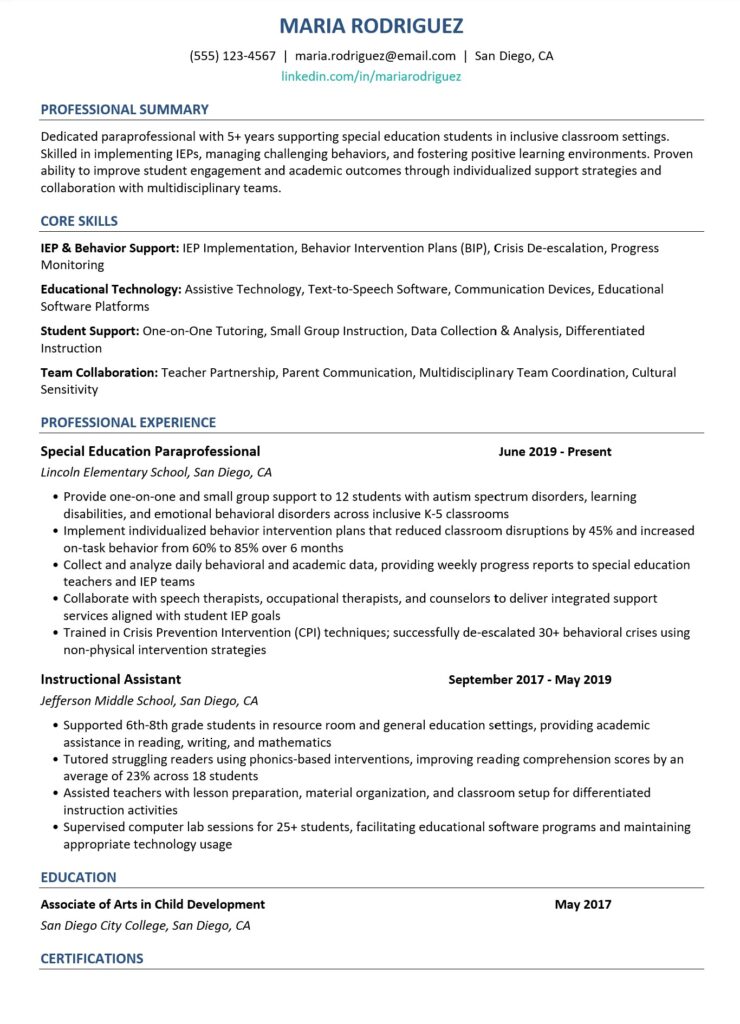
Here’s a professional paraprofessional resume template you can download and customize. This template is designed to be both visually appealing and ATS-friendly, with clean formatting that highlights your strengths.
Blank Customizable Template

Download Your Free Template:
- Download DOCX Template (fully editable in Microsoft Word)
Interview Guys Tip: The DOCX template is fully editable, allowing you to adjust fonts, colors, and spacing to match your personal brand while maintaining professional formatting. Just replace the placeholder text with your own information.
Here’s what most people don’t realize: employers now expect multiple technical competencies, not just one specialization. The days of being “just a marketer” or “just an analyst” are over. You need AI skills, project management, data literacy, and more. Building that skill stack one $49 course at a time is expensive and slow. That’s why unlimited access makes sense:
Your Resume Needs Multiple Certificates. Here’s How to Get Them All…
We recommend Coursera Plus because it gives you unlimited access to 7,000+ courses and certificates from Google, IBM, Meta, and top universities. Build AI, data, marketing, and management skills for one annual fee. Free trial to start, and you can complete multiple certificates while others finish one.
What Hiring Managers Look for in Paraprofessional Resumes
School administrators reviewing paraprofessional applications have specific priorities. They need to quickly verify you meet minimum qualifications, then assess whether you have the right combination of hard and soft skills for their particular classroom environment.
Hard skills matter tremendously. Can you implement behavior intervention plans? Do you know how to use assistive technology for students with disabilities? Are you trained in crisis de-escalation techniques? These technical competencies need prominent placement on your resume.
Soft skills are equally critical. Patience, empathy, adaptability, and strong communication abilities determine your success as a paraprofessional. The challenge is demonstrating these qualities through concrete examples rather than simply listing them.
Hiring managers also look for evidence of collaboration. Paraprofessionals work closely with certified teachers, therapists, parents, and administrators. Your resume should show you understand this team-based approach and have successfully navigated these relationships in previous roles or relevant experiences.
Essential Sections for Your Paraprofessional Resume
Your paraprofessional resume needs a strategic structure that puts your most relevant qualifications front and center. Here’s the optimal section order for maximum impact.
Contact Information
Start with your full name, phone number, email address, city and state, and LinkedIn profile if you have one. Keep it simple and professional.
Professional Summary or Objective
This 2-3 sentence section appears directly below your contact information. A professional summary works best if you have paraprofessional experience, highlighting your years of service and key accomplishments. An objective statement is more appropriate if you’re entering the field, focusing on your relevant education and transferable skills.
For experienced paraprofessionals, try something like: “Dedicated paraprofessional with 5+ years supporting special education students in inclusive classroom settings. Skilled in implementing IEPs, managing challenging behaviors, and fostering positive learning environments. Proven ability to improve student engagement and academic outcomes through individualized support strategies.”
If you’re new to the field: “Recent graduate with Associate’s degree in Early Childhood Education seeking paraprofessional position. Completed 200+ hours of classroom observation and student teaching. Passionate about supporting diverse learners and creating inclusive educational environments.”
Skills
Your Skills section deserves prominent placement because it allows hiring managers to quickly assess your capabilities and helps your resume pass through Applicant Tracking Systems (ATS).
Mix hard skills and soft skills strategically. Hard skills might include: Behavior intervention plan implementation, IEP familiarity, assistive technology proficiency, data collection and progress monitoring, crisis intervention techniques, or specific educational software platforms.
Soft skills should include: Classroom management, patience and empathy, clear communication, flexibility and adaptability, team collaboration, or cultural sensitivity.
Reference the specific job description and incorporate keywords that match your genuine abilities. Don’t list skills you don’t actually possess just to get past ATS systems.
Professional Experience
This section proves you can do the work. Even if you lack formal paraprofessional experience, include relevant positions like tutoring, daycare work, coaching, or volunteer roles in educational settings.
Use bullet points that start with strong action verbs and focus on accomplishments rather than responsibilities. Quantify your impact whenever possible. Instead of “Assisted students with special needs,” write “Provided one-on-one support to 8 students with autism spectrum disorders, implementing individualized behavior intervention plans that reduced classroom disruptions by 40%.”
Each bullet should demonstrate a specific skill or achievement. Show how you’ve collaborated with teachers, supported student learning, managed challenging situations, collected data, or contributed to student success.
Education
List your highest degree first, including the degree type, institution name, location, and graduation year. If you’re currently enrolled, note your expected graduation date.
Include relevant coursework if you’re a recent graduate or career changer, especially courses in child development, special education, educational psychology, or classroom management. These details show you have foundational knowledge even if you lack extensive experience.
Certifications and Training
This section carries significant weight for paraprofessional positions. Include your ParaPro Assessment score if you’ve passed (scores above 456 are required in most states), state-specific educational aide certifications, Child Development Associate (CDA) credential, CPR and First Aid certification, or any specialized training in behavior management, autism support, or assistive technology.
List the certification name, issuing organization, and date obtained or expiration date if applicable.
Writing Powerful Bullet Points That Showcase Your Impact
Generic bullet points kill your chances. “Assisted teacher with classroom duties” tells hiring managers nothing about your actual contributions or capabilities.
Transform your bullets by following the SOAR Method (Situation, Obstacle, Action, Result). Start with a strong action verb, describe what you did, and quantify the outcome whenever possible.
Instead of: “Helped students with reading”
Try: “Tutored 6 struggling readers in small-group settings, implementing phonics-based interventions that improved reading comprehension scores by an average of 23% over one semester”
Instead of: “Supervised students during lunch”
Try: “Managed lunchroom supervision for 150 elementary students, implementing behavior management strategies that reduced incidents requiring administrative intervention by 60%”
Your bullet points should tell a story of impact. Each one should make the hiring manager think, “We need someone who can do that.”
Tailoring Your Resume for Different Paraprofessional Positions
Not all paraprofessional roles are identical. A special education paraprofessional supporting students with significant behavioral challenges needs different skills than a bilingual paraprofessional helping English language learners in a general education classroom.
Read each job description carefully and identify the specific requirements and desired qualifications. Then adjust your resume to emphasize your most relevant experiences and skills for that particular role.
For special education positions, emphasize your experience implementing IEPs, managing challenging behaviors, using assistive technology, or working with specific disability categories mentioned in the posting.
For bilingual positions, highlight your language proficiency, cultural competency, translation experience, and any certifications related to English language learner instruction.
For elementary versus secondary positions, emphasize age-appropriate skills. Elementary roles may value experience with basic literacy and math instruction, while secondary positions might prioritize subject-specific knowledge or experience supporting students with learning disabilities in content areas.
Before you send that resume: most Paraprofessional resumes get filtered out by ATS before a human ever sees them. Upload yours and find out your score. It takes 60 seconds and it’s free.
Common Paraprofessional Resume Mistakes to Avoid
Even strong candidates sabotage their chances with preventable resume errors. Here are the most common mistakes and how to fix them.
- Mistake 1: Listing duties instead of accomplishments. Don’t simply describe what you were supposed to do. Show what you actually achieved and how you made a difference for students or teachers.
- Mistake 2: Using generic language. Phrases like “team player” or “hard worker” mean nothing without evidence. Replace generic claims with specific examples that demonstrate these qualities.
- Mistake 3: Including irrelevant work history. Your retail job from ten years ago doesn’t strengthen your paraprofessional application unless you can draw clear connections to transferable skills like customer service, problem-solving, or working with diverse populations.
- Mistake 4: Neglecting keywords from the job description. Many school districts use ATS to filter applications. If the posting mentions specific software, certifications, or skills, make sure those exact terms appear in your resume where genuinely applicable.
- Mistake 5: Poor formatting that confuses ATS. Fancy graphics, tables, headers, and footers can prevent ATS from properly reading your resume. Stick to simple, clean formatting with clear section headers.
Optimizing Your Resume for Applicant Tracking Systems
School districts increasingly rely on ATS to manage high volumes of applications. Your resume might never reach human eyes if it doesn’t pass ATS screening, no matter how qualified you are.
Use a simple, single-column layout with standard section headings like “Professional Experience,” “Education,” and “Skills.” Avoid tables, text boxes, headers, footers, or complex formatting that confuses parsing software.
Save your resume as a .docx file rather than a PDF unless the application specifically requests PDF format. Many ATS systems handle Word documents more reliably.
Match the exact language from job descriptions. If the posting says “behavior intervention plan implementation,” use that exact phrase rather than “BIP implementation” or “behavior management.” The ATS is looking for keyword matches.
Don’t try to game the system by hiding keywords in white text or overloading your resume with every possible term. Focus on genuinely relevant skills and experiences described using the employer’s preferred terminology.
Preparing for the Interview After Your Resume Gets Noticed
Once your stellar resume lands you an interview, preparation is key to converting that opportunity into a job offer. School administrators will want to see that you can walk the talk.
Prepare specific examples that demonstrate your key skills. Use the SOAR Method to structure your stories: describe the Situation, explain the Obstacle, detail the Actions you took, and share the Results you achieved.
Review common paraprofessional interview questions and practice your responses. You’ll likely face questions about behavior management, collaboration with teachers, supporting diverse learners, and handling challenging situations.
Research the school or district before your interview. Understand their student population, educational philosophy, special programs, and any recent initiatives or achievements. This knowledge helps you tailor your responses and ask informed questions.
When you nail that interview, you’ll be ready to start making the difference you’ve been preparing for. Want more interview preparation strategies? Check out our comprehensive guide on paraprofessional interview questions to help you prepare winning answers.
Beyond Your Resume: Additional Tips for Landing Your Paraprofessional Position
Your resume is just one piece of the job search puzzle. Combine it with a strategic approach to maximize your chances of landing your ideal position.
Network within your target school district. Attend school board meetings, volunteer at school events, or connect with current educators on LinkedIn. Many paraprofessional positions are filled through internal recommendations before they’re even publicly posted.
Craft a compelling cover letter that complements your resume by telling your story and explaining why you’re passionate about supporting student success. Your cover letter provides space to address career changes, employment gaps, or other circumstances that might raise questions.
Consider substitute teaching or volunteering in classrooms while you search for permanent positions. These experiences add to your resume while giving you opportunities to demonstrate your capabilities to potential employers.
Stay current with educational trends and continue developing relevant skills. Take online courses in behavior management, inclusive education practices, or educational technology. These efforts show your commitment to professional growth and make you a more attractive candidate.
Taking Your Next Steps Toward Your Paraprofessional Career
You now have everything you need to create a powerful paraprofessional resume that positions you as an ideal candidate. The template provides the structure, and the guidance in this article ensures you’re filling it with compelling content that captures hiring managers’ attention.
Remember that your resume is a living document. Update it regularly as you gain new experiences, complete additional training, or develop new skills. Each refinement makes you a stronger candidate for your next opportunity.
Your work as a paraprofessional will directly impact students’ educational experiences and life trajectories. That’s meaningful work worth pursuing with a resume that truly reflects your capabilities and dedication.
Ready to explore more resume resources? Browse our complete library of free resume templates covering various roles and industries to find additional inspiration for your job search.
Here’s what most people don’t realize: employers now expect multiple technical competencies, not just one specialization. The days of being “just a marketer” or “just an analyst” are over. You need AI skills, project management, data literacy, and more. Building that skill stack one $49 course at a time is expensive and slow. That’s why unlimited access makes sense:
Your Resume Needs Multiple Certificates. Here’s How to Get Them All…
We recommend Coursera Plus because it gives you unlimited access to 7,000+ courses and certificates from Google, IBM, Meta, and top universities. Build AI, data, marketing, and management skills for one annual fee. Free trial to start, and you can complete multiple certificates while others finish one.
Advice like this is the general version. Longbow scores your actual resume against the actual job you want and shows you what's missing, before the filters decide for you. Here's why we built it.

ABOUT THE INTERVIEW GUYS (JEFF GILLIS & MIKE SIMPSON)
Mike Simpson: Co-founder of The Interview Guys and Longbow. He has been the voice behind our interview advice since 2013 — his work has reached over 100 million job seekers around the world. The strategic mind behind Longbow, our new career platform.
Jeff Gillis: Co-founder of The Interview Guys and Longbow. He built the systems that put our work in front of those readers, and he leads the engineering on Longbow, the cutting edge career platform built for today’s job seeker.