
Dental Assistant Job Description: From Daily Responsibilities to Six-Figure Career Paths (Complete 2025 Guide)

If you’ve ever left a dental appointment thinking, “Wow, that person who helped me was on top of everything,” you were likely appreciating the work of a dental assistant.
These healthcare professionals are the backbone of every dental practice. They juggle patient care, clinical support, and administrative tasks with impressive precision.
But what exactly does a dental assistant do all day?
The answer is more complex and varied than you might think. From taking X-rays and sterilizing instruments to scheduling appointments and educating patients, dental assistants wear multiple hats throughout their workday.
This guide breaks down everything you need to know about the dental assistant role in 2025.
Whether you’re considering a career change into healthcare, preparing for a dental assistant interview, or building your dental assistant resume, you’ll find detailed information about job duties, required skills, salary expectations, and career advancement opportunities.
By the end of this article, you’ll understand not just what dental assistants do, but also how to position yourself as a standout candidate in this high-demand healthcare field.
☑️ Key Takeaways
- Dental assistants combine clinical support with administrative tasks, making them essential to efficient dental practices across all specialties
- The field is growing 8% through 2033, creating approximately 54,900 new job openings annually with strong job security
- Certification as a CDA can boost your hourly pay by $2.50 to $4.50, plus opens doors to specialized roles and leadership positions
- Technology skills are becoming non-negotiable as AI diagnostics, digital impressions, and cloud-based workflows reshape modern dentistry
What Is a Dental Assistant?
A dental assistant is a vital member of the dental healthcare team who supports both clinical and administrative operations.
They work directly with dentists, dental hygienists, and patients to ensure smooth, efficient delivery of dental care.
The role sits at the intersection of patient care and practice management.
On the clinical side, dental assistants prepare treatment rooms, sterilize instruments, and assist during procedures by passing tools and managing equipment.
On the administrative side, they handle patient records, schedule appointments, and manage billing processes.
Think of dental assistants as the connective tissue of the dental office.
They bridge the gap between patients and providers, offering reassurance, explaining post-care instructions, and maintaining efficient workflow behind the scenes.
It’s important to distinguish dental assistants from other dental professionals.
Unlike dental hygienists who perform cleanings autonomously, dental assistants work under direct supervision of a dentist. Their scope of practice varies by state, but generally focuses on supportive functions rather than independent clinical procedures.
The profession offers a unique blend of hands-on patient interaction, technical skill application, and organizational responsibility.
For people who enjoy variety in their workday and want to make a tangible difference in healthcare without committing to years of medical school, dental assisting provides an excellent entry point.
Next, as a Dental Assistant, your interview questions will vary by specific practice—whether it’s Aspen Dental or Heartland Dental—so tailor your prep:
Core Responsibilities and Daily Duties
Patient Preparation and Care
Your day starts with preparing patients for their appointments.
You’ll greet patients as they arrive, verify their medical and dental histories, and seat them comfortably in the treatment chair.
Patient anxiety is real, and you’re often the first line of defense against it.
You’ll explain procedures in simple terms, answer questions, and provide reassurance throughout the visit. Taking vital signs like blood pressure and pulse before procedures has become standard practice in many offices.
Post-procedure, you’ll provide care instructions, discuss oral hygiene techniques, and ensure patients understand their follow-up requirements.
This educational component has become increasingly important as preventive care takes center stage in modern dentistry.
Chairside Assistance
During procedures, you’re the dentist’s right hand.
You’ll anticipate their needs, passing instruments precisely when required and managing suction devices to keep the work area clear.
Chairside assistance requires intense focus and coordination.
You need to stay one step ahead, understanding the procedure flow and having the right tools ready before they’re requested. You’ll hold retractors, position lights, and operate equipment like dental curing lights.
For more complex procedures, you might assist with impressions for crowns or bridges, prepare materials like temporary cement, and help place rubber dams.
The specific duties you can perform vary significantly by state regulations and your certification level.
Infection Control and Sterilization
Maintaining a sterile environment isn’t optional, it’s the foundation of safe dental care.
You’ll follow strict infection control protocols, sterilizing instruments using autoclaves and other equipment after each patient.
This includes properly disposing of hazardous waste, disinfecting all surfaces in the treatment area, and ensuring proper storage of sterile instruments.
You’ll also prepare instrument trays for upcoming procedures, organizing tools in the sequence they’ll be needed.
Modern dental offices have rigorous standards for infection control, and you’re responsible for documenting all sterilization procedures.
This attention to detail protects both patients and staff from cross-contamination.
Radiography and Imaging
Taking dental X-rays is one of the most common technical skills dental assistants perform.
You’ll position patients correctly, place protective lead aprons, and operate X-ray equipment following strict safety protocols.
Digital radiography has revolutionized this aspect of the job.
Instead of developing film, you’re now capturing high-resolution digital images that appear instantly on computer screens. You’ll need to understand proper exposure settings, recognize when images need retaking, and maintain all radiography equipment.
Many states require specific certification to perform radiography, so this is often one of the first additional credentials dental assistants pursue after their initial training.
Laboratory and Prosthetic Support
Behind the scenes, you’ll assist with dental laboratory work.
This includes taking impressions of patients’ teeth for fabrication of crowns, bridges, dentures, and other dental restorations.
You’ll mix materials according to precise specifications, pour and trim study models, and fabricate temporary restorations when needed.
For specialized procedures, you might size stainless steel crowns, adjust provisional restorations, or work with dental laboratories to ensure proper fit and timing of prosthetics.
Some dental assistants develop particular expertise in laboratory work, finding satisfaction in the technical precision and artistic elements of creating dental appliances.
Administrative Responsibilities
Your role extends far beyond the treatment room.
You’ll manage the front desk operations, scheduling appointments strategically to optimize the dentist’s time while accommodating patient preferences.
Record-keeping has gone digital in most practices.
You’ll update electronic health records, input treatment notes, and ensure all documentation complies with HIPAA regulations. This includes securely storing patient information and controlling access to sensitive data.
Billing and insurance processing often falls to dental assistants as well.
You’ll verify insurance coverage, submit claims, explain costs to patients, and coordinate payment plans when necessary. Understanding dental codes and insurance procedures is increasingly valuable.
Inventory and Supply Management
Someone needs to ensure the office never runs out of critical supplies. That someone is often you.
You’ll track inventory levels, place orders for dental supplies and materials, and manage relationships with suppliers.
This responsibility requires organizational skills and attention to detail.
You need to balance having sufficient supplies on hand without over-ordering, which ties up practice funds. You’ll also evaluate new products, negotiating with vendors to get the best value for the practice.
What Hiring Managers Really Look For
Landing a dental assistant position requires more than just technical skills.
Hiring managers evaluate candidates through a specific lens, looking for qualities that predict success in this demanding, multifaceted role.
The Top 3 Soft Skills They Screen For
Adaptability tops the list in 2025.
Dental practices are rapidly adopting new technologies, from AI-powered diagnostic tools to digital workflows. Managers need team members who embrace change rather than resist it.
During interviews, they’ll probe for examples of how you’ve learned new systems or adjusted to unexpected situations.
Communication ability comes in close second.
You’ll interact with anxious patients, busy dentists, and insurance representatives daily. The ability to explain complex dental procedures in simple terms, listen actively to patient concerns, and relay information accurately between team members is non-negotiable.
Attention to detail rounds out the top three.
A single sterilization mistake could compromise patient safety. A documentation error could lead to insurance claim denials.
Managers look for candidates who naturally double-check their work and maintain high standards even during busy periods.
The Unwritten Expectations of the Role
Here’s what job descriptions don’t always spell out clearly.
You’ll frequently work on your feet for extended periods. Physical stamina matters when you’re assisting through back-to-back procedures without breaks.
You’ll also encounter bodily fluids and work in patients’ mouths daily.
If you’re squeamish, this isn’t your field. Managers assess your comfort level with these realities, often through scenario-based questions.
Emotional resilience is another unspoken requirement.
Some patients will be difficult. Some days will be chaotic. The ability to maintain professionalism and positivity under pressure separates adequate dental assistants from exceptional ones.
You’ll likely need to be available for some evening or weekend hours.
Dental practices increasingly offer extended hours to accommodate working patients, and flexibility in scheduling is highly valued.
The Red Flags That Instantly Disqualify Candidates
Poor hygiene or unprofessional appearance is an automatic disqualifier.
You’re representing a healthcare practice that emphasizes oral health and cleanliness. Your personal presentation needs to reflect those values.
Bad-mouthing previous employers raises immediate concerns.
Dental offices are tight-knit teams, and managers know that someone who speaks negatively about past workplaces will likely do the same about them.
Lack of basic computer skills in 2025 is problematic.
Every modern dental practice uses digital records, scheduling software, and imaging systems. Claiming you’re “not a computer person” suggests you’ll struggle with fundamental job requirements.
Inability to provide concrete examples during interviews signals a lack of genuine experience or poor preparation.
When asked behavioral questions, responses should demonstrate actual situations you’ve handled, not theoretical answers about what you would do.
Finally, any indication of unreliability sends up red flags.
Dental schedules are carefully orchestrated, and one person’s absence creates a domino effect of disruption. Excessive gaps in employment without explanation or a pattern of short-term positions suggests you might not stick around.
Required Qualifications and Education
Formal Education Pathways
Most dental assistants complete a certificate or diploma program accredited by the Commission on Dental Accreditation (CODA).
These programs typically take 9 to 12 months to complete and combine classroom instruction with hands-on clinical experience.
You’ll study anatomy, dental terminology, infection control, radiography, and chairside assisting techniques.
Laboratory work lets you practice preparing instruments, mixing materials, and taking impressions before working with actual patients.
Some programs offer associate degrees in dental assisting, which take about two years to complete.
While not always necessary, an associate degree can improve your starting salary and provide additional coursework in business, communication, and healthcare management.
Here’s a reality check: some states allow on-the-job training with no formal education requirement.
Entry-level positions in smaller practices may hire you based on a high school diploma and train you directly. However, formal education significantly expands your opportunities and earning potential.
Certification and Licensure
Requirements vary dramatically by state, creating a complex landscape for dental assistants.
Some states have no formal requirements beyond on-the-job training. Others require graduation from an accredited program and passing one or more certification exams.
The Certified Dental Assistant (CDA) credential from the Dental Assisting National Board (DANB) has become the industry gold standard.
To qualify, you need either two to four years of DANB-approved work experience or graduation from an accredited program.
The CDA exam tests your knowledge across three areas: general chairside assisting, radiation health and safety, and infection control.
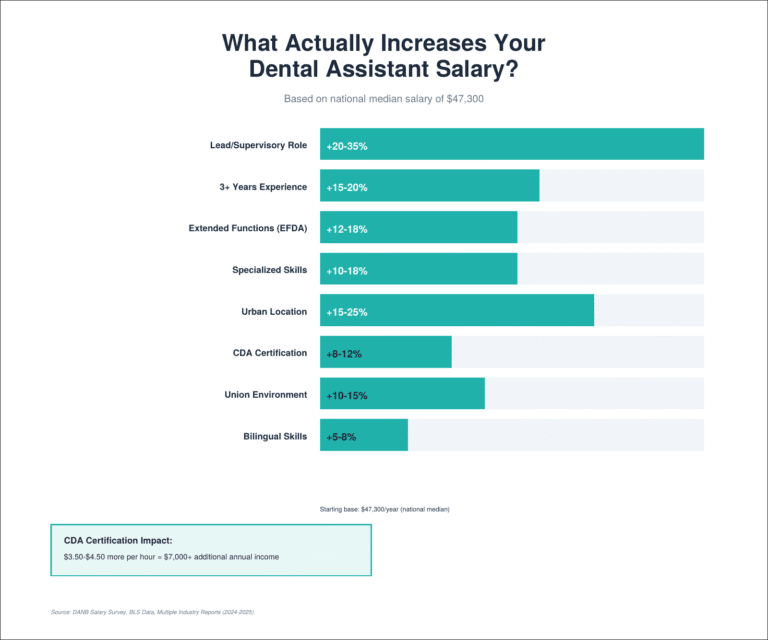
According to DANB’s latest salary survey, CDAs earn approximately $3.50 more per hour than non-certified assistants.
That translates to over $7,000 additional annual income for the same work.
Radiography certification is often required separately.
Most states mandate specific training and examination to take dental X-rays. These credentials typically need renewal every few years through continuing education.
Some states recognize Registered Dental Assistant (RDA) or Registered Dental Assistant in Extended Functions (RDAEF) credentials.
These advanced certifications allow you to perform additional procedures like placing fillings or applying sealants, depending on state law.
Essential Skills and Competencies
Beyond formal credentials, successful dental assistants master a core set of technical and interpersonal skills.
- Technical proficiency includes: operating digital radiography equipment, understanding dental terminology and anatomy, properly sterilizing instruments, using dental practice management software, taking accurate impressions, and maintaining infection control protocols.
- Clinical judgment involves: recognizing potential complications during procedures, identifying when patients are experiencing excessive discomfort, understanding when to escalate concerns to the dentist, and managing emergency situations calmly.
- Interpersonal capabilities matter just as much: building rapport with anxious patients, working efficiently with dentists who have different communication styles, explaining treatment plans in accessible language, and managing difficult conversations about costs or treatment options.
Organization and time management keep practices running smoothly. You’ll juggle multiple responsibilities simultaneously, transitioning seamlessly from chairside assistance to answering phones to updating records.
ATS Resume Keywords for This Role
When applying for dental assistant positions, your resume needs to pass through Applicant Tracking Systems before human eyes ever see it. These automated systems scan for specific keywords that match the job description.
Here’s your strategic keyword bank organized by category:
- Clinical Skills: Chairside assistance, dental radiography, X-ray imaging, instrument sterilization, infection control, vital signs assessment, patient preparation, impressions, dental materials preparation, dental prosthetics assistance, periodontal charting, oral hygiene instruction, post-operative care instructions
- Technical Systems: Dentrix, Eaglesoft, Open Dental, Patterson Imaging, Dexis, Carestream, digital radiography, electronic health records (EHR), dental practice management software, intraoral cameras, dental billing systems
- Procedures and Specialties: Four-handed dentistry, dental dam placement, suction techniques, amalgam preparation, composite placement assistance, crown and bridge assistance, orthodontic procedures, endodontic procedures, oral surgery assistance, pediatric dentistry, periodontal procedures
- Compliance and Safety: OSHA compliance, HIPAA regulations, sterilization protocols, hazardous waste disposal, personal protective equipment (PPE), radiation safety, cross-contamination prevention, bloodborne pathogens, CDC guidelines
- Administrative Capabilities: Appointment scheduling, insurance verification, treatment planning coordination, dental coding (CDT codes), claims processing, patient records management, inventory control, supply ordering, front desk operations
- Certifications to Include: Certified Dental Assistant (CDA), Certified Orthodontic Assistant (COA), Registered Dental Assistant (RDA), CPR/BLS certification, Radiation Health and Safety (RHS), Infection Control (ICE), Nitrous Oxide Monitoring, Coronal Polish certification
- Soft Skills (when woven into accomplishments): Patient education, team collaboration, multitasking, time management, problem-solving, communication, adaptability, attention to detail, compassionate care, stress management
- Use these keywords naturally throughout your resume, particularly in your skills section and within your job descriptions. Don’t just list them. Integrate them into accomplishment statements that demonstrate their application.
Resume Bullet Examples for This Role
Strong resume bullets combine action verbs, specific skills, and quantifiable results. Here are proven examples tailored for different experience levels:
Entry-Level Dental Assistant Bullets
- Assisted dentist during 15-20 procedures daily while maintaining sterile field and anticipating instrument needs, contributing to 98% patient satisfaction scores
- Prepared and sterilized dental instruments using autoclave equipment, ensuring 100% compliance with OSHA and infection control protocols across 400+ monthly patient visits
- Captured digital radiographic images for 30+ patients weekly following proper safety protocols, achieving clear diagnostic quality requiring zero retakes
- Updated electronic health records in Dentrix for all patient visits, maintaining accurate treatment documentation and reducing billing errors by 15%
- Educated patients on proper oral hygiene techniques and post-operative care instructions, resulting in 25% decrease in follow-up calls about routine concerns
Experienced Dental Assistant Bullets
- Coordinated chairside assistance for complex restorative procedures including crowns, bridges, and implants, supporting 8-10 cases weekly with zero complications requiring additional appointments
- Managed inventory and supply ordering for high-volume practice seeing 100+ patients weekly, reducing supply costs by 12% through strategic vendor relationships and just-in-time ordering
- Trained and mentored 3 new dental assistants on office protocols, infection control procedures, and practice management software, accelerating their productivity by 40% within first month
- Implemented digital impression system to replace traditional molds, improving patient comfort scores by 30% and reducing crown fabrication turnaround time from 2 weeks to 5 days
- Processed 150+ insurance claims monthly with 95% first-submission approval rate, maximizing practice revenue and minimizing payment delays
Specialized Dental Assistant Bullets
- Assisted orthodontist with bracket placement, wire adjustments, and appliance installations for 25-30 patients daily in fast-paced orthodontic practice
- Supported oral surgeon during complex extractions, bone grafts, and implant placements while monitoring patient vital signs and sedation levels throughout procedures
- Coordinated treatment plans for pediatric patients ages 2-16, employing behavior management techniques that reduced appointment anxiety and improved treatment acceptance by 35%
- Operated CEREC CAD/CAM system to design and mill same-day crowns, providing patients with completed restorations in single visit and increasing practice efficiency by 45%
- Managed endodontic procedures including root canal assistance, utilizing specialized instruments and microscopes while ensuring patient comfort through 200+ successful treatments
Leadership and Advanced Responsibility Bullets
- Supervised team of 4 dental assistants, coordinating schedules, assigning daily responsibilities, and ensuring quality standards across all clinical and administrative functions
- Developed and implemented new sterilization tracking system that improved compliance documentation and passed state inspection with zero citations for first time in practice history
- Served as liaison between dental office and laboratory for all prosthetic cases, reducing fabrication errors by 40% through improved communication protocols and quality control measures
- Analyzed practice workflow and identified bottlenecks, recommending scheduling optimization that increased patient throughput by 20% without extending office hours
Remember: Use these as templates, not copy-paste material. Customize bullets to reflect your actual experience and achievements. Numbers matter, so quantify your impact whenever possible.
Salary Range and Variables That Move It Up or Down
Understanding dental assistant compensation requires looking beyond a single number. The national median salary sits around $47,300 annually as of 2025, but your actual earnings will vary significantly based on multiple factors.
Here’s what really impacts your paycheck:
Salary Impact Factors
| Factor | How It Impacts Pay |
|---|---|
| CDA Certification | +8% to 12% ($2.50 to $4.50 per hour increase) |
| 3+ Years Experience | +15% to 20% above entry-level rates |
| Specialized Skills (orthodontics, oral surgery) | +10% to 18% depending on specialty |
| Geographic Location | Alaska, Minnesota, Massachusetts top paying states (+20% to 30% above national median) |
| Practice Type | Corporate dental chains typically pay 10-15% less than private practices; DSOs may offset with benefits |
| Urban vs Rural | Metropolitan areas pay 15-25% more but with higher cost of living |
| Extended Functions Certification (EFDA/RDAEF) | +12% to 18% for expanded clinical duties |
| Lead/Supervisory Role | +20% to 35% for team leadership responsibilities |
| Union Environment | +10% to 15% in unionized settings, more common in hospital-based practices |
| Education Level | Associate degree holders earn 8-12% more than certificate holders |
| Bilingual Skills | +5% to 8% in diverse communities with high demand |
| Evening/Weekend Availability | +$2 to $5 per hour shift differential |
| Benefits Package | Comprehensive benefits (health insurance, retirement, PTO) can equal 20-30% of base salary value |
Regional Salary Breakdown
Top-paying states include Alaska (average $58,000+), Minnesota ($56,000+), Massachusetts ($55,000+), New Hampshire ($54,000+), and California ($54,000+ but higher cost of living).
Rapidly growing salary markets saw significant increases from 2024 to 2025. Kentucky jumped 11.27%, Illinois rose 11.2%, and Louisiana increased 8.25%. These states are experiencing higher demand as dental practices expand.
Major metropolitan areas command premium rates. New York City dental assistants average $58,500 annually, while Los Angeles assistants earn around $56,000. Seattle-Tacoma-Bellevue region and Boston metro area also offer above-average compensation.
Rural areas typically pay 15-20% less than urban centers, but often balance this with lower housing costs and better work-life flexibility. Some rural practices also offer relocation bonuses or loan repayment assistance to attract qualified candidates.
Entry-Level vs Experienced Earnings
Starting salaries for new graduates typically range from $35,000 to $40,000 annually, or $16 to $20 per hour. Your earning potential increases steadily with experience and additional credentials.
After 2-5 years, you can expect to earn $42,000 to $50,000. With 5-10 years of experience, especially in specialized settings or with expanded functions credentials, earnings typically reach $50,000 to $60,000.
Lead dental assistants who manage other staff and handle administrative oversight often earn $55,000 to $70,000 depending on practice size and location.
Understanding Total Compensation
Don’t evaluate offers based solely on hourly rate. The benefits package significantly impacts your real earnings. Health insurance alone can be worth $8,000 to $15,000 annually. Add dental coverage (often free for dental office employees), retirement contributions, paid time off, continuing education allowances, and uniform allowances.
Some practices offer performance bonuses tied to patient satisfaction scores or practice productivity. Others provide profit-sharing arrangements. These variable compensation elements can add several thousand dollars annually.
Tuition reimbursement for continuing education or advanced certifications represents another valuable benefit. Some employers will pay for your CDA exam, specialty certifications, or even hygiene school courses if you commit to staying with the practice.
Career Path: Where This Job Leads in 2-5 Years
Dental assisting isn’t a dead-end job. It’s a launchpad. The skills, knowledge, and connections you build as a dental assistant open multiple advancement pathways depending on your interests and goals.
Staying in Dental Assisting with Advancement
Many dental assistants find deep satisfaction in clinical work and choose to advance within the assistant role rather than leaving it behind.
- Expanded Function Dental Assistant (EFDA) credentials represent the most common advancement. With additional training and certification, you can perform expanded clinical procedures like placing fillings, applying sealants, and preparing teeth for bonding. These expanded duties come with 12-18% salary increases and greater clinical responsibility.
- Lead dental assistant positions involve supervising other assistants, coordinating clinic flow, training new hires, and often handling more complex administrative responsibilities. You’ll still work chairside but will also shape how the entire team operates. Lead assistants typically earn 20-35% more than entry-level assistants.
- Specialty dental assisting offers another pathway. Orthodontic assistants, oral surgery assistants, endodontic assistants, and pediatric dental assistants develop specialized skills that command premium compensation. These roles often involve working with cutting-edge technology and managing complex, multi-visit treatment plans.
Transitioning to Dental Hygiene
Dental hygiene represents the most popular career transition for experienced dental assistants. Your hands-on experience gives you significant advantages when entering hygiene programs.
The educational pathway typically requires 2-4 years depending on whether you pursue an associate or bachelor’s degree. Many dental assistants work part-time while attending hygiene school, leveraging their existing knowledge to excel academically.
Dental hygienists enjoy greater autonomy, performing cleanings and preventive care independently. They also earn significantly more, with median salaries around $87,000 nationally. The transition makes financial sense for assistants seeking higher earning potential while staying in direct patient care.
Moving into Practice Management
Your front-row seat to practice operations positions you perfectly for administrative leadership roles.
- Dental office managers oversee the business side of practices, including scheduling, billing, insurance processing, staff management, and compliance oversight. Many successful office managers started as dental assistants, understanding both clinical operations and patient flow.
- Treatment coordinators work with patients to explain treatment plans, discuss costs, arrange financing, and schedule complex multi-appointment procedures. This role requires your clinical knowledge combined with strong communication and sales skills. Treatment coordinators often earn base salaries plus commission on accepted treatment plans.
Exploring Related Healthcare Careers
Some dental assistants use their experience as a springboard into other healthcare fields.
Dental sales representatives for supply companies, equipment manufacturers, or pharmaceutical companies leverage their clinical knowledge to understand customer needs. These positions typically offer higher base salaries plus commissions and travel opportunities.
Dental education attracts assistants who love teaching. Dental assisting programs need instructors with current clinical experience. Teaching positions offer regular hours, summers off (in some programs), and the satisfaction of shaping the next generation of assistants.
Dental insurance specialists work for insurance companies, utilizing their understanding of procedures and billing to process claims, conduct utilization reviews, or serve as provider liaisons.
Pursuing Advanced Dental Careers
Some dental assistants attend dental school, though this requires significant time and financial investment. Your assisting experience provides invaluable context for dental education and gives you a realistic understanding of the profession.
Dental laboratory technicians create prosthetics, crowns, bridges, and orthodontic appliances. If you enjoyed the technical, hands-on aspects of laboratory work as an assistant, this could be a natural fit.
The realistic timeline: Most career advances happen within 2-5 years of starting as a dental assistant. Expanded functions certification can be obtained in 6-12 months. Lead positions typically require 3-5 years of solid experience. Hygiene school takes 2-4 years. Dental school requires 4 years plus undergraduate prerequisites.
Your path depends on your goals. Some assistants are perfectly happy perfecting their craft and earning a solid living without major career changes. Others use dental assisting as their entry point into a larger healthcare career. Both approaches are valid.
Day-in-the-Life Snapshot
Understanding a typical workday helps you evaluate whether dental assisting matches your personality and preferences. Here’s what a real day looks like in a busy general dentistry practice:
Morning (8:00 AM – 12:00 PM)
You arrive 15 minutes before the first patient to prepare. You’ll turn on equipment, check the autoclave from yesterday’s final load, and review today’s schedule. The morning typically includes 10-15 patients across various appointment types.
Your first patient is a routine cleaning and exam. You’ll seat the patient, review their medical history for any updates, take vital signs, and drape them with a protective bib. While the hygienist performs the cleaning, you’ll prepare the doctor’s operatory for examinations.
Next comes a crown preparation. You’ll assist the dentist throughout the procedure, managing suction, passing instruments, and mixing materials. This 90-minute appointment requires intense focus and coordination. You’ll take impressions, fabricate a temporary crown, and ensure the patient understands their temporary crown care instructions.
Between appointments, you’re sterilizing instruments from completed procedures, answering phones, and setting up rooms for upcoming patients. The pace is brisk but manageable when you’re organized.
Before lunch, you’ll take X-rays for a new patient and update their digital records. You’ll also follow up with the dental laboratory about a bridge case scheduled for delivery next week.
Afternoon (1:00 PM – 5:00 PM)
The afternoon brings different challenges. You’ll assist with several fillings, including one for an anxious pediatric patient. Your calm demeanor and patient education skills shine as you help the child feel comfortable and understand the “tooth sleepy juice” (anesthetic).
A late-afternoon emergency works its way into the schedule. A patient calls with a broken crown, and you’ll coordinate with the front desk to fit them in. Flexibility is crucial when unexpected situations arise.
You’ll also handle administrative tasks during brief breaks between patients. Insurance verification calls, supply inventory checks, and updating treatment plans in the practice management software fill these gaps.
The final patient of the day is a consultation for dental implants. You’ll assist the dentist in taking a cone beam CT scan, discussing the treatment plan, and providing the patient with cost estimates and scheduling options for the procedure.
End of Day (5:00 PM – 5:30 PM)
The day doesn’t end when the last patient leaves. You’ll complete final instrument sterilization, ensuring tomorrow morning’s first load is ready. You’ll tidy treatment rooms, restock supplies, and document the day’s work in patient records.
You’ll also prep for tomorrow’s schedule, reviewing complex cases and ensuring any special materials or equipment are ready. Before leaving, you might need to return patient calls or coordinate with the laboratory about pending cases.
The Reality Check
Some aspects aren’t glamorous. You’ll work on your feet most of the day. You’ll occasionally deal with difficult patients. Some days feel chaotic when emergencies disrupt the schedule or equipment malfunctions.
But there’s genuine satisfaction in the work. You’ll help people overcome dental anxiety. You’ll watch children grow up and families maintain their oral health. You’re part of a small, tight-knit team where everyone depends on each other.
The variety keeps things interesting. No two days are exactly alike. One day might focus heavily on restorative work, while another might emphasize pediatric patients or orthodontic procedures.
Physical demands are real. Extended standing, repetitive motions, and occasional awkward positioning to assist in patients’ mouths can be taxing. Proper ergonomics and physical self-care become important for long-term career sustainability.
The work-life balance generally ranks well among healthcare careers. Most dental offices close by 6 PM and aren’t open on Sundays. While some Saturday hours exist, you’re typically not facing night shifts or unpredictable on-call schedules that plague other healthcare professions.
How This Role Is Changing in 2025 and Beyond
The dental assistant profession is evolving rapidly, driven by technological advancement and changing practice models. Understanding these trends helps you future-proof your career.
AI and Diagnostic Technology
Artificial intelligence has moved from buzzword to daily reality in dental offices. AI-powered diagnostic tools now analyze X-rays and imaging to detect cavities, bone loss, and other conditions with impressive accuracy, often spotting issues that human eyes might miss.
For dental assistants, this means learning to operate and troubleshoot AI systems. You’ll need to understand how to capture images that AI can process effectively and interpret AI-generated reports for patient education.
AI chatbots and virtual assistants are also handling routine patient questions and appointment scheduling, shifting your administrative focus toward more complex problem-solving and relationship management.
Digital Workflows and Cloud Integration
The days of paper records and standalone software systems are ending. Modern practices operate on integrated, cloud-based platforms that connect scheduling, imaging, treatment planning, laboratory communication, and billing.
Dental assistants increasingly need comfort navigating multiple digital systems. You’ll transition seamlessly from the practice management software to imaging systems to CAD/CAM design platforms throughout your day.
Digital impressions using intraoral scanners are replacing traditional impression materials in many offices. These scanners are more comfortable for patients and produce more accurate results, but they require training and skill to operate effectively.
Same-Day Dentistry and 3D Printing
CEREC and similar CAD/CAM systems enable dentists to design, mill, and place crowns in a single visit. As a dental assistant, you might operate the scanning equipment, design restorations using software, or manage the milling process.
3D printing is revolutionizing how practices create temporary restorations, surgical guides, and even some prosthetics in-house. Understanding these technologies and maintaining the equipment adds another dimension to your role.
Robotics and Precision Assistance
While still emerging, robotic systems are beginning to assist with implant placement and other precise procedures. These systems use real-time tracking and haptic feedback to guide drilling with submillimeter accuracy.
Your role may evolve to include setting up and calibrating robotic systems, monitoring automated processes, and troubleshooting when technology doesn’t perform as expected. The human element remains crucial, but it’s partnering with machine precision.
Teledentistry and Remote Monitoring
The pandemic accelerated adoption of teledentistry for consultations, follow-ups, and patient education. Dental assistants often facilitate these virtual visits, managing the technology, coordinating between patients and providers, and handling documentation.
Remote monitoring technologies using smartphone cameras or wearable devices allow patients to check in on orthodontic progress or healing without office visits. You’ll help patients understand how to use these tools and process the data they submit.
Expanded Scope of Practice
Many states are reconsidering dental assistant scope of practice laws, allowing trained assistants to perform more clinical procedures. This trend toward expanded functions means greater responsibility and higher earning potential for those who pursue additional training.
Some states now allow assistants to place and finish certain restorations, apply fluoride and sealants, or take impressions independently rather than under direct supervision. These changes require continuing education but significantly increase your value to practices.
Practice Consolidation and DSO Growth
Dental Service Organizations are acquiring independent practices at an accelerating rate. The DSO market is projected to reach $455 billion by 2030, growing at 15.8% annually.
For dental assistants, this means potential changes in workplace culture, standardized protocols across multiple locations, and sometimes more sophisticated benefits packages. DSOs often invest heavily in technology and provide structured career advancement pathways.
Specialization Becomes More Common
As general dentists increasingly refer complex cases to specialists, opportunities in specialty practices are growing. Orthodontic, periodontal, oral surgery, and pediatric dental assistant roles require specialized knowledge but offer higher compensation and focused expertise.
The Skills That Will Matter Most
Looking ahead, technical adaptability tops the list. New technologies will continue emerging, and successful dental assistants will be lifelong learners who embrace change.
Data literacy becomes increasingly important. You’ll need to understand treatment analytics, practice metrics, and how digital systems track outcomes to contribute meaningfully to practice improvement.
Patient education skills grow more valuable as practices shift toward preventive care and treatment acceptance. Your ability to explain complex procedures using digital tools and visual aids directly impacts practice productivity.
Cultural competency and language skills offer significant advantages in diverse communities. Bilingual dental assistants command premium compensation in areas with large Spanish-speaking, Asian, or other non-English-speaking populations.
Interview Guys Tip: Don’t wait for your employer to provide training in emerging technologies. Seek out continuing education courses, manufacturer webinars, and online tutorials to build digital dentistry skills proactively. This initiative distinguishes you from other candidates and positions you for advancement.
What Hiring Managers Look for Beyond the Job Description
There’s what’s written in the job posting, and then there’s what hiring managers actually evaluate when making decisions. Understanding these unwritten criteria helps you present yourself as the ideal candidate.
Cultural Fit Over Perfect Credentials
Managers would rather hire someone with slightly less experience who meshes well with the existing team than a highly credentialed candidate who disrupts office dynamics. They’re envisioning whether you’ll fit into their specific practice environment.
Small practices often feel like families. They want someone who’ll participate in birthday celebrations, handle occasional personal conversations gracefully, and become part of the social fabric. Corporate DSO settings might prioritize efficiency and protocol adherence over warm fuzzies.
During interviews, managers are constantly assessing: Will this person get along with our dentist’s personality? Will patients warm up to them? Can they handle our particular office quirks?
Problem-Solving Ability
Technical skills can be taught. What’s harder to teach is the ability to think on your feet and solve problems creatively. Managers value assistants who don’t need constant hand-holding.
Can you troubleshoot when equipment malfunctions? Will you figure out scheduling puzzles when emergencies arise? Can you calm an upset patient without needing to involve the dentist?
In interviews, be ready with specific examples of challenges you’ve faced and how you resolved them. The best candidates demonstrate resourcefulness and initiative rather than waiting for others to fix problems.
Reliability Above All Else
In dental practices, your absence creates a cascade of problems. Appointments must be rescheduled. The dentist’s productivity drops. Other team members scramble to cover responsibilities.
Managers scrutinize candidates’ work history for patterns of job-hopping or unexplained gaps. They ask behavioral questions designed to assess your dependability. References that mention reliability carry enormous weight.
Patient Advocacy and Empathy
The best dental assistants genuinely care about patient wellbeing and serve as patient advocates within the practice. Managers notice when candidates talk about patients with compassion versus viewing them as inconveniences or tasks to complete.
They want assistants who’ll go the extra mile to help anxious patients feel comfortable, who’ll take time to ensure elderly patients understand their care instructions, and who’ll treat every patient with dignity regardless of their dental condition or financial situation.
Business Awareness
Dental practices are businesses, and assistants who understand this reality are invaluable. Managers appreciate candidates who recognize that efficient scheduling maximizes revenue, that insurance claim accuracy affects cash flow, and that patient satisfaction drives referrals.
You don’t need an MBA, but demonstrating awareness of how your role impacts practice profitability and growth sets you apart from assistants who view dental work purely through a clinical lens.
Technology Enthusiasm
Managers are tired of hiring assistants who say they’re “not good with computers” or resistant to learning new systems. The dental field is rapidly digitizing, and practices need team members who embrace technology rather than fear it.
Expressing genuine interest in learning new software, operating advanced equipment, or improving digital workflows signals that you’ll be an asset as practices continue modernizing.
Appearance and Professionalism
While it shouldn’t matter, it does. Dental practices market themselves based on cleanliness, professionalism, and modern care. Your appearance represents the practice to patients.
Managers notice everything during interviews: appropriate professional attire, well-groomed appearance, clean nails (patients see your hands constantly), and overall polish. Tattoos, piercings, and bright hair colors may or may not be acceptable depending on the practice culture, so research the office beforehand if possible.
Growth Mindset
The best candidates express interest in continuing education, pursuing additional certifications, and growing professionally. Managers want assistants who’ll develop expertise over time rather than remaining at entry-level capabilities.
Asking thoughtful questions about opportunities for advancement, available training programs, or the office’s approach to professional development demonstrates ambition balanced with patience.
Common Interview Questions You’ll Face
Preparation transforms dental assistant interviews from nerve-wracking experiences into opportunities to showcase your qualifications. Here are questions you’ll almost certainly encounter:
“Tell me about yourself.” This opener deserves more than reciting your resume. Frame a concise narrative that connects your background to dental assisting. Mention what attracted you to the field, relevant experience, and what you’re looking for in your next role.
“Why do you want to work as a dental assistant?” Avoid generic answers about helping people. Be specific about what appeals to you: the combination of clinical and administrative work, the patient interaction, the variety in daily tasks, or the hands-on nature of the profession.
“Describe a time you dealt with a difficult patient.” Use the SOAR Method (Situation, Obstacle, Action, Result) to structure your response. Focus on your communication skills, empathy, and problem-solving ability rather than placing blame on the patient.
“How do you handle stress in a fast-paced environment?” Provide concrete examples of busy situations you’ve managed successfully. Discuss your organizational strategies, prioritization techniques, and ability to stay calm under pressure.
“What would you do if you noticed a coworker not following proper sterilization protocols?” This tests your commitment to safety and professionalism. The correct answer involves addressing the concern directly with the coworker first, then escalating to management if the behavior continues.
“How familiar are you with [specific software or equipment]?” Be honest about your experience level. If you haven’t used their particular system, emphasize your quick learning ability and experience with similar technologies.
“Where do you see yourself in five years?” Demonstrate ambition balanced with loyalty. You might mention pursuing CDA certification, developing expertise in specific procedures, or taking on leadership responsibilities, while expressing interest in growing with the practice.
Interview Guys Tip: Prepare 3-5 questions to ask the interviewer about their practice. Questions about training programs, typical patient demographics, team dynamics, and advancement opportunities show genuine interest and help you evaluate whether the position fits your needs.
Conclusion
The dental assistant role offers a compelling combination of clinical work, patient interaction, and career stability.
With 8% projected growth through 2033 and starting salaries in the $35,000 to $40,000 range that can grow to $60,000+ with experience and certifications, it’s a practical entry point into healthcare.
Your success depends on developing both technical competencies and interpersonal skills.
Master the clinical procedures, embrace emerging technologies, and cultivate the communication abilities that distinguish exceptional assistants from merely adequate ones.
Remember that dental assisting doesn’t have to be your final destination.
It can be a rewarding lifelong career or a launching pad into dental hygiene, practice management, dental sales, or even dentistry itself.
As you prepare to enter or advance in this field, focus on continuous learning.
Pursue your CDA certification. Stay current with digital dentistry trends. Build genuine relationships with your team and patients.
These investments in yourself pay dividends throughout your career.
Ready to take the next step?
Polish your dental assistant resume, prepare for your dental assistant interview, and start exploring opportunities in this growing, rewarding healthcare profession.
For more career advice and resources, explore our guides on how to prepare for a job interview, what to bring to a job interview, and common job interview questions.
Additional Resources
Looking for more guidance on breaking into dental assisting or advancing your career? Check out these helpful resources:
- Healthcare Interview Questions – Master common questions asked in healthcare settings
- Medical Assistant Interview Questions – Similar role with overlapping interview strategies
- Customer Service Interview Questions – Build your patient interaction skills
- U.S. Bureau of Labor Statistics: Dental Assistants – Official employment outlook data
- Dental Assisting National Board (DANB) – Information about certification pathways
- American Dental Assistants Association – Professional development and networking opportunities
Before your next Dental Assistant interview, get the 10 questions tailored to the company you’re interviewing with:
This is the general advice. Longbow applies it to your actual search: real match scores, ghost-job checks, and prep for the jobs worth your time. Here's the full story.

ABOUT THE INTERVIEW GUYS (JEFF GILLIS & MIKE SIMPSON)
Mike Simpson: Co-founder of The Interview Guys and Longbow. He has been the voice behind our interview advice since 2013 — his work has reached over 100 million job seekers around the world. The strategic mind behind Longbow, our new career platform.
Jeff Gillis: Co-founder of The Interview Guys and Longbow. He built the systems that put our work in front of those readers, and he leads the engineering on Longbow, the cutting edge career platform built for today’s job seeker.