
The 10X Culture Factor: Why Toxic Workplace Culture Is 10 Times More Influential Than Compensation in Predicting Attrition

The Shocking Numbers Behind the Culture Crisis
You’ve probably heard the phrase “people don’t leave jobs, they leave managers.” But the reality is even more nuanced than that. People are fleeing toxic workplace cultures at unprecedented rates, and the financial devastation is staggering.
Here’s the truth that should make every CEO sit up and pay attention: toxic workplace culture is 10.4 times more likely to drive employee attrition than compensation issues. That’s not a typo. Ten times more influential.
This groundbreaking finding comes from MIT Sloan Management Review researchers who analyzed 34 million online employee profiles and 1.4 million Glassdoor reviews during the Great Resignation. Their conclusion fundamentally challenges the narrative that workers are primarily leaving for better pay.
The financial toll is brutal. According to the Society for Human Resource Management, toxic workplace culture has cost American businesses $223 billion over the past five years in turnover alone. Add in the U.S. Surgeon General’s estimate of $16 billion annually in healthcare costs from toxic work environments, and you’re looking at a quarter-trillion-dollar problem.
Interview Guys Tip: If you’re in a toxic workplace right now, you’re not imagining things. Nearly 75% of employees report having worked for an employer with a toxic culture, according to the 2025 Toxic Workplace Trends Report. The data validates your experience.
☑️ Key Takeaways
- Returnships are designed specifically for professionals with career gaps, offering a structured path back to the workforce with training, mentorship, and real work experience.
- Leading companies across finance, tech, and manufacturing now offer returnship programs with conversion rates of 50-80% to permanent positions.
- Address your career gap directly and positively in your application materials, highlighting skills maintained or gained during your break rather than apologizing for time away.
- Success stories show rapid career advancement is possible after returnships, with some participants advancing to senior leadership roles within a few years of returning.
Why Culture Trumps Cash
The most eye-opening statistic? Nearly 59% of employees say they would accept a new job for a lower salary to escape a toxic employer. Let that sink in. More than half of workers value their mental health and daily work experience over their paycheck.
This isn’t just about millennials or Gen Z either, though younger workers do prioritize culture even more strongly. Among Gen Z employees, 69% prefer a positive company culture over higher compensation.
The MIT research ranked 172 different cultural topics by their impact on attrition. Compensation came in at number 16. Sixteen. Meanwhile, toxic culture dominated the top of the list by such a massive margin that nothing else even came close.
Think about what this means for your career strategy. When you’re evaluating job offers, that extra $10,000 in salary might seem appealing. But if the company has a reputation for toxicity, you’ll likely be back on the job market within a year or two, stressed, burned out, and potentially damaging your professional reputation.
The data backs this up. Companies with healthy cultures, like Southwest Airlines, Johnson & Johnson, and LinkedIn, experienced significantly lower turnover during the Great Resignation. Their secret weapon wasn’t higher salaries. It was creating environments where people actually wanted to work.
The Five Toxic Elements That Drive People Away
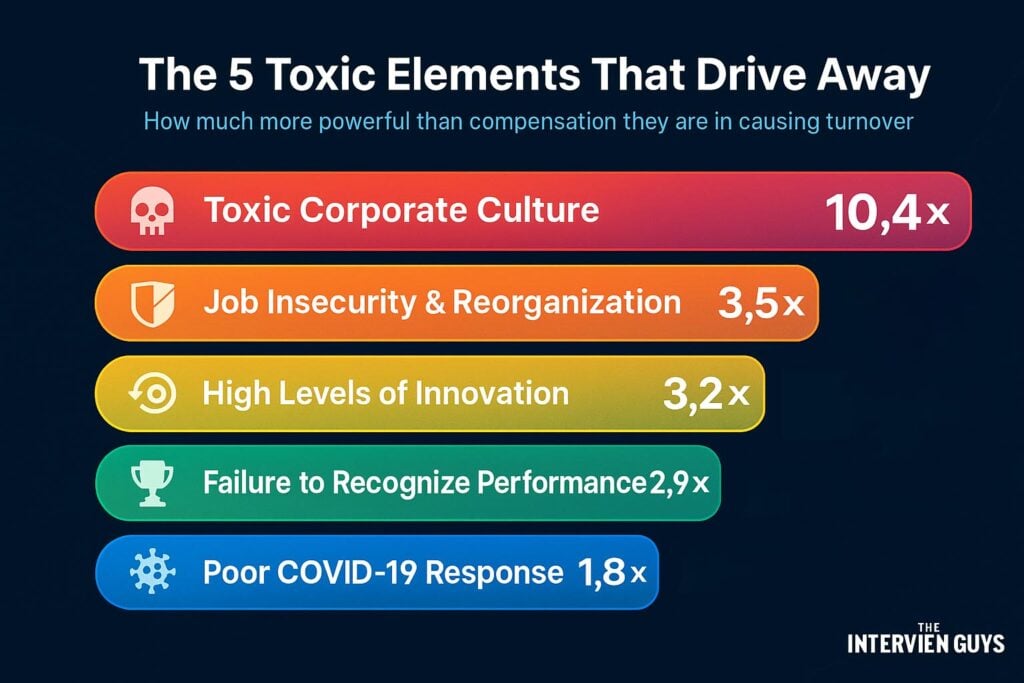
So what exactly makes a culture toxic? MIT researchers identified the leading predictors of attrition, and they paint a clear picture:
1. Toxic Corporate Culture (10.4x more influential than compensation)
This is the big one. A toxic culture manifests in three primary ways: failure to promote diversity, equity, and inclusion; employees feeling disrespected; and unethical behavior or lack of regulatory compliance.
When people describe their workplace as toxic, they’re talking about an environment where they don’t feel safe, valued, or respected. It’s a place where speaking up feels risky, where favoritism runs rampant, and where the rules seem to apply differently depending on who you are.
2. Job Insecurity and Reorganization (3.5x more influential than compensation)
Constant restructuring and layoffs create an atmosphere of anxiety. When employees never know if their position will exist next month, they start looking for stability elsewhere. The irony? These reorganizations often aim to cut costs, but they drive away talent that’s expensive to replace.
3. High Levels of Innovation (3.2x more influential than compensation)
Wait, isn’t innovation good? It can be, but when companies change direction constantly without giving employees time to adjust, it creates chaos. Workers at companies like SpaceX, Tesla, and Netflix experienced higher attrition rates during the Great Resignation, likely due to the relentless pace of change.
4. Failure to Recognize Performance (2.9x more influential than compensation)
Nothing demoralizes high performers faster than watching mediocrity go unrewarded and excellence go unnoticed. When companies fail to distinguish between those who go above and beyond and those who barely show up, the message is clear: your hard work doesn’t matter.
5. Poor Response to COVID-19 (1.8x more powerful than compensation)
How companies handled the pandemic revealed their true colors. Organizations that prioritized employee safety and adapted their policies thoughtfully retained workers. Those that forced people back to the office prematurely or failed to support remote workers lost talent in droves.
Interview Guys Tip: During your interview process, ask questions that reveal these toxic elements. Questions like “How does the company handle conflicts between team members?” or “Can you describe a time when the company made a significant change and how it was communicated?” will give you valuable intel.
The Real Cost of Toxicity Goes Beyond Turnover
The $223 billion figure is just the beginning. That number only captures direct turnover costs like recruiting, hiring, and training replacements. The hidden costs are even more devastating.
Productivity takes a massive hit. Research indicates toxic environments can lead to a 10-30% drop in productivity. Disengaged workers, which toxic cultures create in abundance, cost companies approximately 34% of their annual salary in lost productivity. When you scale that across an entire organization, the numbers become astronomical.
Gallup estimates that low employee engagement costs the global economy $8.9 trillion annually, representing 9% of global GDP. And here’s the kicker: 70% of the variance in team engagement ties directly to managers. Toxic leadership doesn’t just affect individual workers. It poisons entire teams.
Health costs spiral upward. Workers in toxic environments experience higher rates of anxiety, depression, and burnout. They take more sick days. They require more medical interventions. The U.S. Surgeon General pegs the annual healthcare costs of workplace toxicity at $16 billion, but that’s likely a conservative estimate.
Then there’s the reputational damage. In our connected world, toxic cultures can’t hide. Over 75% of job seekers research an employer’s culture before applying, and platforms like Glassdoor make it easy to see what current and former employees really think. A company’s toxic culture becomes public knowledge fast, making it exponentially harder to attract replacements for the talent that fled.
What Makes Employees Choose Culture Over Cash
Let’s dig deeper into why workers prioritize culture over compensation. The answer reveals a fundamental shift in how people think about work.
A 2019 Glassdoor survey of over 5,000 workers found that 77% would consider a company’s culture before applying, while 56% said a good workplace culture was more important than salary for job satisfaction. Another 73% wouldn’t even apply to a company unless its values aligned with their personal values.
The threshold matters. When people are struggling to meet basic needs, compensation naturally takes priority. But research shows that once workers reach approximately $75,000 annually, additional income has diminishing returns on happiness and job satisfaction. At that point, culture, growth opportunities, and work-life balance become the dominant factors.
Women show this preference even more strongly than men. Recent data reveals 30% of women accept lower salaries in new roles compared to 18.6% of men. But it’s not random. Women are 24% more likely to accept offers for better company culture, 20.4% more likely to accept for reduced stress, and 34.6% more likely to accept for flexible schedules.
Interview Guys Tip: When negotiating salary offers, consider the total value package. A job paying $10,000 less but offering psychological safety, growth opportunities, and work-life balance might actually be the better financial decision over the long term when you factor in your physical and mental health.
Red Flags to Watch For
How do you identify a toxic culture before accepting a job? Here are the warning signs that should send you running:
- Excessive turnover. If you notice during interviews that the team has mostly new faces, or if the hiring manager has trouble explaining why multiple positions opened simultaneously, that’s a massive red flag. High turnover doesn’t happen by accident.
- Vague or defensive answers about culture. When you ask about workplace culture and get buzzword-laden responses without concrete examples, be suspicious. Healthy organizations can point to specific policies, initiatives, and behaviors that demonstrate their values.
- Glassdoor reviews paint a consistent picture. One or two negative reviews might be outliers. But when multiple reviews over time mention the same issues like micromanagement, lack of respect, or unethical behavior, believe them. The MIT research confirmed that toxic culture is the strongest predictor of negative Glassdoor reviews.
- Poor communication during the hiring process. How a company treats candidates reveals how they treat employees. Ghosting after interviews, rescheduling repeatedly without apology, or being disorganized during the interview process all signal deeper cultural problems.
- Current employees seem stressed or guarded. If possible, observe or chat with people who work there. Do they seem energized about their work or drained? Are they comfortable speaking freely or do they carefully monitor what they say?
For more guidance on spotting these warning signs, check out our article on job posting red flags and interview red flags.
The Bottom Line: Culture Is Your Career Insurance
Here’s what the 10X culture factor means for you personally: the quality of your daily work experience matters more for your long-term career success and personal wellbeing than almost any other single factor.
You can recover from a lower salary. With time, skills development, and strategic career moves, you can increase your income. But recovering from the stress, burnout, and potential health issues caused by a toxic workplace takes much longer. Some people never fully bounce back.
The math is simple. If toxic culture is 10 times more likely to drive you to quit than compensation issues, you should weight culture 10 times more heavily in your job decisions. That doesn’t mean accepting poverty wages for a nice boss. It means that once you’re in a reasonable compensation range, culture should become your primary decision factor.
Smart job seekers are already making this calculation. They’re asking tougher questions in interviews. They’re walking away from higher-paying offers at companies with red flags. They’re choosing to stay at jobs that pay a bit less but offer psychological safety, recognition, and growth opportunities.
The research is unambiguous: toxic culture is a career killer. It damages your mental health, stalls your professional development, and forces you back into the job search sooner rather than later.
When you’re evaluating your next career move, remember this: companies that invest in healthy cultures see 4X revenue growth compared to competitors. They experience lower turnover, higher engagement, and better financial performance. These are the organizations where careers flourish.
Don’t be seduced by the highest salary offer. Look at the total picture. Evaluate the culture ruthlessly. Ask hard questions. Trust your gut when something feels off. Your career longevity, your mental health, and your overall life satisfaction depend on making the right call.
The 10X culture factor isn’t just a statistic. It’s a roadmap for making smarter career decisions. Choose wisely.
The reality is that firing off more applications rarely lands more interviews — applying to the right ones, the right way, does. That’s why we built Robin: a free tool that reads the exact job you’re applying to and tells you what they want and how you match, before you hit submit:
Turn More Applications Into Interviews
Volume isn’t the answer — precision is. We built Robin to make every application count: it reads the exact posting and tells you what they actually want, how strong your match is, and the gaps to fix before you hit submit — so you stop spraying and start landing. Free, right in your browser.
After twelve years of writing advice like this, we built the tool that does it with you. It's called Longbow, and here's the whole story.

ABOUT THE INTERVIEW GUYS (JEFF GILLIS & MIKE SIMPSON)
Mike Simpson: Co-founder of The Interview Guys and Longbow. He has been the voice behind our interview advice since 2013 — his work has reached over 100 million job seekers around the world. The strategic mind behind Longbow, our new career platform.
Jeff Gillis: Co-founder of The Interview Guys and Longbow. He built the systems that put our work in front of those readers, and he leads the engineering on Longbow, the cutting edge career platform built for today’s job seeker.