
Ghost Jobs Exposed: The Companies Posting Fake Job Listings (With Proof)

You spend three hours tailoring your resume. Another two hours crafting the perfect cover letter. You research the company, practice your interview answers, and hit submit with hope in your heart.
Then nothing.
Not even a rejection email.
After weeks of silence, you realize the truth. That “perfect opportunity” was never real. It was a ghost job, and you’re far from the only one who fell for it.
Welcome to the most frustrating trend in the 2025 job market. Ghost jobs are fake listings companies post with zero intention of filling them. They’re not just annoying. They’re systemic, calculated, and employers are finally admitting they’re doing it on purpose.
The data is damning, the companies are identifiable, and job seekers are fighting back.
☑️ Key Takeaways
- Nearly one in three employers admits to posting fake job listings with no intention of hiring, wasting countless hours of job seekers’ time and energy.
- 45% of HR professionals “regularly” post ghost jobs, while 48% do so “occasionally,” making this deceptive practice far more common than most job seekers realize.
- Companies with 1,001 to 5,000 employees are the worst offenders, with ghost jobs making up nearly 25% of their postings, particularly in tech, publishing, and software development.
- Los Angeles leads the nation with 30.5% ghost jobs, followed by Philadelphia at 30.1%, making these metro areas particularly treacherous for job seekers.
The Shocking Numbers Behind Ghost Jobs
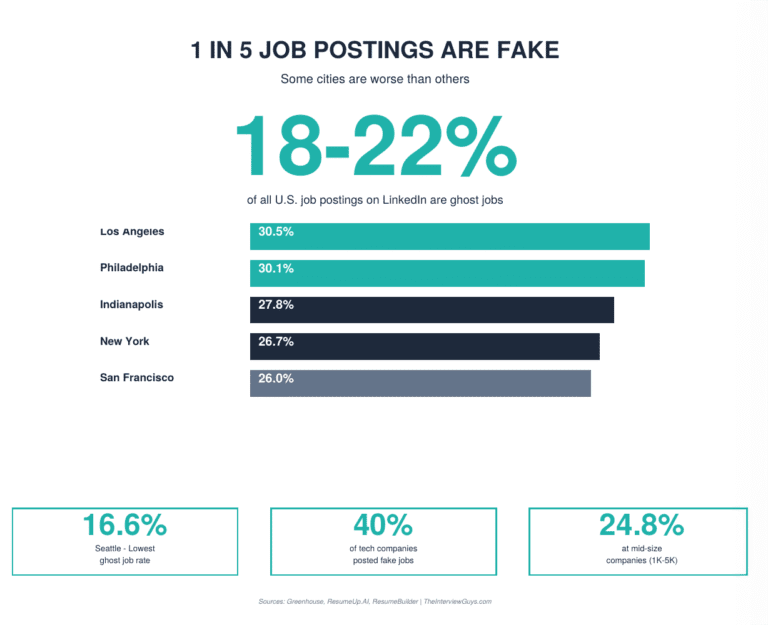
The scope of this problem is staggering. According to a 2025 study by Greenhouse, a major hiring platform, between 18% and 22% of all online job postings are ghost jobs. That means roughly one in five job listings you see is completely fake.
But it gets worse.
A LiveCareer survey of 918 HR professionals in March 2025 revealed that 45% of HR professionals admit they “regularly” post ghost jobs. Another 48% say they post them “occasionally” for purposes like seasonal hiring or building talent pipelines. Combined, that means 93% of HR professionals engage in this practice to some degree.
Only 2% of surveyed HR professionals said they never post ghost jobs.

Let that sink in. When you apply to a job online, there’s roughly a one in five chance it doesn’t exist. And the people posting these fake listings? They know exactly what they’re doing.
ResumeUp.AI analyzed LinkedIn job postings and found that 27.4% of all U.S. job listings on the platform are likely ghost jobs. The research examined postings from the previous 30, 60, 90, 120, and 233 days, considering any job posted more than 30 days ago as a likely ghost listing based on typical hiring timelines.
A separate study by Clarify Capital surveying over 1,000 employers found that nearly one in three employers had job postings active for more than 30 days, with a quarter of companies having no plans to fill posted positions for at least three months.
The Congressional Research Service even issued a report acknowledging the ghost job phenomenon, defining it as “online job postings for positions that do not exist, or that employers are not planning to fill immediately.”
This isn’t speculation. It’s documented, admitted, and happening right now.
Which Cities Have the Most Ghost Jobs
Geography matters when it comes to ghost jobs. ResumeUp.AI’s analysis revealed which U.S. cities are the most dangerous for job seekers:
Los Angeles tops the list with 30.5% ghost jobs, meaning nearly one in three job postings in LA is fake. Philadelphia comes in second at 30.1%, followed by Indianapolis at 27.8%.
Even New York City, despite having the highest volume of ghost jobs (23,000 listings), ranks fourth with 26.7% of postings being fake. San Francisco rounds out the top five at 26.0%.
On the flip side, Seattle has the lowest percentage of ghost jobs at 16.6%, followed by Boston at 18.7% and Dallas at the third-lowest rate.
If you’re job hunting in major coastal cities, especially in California and the Northeast, you’re facing an uphill battle against fake listings.
The Companies Named as Ghost Job Offenders
Here’s what job seekers really want to know: which companies are actually doing this?
While many corporations hide behind corporate speak and refuse to be named, frustrated job seekers have taken matters into their own hands. Reddit communities like r/jobs, r/antiwork, and r/JobSearchHacks have become ground zero for exposing companies that repeatedly post fake listings.
The Reddit Ghost Job List, a community-maintained spreadsheet created by frustrated job seekers, has become the go-to resource for identifying serial offenders. The list is regularly updated based on thousands of reported experiences from job seekers who’ve been burned by fake postings. Companies can dispute their inclusion, but the evidence often speaks for itself.
Among the companies that have been repeatedly flagged by job seekers:
- Accenture appears frequently in ghost job complaints across multiple Reddit threads, with job seekers reporting positions that stay open for months without any hiring activity.
- CVS Health has been called out for posting healthcare and corporate positions that never seem to get filled, despite thousands of applications.
- Dice, ironically a job board platform itself, has been accused of hosting or posting positions that lead nowhere.
- Beyond these named companies, research by Hunter Ng at Baruch College using machine learning analysis of nearly 270,000 Glassdoor reviews identified clear patterns:
Companies with 1,001 to 5,000 employees are statistically the worst offenders, with ghost jobs making up 24.8% of their postings. Even Fortune 500 companies regularly engage in this practice to maintain talent pipelines and improve shareholder optics.
40% of tech companies posted fake jobs in the past year, and 79% of those still had the fake ads active at the time of the survey, according to ResumeBuilder research. The tech sector is particularly notorious because specialized roles like AI engineers, data scientists, and software developers require niche skills, so companies keep ads open indefinitely to scout talent.
By industry, the data shows which sectors are most likely to waste your time:
- Construction industry leads the ghost job rankings, with some of the highest rates of postings that never result in hires. Arts and entertainment, food and beverage services, and legal services follow close behind.
- Corporate services jobs showed a ghost job rate of nearly 31% in the second quarter of 2024, meaning almost one in three corporate job postings resulted in no hires.
- Tech, publishing, and software development remain the most notorious industries for ghost jobs. These fields post openings for advanced positions (requiring master’s degrees or specialized certifications) even when there’s no immediate need, just to see who’s available.
The most revealing statistic? Of tech companies surveyed, 40% posted fake jobs in the past year, and 79% of those fake listings were still active when researchers checked. That means if you’re in tech and applying to jobs that have been open for months, there’s a very high chance you’re wasting your time.
Job Seekers Are Fighting Back With Community Resources
Frustrated by the lack of transparency, job seekers have built their own early warning systems.
- GhostJobs.io has emerged as a comprehensive, community-driven database that monitors job boards and flags listings that appear fake or inactive. The platform aggregates data from multiple sources and highlights companies with questionable posting behavior.
- Reddit communities have become the primary battleground. Threads on r/jobs regularly receive thousands of upvotes when users share detailed experiences with specific companies. Job seekers are creating collaborative spreadsheets, warning each other in real-time, and building a collective defense against deceptive hiring practices.
- Glassdoor has become a weapon in this fight. Job seekers are leaving specific reviews calling out companies for ghost job practices, creating a permanent record that warns future applicants. Career experts encourage this transparency, noting that these reviews allow people to speak up without professional repercussion.
The message is clear: if companies won’t be transparent about their hiring practices, job seekers will force transparency by sharing their experiences publicly.
Why Companies Post Ghost Jobs (In Their Own Words)
The motivations behind ghost jobs are as cynical as they are calculated. When employers were surveyed about why they post fake listings, their answers ranged from strategic to downright manipulative.
According to the Clarify Capital survey, 50% of hiring managers said they posted ghost jobs because the “company is always open to new people.” Another 35% admitted it was “in case an irresistible candidate applies.”
But the real reasons get darker.
43% of employers admitted they post ghost jobs to give the impression that the company is growing, even when it’s not. They want investors, competitors, and even their own employees to believe they’re thriving.
Some employers are even more manipulative. They post ghost jobs to make current employees feel replaceable, hoping it will motivate them to work harder. As many as 68% of recruiters surveyed claimed fake job postings have a “positive impact on revenue,” and 77% noticed an increase in employee productivity when ghost jobs were listed.
Other reasons employers gave for posting ghost jobs include:
- Building a talent pool for future openings. Companies want a database of resumes they can pull from later, even if there’s no current need.
- Testing the job market and competitor wages. They’re gathering intelligence about what other companies pay and what candidates expect.
- Appearing to comply with diversity hiring requirements. Some companies post jobs they plan to fill internally but want to demonstrate they recruited a diverse pool of applicants.
- Meeting federal or contractual posting requirements. Government contractors, in particular, may need to show they’re actively recruiting, even when they already have someone in mind.
- Keeping HR departments busy. Some companies maintain ghost listings to justify their recruiting staff’s workload.
According to MyPerfectResume’s survey, about 38% of recruiters post fake positions to maintain a presence on job boards when they aren’t actively hiring, 36% do so to assess the effectiveness of their job descriptions, and 25% want to assess how difficult it would be to replace certain employees.
The most damning admission? In the LiveCareer survey, when asked about the typical duration of ghost job postings, 37% of HR professionals said these listings remain visible for one to three months. Another 5% said their ghost job postings run indefinitely.
That job you applied to three months ago? It was probably never real.
The Real Cost of Ghost Jobs for Job Seekers
Ghost jobs aren’t just annoying. They’re causing measurable harm to job seekers’ mental health, finances, and career progress.
According to an Aerotek survey, 81% of job seekers feel stressed about their financial situation. When you factor in ghost jobs, that stress compounds exponentially. You’re not just facing rejection. You’re facing rejection from positions that never existed in the first place.
The time cost is staggering. The average job seeker spends between three to five hours perfecting each application. Multiply that by dozens or hundreds of applications, and many of those hours are being invested in complete fiction.
Some applicants spend between $200 and $1,000 getting professionals to write their resumes. When they apply to ghost jobs, all that investment is wasted.
Career coaches estimate that job seekers are spending 20-30% of their job search time on positions that will never be filled. That’s time they could be networking, building skills, or applying to real opportunities.
When a listing does check out, make those hours count: paste the job posting into our new app, Longbow, and it builds your interview prep for that exact role, so your effort goes where the job is real.
The psychological toll is just as severe. According to the Human Capital Institute, 75% of job applicants don’t hear back from employers after submitting their applications. While poor communication plays a role, ghost jobs are a major contributor to this silence.
Job seekers describe feeling “tired,” “depressed,” and “desperate” when discussing the current market. The constant silence and rejection from fake listings creates a sense of futility that can derail entire job searches.
One paralegal who graduated in 2022 shared their experience: “Over a year later, I’m working as a cashier to make ends meet, still trying to land my first professional role. Despite sending out thousands of applications, the silence I’ve received is deafening. On the rare occasions I do receive a response, it’s to tell me I’m not experienced enough, even for positions where I meet every listed qualification.”
This isn’t just about wasted time. It’s about crushed hope, financial strain, and careers put on hold by companies that never intended to hire in the first place.
Candidates Are Fighting Back
Job seekers aren’t taking this quietly anymore. According to the LiveCareer survey, 47% of companies say they’ve received multiple complaints about ghost job postings, while 49% report hearing complaints occasionally.
Social media has become a weapon against ghost jobs. Job seekers are turning to platforms like LinkedIn, Reddit, and X (formerly Twitter) to call out companies posting fake listings. Hashtags like #GhostJobs and #FakeJobListings are gaining traction, with candidates sharing their experiences and warning others.
Reddit communities like r/jobs, r/antiwork, and r/JobSearchHacks have made ghost jobs their top discussion topic. Threads warning about specific companies regularly receive thousands of upvotes, and users are creating detailed spreadsheets tracking which employers repeatedly post fake positions. These communities have become essential resources, with job seekers sharing real-time warnings about which companies to avoid.
Glassdoor has become another battleground. Job seekers are leaving reviews specifically calling out companies for ghost job practices, warning future applicants before they waste their time. Career experts like Jasmine Escalera from MyPerfectResume encourage this transparency, noting that anonymous reviews allow employees to speak up without repercussion.
The backlash is starting to affect company reputations. Businesses that once saw ghost jobs as a harmless recruiting tactic are discovering it damages their employer brand. When word spreads that a company regularly posts fake listings, top candidates become wary and choose to apply elsewhere.
Legislation Is Finally Catching Up
The ghost job epidemic has gotten so bad that lawmakers are stepping in.
Kentucky introduced legislation in January 2025 to ban ghost jobs outright. The bill would require employers to disclose whether a posting is for an existing vacancy or an anticipated future vacancy, with civil penalties for violations.
California passed similar legislation in March 2025, requiring all private employers who publicly advertise job postings to include a clear statement “disclosing whether the posting is for a vacancy for the advertised position or not.” Violations constitute unfair competition under state law, and the California labor commissioner has enforcement power.
New Jersey introduced identical bills in both the General Assembly and Senate in June 2024, also requiring clear disclosure about job posting status and timely removal of filled positions.
The Canadian province of Ontario has gone even further. Legislation scheduled to take effect in January 2026 will require companies to inform job applicants about their candidacy status in a timely fashion, essentially banning HR ghosting during the interview process and eliminating ghost job postings entirely.
At the federal level, a grassroots movement has emerged around the Truth in Job Advertising and Accountability Act (TJAAA). Spearheaded by frustrated tech worker and advocate, the proposed legislation would require all public job listings to include:
Clear disclosure of intent to hire, salary bands, information about how many times the position has been posted in the last two years, guidelines limiting how long posts can remain active (no more than 90 days), and minimum submission periods (at least four calendar days) before applications can be reviewed.
The TJAAA would apply to businesses with more than 50 employees and impose fines of at least $2,500 for each infraction. The proposed legislation would grant enforcement power to both the Department of Labor and the FTC.
The FTC is already taking notice. In February 2025, FTC Chairman Andrew Ferguson directed the agency to form a Joint Labor Task Force, with deceptive job advertising as a priority topic. According to the FTC’s Consumer Sentinel Network database, reports of job and employment agency scams nearly tripled from 2020 to 2024.
Industry platforms are also responding. LinkedIn and Greenhouse have introduced verification systems for job postings. LinkedIn reports that more than half its listings are now tagged as “verified,” indicating confirmed open positions. Greenhouse clients who post verified jobs display a badge showing their commitment to transparency.
Third-party ethical recruiting networks like Truth in Job Ads are forming new standards to encourage clarity, compliance, and fairness in talent acquisition.
How to Spot a Ghost Job Before You Apply
Until legislation catches up nationwide, job seekers need to protect themselves. Here are the red flags experts recommend watching for:
- Check the posting date. If a job has been live for more than 30 days, it’s likely a ghost. Companies genuinely looking to fill positions move quickly in today’s market. A job that’s been open for two or three months is almost certainly fake.
- Cross-reference with the company’s official careers page. Ghost jobs often appear on job boards like Indeed, LinkedIn, and ZipRecruiter but not on the company’s actual website. If you can’t find the listing on their official page, it’s probably not real.
- Look for vague or generic descriptions. Real job postings include specific responsibilities, qualifications, and day-to-day duties. Ghost jobs often use generic language like “seeking a motivated professional” without concrete details about what the role actually involves.
- Check for salary transparency. While not every legitimate posting includes salary information, ghost jobs rarely do. If the listing has no salary range and an astronomically broad compensation description, be suspicious.
- Notice if the job title and responsibilities don’t match. Sometimes companies post aspirational job titles without clarifying what the role actually entails. If the title says “Senior Manager” but the responsibilities sound entry-level, it might be fake.
- Research the company on Glassdoor and Reddit. Check if others have flagged this employer for ghost jobs. Visit r/jobs, r/antiwork, or r/JobSearchHacks to search for the company name and see what other job seekers are saying. The Reddit Ghost Job List and GhostJobs.io database can save you hours of wasted effort.
- Try to reach out directly. If you’re serious about a position, find the hiring manager on LinkedIn and send a brief message asking about the role’s status. Real recruiters will respond. Ghost job listings won’t.
- Watch for repeated postings of the same role. If the same position keeps appearing and disappearing on job boards, it’s likely being reposted to maintain visibility without any genuine hiring intent.
What Job Seekers Should Do Now
Ghost jobs are a reality you’ll have to navigate in 2025, but you’re not powerless. Here’s how to protect your time and energy:
- Focus on recently posted jobs (within the last week) and cross-check them against company websites before investing time in applications.
- Network aggressively. According to career experts, networking is becoming more important than ever. A referral from someone inside the company can help you bypass ghost listings and connect with real opportunities. Learn how to turn cold connections into job referrals and discover unconventional networking tactics that actually work.
- Don’t wait around. If you haven’t heard back within two weeks, move on. The average hiring process shouldn’t take months. If it does, that’s a red flag the position might not be real. Read more about when the perfect time is to follow up after applying.
- Use quality over quantity. Rather than spray-and-pray applications to every listing, focus on 10-15 high-quality applications per week to positions that show clear signs of being legitimate.
- Track your applications. Create a spreadsheet noting which jobs you’ve applied to, when you applied, and any responses. This helps you identify patterns and avoid reapplying to the same ghost jobs.
- Leverage LinkedIn smartly. Don’t just apply through the platform. Use it to research the company, find employees in similar roles, and reach out for informational interviews. Check out our guide on LinkedIn connection request templates and how to use LinkedIn’s algorithm to get noticed by recruiters.
The job market is tough enough without companies actively deceiving you. Understanding how ghost jobs work, which companies post them, and how to spot them before you waste your time is now an essential job search skill.
The Future of Ghost Jobs
The ghost job phenomenon reveals a fundamental breakdown of trust between employers and job seekers. Companies see fake postings as strategic tools. Job seekers see them as cruel deception.
As more states pass legislation and federal proposals gain traction, the landscape may improve. But for now, job seekers must remain vigilant, skeptical, and strategic.
The good news? Awareness is growing. Job seekers are speaking up, sharing information, and holding companies accountable. Reddit lists, community databases like GhostJobs.io, and Glassdoor reviews are creating transparency where none existed before.
The bad news? Until meaningful penalties exist and enforcement takes hold, ghost jobs will remain a standard part of the hiring landscape.
Your job search in 2025 requires more than just a great resume and strong interview skills. It requires the ability to distinguish real opportunities from fake ones. Understanding the data behind ghost jobs, knowing which companies and industries are the worst offenders, and learning to spot red flags before you apply are now essential survival skills in a job market where one in five postings might be completely fake.
The era of trusting every job listing at face value is over. Job seekers who adapt fastest will waste less time, preserve their mental health, and focus their energy on opportunities that actually exist.
Stay skeptical. Do your research. Network relentlessly. And remember: if a job posting seems too good to be true or has been open for months, it probably is exactly what you think it is.
A ghost.
This is the general advice. Longbow applies it to your actual search: real match scores, ghost-job checks, and prep for the jobs worth your time. Here's the full story.

ABOUT THE INTERVIEW GUYS (JEFF GILLIS & MIKE SIMPSON)
Mike Simpson: Co-founder of The Interview Guys and Longbow. He has been the voice behind our interview advice since 2013 — his work has reached over 100 million job seekers around the world. The strategic mind behind Longbow, our new career platform.
Jeff Gillis: Co-founder of The Interview Guys and Longbow. He built the systems that put our work in front of those readers, and he leads the engineering on Longbow, the cutting edge career platform built for today’s job seeker.