
Automation Skills Just Overtook AI Development: Why 44% of AI Jobs Now Require Automation Expertise (And What This Means For Your Career)

The Surprising Shift Reshaping AI Careers
Something fundamental just changed in the AI job market. And if you’re planning a career in tech, this shift matters more than any new AI model release.
According to recent labor market analysis, automation-related positions now represent 44% of all AI job postings as of Q3 2025. That’s up from just 32% in Q2 2024. Meanwhile, traditional AI development roles (the ones focused on building machine learning models and training neural networks) have actually declined as a percentage of total AI jobs.
This isn’t just a statistical anomaly. It represents a fundamental transformation in what companies actually need from their AI talent. The experimentation phase is over. Companies have moved from “Can AI do this?” to “How do we make AI actually work in our business?”
That shift creates massive opportunities for job seekers who understand what’s really happening. You don’t need a computer science PhD to capitalize on this trend. You need business acumen, practical problem-solving skills, and competency with automation platforms. Let’s break down what this means for your career.
☑️ Key Takeaways
- Automation-focused AI roles surged to 44% of all AI job postings in Q3 2025, overtaking pure AI development positions for the first time
- Companies are shifting from AI experimentation to automation implementation, creating massive demand for professionals who can deploy and manage automated workflows
- You don’t need a PhD in machine learning to break into this field. Business process knowledge and familiarity with automation platforms matter more than advanced coding skills
- The skills gap affecting 87% of organizations means qualified automation professionals can command premium salaries across industries from finance to healthcare
Why Automation Overtook AI Development
The rise of automation roles over pure AI development didn’t happen by accident. It reflects how businesses actually implement AI technology in the real world.
Most companies aren’t building AI models from scratch. They’re using existing AI tools (ChatGPT, Claude, Gemini, specialized industry platforms) and integrating them into their business processes. That requires a completely different skill set than traditional AI development.
Think about what a typical mid-size company needs. They want AI to handle customer service inquiries, process invoices, generate reports, qualify leads, and streamline workflows. They don’t need someone who can train a large language model. They need someone who can connect their CRM to an AI API, build automated workflows, and ensure the system actually improves operations.
This explains the surge in automation-focused roles. These positions bridge the gap between AI capability and business value. They require understanding both technology and business processes. And critically, they’re roles that companies are hiring for right now, not theoretical positions that might exist someday.
The data backs this up. Job postings for “Automation Specialist,” “Business Process Automation Analyst,” and “RPA Developer” have increased 127% year-over-year in sectors like finance, healthcare, and logistics. Meanwhile, openings for “Machine Learning Engineer” and “AI Researcher” have grown just 14% over the same period.
Interview Guys Tip: When companies post “AI” jobs, read the actual responsibilities carefully. If the job description mentions “implementing,” “deploying,” or “integrating” more than “developing” or “training,” it’s really an automation role. That’s good news. It means the barriers to entry are lower than you think.
Companies have realized something important. Building AI is hard. Making AI useful is harder. The bottleneck isn’t AI capability anymore. It’s implementation. And that’s creating unprecedented demand for professionals who can actually make AI work in business contexts.
The reality is that firing off more applications rarely lands more interviews — applying to the right ones, the right way, does. That’s why we built Robin: a free tool that reads the exact job you’re applying to and tells you what they want and how you match, before you hit submit:
Turn More Applications Into Interviews
Volume isn’t the answer — precision is. We built Robin to make every application count: it reads the exact posting and tells you what they actually want, how strong your match is, and the gaps to fix before you hit submit — so you stop spraying and start landing. Free, right in your browser.
What Automation Roles Actually Involve
So what do these automation-focused AI roles actually look like? The specifics vary, but there’s a common thread: these positions focus on making technology work for business outcomes.
A typical automation specialist spends their time mapping business processes, identifying automation opportunities, and implementing solutions using platforms like UiPath, Automation Anywhere, or Microsoft Power Automate. They’re not coding neural networks. They’re building workflows that connect different software systems, extract data, make decisions based on rules, and trigger actions.
The technical requirements are real but accessible. You need to understand APIs, workflow logic, basic scripting (usually Python or JavaScript), and how to test and troubleshoot automated processes. But you don’t need advanced mathematics or deep learning expertise.
What you absolutely need is business understanding. The most successful automation professionals can analyze a process, identify inefficiencies, and design automated solutions that actually improve operations. That requires asking the right questions, understanding how different departments work, and thinking through edge cases.
Consider a real example. A healthcare automation specialist might build a workflow that extracts data from patient intake forms, checks insurance eligibility through an API, schedules appointments based on provider availability, and sends confirmation messages, all without human intervention. That’s not traditional AI development. That’s automation that happens to use AI components.
The role also involves change management. You’re not just building systems. You’re changing how people work. That means communicating with stakeholders, training users, addressing concerns, and continuously improving processes based on feedback.
This is why automation roles often pay comparably to traditional software engineering positions despite requiring different technical skills. The value isn’t just in the coding. It’s in the business impact. An automation specialist who eliminates 40 hours of manual work per week creates immediate, measurable value that justifies strong compensation.
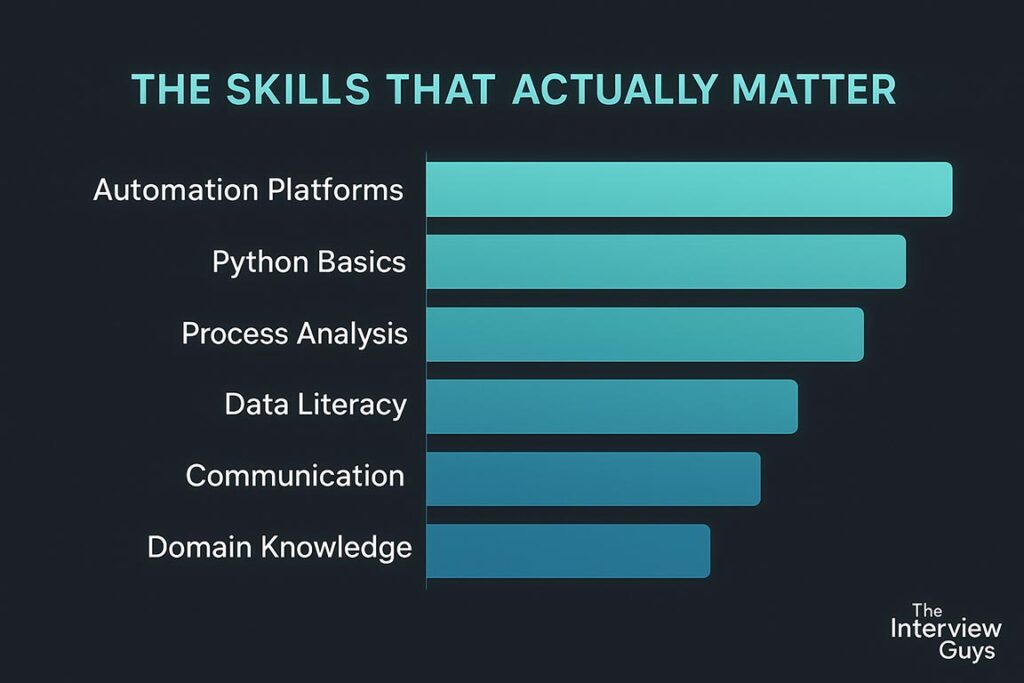
The Skills That Actually Matter
If you’re looking to break into automation-focused AI roles, you need to build the right skills. The good news? Most of them are learnable in months, not years.
The foundation is platform competency. Get hands-on experience with at least one major automation platform. UiPath offers free training and certification. Microsoft Power Automate comes with many Office 365 subscriptions. Zapier and Make.com have generous free tiers. Pick one, build projects, and document your work.
You need basic programming literacy. Python is the most valuable language for automation because it integrates with virtually everything. You don’t need to be an expert programmer. You need to understand variables, loops, conditionals, and how to work with APIs. That’s a few months of focused learning, not years of computer science education.
Process analysis is critical. Learn to map business processes, identify bottlenecks, and spot automation opportunities. This skill develops through practice. Start by documenting your own workflows, then expand to analyzing processes in your current job or volunteer work. Tools like Lucidchart or even just flowcharting in PowerPoint work fine.
Data skills matter more than you might think. Automation involves a lot of data extraction, transformation, and validation. Basic Excel and SQL skills are valuable. Understanding how to clean data, handle errors, and ensure data quality makes you much more effective.
Communication skills might be the most underrated requirement. You need to explain technical concepts to non-technical stakeholders, gather requirements from busy department heads, and persuade people to change how they work. Many technically skilled candidates fail in automation roles because they can’t handle this human element.
Domain knowledge provides a huge advantage. If you understand healthcare billing, insurance claims processing, financial operations, or supply chain logistics, you can identify automation opportunities that pure technologists miss. Consider building automation expertise within your current industry rather than making a complete career pivot.
How to Position Yourself for Automation Roles
Breaking into automation-focused AI positions requires strategic positioning. You need to demonstrate relevant skills even if you haven’t held a formal automation role.
Start building a portfolio immediately. Create automation projects that solve real problems. Automate a tedious personal task. Build a workflow that scrapes data from a website and generates a report. Create a chatbot that answers common questions. Document each project with clear explanations of the problem, your solution, and the results.
These projects don’t need to be complex. A simple automation that saves 30 minutes per week is more impressive than a sophisticated system that doesn’t solve a real problem. Focus on demonstrating business value, not technical sophistication.
Get certified. UiPath offers free RPA Developer certification. Microsoft provides Power Platform certifications. These credentials won’t get you hired by themselves, but they signal serious intent and provide structured learning. Certifications combined with portfolio projects create a compelling package for someone without direct automation experience.
Look for opportunities to build automation skills in your current role. Most companies have repetitive manual processes that could be automated. Volunteer to build solutions. Even if you’re using basic tools like Excel macros or simple scripts, you’re developing relevant experience and creating quantifiable results you can discuss in interviews.
Network strategically. Join automation communities on Reddit, Discord, or LinkedIn. Attend virtual meetups. Follow automation professionals and companies on LinkedIn. This helps you learn current terminology, understand what problems companies are actually solving, and occasionally find job leads before they’re posted publicly.
When applying for jobs, tailor your resume to emphasize relevant skills. If you’ve used Excel extensively, highlight data analysis and process improvement. If you’ve worked with APIs or integrated systems, emphasize that experience. Frame your background around the skills that automation roles require: process thinking, problem-solving, and technical competency.
Consider contract or freelance automation work to build experience. Platforms like Upwork and Fiverr have automation projects available. These gigs won’t pay amazingly at first, but they provide real client experience and additional portfolio pieces. Plus, some contract roles convert to full-time positions if you deliver strong results.
The Industries Hiring Automation Talent
Automation roles exist across industries, but certain sectors are hiring aggressively right now. Understanding where demand is strongest helps you target your job search effectively.
Financial services leads in automation adoption. Banks, insurance companies, and investment firms are automating claims processing, fraud detection, compliance reporting, and customer service. These organizations have complex processes, regulatory requirements, and massive transaction volumes, perfect conditions for automation. Jobs often require understanding financial operations, but the technical requirements are accessible.
Healthcare is experiencing an automation boom. Medical billing, insurance verification, appointment scheduling, and patient record management all involve repetitive processes that automation handles well. The industry faces severe labor shortages, making automation a necessity rather than a nice-to-have. Healthcare automation roles often pay well because of the specialized domain knowledge required.
Logistics and supply chain companies are investing heavily in automation. Inventory management, shipment tracking, demand forecasting, and warehouse operations all benefit from automated systems. E-commerce growth has made supply chain efficiency critical, creating strong demand for professionals who can build and maintain automated logistics systems.
Professional services firms (consulting companies, law firms, accounting practices) are automating administrative tasks to allow professionals to focus on high-value work. Document processing, client intake, billing, and reporting are common automation targets. These roles often combine automation skills with understanding of professional services operations.
Manufacturing continues to expand automation beyond the factory floor into planning, quality control, and maintenance operations. While traditional manufacturing automation focused on physical robots, current opportunities involve automating planning, scheduling, and data analysis processes.
Government and public sector organizations are increasingly adopting automation to improve service delivery while managing budget constraints. Processing permits, managing benefits applications, and handling citizen inquiries are all automation opportunities. These roles often offer strong work-life balance and job security, though salaries may be lower than private sector positions.
Common Mistakes Job Seekers Make
As automation roles become more prominent, job seekers are making predictable mistakes that hurt their chances. Avoiding these pitfalls significantly improves your odds.
- The biggest mistake is thinking you need more technical skills than you actually do. Many candidates delay applying because they believe they need to master Python, learn machine learning, or earn multiple certifications. In reality, companies hiring for automation roles prioritize practical problem-solving and business understanding over technical depth. Apply for roles where you meet 60% of the stated requirements, not 100%.
- Another common error is focusing too much on tools rather than outcomes. Your resume shouldn’t just list platforms you’ve used. It should highlight specific problems you solved, processes you improved, and results you delivered. “Automated invoice processing, reducing processing time by 65%” is far more compelling than “Experienced with UiPath and Power Automate.”
- Job seekers also underestimate the value of domain expertise. If you’ve worked in healthcare, finance, logistics, or any industry with complex operations, that knowledge is valuable. Don’t pivot away from your industry background. Leverage it. An insurance professional learning automation skills is far more valuable than a pure technologist trying to understand insurance processes.
- Many candidates neglect the communication and change management aspects of automation roles. These positions require explaining technology to non-technical stakeholders, managing resistance to change, and training users on new systems. Highlighting soft skills, collaboration experience, and successful project implementations matters as much as technical abilities.
- There’s also a tendency to chase the latest AI trends rather than focusing on established automation needs. While staying current on AI developments is useful, companies hiring today need professionals who can implement solutions with existing tools, not experiment with cutting-edge technologies. Focus on practical skills that create immediate business value.
- Finally, job seekers often fail to quantify their accomplishments. “Improved efficiency” is vague. “Reduced data entry time from 8 hours to 45 minutes per week” is specific and compelling. Always think in terms of measurable impact: time saved, errors reduced, costs eliminated, revenue generated.
What This Trend Means for Your Career
The shift from AI development to automation implementation represents more than a temporary hiring trend. It reflects a fundamental maturation of how businesses use AI technology.
This creates a massive opportunity for career changers. Unlike traditional AI roles that required advanced degrees and years of specialized experience, automation positions are accessible to professionals from diverse backgrounds. Your business knowledge, industry experience, and problem-solving skills have real value. You can build the technical skills you need through focused learning over several months.
The career trajectory for automation professionals is strong. Entry-level roles typically start in the $60,000-$80,000 range, but experienced automation specialists command $90,000-$130,000+ depending on location and industry. Leadership positions like Automation Manager or Head of Business Process Automation can reach $150,000-$200,000 at larger organizations.
Job security is solid. Companies that automate processes become dependent on those systems. They need professionals who can maintain, troubleshoot, and expand their automation infrastructure. This isn’t consulting work that ends when a project launches. It’s ongoing operational responsibility. That creates stable, long-term career opportunities.
The skills you develop in automation transfer well if you want to pivot later. Understanding APIs, data flows, and system integration is valuable across technology roles. Business process expertise is useful in product management, operations, or consulting. Automation provides both immediate career opportunities and long-term skill development.
There’s also increasing demand for automation expertise at the leadership level. As organizations scale their automation efforts, they need directors and VPs who can build automation strategies, manage teams, and deliver enterprise-wide transformation. If you build strong automation skills now, leadership opportunities will emerge as the field matures.
Taking Action on This Opportunity
Knowing about the automation trend is worthless if you don’t act on it. Here’s how to start positioning yourself for these roles immediately.
First, choose a learning path. If you’re completely new to automation, start with Microsoft Power Automate or Zapier. Both have gentle learning curves and free access. Spend two weeks learning the platform, then immediately start building projects. Don’t get stuck in tutorial hell. Build something real as soon as possible.
Second, identify automation opportunities in your current environment. Look at your own job, your team’s workflows, or your company’s operations. Find repetitive manual tasks that could be automated. Even if you can’t implement full automation, document these opportunities. That analysis demonstrates the process thinking that automation roles require.
Third, build three portfolio projects over the next 90 days. They don’t need to be complex. One simple automation that solves a real problem is more valuable than five sophisticated systems that don’t address actual needs. Document each project clearly: the problem, your solution, the technology you used, and the results.
Fourth, start applying to automation roles. Don’t wait until you feel “fully qualified.” Apply when you have basic platform competency, one or two portfolio projects, and the ability to discuss process improvement. Many companies will train the right candidate on specific tools. They’re looking for problem-solvers who can learn, not experts in every platform.
Fifth, leverage your existing network and industry knowledge. If you’ve worked in healthcare, target healthcare automation roles. If you understand supply chain operations, focus on logistics companies. Your domain expertise combined with emerging automation skills creates a unique value proposition.
If you’re currently employed, consider building automation skills within your current role before making a formal job change. Volunteer to automate processes in your department. Even small successes provide concrete examples for future interviews and sometimes lead to internal role changes or promotions.
For those with some technical background, consider freelance automation projects to accelerate your learning. You’ll work with real clients, encounter actual problems, and build a portfolio faster than personal projects alone. Start with small, defined projects and gradually take on more complex work as your skills develop.
The Bottom Line
The automation surge from 32% to 44% of AI-related roles isn’t just a statistical blip. It represents a fundamental shift in how companies are approaching technology implementation. They’re done experimenting. They’re focused on execution.
This shift creates massive opportunities for job seekers who understand what employers actually need. You don’t need a computer science degree or years of coding experience. You need business acumen, practical problem-solving skills, and competency with automation platforms. Those are all learnable in months, not years.
The skills gap affecting 87% of organizations means companies are desperate for this talent. The automation roles are available across industries and geographies. The salaries are competitive. The career trajectory is strong. And the barriers to entry are lower than traditional tech roles.
The question isn’t whether automation will continue growing. With AI/Automation roles doubling year-over-year even in a cooling job market, that trend is clear. The question is whether you’ll position yourself to take advantage of it.
Start building your automation portfolio today. Pick one process. Automate it. Document the results. That’s how you go from watching this trend to benefiting from it. The companies hiring for these roles aren’t looking for perfection. They’re looking for people who can solve problems and deliver results. That could be you.
Ready to take your career transition seriously? Explore our resources on how to change careers and start building the skills that companies are actually hiring for in 2025.
The reality is that firing off more applications rarely lands more interviews — applying to the right ones, the right way, does. That’s why we built Robin: a free tool that reads the exact job you’re applying to and tells you what they want and how you match, before you hit submit:
Turn More Applications Into Interviews
Volume isn’t the answer — precision is. We built Robin to make every application count: it reads the exact posting and tells you what they actually want, how strong your match is, and the gaps to fix before you hit submit — so you stop spraying and start landing. Free, right in your browser.
This is the general advice. Longbow applies it to your actual search: real match scores, ghost-job checks, and prep for the jobs worth your time. Here's the full story.

ABOUT THE INTERVIEW GUYS (JEFF GILLIS & MIKE SIMPSON)
Mike Simpson: Co-founder of The Interview Guys and Longbow. He has been the voice behind our interview advice since 2013 — his work has reached over 100 million job seekers around the world. The strategic mind behind Longbow, our new career platform.
Jeff Gillis: Co-founder of The Interview Guys and Longbow. He built the systems that put our work in front of those readers, and he leads the engineering on Longbow, the cutting edge career platform built for today’s job seeker.