
Where the Money Actually Is: 2025’s Highest-Paying Industries for Salary Growth (And Who’s Losing Out)

You worked hard all year. You crushed your goals. Your manager loves you. But when that raise notification arrives, you’re looking at a measly 3.1% increase that barely covers inflation.
Meanwhile, your friend in government work just got 4.5%. Same experience level. Same city. Same work ethic. But their industry actually values them.
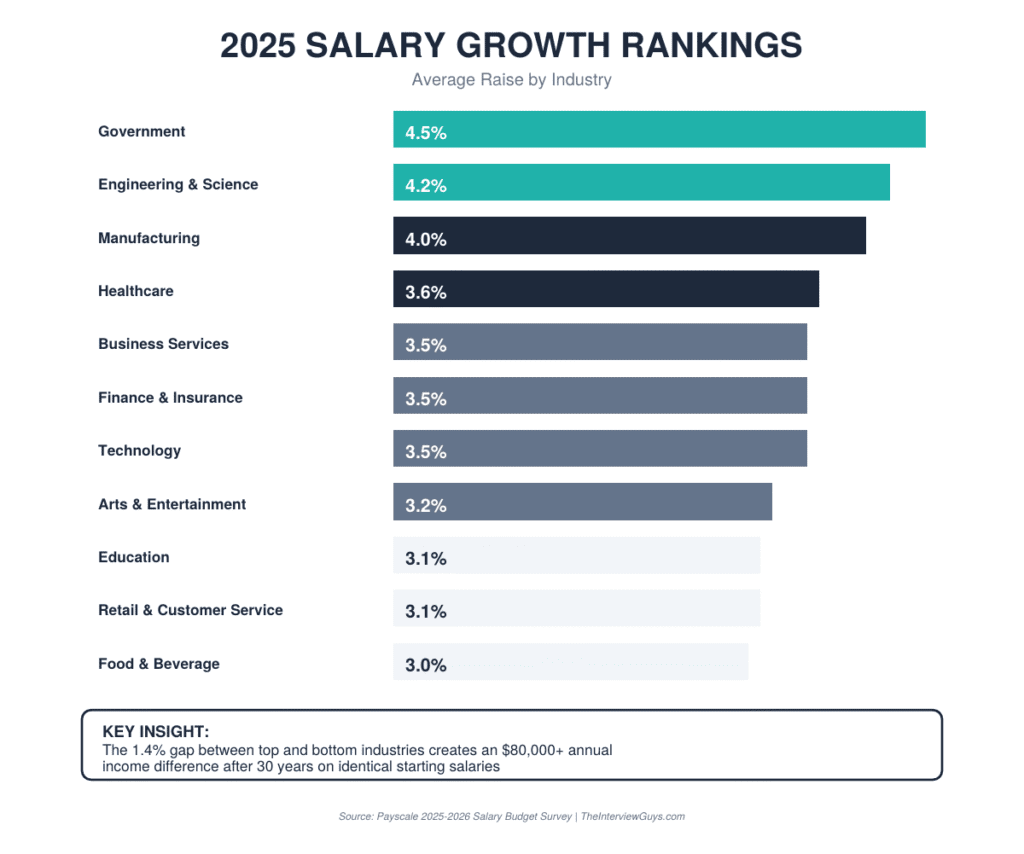
Here’s the brutal truth about 2025 salary increases: your industry determines your raise more than your performance ever will. Employers across the United States are budgeting an average 3.5% salary increase for 2025, according to comprehensive research from Payscale and the Bureau of Labor Statistics. But that average hides a massive divide.
Some industries are rewarding employees generously. Others are essentially offering pay cuts when you account for inflation. If you’re in the wrong sector, you’re leaving thousands of dollars on the table every single year.
This complete breakdown shows exactly which industries are paying top dollar in 2025, which ones are falling behind, and what you need to know if you’re stuck in a low-growth field. By the end of this guide, you’ll understand where the real money is and whether it’s time to consider changing careers in 2025 to maximize your earning potential.
☑️ Key Takeaways
- Government and engineering workers are getting 4.5% and 4.2% raises while retail, customer service, and education employees receive just 3.1%
- The 1.4 percentage point gap between top and bottom industries translates to thousands of dollars in lifetime earnings differences
- Technology sector sees salary increases drop from 4% to 3.5% as the industry cools from post-pandemic hiring frenzy
- Your industry matters more than your performance when it comes to 2025 raises, with some sectors offering 45% higher increases than others
The Industries Winning Big in 2025
Not all industries are created equal when salary increase season rolls around. Three sectors are significantly outpacing everyone else, offering raises that actually feel meaningful.
Government: The Surprising Leader at 4.5%
Government positions are offering the highest salary increases in 2025 at 4.5%, crushing the national average and defying every stereotype about public sector pay. This represents a stunning reversal from decades of private sector dominance.
Federal, state, and local government agencies are competing aggressively for talent as baby boomers retire in massive numbers and younger workers initially avoided public service careers. The result? Agencies are finally opening their wallets.
The 4.5% increase applies across government levels, from federal agencies to municipal offices. These raises come on top of typically excellent benefits packages including pension plans, generous time off, job security, and work-life balance that private companies can’t match.
Government jobs also offer something increasingly rare: stability. While private companies implement hiring slowdowns and layoffs, government positions remain secure even during economic uncertainty.
Interview Guys Tip: Government hiring processes move slowly but offer exceptional long-term value. If you’re considering this sector, start your applications now. The combination of 4.5% raises, incredible benefits, and job security makes government work one of 2025’s smartest career moves.
The remote job market is real. The fake listings cluttering up the free job boards are also real. FlexJobs fixes the second problem.
Less Scrolling. More Applying. Actually Getting Callbacks.
FlexJobs hand-screens every listing so you’re not wasting your energy on scams and ghost jobs.
Start for $2.95, kick the tires for 14 days, and get a full refund if it’s not clicking for you.
Engineering and Science: Commanding 4.2% Increases
Engineering and science professionals are securing 4.2% salary increases in 2025, second only to government workers. This premium reflects sustained demand for technical expertise across multiple industries.
The engineering advantage spans specialties. Automation engineers supporting Industry 4.0 transformations see particularly strong compensation growth. Environmental engineers working on sustainability initiatives command premium salaries. Software engineers, despite tech sector challenges, still earn significantly above-average raises.
According to Bureau of Labor Statistics data, wages for engineering roles increased 4.6% over the 12 months ending June 2025. That’s even higher than the planned increases, suggesting actual market competition is driving compensation beyond initial budgets.
Science professionals including data scientists, research scientists, and laboratory specialists benefit from similar dynamics. Organizations recognize these roles as impossible to offshore or automate easily, resulting in sustained investment in talent retention.
The highest paying engineering jobs in 2025 aren’t just offering better percentage increases. They’re applying those percentages to already elevated base salaries, creating compound advantages that add up to hundreds of thousands over a career.
Healthcare: Steady 3.6% Growth with Long-Term Security
Healthcare workers are receiving 3.6% salary increases in 2025, slightly above the national average. While not matching government or engineering, healthcare offers something equally valuable: guaranteed long-term demand.
The healthcare sector is experiencing sustained growth driven by aging demographics. Baby boomers require increasing medical services while the workforce replacing retiring healthcare professionals isn’t keeping pace with demand.
Nursing professionals, medical technicians, and specialized healthcare roles all benefit from this structural shortage. The Bureau of Labor Statistics projects healthcare roles will grow faster than average over the next decade, ensuring salary pressure remains upward.
Healthcare also offers geographic flexibility. Unlike tech jobs concentrated in expensive coastal cities, healthcare positions exist in every community, allowing professionals to choose their preferred cost of living.
The industry’s recession resistance adds another advantage. Economic downturns don’t stop people from getting sick or needing medical care, making healthcare compensation relatively stable compared to cyclical industries.
The Industries Getting Left Behind
While some sectors thrive, others are offering raises that feel more like insults. Three industries are significantly underperforming, leaving workers frustrated and looking for exits.
Retail and Customer Service: The 3.1% Ceiling
Retail and customer service workers are receiving the lowest salary increases in 2025 at just 3.1%. This barely exceeds inflation, meaning many workers are essentially running in place financially.
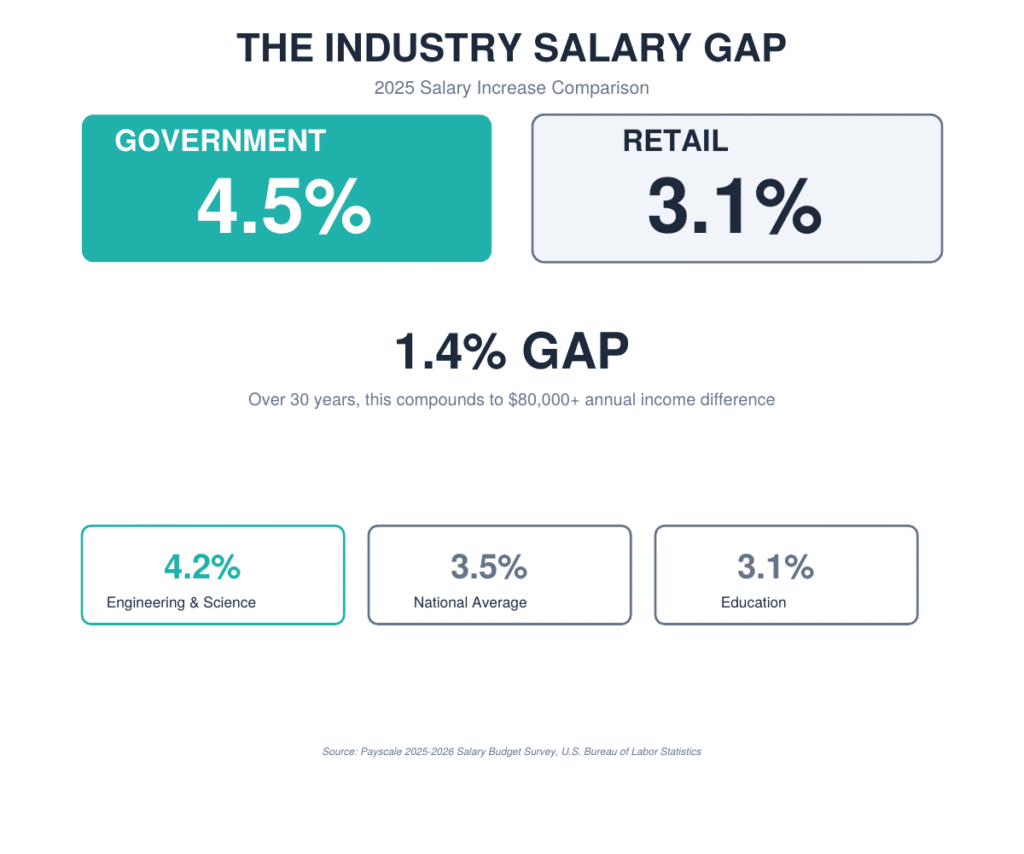
The 3.1% figure represents more than just a number. It’s a 1.4 percentage point gap compared to top-performing industries, translating to real purchasing power differences that compound over time.
Retail’s challenges are structural. E-commerce continues pressuring brick-and-mortar stores. Automation replaces cashiers and basic service roles. Labor costs remain the industry’s largest controllable expense, making raises the first casualty when margins tighten.
Customer service faces similar dynamics. AI chatbots and automated systems are rapidly replacing entry-level customer service representatives, creating downward pressure on compensation for remaining human workers.
The combination of low raises and job automation threats makes retail and customer service particularly challenging for long-term career building.
Education: 3.1% Increases Despite Critical Shortages
Education workers including teachers, administrators, and support staff are also stuck at 3.1% salary increases in 2025. This is particularly frustrating given widespread teacher shortages and constant discussion about education’s importance.
The disconnect between rhetoric and reality is stark. Politicians and communities claim to value education while compensation remains near the bottom of professional industries. The 3.1% increase barely keeps pace with cost of living changes.
Education budgets face unique constraints. Most funding comes from state and local governments operating under tight fiscal conditions. Unlike private companies that can adjust pricing to support higher wages, schools depend on tax revenue and enrollment-based funding formulas.
Teacher compensation varies dramatically by state, creating massive pay discrepancies for identical work. Some states invest heavily in education while others treat it as a budget afterthought.
Interview Guys Tip: If you’re passionate about education but frustrated by compensation, consider adjacent roles in educational technology or corporate training. These positions leverage teaching skills while offering significantly better compensation trajectories.
Food, Beverage, and Hospitality: The 3.0% Bottom
Food, beverage, and hospitality workers are receiving the absolute lowest salary increases in 2025 at just 3.0%. This sector never fully recovered from pandemic disruptions and continues struggling with profitability and worker retention.
Restaurants operate on notoriously thin margins, typically 3-5% profit after all expenses. Labor costs represent 25-35% of revenue in most establishments. This leaves minimal room for meaningful wage increases even when businesses want to reward employees.
The hospitality sector faces similar challenges. Hotels and event venues compete fiercely on price while managing high fixed costs. Entry-level positions often rely on tips rather than base wages, creating income volatility.
Recovery from pandemic-era closures remains incomplete. Many hospitality businesses took on significant debt to survive lockdowns. Servicing that debt while rebuilding customer volumes leaves little capital for competitive salary increases.
The 3.0% figure also masks significant variation within the industry. Executive chefs, hotel general managers, and specialized roles command better compensation growth. Front-line service positions see the most constrained increases.
The Industries in Transition
Several major sectors fall somewhere in the middle, offering average or slightly above-average raises while facing significant structural changes that could reshape their compensation trajectories.
Technology: Cooling from 4.0% to 3.5%
The technology sector is experiencing a notable moderation in salary increases, dropping from 4.0% in 2025 to a planned 3.5% for 2026. This represents a significant shift after years of tech workers commanding premium compensation.
High-profile layoffs at major tech companies throughout 2024 and 2025 fundamentally changed the industry’s dynamics. When companies including Meta, Amazon, and Google reduced headcount by thousands, the labor market shifted from worker-advantaged to employer-advantaged.
AI is simultaneously creating and destroying tech jobs. While demand for AI engineers, machine learning specialists, and data scientists remains incredibly strong, traditional software engineering roles face new competition from AI coding assistants that dramatically increase individual productivity.
Geographic factors also matter. Tech salaries in Silicon Valley, Seattle, and New York remain significantly higher than average, but the remote work revolution enabled companies to hire talent from lower-cost markets, applying downward pressure on compensation.
The 3.5% average still exceeds many industries, and top performers continue earning substantial increases. But the era of automatic 6-8% annual raises for simply working in tech has ended.
Manufacturing: Rebounding with 4.0% Growth
Manufacturing workers are seeing surprisingly strong salary growth at 4.0% in 2025, driven by Industry 4.0 transformations and reshoring initiatives bringing production back to the United States.
Modern manufacturing looks nothing like the assembly lines of previous generations. Automation, robotics, and advanced manufacturing techniques require skilled technicians who can program, maintain, and optimize sophisticated equipment. These roles command premium compensation.
According to the National Association of Manufacturers, the sector contributes nearly $3 trillion annually to the U.S. economy. Federal incentives for domestic production, particularly in semiconductors and clean energy technologies, are driving massive manufacturing investments.
The manufacturing renaissance creates opportunities for workers with the right skills. Automation engineers, industrial data analysts, and advanced manufacturing specialists see particularly strong compensation growth. Traditional production roles with minimal technical requirements face more limited increases.
Interview Guys Tip: Manufacturing offers an overlooked opportunity for career changers. Many positions provide on-the-job training, don’t require four-year degrees, and offer clear advancement paths. Consider exploring trade skills in advanced manufacturing for a recession-resistant career with above-average pay growth.
Finance: Steady 3.5% Growth Despite Fintech Disruption
Finance and insurance sectors are offering right-at-average salary increases of 3.5% in 2025. This steady performance masks significant internal variation based on specialization and embracing of new technologies.
Traditional banking roles face pressure from digital-first competitors and automation of routine transactions. Bank tellers see employment projected to decline 15% through 2033 while back-office processing roles face similar challenges.
However, fintech specialists, compliance officers managing increasingly complex regulations, and risk management professionals command significantly higher compensation growth. Financial advisors leveraging technology rather than competing against it continue earning strong increases.
The sector’s challenge involves navigating technological transformation without abandoning the personal relationships that define premium financial services. Professionals who successfully blend technology expertise with client management skills position themselves for above-average compensation growth.
Cybersecurity professionals in finance command particularly strong salaries given the industry’s security requirements and regulatory obligations around data protection.
What This Means for Your Career Strategy
Industry-level salary data tells you where the money is flowing, but translating that knowledge into career action requires strategic thinking.
Should You Switch Industries for Better Pay?
The 1.4 percentage point gap between top and bottom industries might not sound dramatic. But compounded over a 30-year career, it creates massive wealth differences.
Consider two professionals earning $60,000 annually. One receives 4.5% raises (government) while the other gets 3.1% (retail). After 30 years, the government worker earns $227,000 annually while the retail worker makes $147,000. That’s an $80,000 annual difference for identical starting salaries.
However, switching industries isn’t always straightforward. Skills don’t always transfer cleanly between sectors. Starting over in a new field might mean accepting lower initial compensation even if long-term trajectory is better.
The math works when your current industry shows persistent low growth and you have transferable skills valued in higher-growth sectors. For example, moving from retail management to supply chain and operations roles in manufacturing or government leverages leadership experience while accessing better compensation growth.
Interview Guys Tip: Before changing industries for better salary growth, research specific job requirements carefully. Many high-growth industries value transferable skills but require specific certifications or credentials. Plan the transition strategically rather than jumping impulsively.
How to Maximize Raises in Low-Growth Industries
If switching industries isn’t feasible or desirable, you’re not entirely powerless. Several strategies can help you beat your industry’s average.
Develop high-value specialized skills that differentiate you from peers. In retail, that might mean mastering inventory analytics or customer relationship management systems. In education, developing expertise in educational technology or data-driven instruction creates premium opportunities.
Pursue promotions aggressively. While your industry might offer limited annual raises, promotional increases typically range 10-20%. Advancing from teacher to department head or from server to restaurant manager provides pay bumps that dwarf annual merit increases.
Consider geographic arbitrage. Some states and cities pay significantly more for identical roles. A teacher earning $45,000 in one state might earn $65,000 performing the same job elsewhere. Research highest paying locations for your field and whether relocation makes financial sense.
Negotiate more aggressively when you have leverage. Low industry averages create opportunities when you deliver exceptional results or possess specialized skills your employer desperately needs. Use strategic negotiation techniques that position you as uniquely valuable.
Supplement income with side hustles aligned with your industry. Teachers create and sell curriculum materials. Retail workers develop consulting practices helping small businesses improve operations. These activities leverage your expertise while creating income beyond salary limitations.
The Long-Term Industry Outlook
Looking beyond 2025, several trends will likely reshape industry compensation hierarchies over the next 5-10 years.
Government and healthcare positions will likely maintain strong growth driven by demographic changes and public investment. These sectors offer the closest thing to guaranteed long-term demand in an AI-disrupted economy.
Technology remains strong but increasingly stratified. Elite AI specialists and senior engineers continue commanding premium compensation while entry-level and routine coding roles face pressure. The middle is disappearing.
Manufacturing could surprise as the next growth industry. Reshoring trends, infrastructure investments, and Industry 4.0 transformations create opportunities many workers overlook. Advanced manufacturing roles blend technical skills with hands-on work, offering AI-resistant career paths with strong compensation growth.
Retail and hospitality face existential challenges. Automation, AI, and changing consumer behaviors continue disrupting these industries. While demand for services won’t disappear, the number of human workers required keeps declining. Long-term career building in these sectors requires constant skill development and willingness to embrace technology rather than compete against it.
Education compensation depends entirely on political will. The sector has resources to pay competitively, the funding simply requires prioritization. Whether teachers see meaningful compensation improvements over the next decade depends on policy decisions rather than market dynamics.
The Bottom Line: Industry Choice Is Your Most Important Career Decision
Your talent, work ethic, and skills matter enormously. But in 2025, they matter less than your industry choice when determining salary growth.
The data is unambiguous: government workers get 4.5% raises while retail employees get 3.1%. That gap compounds into life-changing wealth differences over a career. A couple both working in high-growth industries versus low-growth sectors might see $160,000+ annual income differences by retirement age for identical starting salaries.
This doesn’t mean everyone should become government engineers. Personal fulfillment, lifestyle preferences, and individual strengths all factor into career satisfaction. Some people thrive in retail’s fast-paced environment or find education’s mission deeply rewarding despite compensation limitations.
But you deserve to make career decisions with complete information. If you’re in a low-growth industry, understand you’re fighting significant headwinds. That doesn’t make success impossible, but it requires exceptional performance and strategic career management to overcome industry-level constraints.
If you’re choosing a career path or considering a change, industry selection is arguably your most important decision. Research not just current salaries but growth trajectories, automation risk, and long-term demand. Your future self will thank you for taking the time to get this right.
The good news? You now know exactly where the money is in 2025. Whether you’re negotiating your next raise, planning a career change, or just starting your professional journey, use this industry intelligence to position yourself for financial success. Your earning potential depends on it.
The remote job market is real. The fake listings cluttering up the free job boards are also real. FlexJobs fixes the second problem.
Less Scrolling. More Applying. Actually Getting Callbacks.
FlexJobs hand-screens every listing so you’re not wasting your energy on scams and ghost jobs.
Start for $2.95, kick the tires for 14 days, and get a full refund if it’s not clicking for you.
After twelve years of writing advice like this, we built the tool that does it with you. It's called Longbow, and here's the whole story.

ABOUT THE INTERVIEW GUYS (JEFF GILLIS & MIKE SIMPSON)
Mike Simpson: Co-founder of The Interview Guys and Longbow. He has been the voice behind our interview advice since 2013 — his work has reached over 100 million job seekers around the world. The strategic mind behind Longbow, our new career platform.
Jeff Gillis: Co-founder of The Interview Guys and Longbow. He built the systems that put our work in front of those readers, and he leads the engineering on Longbow, the cutting edge career platform built for today’s job seeker.