
Free Software Developer Resume Template: Examples + 2025 Writing Guide

You’ve spent years perfecting your code. You can debug complex applications in your sleep. But when it comes to writing your resume? That’s a different kind of challenge entirely.
Here’s the thing: the software development job market in 2025 is more competitive than ever. According to recent industry data, software engineering job postings hit a five-year low earlier this year, yet applications per posting have surged to record highs. Some companies report receiving over 3,000 applications for a single developer role.
That means your resume needs to work twice as hard. It needs to pass automated screening systems, catch a hiring manager’s attention in under six seconds, and prove you’re worth that coveted interview slot.
The good news? You’re in the right place. By the end of this article, you’ll have access to professional software developer resume templates, understand exactly what hiring managers look for in tech resumes, and know how to showcase your skills in a way that gets results. We’ll cover everything from structuring your technical skills to writing achievement-focused bullet points that actually demonstrate your value.
Let’s build a resume that opens doors.
☑️ Key Takeaways
- Software developer resumes must balance technical depth with readability for both human reviewers and ATS systems
- Quantified achievements beat generic responsibilities every time when showcasing your coding impact
- Modern tech resumes need cloud skills and AI proficiency to compete in today’s rapidly evolving market
- Strategic keyword placement from job descriptions can increase your interview callback rate by up to 40%
What Makes a Software Developer Resume Different?
Software developer resumes have unique requirements that set them apart from other professions. You’re not just listing job duties. You’re demonstrating technical expertise, problem-solving abilities, and measurable impact.
The biggest difference? Technical depth matters. Hiring managers and technical recruiters need to quickly assess your programming languages, frameworks, and tools. But here’s the catch: they also need to understand the business value you created with those skills.
According to the U.S. Bureau of Labor Statistics, employment for software developers is projected to grow 17% from 2023 to 2033, adding approximately 327,900 jobs. Despite recent market fluctuations, the long-term demand remains strong, particularly for developers who can demonstrate both technical skills and business impact.
Another key difference is how your resume gets screened. Most tech companies use Applicant Tracking Systems (ATS) that scan for specific keywords, programming languages, and technologies. Your resume needs to be formatted correctly and include relevant terms to make it past this initial filter.
Before you send that resume: most Software Developer resumes get filtered out by ATS before a human ever sees them. Upload yours and find out your score. It takes 60 seconds and it’s free.
Software Developer Resume Example
Here’s a professional resume example. This example gives you an idea of what type of content fits in a good ATS friendly resume.
Example Resume:
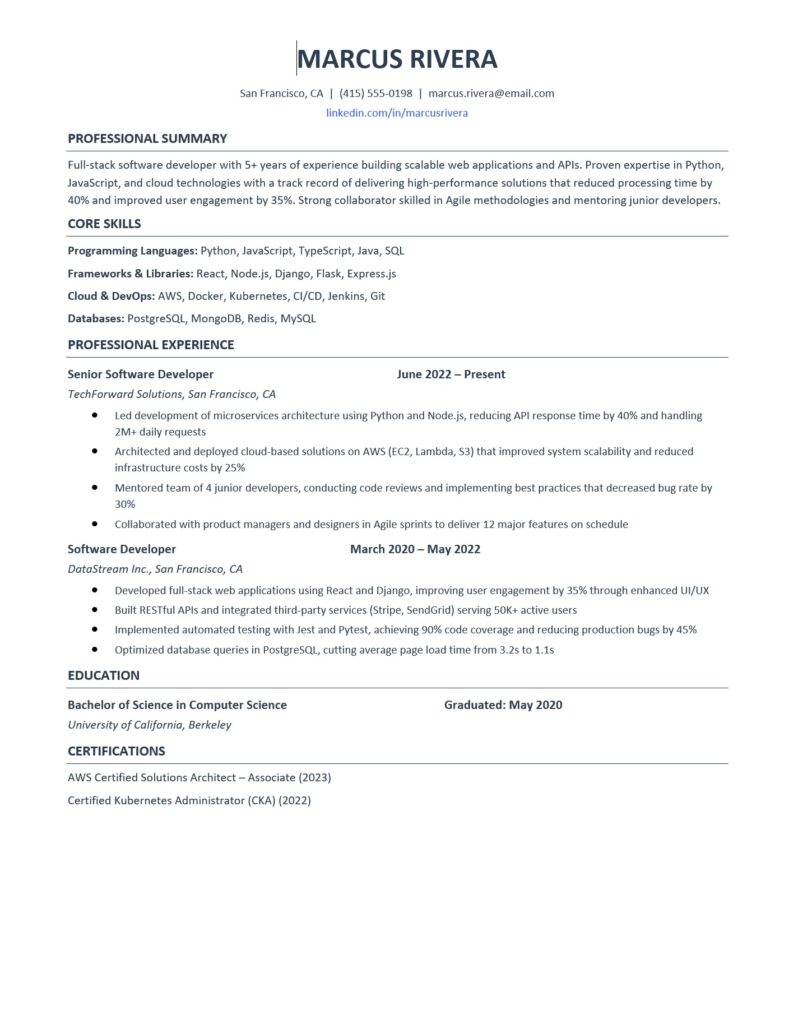
Here’s a professional resume template you can download and customize. This template is designed to be both visually appealing and ATS-friendly, with clean formatting that highlights your strengths.
Blank Customizable Template

Download Your Free Template:
- Download DOCX Template (fully editable in Microsoft Word)
Interview Guys Tip: The DOCX template is fully editable, allowing you to adjust fonts, colors, and spacing to match your personal brand while maintaining professional formatting. Just replace the placeholder text with your own information.
Here’s what most people don’t realize: employers now expect multiple technical competencies, not just one specialization. The days of being “just a marketer” or “just an analyst” are over. You need AI skills, project management, data literacy, and more. Building that skill stack one $49 course at a time is expensive and slow. That’s why unlimited access makes sense:
Your Resume Needs Multiple Certificates. Here’s How to Get Them All…
We recommend Coursera Plus because it gives you unlimited access to 7,000+ courses and certificates from Google, IBM, Meta, and top universities. Build AI, data, marketing, and management skills for one annual fee. Free trial to start, and you can complete multiple certificates while others finish one.
Essential Components of a Strong Software Developer Resume
Your software developer resume should include these core sections, each serving a specific purpose in your job search strategy.
Professional Summary
Skip the objective statement. Instead, open with a powerful professional summary that showcases your experience level, technical specialties, and most impressive achievements. This 2-3 sentence section should immediately communicate your value.
For example: “Full-stack software developer with 5+ years of experience building scalable web applications and APIs. Proven expertise in Python, JavaScript, and cloud technologies with a track record of delivering high-performance solutions that reduced processing time by 40%.”
Interview Guys Tip: Your professional summary should mirror the language used in the job description. If they’re looking for someone with “extensive microservices experience,” use that exact phrase if it’s true for you.
Core Skills Section
This is where you list your technical stack. Organize it into clear categories like Programming Languages, Frameworks & Libraries, Cloud & DevOps, and Databases.
Here’s what matters: prioritize the skills mentioned in the job description. ATS systems look for exact matches. If the job posting asks for “Python” and you only list “Python 3.9,” you might not get flagged as a match.
Research from Aura Intelligence shows that Python and SQL remain the most in-demand software engineering skills in 2025, with Python appearing in 26,816 job postings and SQL in 25,886. Following close behind are AI expertise, AWS proficiency, and troubleshooting skills.
Professional Experience
This section makes or breaks your resume. Here’s where you prove you can do more than write code. You need to show you can deliver business results.
Each bullet point should follow this formula: Action verb + what you built + technology used + quantified result.
Bad: “Developed web applications using React”
Good: “Built full-stack web applications using React and Django, improving user engagement by 35% through enhanced UI/UX and serving 50K+ active users”
Notice the difference? The second example tells a complete story with specific technologies and measurable impact.
When describing your achievements, use the SOAR method rather than STAR. Focus on the Situation, Obstacle, Action, and Result to create compelling narratives about your technical contributions.
Education and Certifications
List your degree, university, and graduation year. If you’re a recent graduate with limited experience, you can include relevant coursework or academic projects.
Certifications matter more in tech than in many other fields. AWS certifications, Google Cloud credentials, and Kubernetes certifications can significantly boost your credibility. List them with the year obtained.
How to Write Each Resume Section
Crafting Your Professional Summary
Your professional summary needs to accomplish three things in 2-3 sentences: establish your experience level, highlight your technical expertise, and showcase your biggest achievement.
Start with your title and years of experience. Then mention your primary technologies. Finally, include a quantified achievement that proves your impact.
Keep it conversational but professional. Avoid buzzwords like “passionate” or “rockstar developer.” Instead, focus on concrete skills and results.
Building Your Technical Skills Section
Group your skills into logical categories. Don’t just dump everything into one long list. Categories help both humans and ATS systems process your expertise.
Interview Guys Tip: Place your most relevant skills first within each category. If a job emphasizes React experience, list React before other frameworks even if you know Angular better. You’re tailoring for this specific opportunity.
Include both hard skills (programming languages, frameworks) and soft skills (Agile methodologies, mentoring). But be strategic. If you list “Git” as a skill, you should be comfortable discussing branching strategies in an interview.
Don’t inflate your skills. If you’ve only used a technology in one project, don’t list it at the same level as tools you use daily. Honesty prevents awkward interviews.
Writing Powerful Experience Bullets
This is where most developers struggle. You know what you built, but translating technical work into resume-worthy achievements takes practice.
Start each bullet with a strong action verb: Led, Architected, Developed, Implemented, Optimized. Avoid weak verbs like “Helped” or “Was responsible for.”
Then describe what you built. Be specific about the technology stack. Don’t just say “created an application.” Say “developed a microservices architecture using Node.js and Docker.”
Always quantify impact. How much faster? How many users? How much money saved? Numbers transform ordinary bullets into impressive achievements. If you improved performance, by what percentage? If you reduced bugs, by how many?
According to recent hiring trends, companies receiving thousands of applications per role are specifically looking for developers who can demonstrate measurable business impact, not just technical skills.
Selecting Projects to Highlight
For junior developers or career changers, a projects section can substitute for limited professional experience. Choose projects that demonstrate relevant skills for the role you’re applying for.
Each project description should include the technologies used, the problem you solved, and the outcome. Link to your GitHub repository or live demo if possible.
Don’t include every project you’ve ever touched. Select 2-4 that best showcase the skills mentioned in the job description. Quality beats quantity.
Common Mistakes to Avoid
The Generic Resume Trap
Sending the same resume to every job posting is the fastest way to get rejected. Each application needs tailoring to match the specific job description you’re targeting.
This doesn’t mean rewriting everything. It means adjusting your skills order, tweaking your professional summary, and emphasizing relevant experience.
Overloading with Technologies
Listing every framework you’ve ever touched makes you look scattered, not versatile. Focus on depth over breadth. It’s better to show expertise in React than mediocre knowledge of ten frameworks.
Ignoring Soft Skills
Technical skills get you past ATS. Soft skills get you hired. Collaboration, communication, and leadership matter, especially as you advance in your career.
According to Robert Half’s research, companies are increasingly looking for developers who can work cross-functionally and mentor junior team members. Pure coding jobs are evolving into roles requiring more interpersonal skills.
Interview Guys Tip: For every technical achievement on your resume, try to include a collaboration element. “Led migration to microservices architecture, coordinating with three product teams” is stronger than just “Migrated to microservices architecture.”
Poor Formatting Choices
Creative resumes with graphics and unusual layouts might look impressive, but they fail ATS screening. Stick to clean, simple formatting. Use standard section headings. Save the PDF with a clear name like “FirstName_LastName_Software_Developer_Resume.pdf.”
ATS Optimization and Keywords
Understanding ATS is crucial in 2025. These systems scan your resume for keywords before a human ever sees it. Here’s how to optimize without keyword stuffing.
- First, analyze the job description. Highlight every technical skill, tool, and qualification mentioned. These are your target keywords.
- Second, naturally incorporate these keywords into your resume. If they want “RESTful API development experience,” use that exact phrase in your experience section when describing relevant work.
- Third, use both acronyms and full terms. Write “Continuous Integration/Continuous Deployment (CI/CD)” on first use, then “CI/CD” in subsequent mentions. This ensures you match different search variations.
According to a recent analysis, 83% of companies will use AI resume screening by 2025. Your resume needs to be both human-readable and machine-optimized. That means clear section headings, standard formatting, and strategic keyword placement throughout.
Don’t hide keywords in white text or overload a skills section hoping to game the system. Modern ATS tools detect these tactics and will flag your resume as spam.
Showcasing AI and Modern Skills
The 2025 job market has shifted dramatically. Hiring managers now expect developers to have AI literacy and experience with modern development practices.
If you’ve worked with AI tools like GitHub Copilot, ChatGPT for code generation, or implemented machine learning models, showcase this prominently. These skills are increasingly valuable across all development roles.
According to recent research, professionals with AI skills earn 56% more than those without. This wage premium reflects the high demand for developers who can leverage AI tools effectively.
Cloud skills remain critical. AWS, Azure, and Google Cloud experience should be highlighted if you have it. Even basic cloud knowledge distinguishes you from candidates who only know traditional server infrastructure.
DevOps practices matter more than ever. CI/CD pipelines, containerization with Docker, and orchestration with Kubernetes are no longer specialized skills. They’re becoming baseline expectations for modern developers.
Frequently Asked Questions
How long should a software developer resume be?
One page for developers with less than 5 years of experience. Two pages are acceptable for senior developers with extensive experience, but make sure every line adds value. Hiring managers spend an average of six seconds on initial resume screening, so concise wins.
Should I include every programming language I’ve ever used?
No. Focus on languages where you have genuine proficiency and recent experience. If you learned Java in college but haven’t touched it in five years, leave it off unless the job specifically requires it. Depth beats breadth.
How do I explain employment gaps on my software developer resume?
Be honest and brief. If you were learning new technologies, contributing to open source, or working on personal projects, mention that. Gaps are common in tech, especially in 2025’s fluctuating market. What matters is showing you stayed current with your skills.
Do I need a cover letter for software developer positions?
While not always required, a well-crafted cover letter can differentiate you from hundreds of other applicants. Use it to explain your interest in the specific company and role. Learn how to write an effective cover letter that complements your resume without repeating it.
What’s the best file format for submitting my resume?
PDF is generally safest as it preserves formatting across different systems. However, if the application specifically requests a Word document (.docx), follow those instructions. Some ATS systems parse Word documents more effectively than PDFs.
Taking Action
The software developer job market in 2025 is challenging but full of opportunity for candidates who present themselves effectively. Your resume is your first impression. Make it count.
Start by downloading our free software developer resume templates below. Use the example to see what a strong resume looks like, then customize the blank template with your own experience and achievements.
Remember to tailor each application to the specific role. Use keywords from the job description. Quantify your achievements. Showcase both your technical depth and your ability to deliver business results.
Your next opportunity is waiting. Now you have the tools to reach it.
Here’s what most people don’t realize: employers now expect multiple technical competencies, not just one specialization. The days of being “just a marketer” or “just an analyst” are over. You need AI skills, project management, data literacy, and more. Building that skill stack one $49 course at a time is expensive and slow. That’s why unlimited access makes sense:
Your Resume Needs Multiple Certificates. Here’s How to Get Them All…
We recommend Coursera Plus because it gives you unlimited access to 7,000+ courses and certificates from Google, IBM, Meta, and top universities. Build AI, data, marketing, and management skills for one annual fee. Free trial to start, and you can complete multiple certificates while others finish one.
Before you send that resume: most Software Developer resumes get filtered out by ATS before a human ever sees them. Upload yours and find out your score. It takes 60 seconds and it’s free.
Advice like this is the general version. Longbow scores your actual resume against the actual job you want and shows you what's missing, before the filters decide for you. Here's why we built it.

ABOUT THE INTERVIEW GUYS (JEFF GILLIS & MIKE SIMPSON)
Mike Simpson: Co-founder of The Interview Guys and Longbow. He has been the voice behind our interview advice since 2013 — his work has reached over 100 million job seekers around the world. The strategic mind behind Longbow, our new career platform.
Jeff Gillis: Co-founder of The Interview Guys and Longbow. He built the systems that put our work in front of those readers, and he leads the engineering on Longbow, the cutting edge career platform built for today’s job seeker.