
State of Remote Work 2025: How Remote and Hybrid Arrangements Are Reshaping Hiring, Salaries, and the Future of Employment (A Comprehensive Research Report)

Five years ago, remote work was an emergency response to a global crisis.
Today, it’s a permanent fixture reshaping how we think about employment, career progression, and work-life balance.
The numbers tell a clear story. 32.6 million Americans now work remotely. 83% of employees prefer hybrid arrangements. The workplace transformation isn’t slowing down.
It’s accelerating.
Yet a fierce battle is brewing. Major corporations like Amazon, Dell, and JPMorgan Chase are demanding full-time office returns. Meanwhile, nearly half of remote workers say they’d quit rather than lose flexibility.
Industries from tech to healthcare are discovering something important. Remote work isn’t just possible. It’s often more productive.
This comprehensive research report synthesizes data from Robert Half, Gallup, FlexJobs, the U.S. Bureau of Labor Statistics, and 10+ authoritative sources. We’ll show you how remote work is transforming hiring practices, reshaping compensation structures, and creating new workplace norms.
Whether you’re a job seeker navigating the hidden remote job market, an employer designing flexible work policies, or a professional trying to understand where your industry is headed, this report provides the insights you need.
☑️ Key Takeaways
- Hybrid work dominates with 24% of new job postings offering flexible arrangements, while fully remote roles stabilize at 12% as organizations find their optimal balance between collaboration and flexibility.
- 60% of remote-capable employees prefer hybrid models, but 46% would quit if forced back to the office full-time, creating unprecedented retention challenges for companies implementing strict mandates.
- Remote workers report 31% higher engagement but also 45% more stress, revealing a productivity paradox that demands new management approaches focused on wellbeing alongside performance.
- Geographic salary adjustments are reshaping compensation, with 40% of workers willing to take pay cuts for flexibility valued at the equivalent of an 8% salary increase.
The Remote Work Landscape by the Numbers
Let’s start with the big picture.
Approximately 32.6 million Americans work remotely in 2025, representing about 22% of the workforce. That’s a massive increase from pre-pandemic levels when only 6.5% of workers primarily worked from home.
And it’s not just an American phenomenon. Globally, 83% of employees say they prefer a hybrid work environment that offers a mix of in-office and remote days.
The job market itself reflects this transformation.
Robert Half’s analysis shows that 24% of new job postings in Q2 2025 were hybrid and 12% were fully remote. Compare that to just two years earlier when only 15% of postings in Q2 2023 offered hybrid arrangements.
The shift is unmistakable.
Meanwhile, fully on-site roles have steadily declined. New, fully in-office job postings dropped from 83% to 66% during 2023 alone. Throughout 2024, that rate continued falling.
The trend is clear: flexible work arrangements aren’t going anywhere.
Remote Work by Experience Level
Here’s something interesting. Not all positions offer equal access to remote work.
Senior-level roles show the highest rates of flexibility. Nearly half of senior positions (31% hybrid, 14% remote) include some form of location flexibility.
Mid-level positions offer somewhat less. About 37% of these roles (25% hybrid, 12% remote) provide flexibility options.
Entry-level positions show the most limited options. Only 28% of entry-level jobs (18% hybrid, 10% remote) offer any flexibility.
This creates challenges for early-career professionals who often have the most to gain from remote work. The pattern suggests organizations view flexibility as something you must earn rather than a baseline offering.
However, this may be changing. As skills-based hiring practices gain traction, companies are competing more fiercely for entry-level talent.
Geographic Distribution
Where you live significantly impacts your access to remote work opportunities.
High-cost urban areas like San Francisco, New York, Seattle, and Los Angeles lead in remote job availability. These cities historically concentrated knowledge work, making them natural hubs for remote-friendly positions.
But here’s what’s fascinating. Remote work is enabling a talent exodus from expensive coastal cities to more affordable locations.
Workers are maintaining their high-paying jobs while relocating to areas with lower costs of living. It’s effectively giving themselves substantial raises without changing employers.
State-by-state analysis reveals significant variations. Tech hubs, financial centers, and regions with strong professional services sectors offer the most flexibility. Among U.S. metro areas, twelve cities saw the greatest volume of new hybrid jobs in Q2 2025.
Internationally, remote work opportunities are expanding fastest in Latin America and Eastern Europe. These regions offer skilled talent at more competitive costs, making them attractive for companies building distributed teams.
Interview Guys Tip: If you’re job searching in 2025, don’t limit yourself to your immediate geographic area. Many companies now hire across state lines or even internationally for the right candidates. Understanding which locations offer the most remote opportunities can dramatically expand your options.
The Great Divide: Employee Preferences vs. Employer Mandates
Here’s where things get interesting. And contentious.
The workplace is experiencing an unprecedented clash between what employees want and what many employers are demanding.
What Employees Actually Want
The data on employee preferences is remarkably consistent.
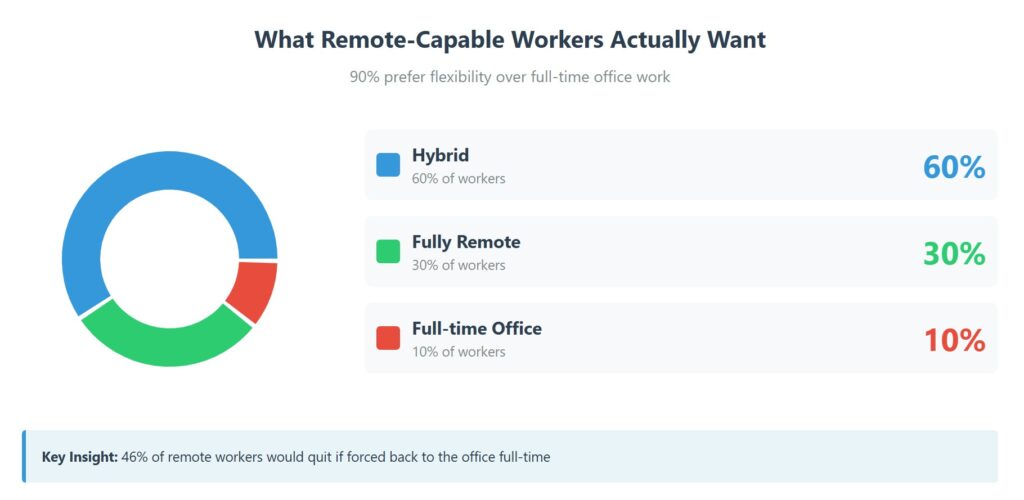
Gallup’s research reveals that 60% of remote-capable employees prefer a hybrid arrangement. Another 30% want to be fully remote. Less than 10% prefer to work on-site full time.
That means nine out of ten employees with remote-capable jobs prefer some form of flexibility.
This isn’t a marginal preference. It’s an overwhelming consensus.
The depth of this preference becomes clearer when you look at what employees are willing to sacrifice. Workers consistently report valuing hybrid work similarly to an 8% raise, according to research by Stanford economist Nick Bloom.
In fact, 40% of surveyed workers said they would accept a pay cut of 5% or more to maintain remote work flexibility.
The commitment to flexibility shows up in job search behavior too. According to Robert Half’s research, 46% of remote-capable workers would be somewhat or very unlikely to stay at their job if their employer eliminated remote work.
Nearly half the workforce is prepared to walk away rather than give up flexibility.
The Return-to-Office Mandate Wave
Despite overwhelming employee preferences, 2025 has seen an aggressive push for return-to-office mandates.
Amazon made headlines by implementing a five-day in-office requirement starting in January 2025. Dell took an even harder line, eventually eliminating hybrid work entirely in March 2025. JPMorgan Chase, Boeing, AT&T, and UPS have all implemented similar full-time office mandates.
The motivation behind these mandates remains controversial.
While executives cite collaboration, innovation, and company culture as justifications, research from BambooHR reveals a more calculated strategy.
One in four C-suite executives admitted they hoped return-to-office policies would lead to voluntary turnover. One in five HR professionals acknowledged their in-office policy was explicitly designed to make staff quit.
In other words, some companies are using RTO mandates as “stealth layoffs.”
The impact on company performance has been disappointing for mandate advocates. Research consistently shows that return-to-office mandates don’t significantly improve company performance. No measurable spikes in profitability or stock valuations.
What they do lead to is a dramatic dip in employee satisfaction and engagement.
According to multiple studies, 99% of companies with RTO mandates have seen drops in employee engagement. That’s not a typo. Virtually every organization forcing employees back to the office is experiencing measurable declines in how connected and motivated their workforce feels.
The Resistance Movement
Employees aren’t accepting these mandates quietly.
According to Kadence’s research, 73% of employees say they need a better reason to go into the office besides company mandates. Simply being told “because leadership says so” no longer works.
The resistance is particularly strong among certain demographics.
Women are most likely to resist full return-to-office requirements. Only about one-third would comply with a five-day office mandate. More than half would look for another job. Nearly 10% would quit outright.
Parents face acute challenges too. Those with young children under six find full-time office requirements especially difficult. Childcare logistics that worked with hybrid schedules become untenable with five-day office weeks.
Perhaps most significantly, the proportion of workers willing to quit immediately over an RTO mandate doubled. It went from 5% in early 2022 to nearly 10% by mid-2024.
This highlights a dramatic shift. Workers view flexibility as essential, not optional.
By 2024, after years of successfully working from home, flexibility had become deeply integrated into people’s lives. Removing it now feels like taking away something fundamental.
The Trust and Control Paradox
The disconnect between employer concerns and employee reality reveals deeper issues.
According to ZipRecruiter surveys, about 59% of employers worry that remote work harms company culture. Half of workers acknowledge it “hurts” their ability to feel connected with co-workers.
This seems to validate employer concerns about cultural cohesion.
However, the solution many companies chose (forcing everyone back to the office) isn’t supported by performance data. Multiple studies show that return-to-office mandates don’t improve financial outcomes.
MIT Sloan Management Review notes that RTO requirements instead damage employee engagement and increase attrition, especially among high performers.
The mandates reflect what many experts describe as the weakest form of leadership: management through monitoring.
When executives justify office requirements by saying they need to “see” employees working, they’re essentially admitting they don’t trust their teams. Or they don’t know how to measure performance based on outcomes.
This trust deficit flows both ways.
Zoom’s research found that 64% of employees agree that an RTO mandate would reduce their trust in leadership. When companies implement policies that ignore employee preferences and contradict productivity data, they signal that control matters more than results.
Interview Guys Tip: If you’re facing an RTO mandate, focus your job search on companies that have committed publicly to long-term flexibility. These organizations have already weathered the internal debate. Look for employers that talk about outcomes rather than hours or presence in their job descriptions.
The Productivity Paradox: Engagement vs. Wellbeing
Remote work creates a fascinating contradiction: workers are simultaneously more engaged and more stressed than their in-office counterparts.
The Good News: Higher Engagement
Gallup’s State of the Global Workplace report reveals that globally, fully remote workers are the most likely to be engaged at work at 31%, compared with hybrid workers at 23%, on-site remote-capable workers at 23%, and on-site non-remote-capable workers at 19%.
Employee engagement measures the enthusiasm workers feel for their work and their attachment to their team and organization. It directly affects team performance and business outcomes. By this measure, remote work is succeeding beyond what many skeptics predicted.
Remote workers may be more engaged because they have more autonomy in their work. This freedom allows them to play to their strengths, reach a flow state more easily, and use their time more efficiently. When you can structure your workday around your natural energy patterns and eliminate workplace distractions, engagement naturally increases.
The productivity data supports these engagement findings. According to research by the U.S. Bureau of Labor Statistics, industries that saw larger increases in remote work during the pandemic also experienced faster growth in productivity. Specifically, for every 1 percentage-point increase in remote work, there was about a 0.08 to 0.09 point rise in total factor productivity.
A separate survey conducted in December 2024 backs this up further. In that study, 61% of workers said they’re more productive working from home, while 34% said they get the same amount of work done at home as they would in the office. Only 5% reported being less productive working from home.
Younger workers show even stronger productivity gains. According to Zoom’s research on the future of work, 84% of workers, especially younger employees, said they perform better in hybrid or remote environments. This preference dips slightly with age, but the trend holds across all age groups.
Time savings contribute significantly to these productivity gains. Research shows that remote workers save approximately 72 minutes in commute time every day. What makes this finding particularly interesting is that much of this reclaimed time gets channeled back into working more, not just personal activities.
The Concerning Reality: Wellbeing Challenges
Despite higher engagement, fully remote workers face serious wellbeing challenges that organizations can’t ignore.
According to the same Gallup research, although fully remote workers report higher engagement, they are less likely to be thriving in their lives overall. Only 36% of fully remote workers report thriving compared to 42% of hybrid workers and 42% of on-site remote-capable workers.
The stress statistics are particularly concerning. Fully remote employees are more likely to report experiencing a lot of stress the previous day at 45% compared to on-site workers at 38-39% and about the same as hybrid workers at 46%. They’re also more likely to report experiencing anger, sadness, and loneliness than hybrid and on-site workers.
These findings suggest that being a fully remote worker is often more mentally and emotionally taxing than working on-site or in a hybrid arrangement. Several factors may explain this pattern.
Physical distance can create mental distance. For some employees, remote work may feel like “just work” without the friendships, team lunches, storytelling, and camaraderie that on-site and hybrid work naturally provide. When work becomes purely transactional without social connection, wellbeing suffers even as productivity increases.
The lack of clear boundaries between work and personal life creates additional stress. Without the physical transition of a commute or the clear endpoint of leaving an office, remote workers often struggle to “turn off” work mentally. This leads to longer work hours and less recovery time.
Isolation compounds these challenges. While introverts may thrive with less social interaction, even they need some connection. The absence of casual hallway conversations, spontaneous problem-solving sessions, and the energy of being around colleagues can leave remote workers feeling disconnected and lonely.
The Hybrid Sweet Spot
The data increasingly points to hybrid work as the optimal arrangement for most workers and most organizations.
Multiple studies confirm that hybrid workers experience the best psychological health outcomes. They get the flexibility and focused work time that comes with remote days, plus the collaboration and connection that comes with in-office days. This balance addresses the wellbeing concerns of fully remote work while maintaining the productivity benefits.
The most common hybrid model in 2025 is three days in the office and two days remote, with 39% of hybrid employees following this pattern. However, there’s been significant “hybrid creep” over time. According to Owl Labs’ State of Hybrid Work Report 2025, 34% of hybrid workers now go into the office four days a week, up from 32% in 2024 and just 23% in 2023.
This gradual increase in office days suggests that even without formal mandates, many employees are experiencing a slow-motion return to office. However, the key difference is choice. When employees voluntarily increase their office days because they see value in the face-to-face interaction, the impact on engagement and wellbeing differs dramatically from when companies force them back through mandates.
Burnout and Mental Health Concerns
Despite productivity gains, burnout remains a serious concern across all work arrangements.
Research shows that 69% of remote employees are experiencing burnout. This alarmingly high number suggests that eliminating the commute and offering flexibility doesn’t automatically prevent burnout. The sources of workplace stress like tight deadlines, heavy workloads, and pressure to perform remain regardless of location.
A new phenomenon called “quiet cracking” is emerging as the newest workplace red flag. This happens when workers feel stressed and silently burn out while still going through the motions of their jobs. Unlike quiet quitting where engagement drops visibly, quiet cracking involves maintaining appearances while experiencing serious mental health deterioration internally.
Managers seem to sense this risk. According to Owl Labs research, 33% of managers are concerned about in-office employees’ satisfaction and 27% worry about their teams overworking and burning out. Interestingly, only 26% are concerned about remote employees’ satisfaction and 21% worry about remote overwork and burnout, suggesting managers may be underestimating remote worker stress.
The solution requires intentional wellbeing strategies that go beyond offering flexibility. Companies need to encourage actual boundaries, model healthy work habits from leadership, provide mental health resources, and create cultures where taking time off is truly acceptable.
Understanding workplace burnout in 2025 is essential for both employers designing policies and employees managing their own wellbeing in remote and hybrid environments.
Interview Guys Tip: Remote work success requires intentional relationship-building. Schedule regular video calls with colleagues even when email would suffice, join virtual coffee chats, and participate in team activities even when they feel optional. Connection actively combats isolation and improves both wellbeing and career progression.
The Compensation Conundrum: How Remote Work Affects Your Paycheck
One of the most complex aspects of remote work’s evolution involves how companies determine fair compensation for distributed employees.
Salary Structure Approaches
Organizations have adopted widely varying approaches to remote work compensation, creating a patchwork landscape that job seekers must navigate carefully.
Location-based compensation remains the most common strategy. This approach ties compensation to an employee’s geographic location, whether at a local, regional, national, or international level. Under this model, two employees in the same role working for the same company will likely be compensated differently based solely on where they choose to live.
Some companies add complexity by implementing geographic tiers. They might pay one rate for employees living in high-cost cities like San Francisco or New York, a lower rate for those in mid-tier cities, and an even lower rate for those in rural areas or low-cost locations.
The rationale makes intuitive sense: cost of living varies dramatically across geographies, so compensation should reflect what employees need to maintain similar lifestyles. However, this approach creates fairness questions when employees doing identical work receive vastly different pay.
National or regional rate strategies are emerging as an alternative. Under this approach, companies use national averages for a role as a benchmark, paying the same rate regardless of where in the country the employee lives. Airbnb famously adopted this approach, allowing employees to choose whether to remain remote or return to the office without any penalty to their salary compensation.
Role-based compensation that ignores location entirely represents the most employee-friendly approach but the least common. Companies like Basecamp have adopted this strategy, paying everyone at the same seniority level the same amount regardless of location. Basecamp sets salaries at the 90th percentile of the San Francisco market, ensuring highly competitive compensation but at significant cost to the company.
According to salary research, 92% of employers still lack a formal system for determining compensation for employees who work remotely only part of the time. This suggests most organizations are still figuring out fair approaches rather than operating from established frameworks.
The Pay Cut Reality
The willingness of many workers to accept lower compensation for remote flexibility has important implications for both job seekers and employers.
Research from Harvard Business School asked workers if they would be willing to give up part of their salaries to keep flexibility rather than return to the office five days a week or find a new job. While more than half of workers surveyed wouldn’t take a salary reduction, 40% said they would accept a pay cut of 5% or more.
Breaking this down further, the research found that women were more willing to forgo 20% or more of their salaries compared with men. The research team initially thought that women’s childcare responsibilities might explain the gap, but they detected few differences based on whether the respondent was the primary caregiver for a child.
Workers who reported being even moderately productive while working remotely were willing to accept salary reductions to continue working outside the office. Only those who said they were least productive while working remotely were also least likely to sacrifice compensation.
This data reveals something important about how employees value flexibility. For many workers, remote work provides benefits beyond what salary can capture. The time saved on commuting, the ability to manage family responsibilities, the reduced stress of not navigating office politics daily, all these factors create value that makes a nominal pay cut worthwhile.
Stanford economist Nick Bloom’s research quantifies this at about an 8% raise equivalent. Workers value the option of hybrid work similar to receiving an 8% salary increase. This helps explain why so many employees are willing to quit rather than lose flexibility. They’re not just losing a perk. They’re experiencing what feels like a substantial pay cut.
Location Arbitrage Opportunities
The geographic flexibility of remote work is creating fascinating compensation dynamics and opportunities.
Companies are discovering they can cut costs significantly through strategic remote hiring. According to analysis of remote advertising salaries in 2025, businesses are reducing costs by 50-70% through remote hiring while still offering competitive pay for in-demand skills.
Here’s how the regional breakdown looks for remote work compensation:
North America continues to offer the highest salaries due to strong demand and high costs of living. Tech workers in the United States can command top-tier compensation even in fully remote roles.
Western Europe offers mid-to-high pay that balances competitive salaries with somewhat lower costs of living than North American hubs. Eastern Europe provides cost-effective talent with skilled professionals earning 40-60% less than their Western European counterparts while maintaining strong technical capabilities.
Latin America has emerged as a major remote work hub, with skilled professionals earning 50-70% lower salaries than North America while often working in the same time zones. This makes Latin American talent particularly attractive for U.S. companies building distributed teams.
The Asia-Pacific region shows the widest salary ranges, from developed markets like Singapore and Australia offering high compensation to emerging markets providing more affordable options.
For workers, this creates location arbitrage opportunities. A software developer earning a San Francisco salary who relocates to a mid-sized Midwest city or a small town can maintain their income while dramatically reducing their living expenses. This effectively gives them a substantial raise without changing jobs.
Of course, companies are increasingly aware of this dynamic and adjusting compensation accordingly. Facebook and Google both implemented internal calculators showing employees how their pay would adjust if they moved to lower-cost areas. The transparency helps, but it also means workers can’t always maintain Bay Area salaries while living in rural Montana.
The Promotion and Advancement Factor
Remote work’s impact on career progression remains one of employees’ biggest concerns.
Dell’s approach illustrates the promotion challenge. In February 2024, Dell introduced a hybrid work policy requiring employees to classify themselves as either hybrid or remote, with promotions withheld from remote workers. Despite this significant career penalty, almost 50% of Dell’s workforce still chose to work remotely, demonstrating how highly they valued flexibility.
Research confirms these concerns have merit. Fully remote workers are 1.3 times more likely to feel job insecurity than people who are always in the office, according to Zoom’s research. The fear of being “out of sight, out of mind” isn’t paranoia. It’s a rational concern based on how many organizations still operate.
Paradoxically, 85% of remote workers surveyed believe that office time helps their career advancement. They recognize the reality that face-time with managers and executives often influences promotion decisions, even if it shouldn’t matter in a purely meritocratic system.
The good news is that forward-thinking organizations are implementing outcome-based promotion criteria that don’t penalize remote workers. Skills-first hiring practices are gradually replacing traditional factors like office presence and face-time in determining who advances.
Total Compensation Evolution
Smart job seekers in 2025 look beyond base salary to evaluate total compensation value.
Home office stipends are becoming standard, with many companies providing $500-2,000 annually for desk chairs, monitors, keyboards, and other equipment. Technology allowances cover internet costs, often $50-75 monthly. Professional development budgets help remote workers upskill, typically ranging from $1,000-5,000 annually.
The flexibility premium itself has quantifiable value. According to multiple studies, workers assign flexibility a value equivalent to 8% of their salary. Mental health benefits are emerging as key differentiators, with comprehensive support programs worth thousands in avoided healthcare costs and improved wellbeing.
When you factor in commute savings, both time and money, the total value picture changes dramatically. A worker who previously spent 90 minutes daily commuting saves 375 hours annually, equivalent to 9+ work weeks. Add gas, vehicle maintenance, parking, and other commuting costs, and remote work can save $5,000-10,000 yearly.
Interview Guys Tip: When evaluating remote job offers, calculate total compensation value including commute savings (time and money), home office benefits, and flexibility value. A seemingly lower salary might actually be more valuable when you account for all factors. Create a spreadsheet comparing the true economic value of each offer, not just the base salary number.
Industry-by-Industry Remote Work Adoption
Remote work adoption varies dramatically across industries, creating very different opportunity landscapes depending on your field.
Technology Sector: Remote Work Pioneer
The tech industry continues to lead the remote work revolution, though not without controversy.
Computer and IT roles show the highest rates of flexible arrangements, with 55% of positions offering hybrid or remote options according to industry analysis. Back in 2021, 48% of tech companies offered full-time remote work, making technology the most remote-friendly sector.
FlexJobs’ Remote Work Economy Index for Q2 2025 shows remote job postings in computer and IT grew 8%, signaling steady demand. The technology sector accounts for the largest volume of remote opportunities across all fields.
Specific tech subsectors show even higher remote work rates. Computer systems design and related services, one of the most detailed industry categories tracked by the Bureau of Labor Statistics, had over 46% of its workforce working remotely in 2022. Publishing industries including software showed similar patterns.
Even as some high-profile tech companies implement return-to-office mandates, the broader industry continues expanding remote options. For every headline about Amazon or Meta requiring office returns, dozens of smaller tech companies are doubling down on remote-first strategies to attract talent their larger competitors are alienating.
The tech industry’s commitment to remote work makes sense given the nature of the work. Software development, system administration, data analysis, and many other tech roles don’t require physical presence. The work is already digital, making location largely irrelevant to productivity.
For job seekers in tech, this creates exceptional opportunities. Even if you start in a different industry, tech positions remain highly accessible for remote work. The net gain of 70% shows that for every 100 Gen Z workers who leave other industries, 70 move into tech, drawn partly by flexibility options.
Finance and Professional Services
The finance sector has undergone a remarkable transformation in its approach to remote work.
According to multiple sources, 30% of the finance and insurance sector now works fully remotely, the highest rate of any major industry. This represents a dramatic shift for a sector that traditionally valued in-person client relationships and physical presence in financial centers.
Finance remote roles have surged as companies adapted to regulatory requirements and invested heavily in cybersecurity and compliance infrastructure. What once seemed impossible, securing financial transactions and maintaining compliance remotely, has become standard practice through better technology and processes.
Professional services including consulting and legal work have similarly embraced hybrid arrangements. These fields initially seemed resistant to remote work given their emphasis on client relationships and confidential work. However, firms discovered that video conferencing could maintain client relationships effectively while reducing travel costs and improving work-life balance for employees.
Investment management, securities trading, and other high-stakes financial roles that many assumed required trading floor presence have proven adaptable to remote work. Companies still maintain physical offices for certain functions, but far more work happens remotely than anyone predicted in 2019.
For finance professionals, this shift creates access to opportunities previously requiring relocation to financial centers like New York, Chicago, or San Francisco. A financial analyst in a mid-sized city can now compete for positions at major investment firms without moving.
Healthcare: Partial Transformation
Healthcare presents unique challenges and opportunities for remote work.
Clinical roles requiring physical presence with patients obviously can’t go remote. Surgery, nursing, physical therapy, and many other healthcare positions require in-person delivery. However, healthcare has seen a tremendous increase in remote-friendly positions that many people overlook.
Telemedicine exploded during the pandemic and has largely maintained its growth. Mental health services, routine checkups, chronic disease management, and many other forms of care now regularly happen via video calls. This enables healthcare providers to work from anywhere while serving patients in their homes.
Administrative positions in healthcare have increasingly gone virtual. Medical billing, coding, scheduling, insurance verification, and countless other back-office functions don’t require hospital or clinic presence. These roles represent thousands of remote opportunities for people with healthcare knowledge but not necessarily clinical training.
Remote patient monitoring has created entirely new categories of healthcare jobs. Professionals monitor patient data transmitted from home devices, alerting doctors to concerning patterns and providing coaching to patients managing chronic conditions. This work happens entirely remotely but requires clinical knowledge and judgment.
In life sciences, roles in clinical research, data management, regulatory affairs, and pharmaceutical marketing are increasingly moving to virtual environments. Organizations are using remote work to bring highly qualified professionals into projects without requiring relocation, leading to faster innovation in areas like vaccine development, genomics, and personalized medicine.
For healthcare professionals, understanding which roles within the massive healthcare ecosystem are remote-friendly can open up opportunities you might have overlooked. Nursing careers in particular have evolved to include numerous remote options in utilization review, case management, and telehealth.
Education and Training
Education has experienced one of the most dramatic remote work transformations.
Remote education job growth exceeded 20% in Q2 2025 according to FlexJobs data, making education one of the fastest-growing sectors for remote opportunities. Virtual instruction, online course development, and educational technology roles have proliferated.
K-12 and higher education institutions discovered during pandemic closures that much administrative work doesn’t require physical presence on campus. Admissions, financial aid, student services, and many other functions now operate in hybrid or fully remote models.
Corporate training and professional development have moved almost entirely online in many organizations. Instructional designers, trainers, and learning and development specialists now predominantly work remotely, creating training materials and conducting sessions virtually.
The ed-tech sector itself has boomed, creating thousands of remote positions in companies building learning platforms, educational software, and digital curriculum. These roles range from technical positions developing the technology to instructional experts designing learning experiences.
Customer Service and Support
Customer service represents one of the highest-adoption sectors for remote work.
According to industry data, 82% of customer service roles have adapted to remote work models. What were once massive call centers in specific geographic locations are now distributed networks of home-based representatives.
Virtual platforms have replaced physical call centers entirely at many companies. The technology enabling call routing, quality monitoring, and customer relationship management works just as well, often better, with distributed teams compared to centralized locations.
Companies have discovered significant benefits to remote customer service beyond cost savings. Access to global talent pools means 24/7 coverage becomes easier to staff. Representatives working from home often have quieter environments than noisy call centers, improving customer experience.
Quality metrics have maintained or improved with remote customer service teams, putting to rest early concerns that productivity would drop without direct supervision. Many companies report higher customer satisfaction scores and better employee retention among remote customer service teams compared to their traditional call center operations.
For job seekers, customer service represents one of the most accessible entry points to remote work. Many positions require no specific degree, just communication skills and basic computer literacy. While pay varies widely, remote customer service jobs offer flexibility that many workers value highly.
Industries Lagging in Remote Adoption
Not all sectors have embraced remote work equally.
Manufacturing remains largely on-site with only 10-15% of positions offering remote options, primarily in administrative, engineering, and management roles. Production work simply requires physical presence on factory floors.
Retail shows limited remote opportunities outside corporate offices and e-commerce operations. Store associates, managers, and most retail positions require in-person customer interaction. However, retail corporate roles in merchandising, marketing, and operations are often hybrid or remote.
Hospitality and food service remain almost entirely on-site due to the nature of the work. Hotels need staff physically present, restaurants need cooks and servers in the building, and similar service-focused businesses require in-person delivery.
Construction, trades, and similar physical work can’t be done remotely. Electricians, plumbers, carpenters, and construction workers must be on job sites. However, even these industries have some remote positions in project management, estimating, and administrative support.
Transportation and logistics require drivers, warehouse workers, and others to be physically present. However, dispatch, routing, scheduling, and management roles are increasingly remote-friendly.
Interview Guys Tip: Research which specific roles within your industry are most remote-friendly. Even traditional sectors have pockets of remote opportunity in areas like marketing, HR, IT support, and project management. If you’re committed to remote work but in a field that seems incompatible, consider how your skills might transfer to remote-friendly roles within your industry.
The Generational Divide: Age and Remote Work Preferences
Different generations approach remote work with strikingly different preferences and expectations.
Gen Z: The Office-Curious Generation
The youngest workers in the labor force have surprised many observers with their attitudes toward office work.
Despite growing up as digital natives, 74% of Gen Z prefer face-to-face colleague interactions according to multiple studies. This is actually higher than Baby Boomers at 68% and Gen Xers at 66%, contradicting assumptions that the most digitally connected generation would prefer the most remote work.
Gen Z workers are coming to the office an average of three days a week, more than all other age groups. When given the choice, young workers often select more office time than their older colleagues.
However, only 26% of Gen Z want to be fully remote, lower than Millennials (31%), Gen X (33%), and even Baby Boomers (37%). This doesn’t mean Gen Z opposes flexibility. Rather, they recognize that as early-career professionals, they benefit from the mentorship, relationship-building, and learning opportunities that in-person work provides.
Gen Z’s preference for some office time reflects their career stage more than generational character. As the newest entrants to professional environments, they’re still learning workplace norms, building professional networks, and establishing their reputations. These activities happen more naturally with at least some face-to-face interaction.
That said, Gen Z strongly values flexibility in when they work even if not always where. They expect 64% of employers to provide wellness technology in offices and 56% believe digital transformation tools are critical to their success.
For Gen Z professionals navigating workplace dynamics in 2025, the key is finding arrangements that provide both the flexibility they value and the in-person learning opportunities they need at this career stage.
Millennials: Hybrid Advocates
Millennials have emerged as the strongest advocates for hybrid work arrangements.
Approximately 31% of Millennials prefer fully remote work, while the majority favor hybrid options that provide both flexibility and connection. They’re driving hybrid work adoption across industries, having experienced both traditional office culture and remote work success.
For Millennials, hybrid work represents an ideal balance. Many are in their 30s and 40s, juggling career ambitions with family responsibilities. The flexibility to work from home some days helps manage childcare, eldercare, and personal commitments while maintaining the professional relationships and visibility that office time provides.
Research shows that 60% of workers include hybrid arrangements in their top two workplace preferences, with Millennials leading this movement. They’ve proven they can be productive remotely but also understand the career benefits of strategic in-person time.
Millennials are also driving the conversation around mental health in the workplace. According to research, 27% say remote work helps them save money, making flexibility a practical financial benefit rather than just a lifestyle preference.
Gen X: Experienced Flexibility Seekers
Generation X workers, now in their mid-40s to early 60s, show strong preferences for remote work despite their experience with traditional office culture.
Surprisingly, 33% of Gen X prefer fully remote arrangements, nearly matching Millennials and significantly higher than the youngest workers. This preference reflects both their career confidence and their life stage priorities.
Gen Xers average 2.8 years of job tenure compared to 1.1 for Gen Z, showing greater stability partly because they’ve found arrangements that work for them. Many have caregiving responsibilities for both children and aging parents, making flexibility especially valuable.
While Gen X workers use AI and collaboration tools somewhat less than younger generations with only 37% using AI to problem-solve compared to 55% for Gen Z and Millennials, they’ve adapted effectively to remote work technologies. Their comfort with both traditional and modern work styles makes them valuable bridge figures in multi-generational teams.
As older workers, Gen X increasingly values the work-life balance that remote work enables. Having witnessed colleagues sacrifice health and family for career advancement, many are making different choices as they enter their later career stages.
Baby Boomers: Traditional with Exceptions
The oldest generation still in the workforce shows more varied preferences than stereotypes suggest.
While 40% of Boomers prefer office work, the highest among generations, a surprising 37% prefer fully remote arrangements. This challenges assumptions that older workers universally resist remote work or lack the technical skills to succeed remotely.
The Boomers who embrace remote work often do so for lifestyle reasons as they approach or contemplate retirement. Remote work enables them to continue contributing professionally while enjoying greater flexibility for travel, hobbies, or gradual workforce exit.
However, only 56% of Boomers are comfortable with hybrid arrangements compared to higher percentages among younger generations. This reflects both generational preferences and career stage. Many Boomers spent decades working entirely in offices and feel most effective in traditional environments.
Boomer employers show different perspectives on remote work than younger leaders. According to Cisco’s 2025 Global Hybrid Work Study, only 28% of Boomer employers believe remote work is most productive compared to 48% of Gen Z employers. Meanwhile, 40% of Boomer employers prefer office work versus just 28% of Gen Z employers.
Leadership Generation Gap
The generational divide extends into leadership and policy-making decisions.
According to research, 83% of both employers and employees believe managers from older generations are more likely to want to mandate working from the office, while younger generations are more likely to want to work remotely. This perception reflects reality in many organizations where executive teams skew older while workforce demographics skew younger.
The complex nature of many workforces within firms only adds to the challenge of defining and implementing mandates that can be applied company-wide and be received positively at different levels of seniority, performance, and generational cohorts.
Organizations navigating these dynamics successfully involve multiple generations in policy decisions rather than letting senior leadership alone determine remote work policies. They recognize that different generations bring valid perspectives based on both their life stages and their career needs.
Interview Guys Tip: When interviewing, ask who makes remote work policy decisions. Companies with younger leadership or inclusive policy committees that involve multiple generations tend to offer more sustainable flexibility that won’t suddenly disappear due to executive whims.
The Technology Infrastructure Enabling Remote Work
The tools and systems supporting remote work have evolved dramatically, though challenges remain.
Collaboration Tools Evolution
The average remote worker now uses 4.8 different conferencing and collaboration tools, according to FinancesOnline statistics. This proliferation of tools reflects both the richness of available options and the fragmentation of the collaboration technology landscape.
About 80% of remote workers use instant messaging apps regularly, up from 75% before the pandemic. Video conferencing, once a occasional tool for specific meetings, has become standard for daily communication. File sharing and document collaboration tools have similarly moved from nice-to-have to essential.
However, this tool proliferation creates its own challenges. While employees older than 55 usually use fewer collaboration apps, about 40% think they waste time switching between different collaboration technologies. This context-switching tax reduces some of the efficiency gains that remote work otherwise provides.
The meeting setup challenge remains surprisingly persistent. Workers in offices spend an average of six minutes getting each meeting started, with 27% saying they spend 10 minutes or more on setup. A staggering 77% have lost additional time because meetings started late due to technical difficulties.
More than two-thirds (67%) of workers have tried to set up video technology for a meeting but gave up because it was too difficult. This isn’t just frustrating. It actively undermines the collaboration that remote work depends on.
The most successful remote organizations invest in simple, reliable tools rather than the most feature-rich options. They standardize on specific platforms rather than letting every team choose their own tools. They provide training and support rather than assuming everyone will figure it out themselves.
Next-generation video solutions are addressing some of these challenges with AI-powered transcription, real-time language translation, and immersive meeting environments. Companies like Neat are delivering intelligent video conferencing hardware with one-touch join features, auto-framing cameras, and crystal-clear audio that make virtual meetings as simple as walking into a conference room.
AI and Automation Integration
Artificial intelligence is rapidly transforming how remote work happens.
According to Owl Labs research, 80% of employees have experimented with AI tools, representing a 45% increase from just March 2025. This explosive growth shows workers are actively seeking tools that make remote work more efficient and effective.
AI tools are streamlining remote workflows in numerous ways. Smart assistants schedule meetings by finding times that work across multiple calendars and time zones. Real-time transcription creates searchable records of meetings, making it easier to reference what was discussed. AI-powered summaries distill hour-long meetings into key points and action items.
Sentiment analysis helps managers understand team engagement and wellbeing in text-based communications, providing early warning signs of problems. Translation tools enable real-time collaboration across language barriers, opening up truly global remote teams. AI writing assistants help workers communicate more clearly and professionally across cultures.
Looking ahead, 67% of hiring managers expect AI adoption in recruitment to increase. This will affect remote workers in specific ways as AI tools screen applications, conduct initial interviews, and assess candidate fit for remote positions.
Virtual reality and augmented reality are creating immersive collaboration experiences that bridge the gap between remote and in-person meetings. While still emerging, these technologies promise more engaging alternatives to standard video calls, with virtual meeting rooms where remote participants feel genuinely present.
Cybersecurity Imperatives
The distributed nature of remote work expands the attack surface that companies must defend.
According to CheckPoint’s reports, 87% of companies have experienced an attempted exploit of an already-known, existing vulnerability. The shift to remote work hasn’t created these vulnerabilities, but it has made them easier for attackers to exploit as the traditional network perimeter disappears.
About 73% of companies rely on VPN connections to secure remote access to company applications and tools. Multi-factor authentication has moved from optional security enhancement to mandatory baseline protection. Endpoint protection ensures that each device connecting to company systems is secure, whether it’s in an office or a home.
However, technology alone doesn’t create security. According to Tech.co’s research, 59% of employees aren’t using available security features despite their availability. This suggests that security awareness and compliance remain significant challenges as much as technical capabilities.
Companies successfully managing remote security take several approaches. They provide easy-to-use security tools rather than complex systems that employees work around. They conduct regular training that goes beyond boring compliance videos to help workers understand genuine risks. They monitor for suspicious activity without creating invasive surveillance that damages trust.
Organizations in highly regulated industries like finance, healthcare, and legal services face additional compliance requirements. They must ensure encrypted communications, secure data storage, and proper access controls while enabling the flexibility that remote work requires. Meeting these requirements while maintaining usability remains an ongoing challenge.
Home Office Technology Standards
The quality of remote workers’ home technology setup significantly impacts their effectiveness and satisfaction.
Research shows that 89% of remote workers say they have the necessary technology to work efficiently from home. That’s encouraging, but it also means 11% are struggling with inadequate tools, which likely impacts their productivity and job satisfaction.
Among those with adequate technology, 77% report increased productivity. Remote employees with the right materials are twice as likely to be engaged compared to those without proper equipment. This makes home office technology not just a nice perk but a strategic business investment.
Many companies now provide stipends for home office setup, typically ranging from $500 to $2,000 for initial equipment plus ongoing allowances for internet costs and maintenance. This might include ergonomic desk chairs to prevent back problems, dual monitors to improve multitasking, quality keyboards and mice, proper lighting, and high-quality webcams and headsets for video calls.
The pandemic forced many people to work from kitchen tables and couches, but sustainable remote work requires proper workspace. Companies that treat home office stipends as optional perks rather than essential infrastructure are setting their remote workers up to fail.
The Meeting Equity Challenge
Perhaps the trickiest technology challenge in hybrid work involves ensuring meeting equity between in-office and remote participants.
In many hybrid meetings, the in-office participants cluster around a conference room table with a single camera and speakerphone, while remote participants appear in individual boxes on a screen. This setup systematically disadvantages remote attendees who struggle to hear side conversations, can’t read body language and facial expressions clearly, and often get overlooked when people want to speak.
Smart framing technology helps by automatically tracking speakers and adjusting the camera view. Voice tracking ensures the camera focuses on whoever is speaking, making remote participants feel more included. Spatial audio creates a sense of direction so remote attendees can tell who’s speaking even in crosstalk.
One-touch join features eliminate the fumbling with meeting IDs and passwords that wastes time at the start of every call. Cross-platform functionality means the same room system works seamlessly whether the meeting is on Zoom, Microsoft Teams, Google Meet, or other platforms.
Some forward-thinking organizations are implementing a default remote-first meeting culture. Even when some participants are in the office, everyone joins the video call from their own device to level the playing field. This sounds counterintuitive, but it creates much more equitable experiences than traditional conference room setups.
Interview Guys Tip: Before accepting a remote role, ask what technology stipends and support the company provides. Quality home office setup significantly impacts remote work success and job satisfaction. Red flags include companies that expect you to supply everything yourself or that have no established remote work technology policies.
Remote Work Success Strategies: What Works and What Doesn’t
Some remote work implementations thrive while others struggle. The difference often comes down to intentional design rather than luck.
Effective Remote Work Policies
The most successful remote work policies share several characteristics.
Flexible scheduling consistently outperforms rigid structures. When companies specify that employees must work exactly 9-to-5 Eastern Time regardless of location, they eliminate many of remote work’s benefits. Better approaches set core collaboration hours when everyone should be available while allowing flexibility around those hours for focused work.
Outcome-focused management trumps presence-monitoring every time. Companies that measure what people accomplish rather than when they’re online see better results and higher engagement. Those that install activity monitoring software and track mouse movements create resentment and anxiety without improving performance.
Clear communication guidelines prevent confusion and conflict. Should you expect immediate responses to messages or is asynchronous communication acceptable? When should people use email versus instant messaging versus video calls? Are there expectations about response times on nights and weekends? Making these expectations explicit reduces friction.
Defined core collaboration hours help global or distributed teams coordinate despite time zone differences. A company with employees in California, New York, London, and Mumbai might establish 9am-11am Pacific as core hours when everyone makes themselves available for meetings, then allow flexibility the rest of the day.
Asynchronous work options recognize that some tasks don’t require real-time coordination. Writing documents, analyzing data, creating designs, and many other activities happen better with focused time rather than constant availability. Successful remote teams build in substantial asynchronous work rather than filling every hour with meetings.
Regular check-ins without micromanagement maintain connection and accountability. Weekly one-on-ones between managers and team members, brief daily standups to coordinate work, and monthly all-hands meetings create structure without surveillance.
Building Remote Culture
Company culture doesn’t automatically emerge from physical proximity, but it also doesn’t automatically translate to remote environments without intention.
The most effective remote organizations schedule regular relationship-building activities that go beyond work tasks. Virtual coffee chats where colleagues spend 20-30 minutes talking about anything except work help build the personal connections that spontaneous hallway conversations once provided. Some companies randomly pair employees for these conversations, creating cross-functional connections.
Recognition systems need adaptation for distributed teams. When celebrating wins happened naturally by calling out accomplishments in team meetings or posting on office walls, remote work requires more deliberate recognition. Public Slack channels for celebrating wins, virtual award ceremonies, and peer recognition programs fill this gap.
Inclusive decision-making processes ensure remote workers have equal voice in shaping company direction. When important decisions get made during impromptu office conversations that remote workers can’t join, resentment builds quickly. Better approaches ensure decision-making happens in forums where everyone can participate, whether in-person or remote.
According to research, 92% of employees rank collaboration and community as very important aspects of office culture. This is the highest of any attribute, suggesting that even remote workers deeply value connection to their colleagues and organization. The companies that thrive in remote work create this collaboration and community intentionally rather than hoping it emerges organically.
Transparent communication from leadership becomes even more critical in remote environments. When employees don’t see executives in hallways or cafeterias, they need other ways to understand company direction, performance, and priorities. Regular video updates from leadership, transparent company-wide meetings, and accessible executive communication channels help maintain connection.
Manager Training Requirements
Leading remote teams effectively requires different skills than managing in-office teams.
Leadership style adaptation is essential. Managers accustomed to managing by walking around and observing who’s busy need to shift to outcome-based evaluation. Those who believe presence equals productivity must learn to trust team members and judge performance on results.
Trust-building becomes a deliberate activity rather than a byproduct of proximity. Managers need to demonstrate that they trust team members by giving autonomy, avoiding surveillance tactics, and assuming good intentions when issues arise. This trust flows both ways, with managers needing to be transparent about expectations and challenges.
Performance evaluation based on outcomes rather than activity prevents unfair assessments. In office settings, managers often unconsciously reward face time and visibility. Remote work requires more objective assessment of what people accomplish rather than when they’re visible.
Supporting employee wellbeing remotely includes checking in on how people are doing, not just what they’re doing. Managers need to watch for signs of burnout, isolation, or struggle and proactively offer support. This means being comfortable having conversations about mental health and work-life balance, topics that previous generations of managers often avoided.
Technology fluency across communication platforms ensures managers can connect effectively with their teams. A manager who only does email in an organization where everyone else uses Slack and video calls will struggle to stay connected and informed.
Recognizing signs of burnout and isolation before they become serious requires attention to subtle changes. Decreased communication, missed deadlines, or quality drops can signal struggling employees who need support rather than discipline.
Employee Best Practices
Remote workers themselves play a significant role in their own success.
Dedicated workspace and boundaries separate work from personal life even when both happen at home. This might mean a separate room used only for work, or simply a specific desk that signals work mode. The key is creating psychological and physical separation.
Regular communication with team members prevents the isolation that erodes wellbeing and performance. This includes both work-related updates and casual social interaction. Overcommunicating somewhat is better than undercommunicating in remote settings.
Proactive relationship-building means not waiting for others to reach out. Successful remote workers schedule virtual coffee chats with colleagues, contribute to team communication channels, and generally make themselves visible and engaged.
Self-management and accountability become more important when no one is physically watching. This includes setting your own schedule, managing your workload, and meeting deadlines without external pressure. Those who need significant external structure to stay motivated often struggle with remote work.
Participation in virtual team activities, even optional ones, builds the connections that make remote work sustainable. It’s tempting to skip every social event that’s not mandatory, but doing so leads to feeling disconnected from colleagues and culture.
Managing work-life boundaries intentionally prevents the work creep that causes burnout. This includes setting specific work hours, taking real breaks, and actually disconnecting in the evenings and on weekends. Without the physical transition of leaving an office, these boundaries require discipline.
Hybrid Work Optimization
For organizations and individuals implementing hybrid work, strategic planning makes all the difference.
Planning which activities happen on in-office days versus remote days maximizes the value of both. Office days should focus on high-value collaboration activities like brainstorming sessions, team building, complex problem-solving that benefits from real-time discussion, mentorship and coaching, and meeting new team members or clients.
Remote days should focus on tasks requiring concentration like writing documents, analyzing data, strategic thinking, learning new skills through online courses, and attending meetings that work just as well virtually.
This strategic allocation means that when people come to the office, there’s a clear purpose beyond just being present. The office becomes a place for specific kinds of valuable work rather than a default location where any work happens.
Clear expectations about office presence prevent confusion and resentment. If hybrid means different things to different people, conflicts emerge quickly. Better approaches specify required office days, explain how decisions get made, and communicate how expectations might vary by role or department.
Measuring what matters means focusing on outcomes rather than office attendance. Companies should track productivity, quality, innovation, customer satisfaction, and employee engagement rather than fixating on how many days people are in the office.
Interview Guys Tip: During the interview process, ask specific questions about how the company measures remote performance, what communication tools they use, and how they build culture across distributed teams. Detailed, thoughtful answers reveal mature remote work infrastructure. Vague responses or visible discomfort with questions suggest the company is still figuring things out.
The Future of Remote Work: Predictions and Emerging Trends
Remote work continues evolving rapidly, with several clear trends emerging for the next few years.
Short-Term Trends (2025-2026)
The immediate future shows hybrid work continuing to stabilize as the dominant model for knowledge work.
Return-to-office mandate backlash is creating significant talent shifts as workers move to companies offering flexibility. This will likely accelerate throughout 2025 as labor markets show which companies are winning and losing the talent war.
Four-day workweeks are gaining traction as the next frontier of flexibility. According to Owl Labs research, 27% of workers say a four-day workweek would be appealing if a prospective employer offered it. Workers would even sacrifice 8% of their salaries for this benefit.
The distinction between flexible hours and flexible locations is becoming more pronounced. Research shows that nearly half of workers (47%) do not have the overall work flexibility they want, with 37% saying they wouldn’t accept a job offer from a company that doesn’t allow flexible working hours.
AI collaboration tools are becoming standard rather than experimental. With 80% of employees having now experimented with AI and adoption increasing 45% in just months, AI-augmented work is rapidly becoming the baseline expectation.
Skills-based hiring is reducing location barriers as companies focus more on what candidates can do rather than where they do it. This trend benefits remote workers by making location less relevant to hiring decisions.
Medium-Term Evolution (2027-2028)
Looking a few years ahead, office space itself is being fundamentally redesigned.
The traditional office full of individual desks and cubicles is giving way to offices designed primarily for collaboration. Companies are reducing square footage per employee while improving the quality of collaborative spaces like meeting rooms, brainstorming areas, and social spaces.
Outcome-based performance management will become universal as organizations perfect methods for evaluating remote work. The current awkward transition phase where some managers still focus on presence while others focus on outcomes will resolve in favor of outcome-based approaches.
Mental health support is transitioning from exceptional benefit to standard expectation across industries. After years of Gen Z and Millennials demanding better mental health resources, companies are building comprehensive support into their benefits packages as competitive necessities rather than differentiators.
Global talent pools are becoming fully accessible as companies master the logistics of international remote hiring. Time zone management, international payroll, compliance with different countries’ labor laws, and other challenges that currently limit international remote hiring will be largely solved through better systems and platforms.
Virtual reality meetings will become more common as the technology improves and becomes more affordable. While not replacing all video calls, VR will be used for specific high-value interactions like team offsites, complex design collaborations, and immersive training.
Work-from-anywhere options will expand beyond current offerings. More companies will move from location-based compensation to role-based compensation, eliminating the pay penalty that currently limits geographic flexibility for many workers.
Long-Term Transformation (2029-2030)
By the end of the decade, the workplace may look dramatically different from today.
The traditional office concept may be fundamentally reimagined, with fewer companies maintaining large permanent office spaces. Instead, many will use flexible office arrangements, shared workspaces in multiple locations, and periodic in-person gatherings rather than daily office presence.
Hybrid work will likely be the default across most knowledge work, with fully on-site positions becoming the exception requiring specific justification rather than the default expectation.
Location-independent compensation models will evolve as companies develop more sophisticated approaches to balancing fairness, competitiveness, and cost management across geographies. The current confused state with 92% of companies lacking formal systems will resolve into clearer frameworks.
Metaverse integration for immersive collaboration might move from science fiction to reality as multiple companies invest heavily in making virtual collaboration spaces feel more natural and engaging than current video calls.
AI will handle routine coordination and scheduling tasks that currently consume significant time and attention. Meeting scheduling, status updates, routine approvals, and similar administrative work will be largely automated.
Purpose-driven work arrangements will be prioritized as younger generations continue entering leadership positions and bringing their values-focused approach to organizational design. Companies will need authentic commitment to social and environmental goals, not just marketing claims, to attract top talent.
Technology Predictions
The tools enabling remote work will continue advancing rapidly.
Sophisticated VR and AR collaboration environments will offer immersive experiences that replicate being together physically without requiring anyone to be in the same location. Participants will be represented by realistic avatars that capture facial expressions and body language.
AI-powered productivity and wellness monitoring will help workers understand their own patterns and optimize their schedules without creating invasive surveillance. These tools will focus on empowering individuals rather than monitoring them for managers.
Seamless cross-platform integration will solve the current frustration of juggling multiple tools that don’t work well together. Collaboration platforms will interoperate smoothly rather than forcing users to choose one ecosystem.
Advanced cybersecurity will protect distributed teams through zero-trust architectures, AI-powered threat detection, and security approaches designed specifically for remote work rather than adapted from on-premises models.
Holographic presence technology may enable more natural remote interactions where people appear three-dimensionally in each other’s spaces rather than on flat screens.
Brain-computer interfaces for enhanced remote communication, while still far from mainstream, could eventually enable faster, more intuitive remote collaboration for specialized applications.
Policy and Legal Evolution
The legal and regulatory framework around remote work will continue developing.
Employment law will adapt to remote work realities, clarifying issues around jurisdiction, labor protections, and employer obligations for remote workers. Current ambiguities about which state or country’s laws apply to remote workers will be resolved through new legislation and court precedents.
Right to disconnect legislation, already implemented in some European countries, may expand to more jurisdictions. These laws establish employees’ right to ignore work communications outside designated hours without fear of retaliation.
Tax implications of cross-border remote work will be clarified through international agreements. Current confusion about where remote workers pay taxes, especially those working internationally, will be resolved through coordinated policy development.
Benefits structures will be redesigned for distributed workforces, with health insurance, retirement plans, and other benefits adapted to serve employees who may live anywhere rather than clustered near office locations.
Union representation for remote workers will evolve as labor organizations adapt to organizing and representing distributed employees. The tactics and structures that worked for organizing workers in specific facilities will be updated for the remote work era.
Global remote work visa programs will grow as countries compete to attract remote workers who earn foreign salaries while living locally and spending money in the domestic economy. More nations will follow Portugal, Spain, Croatia, and others in creating specific visa categories for remote workers.
Organizational Structure Changes
How organizations are structured and operate will shift significantly.
Less hierarchical, more collaborative organizational models will become more common as remote work makes traditional command-and-control management less effective. Flatter organizations with more distributed decision-making will thrive in remote environments.
Project-based versus role-based work structures will gain ground. Instead of having fixed job descriptions and reporting lines, more work will be organized around projects that draw on contributors from across the organization based on skills and availability.
Skills-based advancement will increasingly replace tenure-based career progression as organizations recognize competency over longevity. Promotion decisions will focus more on what you can do and less on how long you’ve been there.
Purpose-driven business models will become competitive necessities as values alignment influences talent attraction and retention. Companies without authentic missions beyond profit maximization will struggle to compete for the best workers.
Flexible team composition across geographies will be standard, with project teams regularly including members from multiple countries working across time zones.
Network organizational structures will replace traditional pyramids as the most effective way to organize distributed teams. These networked structures emphasize connections and information flow rather than hierarchical control.
Interview Guys Tip: Position yourself as a forward-thinking professional who understands where remote work is headed. Develop AI collaboration skills, cross-cultural communication abilities, and self-management competencies that will be essential in future remote environments. The workers who thrive in the next decade will be those who adapt to these emerging trends rather than clinging to traditional approaches.
Making Remote Work Work: Practical Guidance
Success in remote work environments requires different strategies for different stakeholders.
For Job Seekers
Finding and succeeding in remote positions requires strategic approaches.
Identifying truly remote-friendly companies means looking beyond job descriptions that say “remote OK” to understanding company culture and long-term commitment to flexibility. Research the company’s history with remote work. Have they been remote-friendly for years or are they experimenting cautiously? Do leadership team members work remotely themselves or only allow it for others?
Look for specific signals in job postings and company materials. Companies committed to remote work mention it prominently, describe their distributed team structure, and explain their remote work philosophy. Those treating it as a reluctant accommodation tend to mention it briefly without details.
Negotiating remote work arrangements effectively requires understanding what concerns employers might have and proactively addressing them. Propose trial periods, offer to come to the office periodically for important meetings, and demonstrate how you’ll maintain communication and productivity.
Building remote-first professional networks helps you learn about opportunities that never get publicly posted. Join online communities for remote workers in your industry. Follow and engage with remote work advocates on LinkedIn. Participate in virtual industry events and conferences.
Developing skills for remote success includes mastering virtual communication, learning to manage your time without external structure, understanding collaboration tools deeply rather than superficially, and building strong written communication skills since more remote interaction happens through text.
Creating effective home office environments requires investment in proper equipment, dedicated workspace, reliable internet, good lighting for video calls, and acoustics that enable clear communication. Don’t try to make do with inadequate setup. It affects your performance and job satisfaction.
Maintaining career progression remotely means being more intentional about visibility, proactively communicating accomplishments, building relationships with managers and colleagues, seeking out challenging assignments, and documenting your contributions clearly.
For comprehensive guidance on finding remote opportunities, explore our remote work hidden job market strategies and highest-paying remote jobs resources.
For Employers
Designing sustainable remote work policies requires thoughtful consideration of multiple factors.
Start by clarifying your philosophy about remote work. Is it a strategic advantage you’re committed to or a temporary accommodation? Your answer shapes everything else. Half-hearted remote work where leadership resents flexibility while offering it reluctantly creates toxic dynamics.
Building infrastructure for distributed teams includes investing in collaboration technology, developing clear communication norms, creating systems for knowledge sharing and documentation, and establishing processes that work asynchronously across time zones.
Measuring remote performance effectively means defining clear outcomes and metrics for different roles, tracking results rather than activity, conducting regular check-ins focused on goals and obstacles, and using surveys to monitor engagement and wellbeing.
Attracting and retaining remote talent requires communicating your remote work commitment clearly in recruiting materials, offering competitive compensation including home office stipends, providing career development opportunities for remote workers, and creating equitable experiences between remote and in-office employees.
Managing multi-location teams successfully involves being intentional about inclusive practices, rotating meeting times to share time zone burdens fairly, using asynchronous communication for information sharing, and making documentation thorough so everyone stays informed.
Calculating ROI on remote work investments includes real estate cost savings, reduced turnover and recruiting costs, productivity improvements, and expanded talent pool access. These benefits often dramatically outweigh the costs of better technology and home office stipends.
Companies learning from small businesses that stayed remote can gain insights into sustainable approaches that prioritize flexibility while maintaining performance.
For Managers
Leading distributed teams effectively requires adapting traditional management skills and developing new ones.
Setting clear expectations becomes even more critical when you can’t casually check in throughout the day. Managers need to be explicit about priorities, deadlines, communication preferences, availability expectations, and quality standards. What might have been clarified through quick conversations in an office requires more deliberate communication remotely.
Building trust across distances means giving team members autonomy to manage their work, assuming good intentions when issues arise, being transparent about challenges and constraints, and demonstrating that you trust people through your actions, not just words.
Performance management in remote contexts requires focusing on outcomes rather than activity, providing regular feedback through scheduled check-ins, documenting accomplishments and challenges clearly, and separating performance issues from communication style differences.
Supporting employee wellbeing remotely includes checking in on how people are doing personally, watching for signs of stress or burnout, encouraging work-life boundaries and vacation time, and connecting team members to mental health resources when needed.
Facilitating effective virtual collaboration means choosing the right medium for different types of communication, ensuring meetings have clear agendas and outcomes, creating space for all voices to be heard, and using collaborative documents to enable asynchronous contribution.
Recognizing and preventing remote burnout requires attention to warning signs like decreased communication, missed deadlines, quality drops, withdrawal from team interactions, and increased negativity. Early intervention prevents small issues from becoming serious problems.
Common Pitfalls to Avoid
Certain mistakes consistently undermine remote work success.
Micromanagement destroys trust faster in remote environments than in-office ones. When managers implement activity monitoring software, require constant status updates, or question every moment away from the computer, they create anxiety and resentment without improving performance. The data is clear: outcome-focused management works better than surveillance.
Lack of clear communication expectations creates constant friction. When some people expect immediate responses while others work asynchronously, conflict emerges. Successful remote organizations establish clear norms about response times, appropriate channels for different types of communication, and when synchronous versus asynchronous communication is needed.
Insufficient technology investment handicaps remote workers from the start. Expecting employees to make do with inadequate equipment, unreliable internet, or collaboration tools that barely work is setting them up to fail. Smart organizations treat technology as infrastructure, not optional perks.
Ignoring mental health concerns allows small issues to become serious problems. The isolation and stress that some remote workers experience won’t resolve itself. Organizations need to proactively offer support, normalize conversations about mental health, and create cultures where asking for help is accepted rather than seen as weakness.
Treating remote workers as second-class creates resentment and attrition. When in-office employees get better equipment, more visibility, preferential treatment for promotions, and more face time with leadership, remote workers notice. Organizations must create genuinely equitable experiences.
Over-reliance on synchronous communication eliminates many benefits of remote work. When every decision requires a meeting and every question needs a video call, remote workers lose the flexibility that makes remote work valuable. Successful teams document decisions, share information asynchronously, and reserve synchronous communication for when it truly adds value.
Avoiding these pitfalls while implementing the strategies that work creates remote work environments where both organizations and individuals thrive. The key is treating remote work as a strategic advantage requiring intentional design rather than a temporary accommodation to be tolerated until everyone can return to offices.
The New Workplace Reality
Remote work has fundamentally transformed from an emergency pandemic response into a permanent workplace model that’s reshaping how we think about employment, productivity, and work-life balance.
The Transformation is Permanent
The evidence is overwhelming. Five years after the pandemic forced the largest workplace experiment in history, remote and hybrid work have proven sustainable and often superior to traditional office-centric models.
With 32.6 million Americans working remotely, 83% of employees preferring hybrid arrangements, and job postings increasingly offering flexibility, the workplace has permanently changed. This isn’t a temporary accommodation waiting to revert to 2019 norms. It’s the new reality.
Hybrid arrangements are emerging as the optimal balance for most organizations and most workers. They provide the flexibility and focused work time that remote days enable while maintaining the collaboration and connection that in-office days facilitate. The 60% of workers who prefer hybrid arrangements have experienced both fully remote and fully in-office work and chosen the middle path.
Employee preferences have permanently shifted toward flexibility. The 46% of workers who would quit rather than return to the office full-time aren’t bluffing. They’ve rebuilt their lives around remote work, from relocating to more affordable areas to restructuring family responsibilities. Taking away flexibility now feels like a fundamental violation of the employment contract.
Organizations resisting this change face serious talent attraction and retention challenges. The data shows that companies with RTO mandates experience 13% higher annual turnover rates than those supporting remote work. Companies implementing rigid return-to-office policies are watching their best performers leave for competitors offering flexibility.
The Data Speaks Clearly
Every major research study on remote work tells essentially the same story.
The engagement data is unambiguous. Remote workers are 31% more engaged than their on-site counterparts. They show higher enthusiasm for their work and stronger attachment to their teams and organizations. The skeptics who predicted remote work would damage engagement have been proven wrong by the evidence.
Productivity evidence supports remote work effectiveness. Industries that increased remote work saw corresponding increases in total factor productivity. Individual workers report being more productive at home. Time previously wasted on commutes now gets channeled into actual work. The productivity case for remote work is settled.
However, the wellbeing challenges require intentional management. The 45% higher stress levels among fully remote workers and the higher reports of loneliness demonstrate that remote work isn’t automatically better for mental health. Organizations must proactively address isolation, burnout, and work-life boundary issues rather than assuming flexibility solves everything.
Compensation structures are evolving to match new realities, though the transition remains messy. The 40% of workers willing to take pay cuts for flexibility reveals the high value placed on remote options. Meanwhile, companies are developing more sophisticated approaches to geographic compensation, moving beyond the confused state where 92% currently lack formal systems.
Winners and Losers
The remote work transformation is creating clear winners and losers in the competition for talent.
Companies embracing flexibility strategically are gaining significant competitive advantages. They access broader talent pools unrestricted by geography. They save on real estate costs while investing in better technology and benefits. They attract passionate employees who bring discretionary effort because they value the flexibility. They build cultures based on trust and outcomes rather than surveillance and presence.
Organizations implementing rigid return-to-office mandates are losing their best performers to more flexible competitors. The research shows that high performers are most likely to leave when flexibility is removed. Top talent has options. When companies eliminate remote work, they’re selecting for the least marketable employees who can’t easily find other jobs, not the most committed ones.
Industries adapting quickly to remote work are capturing broader talent pools and accessing specialists previously out of reach. Tech companies can hire brilliant engineers regardless of location. Financial services firms can access specialized expertise without requiring relocation to expensive financial centers. Healthcare organizations can build distributed teams of medical coders and administrators.
Sectors resisting change are struggling with recruitment and retention. When an entire industry remains largely in-office while offering similar compensation to remote-friendly competitors in adjacent fields, they lose talent to those alternatives. Young professionals increasingly choose industries based partly on flexibility offered.
The Path Forward
Success in this transformed workplace requires more than grudging accommodation of remote work. It demands strategic flexibility.
Organizations must stop viewing remote work through the lens of “how do we replicate the office at home” and instead ask “how do we design work optimally for the outcomes we need.” This mindset shift opens up possibilities that office-centric thinking closes off.
Technology investment is non-negotiable. The collaboration tools, security systems, home office equipment, and communication platforms enabling distributed work aren’t optional luxuries. They’re essential infrastructure that determines whether remote work succeeds or fails.
Culture-building requires intentionality across distances. The spontaneous culture that emerged from physical proximity in offices doesn’t automatically translate remotely. Successful remote organizations deliberately create connection through virtual social events, recognition systems, transparent communication, and inclusive decision-making.
Outcome-focused performance management must replace presence-based evaluation. When managers can’t see employees in adjacent cubicles, they must shift to measuring what people accomplish rather than when they’re visible. This is actually a better management approach regardless of location, but remote work forces the issue.
Employee wellbeing must be treated as a business imperative, not a soft perk. The stress and isolation that some remote workers experience directly impacts productivity, engagement, and retention. Smart organizations invest in mental health support, encourage boundaries, and create cultures where wellbeing is genuinely prioritized.
Final Takeaway
The question facing every organization isn’t whether remote work will remain part of the workplace landscape. The evidence definitively shows that it will.
The real question is whether your organization will adapt quickly enough to remain competitive in attracting and retaining the talent that drives business success.
Companies that embrace remote work strategically, invest in the necessary infrastructure, prioritize employee wellbeing, and create authentic flexibility will thrive in this new environment. They’ll attract passionate people who bring their best work because they feel trusted and valued.
Those that resist, implementing rigid mandates based on outdated assumptions about productivity and control, will struggle. They’ll watch top performers leave for competitors who understand the future of work. They’ll spend more on recruiting to replace departed employees than they would have spent enabling remote work effectively. They’ll compete from a position of weakness in labor markets where flexibility is increasingly non-negotiable.
The workplace revolution is here. It’s not coming someday. It’s already reshaped how millions of people work, where they live, and what they expect from employers.
The future belongs to those who understand that remote work represents evolution, not disruption. Smart organizations and professionals will adapt accordingly, while those clinging to 2019 workplace models will find themselves increasingly unable to compete.
For job seekers navigating this transformed landscape, the opportunities are unprecedented. You can live where you want while accessing jobs previously requiring relocation. You can design your work around your life rather than your life around your work. You can find organizations that align with your values and treat you as a trusted professional rather than a presence to be monitored.
For employers, the path forward requires courage to challenge assumptions and willingness to redesign work around outcomes rather than outdated norms. Those who take this path will build competitive advantages that translate directly to business results.
The state of remote work in 2025 is clear. It’s thriving, evolving, and permanent. The only remaining question is whether you’ll lead this transformation or be left behind by it.
Resources & References
This report draws on comprehensive research from authoritative sources, including industry surveys, labor market analyses, and academic studies current as of Q1-Q3 2025.
Primary Research Sources
Robert Half Remote Work Statistics and Trends (Q2 2025) Robert Half Research – Comprehensive analysis of job posting data showing 24% hybrid and 12% remote positions, with experience-level and geographic breakdowns
Gallup State of the Global Workplace Report Gallup Research – Survey of global employees revealing the remote work paradox: 31% higher engagement but 45% more stress
FlexJobs Remote Work Economy Index (Q2 2025) FlexJobs Research – Analysis of remote job market trends showing 8% growth in remote positions and industry-specific data
Cisco Global Hybrid Work Study 2025 Cisco Research – Survey of 21,513 employers and employees across 21 markets examining hybrid work preferences and generational differences
U.S. Bureau of Labor Statistics Remote Work and Productivity Analysis BLS Research – Government data showing 0.08-0.09 point productivity increases for every 1% increase in remote work
Owl Labs State of Hybrid Work Report 2025 Owl Labs Study – Research showing 80% of employees experimenting with AI and hybrid work patterns across generations
Pew Research Center Remote Work Trends Pew Research – Survey data revealing 46% of remote workers would quit if flexibility eliminated
Stanford Economics Remote Work Research Stanford Study – Academic research quantifying remote work value at 8% salary equivalent
BambooHR Return to Office Survey BambooHR Research – Study revealing 25% of executives hoped RTO mandates would trigger voluntary turnover
Zoom Navigating the Future of Work Zoom Research – Analysis of 600+ IT leaders and 1,900+ knowledge workers showing 75% prefer hybrid models
World Economic Forum Future of Work Analysis WEF Research – Global perspective on RTO mandates and employee resistance patterns
Oyster HR Status of Remote Work 2025 Oyster Research – Analysis of global remote work trends and employee preferences
Neat State of Remote Work 2025 Statistics Neat Report – Comprehensive data on remote work adoption and technology enablement
MIT Sloan Management Review Return-to-Office Analysis MIT Research – Academic analysis of RTO mandate impacts on high performers
King’s College London Return to Office Study King’s College Research – UK research showing 10% of workers would quit immediately over RTO mandates
Related Interview Guys Content
The Remote Work Revolution Was a Scam – Critical analysis of remote work promises versus reality
Remote Work Hidden Job Market – Strategies for finding unadvertised remote opportunities
The Return to Office Mandate Backfire – Analysis of why rigid RTO policies are driving top talent away
67% of Small Companies Stay Remote – Research on why smaller organizations maintain flexibility
Highest Paying Remote Jobs – Comprehensive guide to remote positions offering top compensation
Remote Work Red Flags – Warning signs of companies not truly committed to remote work
The 4-Day Work Week Job Hunt – Guide to finding positions offering ultimate flexibility
LinkedIn for Remote Workers – Strategies for building remote-focused professional networks
Best Part-Time Jobs 2025 – Analysis of flexible employment options
The Remote Job Resume Hack Sheet – Optimizing your resume for remote position applications
The State of Gen Z in the Workplace 2025 – Comprehensive report on generational workplace preferences
Workplace Burnout in 2025 Research Report – Deep dive into burnout affecting remote and hybrid workers
The Skills-Based Hiring Playbook – How skills-first approaches enable remote hiring
Highest Paying Tech Jobs – Technology sector compensation analysis including remote roles
The Nursing Interview Hack Sheet – Healthcare career guidance including telehealth opportunities
BY THE INTERVIEW GUYS (JEFF GILLIS & MIKE SIMPSON)
Mike Simpson: The authoritative voice on job interviews and careers, providing practical advice to job seekers around the world for over 12 years.
Jeff Gillis: The technical expert behind The Interview Guys, developing innovative tools and conducting deep research on hiring trends and the job market as a whole.
This is the general advice. Longbow applies it to your actual search: real match scores, ghost-job checks, and prep for the jobs worth your time. Here's the full story.