
State of AI in the Workplace Q1 2026: A Comprehensive Interview Guys Research Report

Introduction: The Year the Hype Became Your Reality
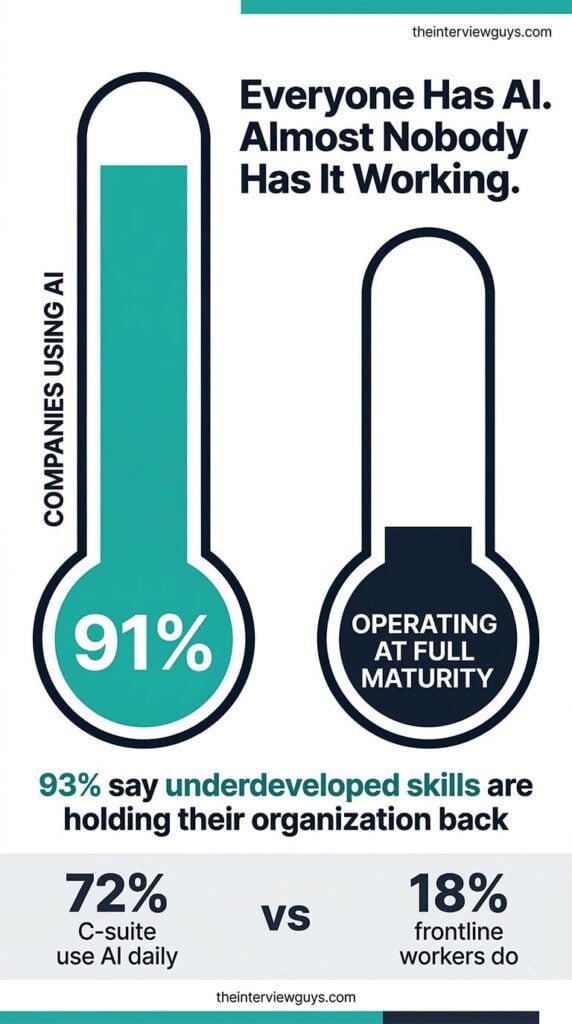
Here’s a number worth sitting with: 91% of organizations now use at least one form of AI in their operations.
Not piloting. Not planning to. Using it right now, in the same workplaces where you’re trying to get hired, keep your job, or get promoted.
That’s the Q1 2026 reality. And if you’re a job seeker, a career switcher, or someone wondering whether to put AI skills on your resume, this report is going to give you the clearest picture yet of what’s actually happening inside organizations, what they’re prioritizing, what’s working, and where the very real friction points are.
Because here’s what most AI coverage misses: the story isn’t just about the technology. It’s about what it means for the people navigating workplaces being rapidly reshaped by it.
This isn’t clean. The data reveals a workplace in genuine tension. Productivity is up in some corners, resentment is up in others. Companies are spending more on AI tools while quietly cutting the training budgets that would help employees use them. Agentic AI systems that can autonomously complete multi-step tasks are moving from lab experiments to live deployments faster than anyone expected.
We’ve synthesized data from major research institutions, fresh industry surveys, and Q1 workforce studies to give you the most honest picture of where things stand. No hype, no doom. Just what the numbers actually say and what they mean for your career.
☑️ Key Takeaways
- 91% of organizations now use at least one form of AI, yet only 1% consider their implementation “mature,” revealing a massive gulf between adoption and effective integration
- The agentic AI era has officially arrived, with AI agents projected to be embedded in 80% of enterprise applications by the end of 2026, fundamentally reshaping how work gets done
- 44% of workers believe AI does more harm than good, even as companies increase AI spending, exposing a widening trust crisis between leadership and the workforce
- AI skills command an 18-24% wage premium, yet training investment is falling, with organizations now offering formal upskilling programs at a lower rate than a year ago
Section 1: AI Is Everywhere. But “Everywhere” Doesn’t Mean “Working.”
Let’s start with the headline: 91% of organizations now report using at least one form of AI technology. That’s not a projection. That’s Q1 2026.
For context, that same number was closer to 65-70% just 18 months ago. The acceleration has been remarkable. AI adoption is no longer a competitive differentiator for large organizations. It’s table stakes, the cost of staying in the game.
A few data points show just how fast this has consolidated:
- McKinsey research shows 92% of companies plan to increase AI investments over the next three years
- Leading AI platforms now have over 800 million weekly active users globally
- Enterprise adoption of leading AI tools saw a tenfold increase in just one year
- KPMG reports 31% of employees now use AI weekly or daily, a steady rise from previous years
Among those regular users, 67% say they primarily use AI for efficiency gains, with 61% citing information access and 59% citing innovation as core motivators.
Here’s the catch, though. High adoption rates and effective implementation are two very different things.
Only 1% of leaders consider their organizations “mature” in AI deployment, meaning AI is fully integrated into workflows with substantial business outcomes. 39% of C-suite respondents say their organizations are still in the “emerging” stage, with pilot projects showing value but lacking the scale to matter.
Slalom’s 2026 AI Research Report puts a number on the disconnect: 68% of leaders and employees say they can keep pace with AI, yet 93% report that workforce barriers including underdeveloped skills and inadequate training are limiting their progress.
Read that again. 93% say they’re being held back. That’s not a technology problem. That’s an organizational failure.
The leadership-to-frontline divide is equally stark. 72% of C-suite executives use AI daily. Only 18% of individual contributors do. The people making decisions about AI rollouts are the heaviest users. The people expected to adapt to those rollouts are largely still on the sidelines.
What This Means If You’re Job Searching Right Now
This gap is actually an opportunity for you. Most organizations are hungry for people who already understand how to work effectively with AI tools. Not build them. Not code them. Just use them confidently and productively in real work contexts.
If you’re showing up to interviews having already integrated AI into your workflow, you’re ahead of the 82% of frontline workers who haven’t made the jump yet. That’s a genuine advantage you can articulate.
Interview Guys Take: The 93% barrier number is the most important data point in this section. Companies aren’t struggling to buy AI. They’re struggling to use it. That’s a people and training problem, and it’s creating a genuine talent gap for workers who’ve figured out how to bridge the human-AI divide. If you’re one of those people, say so loudly in your next interview.
Section 2: Agentic AI Is the Shift Nobody’s Fully Ready For
If 2025 was the year generative AI went mainstream, 2026 is the year AI started doing things on its own.
Welcome to the agentic AI era, and it’s moving faster than any organization planned for.
Here’s the distinction that matters. Generative AI responds to what you ask. Agentic AI pursues goals. It executes multi-step tasks, makes judgment calls, and operates with limited human oversight. Where a standard AI tool drafts your email, an AI agent researches the prospect, writes the email, sends it at the optimal time, logs it in your CRM, and schedules the follow-up. All while you’re in a different meeting.
That’s not science fiction. That’s already happening inside companies right now. And the scale of deployment is accelerating:
- IDC forecasts AI copilots embedded in nearly 80% of enterprise workplace applications by end of 2026
- AI agents are already being designed to handle up to 15% of work decisions autonomously
- The global agentic AI market is projected to grow from $9.14 billion in early 2026 to more than $139 billion by 2034
- Gartner finds that by 2026, more than 60% of enterprise workflows will be driven by AI agents
Deloitte’s agentic AI research describes this plainly: the future enterprise will include digital agents autonomously handling entire job functions alongside human workers. That’s not hyperbole anymore. The infrastructure for it is being deployed right now, at companies of every size.
What It Actually Looks Like on the Ground
At insurance company Mapfre, AI agents now handle routine claims tasks like damage assessments. For anything sensitive like customer communication, a human stays in the loop. Their chief data officer calls it “hybrid by design,” noting the agents aren’t replacing people so much as changing what people spend their time doing, which is the key insight most coverage gets wrong.
PwC’s 2026 AI Business Predictions describe what’s happening as “the rise of the generalist.” One experienced engineer can now orchestrate teams of AI agents across multiple development stages: architecture, testing, troubleshooting, documentation. What used to require a team can increasingly be managed by one person with strong AI fluency.
New roles are emerging directly from this shift. “AI workforce managers” are appearing on org charts, responsible for:
- Task orchestration: deciding what work goes to humans versus AI agents
- Agent governance: making sure AI operates within ethical and compliance limits
- Performance optimization: monitoring agent outputs and fixing what breaks
The Governance Problem Nobody Wants to Talk About
Here’s our honest read on the agentic AI situation: the technology is real, the productivity gains are real, and the governance is a mess.
IDC’s Future of Work 2026 research shows that organizations with mature AI Centers of Excellence are 20% more capable of competing on innovation and service quality. But the same research warns that agentic AI tools are advancing faster than most enterprise structures can adapt. Gartner predicts 50% of organizations will require “AI-free” skills assessments by 2026 specifically because they’re worried AI dependency is quietly eroding employees’ ability to think critically without it.
That’s a remarkable admission from the world of enterprise technology research.
What Agentic AI Means for Your Career
The honest career implication of the agentic AI shift is this: jobs aren’t disappearing as fast as the headlines suggest, but the shape of jobs is changing fast. The people who will thrive are those who learn to orchestrate AI rather than compete with it.
Check out our breakdown of the top 10 agentic AI jobs emerging right now, and our guide on how to start positioning yourself as an AI orchestrator in your current role.
Interview Guys Take: The agentic AI transition is the biggest structural shift in white-collar work since the spreadsheet, and most workers are completely unaware it’s already happening. The conversation inside companies has already moved from “can AI do this?” to “who is responsible when the AI gets this wrong?” That’s a mature, serious conversation, and the employees who understand how to participate in it are going to be extremely valuable.
Section 3: The Productivity Numbers Are Impressive. The Distribution Is Not.
Let’s talk about what AI is actually doing to productivity at work, because the headlines tend to get this one partially right and partially wrong.
The performance numbers from Q1 2026 are genuinely impressive:
- Industries using AI extensively have seen productivity growth reach 27%, compared to 7% before AI adoption (PwC Global AI Jobs Barometer)
- Programmers using AI complete about 126% more coding projects per week than those without AI support
- GitHub reports Copilot users complete coding tasks 55.8% faster during controlled experiments
- Accenture research indicates AI can increase productivity by up to 30% based on real workplace tests
- AI tools save workers an average of 1.5 to 2.5 hours per week on writing and problem-solving tasks alone
Those numbers are real. For workers who’ve figured out how to integrate AI into their day, the productivity advantage over peers who haven’t is growing fast.
But here’s the counterintuitive finding that rarely makes the headlines: 47% of workers say AI tools introduced at their company have actually increased their workload. More work, not less.
The reason? They’re spending time learning systems nobody properly trained them on, fixing errors in AI-generated outputs, and managing automated workflows that still require constant human babysitting. The tools were deployed. The support wasn’t.
IMD’s 2026 workplace trends research puts it well: workers can feel the time savings from AI, but most lack any guidance on what to do with that recovered time in ways that create real business value. The potential evaporates without intentional direction.
This is one of the starkest organizational failures in the Q1 data. Companies bought productivity tools and forgot to explain what productive work actually looks like with them.
How AI Is Being Used at Work Right Now
For career people curious about the real day-to-day picture, here’s where AI is showing up most heavily inside organizations:
Financial services has seen some of the steepest gains, with AI absorbing routine analysis, fraud detection, and regulatory compliance work. Analysts are spending more time on the advisory work that actually drives client value. Burnout is up too, though, because expectations have risen alongside capability.
Healthcare tells an encouraging story for workers in that space: AI is supporting diagnostic accuracy and slashing administrative overhead, but the sector still projects 30% growth in demand for health professionals through 2030. Augmentation, not replacement, is the dominant reality. Our healthcare hiring boom analysis has more on this.
Manufacturing has seen productivity growth nearly quadruple in AI-exposed sectors since 2022. The workforce story there is about evolution, not elimination. Workers are shifting from doing repetitive tasks to overseeing the systems doing them.
Customer service is the complicated one. Efficiency gains are real. But nearly 40% of workers in customer-facing roles say AI has reduced meaningful human interaction at work, and they’re feeling it in their job satisfaction.
PwC reports that daily AI users experience higher productivity and job security, yet only 54% of workers used AI at all over the past year. The gains are concentrating among early adopters. The gap between AI-fluent workers and everyone else is widening every quarter.
Interview Guys Take: The productivity story is really two stories. For workers who’ve embraced AI tools and have organizational support to use them well, this is genuinely one of the best professional moments in a generation. For workers who’ve had AI dumped on them with no training and rising expectations, it feels like being handed a race car with no driving lessons and being told to go faster. Both experiences are real. The difference isn’t the technology. It’s the support structure around it.
Section 4: The Trust Crisis Is the Story Nobody at the Top Wants to Hear
Here’s a finding that deserves far more attention than it’s getting in mainstream AI coverage.
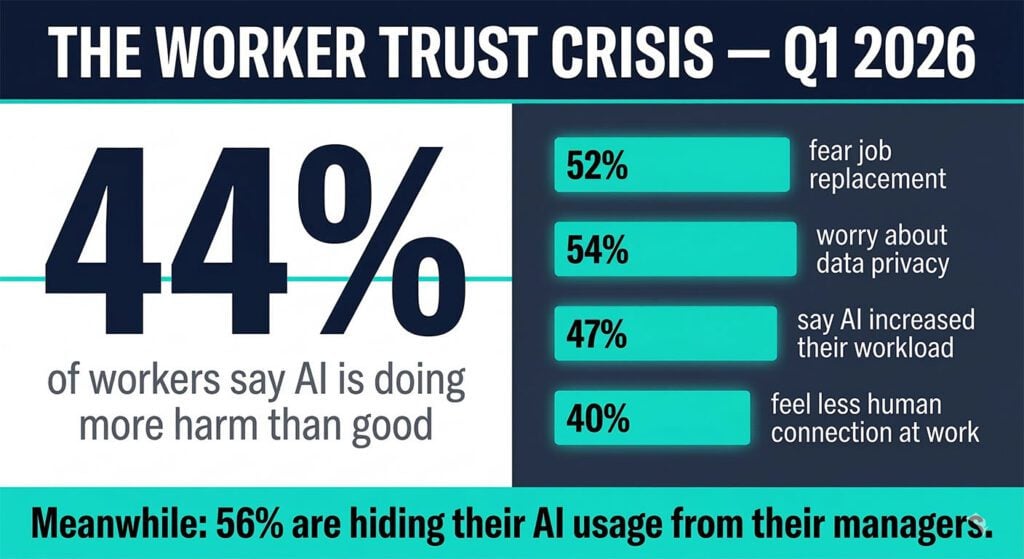
A National University survey conducted in early 2026, polling more than 2,000 full-time workers across industries, found that 44% of American workers believe AI is doing more harm than good in their workplace. Only 31% felt it was a net positive.
That’s not a niche concern. That’s close to half the workforce.
And the specific concerns they cited aren’t abstract:
- 52% worry AI will eventually replace their role entirely
- 47% say AI tools have increased their workload rather than reduced it
- 40% say AI has reduced meaningful human interaction at work
- 54% are worried about data security and privacy around the AI tools their company uses
SurveyMonkey’s Q1 2026 AI workplace report adds a revealing behavioral layer to this: 29% of employees are using AI at work without telling their manager, and 23% are using it without disclosing it to the customers or users their work affects.
Think about that for a second. Nearly a third of the workforce is using AI covertly because the workplace culture around it hasn’t been worked out. They’re not acting out of malice. They’re adapting to broken organizational communication.
The Comfort Cliff
Here’s something the generational narrative misses. Workers of all ages are actually pretty comfortable with AI in low-stakes contexts. 55% of consumers are fine with an AI agent taking their drive-thru order. The resistance kicks in when the stakes rise.
Only 34% are comfortable with HR using AI to screen resumes. Only about a third are comfortable with a doctor using AI to personalize medical advice. Workers aren’t anti-AI. They’re specifically skeptical about AI being used to make consequential decisions about their lives and careers without transparency or accountability.
That’s a reasonable position. The data doesn’t support dismissing it.
The U.S. also lags significantly behind other markets on AI confidence. Only 39% of Americans see AI products and services as more beneficial than harmful, compared to 83% in China. Part of that reflects legitimate concerns about transparency and accountability. Part of it reflects the messiness of AI rollouts in American workplaces that the trust numbers make visible.
The Hidden AI Use Problem Is Also a Liability Problem
56-57% of workers who use AI regularly admit to hiding that usage or presenting AI-generated output as entirely their own work. This isn’t a fringe behavior. It’s close to majority practice in organizations where AI policies are unclear or trust is low.
This creates compounding risks that leadership teams are only beginning to grapple with: legal exposure when AI errors surface under a human’s name, quality control failures when no one is accountable for reviewing outputs, and institutional trust collapse when the hidden usage eventually comes to light.
The problem isn’t workers using AI. It’s organizations failing to create environments where workers feel safe being transparent about how they’re working.
What This Means for Your Job Search
If you’re interviewing right now, the trust crisis in AI is a live topic in almost every hiring conversation. Companies want people who can use AI effectively and responsibly. Knowing how to talk about when you use AI, why you use it, and how you verify outputs is increasingly a genuine differentiator.
Our guide on how to answer “how do you use AI in your work” walks through exactly how to frame this in an interview context.
Interview Guys Take: The trust crisis is the underreported story of Q1 2026. Executives are reading productivity dashboards and feeling good. Their employees are reading the same AI news and wondering if they’re being automated out of their livelihoods. That gap won’t be closed by an all-hands memo. It requires real transparency about what AI will and won’t do to specific roles, real investment in training, and real accountability when AI rollouts go wrong. The companies that figure this out first are going to have a significant retention and talent advantage over those still pretending the anxiety isn’t real.
Section 5: The Skills Gap Is a Four-to-One Crisis and Getting Worse
Let’s put the AI skills situation in blunt terms.
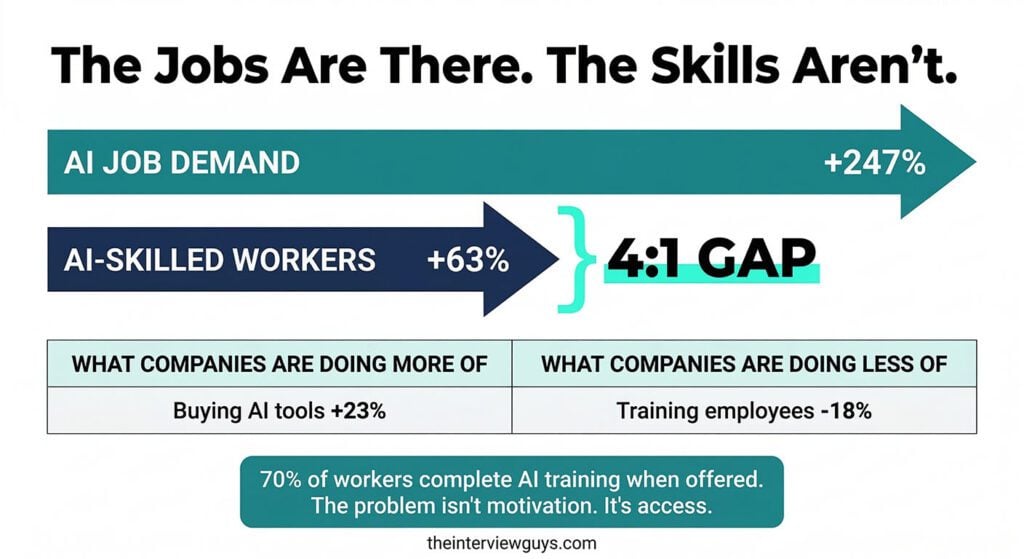
Job postings requiring AI skills have increased 247% since 2023. The supply of workers with verified AI competencies has grown 63% over the same period. That’s a roughly four-to-one gap between what employers need and what the labor market can provide.
And here’s the part that should make any organizational leader uncomfortable: companies are actively making this worse.
LinkedIn’s 2026 Workplace Learning Report shows only 26% of organizations now offer formal AI upskilling programs, down from 35% just a year ago. Meanwhile:
- Gartner found AI training budgets were cut by an average of 18% in the second half of 2025
- AI tool spending increased 23% over that same period
- Deloitte’s 2026 Human Capital Trends found 47% of CHROs say their boards are questioning whether AI training delivers measurable ROI
Companies are spending more on AI and less on the people who need to use it. That’s not a strategy. That’s a setup for a wave of expensive failed deployments.
The Real Nature of the Gap
Here’s what most AI skills coverage gets wrong: the gap isn’t primarily about engineers and data scientists. DataCamp’s 2026 survey of 500+ enterprise leaders found the skills deficit shows up most acutely in areas like:
- Knowing how to evaluate whether an AI output is actually accurate
- Understanding when to trust an AI recommendation versus when to push back
- Applying AI tools effectively to specific, real-world role contexts
These are judgment skills. Applied literacy. The kind of thing you develop through practice, not by watching a 40-minute onboarding video. And yet video-based courses are still the most common AI training format at 40%, with 23% of enterprise leaders saying they’re essentially useless for building real-world capability.
The access divide inside organizations is also stark and important. 72% of C-suite executives use AI daily. Just 18% of individual contributors do. That gap isn’t about aptitude. It’s about who has the time, the organizational permission, and the support structure to experiment. Executives have all three. Frontline workers often have none.
The IMF’s early 2026 research adds a harder edge: AI skill demands are concentrating wages upward, benefiting high-skilled workers while potentially deepening middle-class erosion. The people who most need upskilling are the least likely to receive it.
But here’s the genuine bright spot: World Economic Forum research through Udemy found that 70% of U.S. workers completed AI training when their employers actually made it available. The demand is there. Workers want to learn. The supply of good organizational training just isn’t meeting it.
And a crucial corrective to the replacement narrative: ManpowerGroup’s 2026 Talent Shortage Survey found only 10% of employers are using AI to replace headcount. The full-scale displacement story, while true in pockets, is being dramatically overstated in the media.
What This Means for Your Resume and Career
The skills gap is your opportunity if you’re willing to do what most workers aren’t: learn proactively, before your employer tells you to.
Check out our guides on AI skills to add to your resume in 2026 and what employers will actually evaluate in 2026 to understand exactly where to focus your energy.
Interview Guys Take: The skills gap is a policy failure dressed up as a talent shortage. Workers want to learn. The data is extremely consistent on this. What’s failing is the organizational will to invest in structured, accessible, role-specific training at the speed AI deployment demands. The companies cutting training while buying more AI tools aren’t saving money. They’re deferring costs into future productivity failures, morale problems, and talent exits. You’ll see it in their turnover numbers inside the next two to three quarters.
Section 6: What the Labor Market Data Actually Shows
The labor market picture on AI is genuinely more nuanced than either the doomsday crowd or the pure optimists want to acknowledge. Let’s look at it straight.
The World Economic Forum’s current projections estimate that by 2030, AI-related disruption will affect 22% of all jobs, with 170 million new roles created and 92 million displaced. Net result: 78 million more positions than we started with. The fastest-growing categories are in technology, data, and AI, but healthcare, education, and the green economy are also major job creation engines.
IMD’s 2026 workplace research describes this year as the first real chance to measure AI’s actual labor market impact rather than just modeling it. What’s emerging isn’t uniform displacement. It’s more targeted:
- White-collar roles at junior to mid-levels face the greatest immediate pressure
- Skilled trades including electricians, plumbers, and construction workers remain largely insulated
- Middle management is under structural attack, with Gartner predicting 20% of organizations will flatten their hierarchy using AI, eliminating more than half of current middle management positions
Deloitte adds an important workplace reality to this: 71% of workers are already performing work outside their formal job description. Job descriptions are becoming outdated within months of posting. Organizations are being forced to define work around skills and outcomes rather than titles and tasks.
The Entry-Level Squeeze
This is the part of the labor market story we want to make sure career folks don’t miss, because it’s deeply underreported.
The jobs being automated first are disproportionately the entry-level roles that have historically served as career on-ramps: data entry, basic research, first-tier customer support, routine drafting tasks. Our research on the highest paying entry-level jobs in 2026 shows a clear bifurcation between entry-level roles that require human judgment and those that don’t. The latter are shrinking.
For anyone early in their career, this is a real and immediate concern. Robert Half’s 2026 salary guide found that workers with demonstrated AI proficiency already earn 18-24% more than peers in equivalent roles without it. The premium isn’t arriving in the future. It’s here now.
And World Economic Forum data projects that 44% of workers’ core skills will need to change by 2030, with AI literacy at the top of that list alongside analytical thinking and creative problem-solving. That’s not a soft suggestion. That’s a structural shift in what competent professional work looks like.
Regulation Is Finally Arriving
The EU AI Act now classifies workplace AI uses like recruitment screening and performance evaluation as “high risk,” legally requiring transparency, human oversight, and worker notification. This will create compliance headaches for multinationals, but it also signals something important: the era of unchecked AI deployment in hiring and management is ending, at least in some jurisdictions.
For workers in the U.S., similar protections are patchwork and largely absent. That’s worth knowing. It’s also worth advocating for.
Our analysis on how employers are evaluating AI skills in 2026 confirms what we’re seeing across the hiring market: AI literacy has crossed the line from differentiator to baseline expectation in a growing number of roles and industries.
Interview Guys Take: The 78 million net positive jobs figure is real, but the transition math doesn’t work out cleanly for individual workers whose specific role gets automated. New AI jobs don’t automatically go to displaced workers. They require different skills, different credentials, and they often exist in different cities and industries than the roles being eliminated. The aggregate number is encouraging. The individual experience can still be brutal. Both are true at the same time, and any honest analysis has to hold that tension.
Section 7: What Q2 2026 Is Likely to Bring
Based on what the Q1 data shows, here’s where we see things heading over the next quarter.
The agentic AI pilot period is ending. Organizations that spent late 2025 running controlled experiments are now scaling. That means the operational failures, unexpected outputs, and governance gaps that come with real-world deployment at scale will start surfacing publicly. How companies respond to those failures will define who becomes a leader in AI and who becomes a cautionary tale.
The training gap will hit productivity numbers. The lag between cutting training budgets and seeing the downstream effects in employee performance is typically two to four quarters. Organizations that pulled back on upskilling in late 2025 should expect measurable capability declines and rising error rates in AI-assisted work by mid-2026. Watch for this in earnings calls and productivity reports.
Middle management is the most exposed layer. The Gallup State of the Global Workplace report notes that managers influence 70% of employee engagement, yet manager engagement is already falling. These are the people being asked to implement AI rollouts, calm their teams’ job anxieties, and hit higher performance targets simultaneously. The burnout risk in this cohort is severe, and losing experienced middle managers to exhaustion has second-order consequences that take years to recover from.
AI screening in hiring is becoming standard. 72% of hiring managers now say they consider a candidate’s comfort with AI tools when making decisions, up from 48% in 2024. That number will keep climbing. AI fluency is no longer an optional resume line. It’s increasingly a filter.
Worker backlash is building. The combination of trust deficits, hidden AI usage, and inadequate training documented throughout Q1 is creating conditions for organized pushback. As we’ve written in our analysis of why 4 in 10 recruiters worry AI is making hiring too robotic, the human resistance to unchecked AI deployment isn’t irrational, and treating it as such is a strategic mistake. Workers have legitimate concerns. The organizations that engage with those concerns honestly will manage this transition better than those that don’t.
Also worth watching in Q2: what happens to the job market recovery we analyzed going into spring. AI deployment decisions being made right now will show up in hiring patterns by late Q2.
Conclusion: The Organizations Winning Are Solving the Human Problem, Not the Technology Problem
The Q1 2026 data adds up to a clear argument: AI in the workplace has moved from a strategic discussion to an operational reality, and the gap between companies getting it right and companies struggling isn’t about who has better tools.
It’s about who invested in their people.
The organizations generating genuine, sustainable value from AI aren’t deploying the most sophisticated technology. They’re treating AI adoption as a human change management challenge first and a technology challenge second. They’re training when peers are cutting. They’re building governance frameworks before they’re legally required to. They’re having real conversations with their workforces about what’s changing and why.
The 44% of workers who say AI is doing more harm than good aren’t wrong. For them, in their specific roles with their specific levels of support, the harm may genuinely outweigh the benefit right now. That perspective deserves serious attention rather than dismissal from leadership.
For job seekers and career professionals reading this, the takeaway is both honest and genuinely encouraging. The skills gap is real and it’s your opening. The organizations struggling most with AI are struggling with the human side of it, which means people who can bridge that gap, who can use AI confidently, communicate about it clearly, and help their teams adapt, are in the strongest position they’ve been in years.
The AI era isn’t arriving. It’s here, and it’s messy, and it’s full of real opportunity for people willing to engage with it honestly.
For more context on navigating all of this, our State of Job Search Mental Health in 2026 covers the psychological reality of job searching in this environment, and our Jobs on the Rise for 2026 report identifies exactly which roles are benefiting most from everything this report describes.
The question isn’t whether AI reshapes work. It already has. The question is whether you’re positioned to thrive inside that reshaping. Based on what we’re seeing in Q1 2026, the window to make that call is still open. But it won’t be for long.
Resources & References
This report represents an analysis of publicly available research and data current as of Q1 2026. All statistics and claims have been verified through primary or credible secondary source documentation where possible.
Primary Research Sources
Gallup: Frequent Use of AI in the Workplace Q4 2025
Gloat: AI Workforce Trends 2026
Deloitte: Agentic AI Strategy and the Future Enterprise
PwC: No More Pyramids, Rethinking Your Workforce for the Agentic AI Era
IDC: The Future of Work, AI Agents as Instruments Not Co-Workers
SurveyMonkey: AI In The Workplace Statistics Report 2026
Metaintro: Workers Say AI Does More Harm Than Good
DataCamp: The AI Skills Gap in 2026
World Economic Forum: The AI Perception Gap
IMD: Workplace Trends for 2026, The New Labor Market Reality
IMF: Bridging Skill Gaps for the Future, New Jobs Creation in the AI Age
PRSA: 6 Workplace Trends Shaping 2026
ManpowerGroup via Workplace Journal: AI Skills Shortage Tops Employer Concerns
Slalom via HBR: Close Your Workforce’s AI Skills Gap
Second Talent: AI in the Workplace Statistics and Trends for 2026
Related Interview Guys Reports and Articles
The State of AI in the Workplace in 2025
State of Job Search Mental Health in 2026
How Employers Will Evaluate AI Skills in 2026
Jobs on the Rise for 2026
Why 4 in 10 Recruiters Worry AI Is Making Hiring Too Robotic
Top 10 Agentic AI Jobs
Highest Paying AI Jobs in 2026
AI Skills for Your Resume in 2026
Start Being an AI Orchestrator
What VCs Know About AI’s 2026 Job Impact
After twelve years of writing advice like this, we built the tool that does it with you. It's called Longbow, and here's the whole story.

ABOUT THE INTERVIEW GUYS (JEFF GILLIS & MIKE SIMPSON)
Mike Simpson: Co-founder of The Interview Guys and Longbow. He has been the voice behind our interview advice since 2013 — his work has reached over 100 million job seekers around the world. The strategic mind behind Longbow, our new career platform.
Jeff Gillis: Co-founder of The Interview Guys and Longbow. He built the systems that put our work in front of those readers, and he leads the engineering on Longbow, the cutting edge career platform built for today’s job seeker.