
Resume for Someone Returning to the Workforce: The Tactical Guide That Actually Works

Why Standard Resume Advice Fails People Returning to Work
Most resume guides assume you’ve been continuously employed. They tell you to lead with your most recent job, list your last five positions in reverse order, and make sure there are no gaps.
That advice actively works against you if you’ve been out of the workforce for a year, two years, or longer.
The standard resume template was built for people who never stopped working. It treats a career gap as a red flag by design, because the format puts dates front and center and expects an unbroken chain of employers.
If you follow that template as a returner, you’re handing a recruiter a document that immediately surfaces the one thing you’re worried about. The gap sits there, in plain view, in the most-read section of the page.
There’s a better approach. It starts with understanding what hiring managers actually fear about career gaps, and then systematically addressing each of those fears before they become objections.
What recruiters worry about when they see a gap:
- Your skills may be outdated
- You may have lost professional momentum
- You might not be “serious” about returning
- You won’t be able to handle the pace of a modern workplace
Your resume’s job is to answer every one of those concerns before the interview ever happens. That means choosing the right format, front-loading your most current and relevant skills, making the gap legible rather than mysterious, and showing proof that you stayed sharp.
☑️ Key Takeaways
- A functional or hybrid resume format almost always outperforms a chronological one for returners, because it leads with what you can do now
- Your career gap belongs on the resume – hiding it makes things worse, framing it strategically makes it an asset
- A recent certification can single-handedly neutralize the “outdated skills” objection before a recruiter even finishes reading your summary
- Caregiving, freelance, and volunteer work all count as real experience when written with measurable results and action verbs
Disclosure: This article contains affiliate links. If you purchase through these links, we may earn a commission at no additional cost to you.
Find out where you stand. Your situation isn’t the problem. How your resume handles it might be. Upload yours below for a free score in 60 seconds.
How to Choose the Right Resume Format as a Returner
This is the single most important structural decision you’ll make.
For most job seekers, a reverse-chronological format works fine. For returners, it often doesn’t. Here’s why: reverse-chronological puts your employment history first, which means your gap is the first substantive thing a recruiter reads.
You have three realistic options.
Option 1: The Hybrid (Combination) Resume
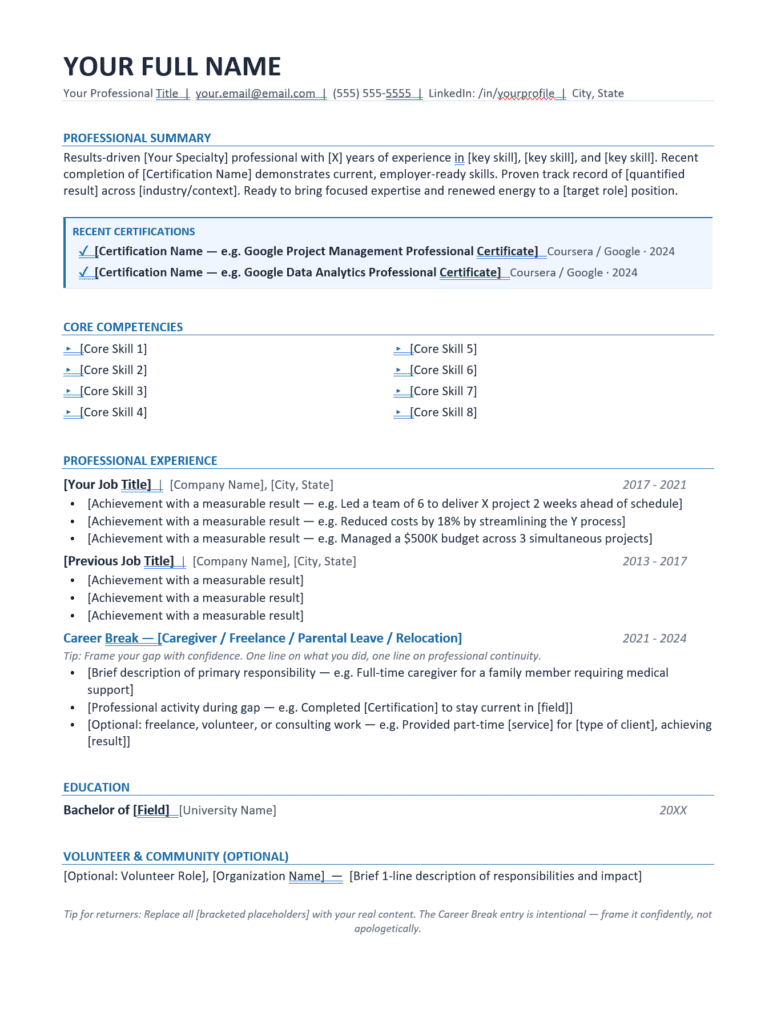
This is the recommended format for most returners. It opens with a skills-based summary and a core competencies section, then moves into work experience.
The structure looks like this:
- Contact information
- Professional summary (skills-focused)
- Core competencies / key skills
- Work experience (still in reverse-chronological order)
- Education
- Certifications
This format lets you lead with what you bring to the table today, not when you last worked. The experience section is still there, but by the time a recruiter reaches it, they’ve already seen your value.
Option 2: The Functional Resume
A functional resume groups experience by skill category rather than by employer. It minimizes dates and emphasizes transferable abilities.
Use this if your gap is very long (five or more years), your previous roles are largely irrelevant to your target job, or you’re pivoting industries entirely.
The risk: some ATS systems and recruiters distrust purely functional resumes. Use it strategically, not as a default.
Option 3: Reverse-Chronological with a Strong Summary
If your gap is under 12 months, a traditional format with an extremely well-crafted summary can work. The summary needs to do a lot of heavy lifting, and you’ll want to address the gap directly in a brief line item.
For most people reading this, the hybrid format is your best starting point. Our guide on the best resume template for 2025 walks through what each format looks like in practice and includes downloadable options.
Here’s what most people don’t realize: employers now expect multiple technical competencies, not just one specialization. The days of being “just a marketer” or “just an analyst” are over. You need AI skills, project management, data literacy, and more. Building that skill stack one $49 course at a time is expensive and slow. That’s why unlimited access makes sense:
Your Resume Needs Multiple Certificates. Here’s How to Get Them All…
We recommend Coursera Plus because it gives you unlimited access to 7,000+ courses and certificates from Google, IBM, Meta, and top universities. Build AI, data, marketing, and management skills for one annual fee. Free trial to start, and you can complete multiple certificates while others finish one.
How to Frame the Gap Directly on Your Resume
The biggest mistake returners make is leaving a blank space where the gap years should be.
A mysterious gap is far more alarming than an explained one. Recruiters fill unexplained gaps with their worst assumptions. Your job is to fill that space with a brief, confident explanation.
Here’s how to do it without over-explaining.
Add a Gap Entry to Your Work Experience Section
Treat the career break like any other entry, but keep it tight. A single line or two is enough.
Examples:
Career Break - Caregiver (2021–2024)
Full-time caregiver for a family member requiring medical support. Maintained professional skills through online coursework and industry reading.
Career Break - Parental Leave & Professional Development (2022–2024)
Primary caregiver for two children. Completed Google Project Management Professional Certificate during this period.
Freelance Marketing Consultant (2020–2023)
Provided content strategy and SEO consulting for three small business clients on a part-time basis.
Notice what these entries do. They explain the gap, signal intentionality, and immediately pivot to what you did with the time. None of them apologize. None of them over-explain.
Interview Guys Tip: “You never need to justify a gap on your resume. You only need to make it legible. One line that explains what you were doing and one line that shows professional continuity is all it takes. Recruiters aren’t looking for a perfect record – they’re looking for self-awareness and intentionality.”
Using Years-Only Dating to Reduce Gap Visibility
One tactical trick: list dates as years only (2019–2022) rather than month and year (March 2019 – November 2022). This reduces the visual prominence of short gaps between roles and is completely standard practice.
This doesn’t eliminate a multi-year gap, but it keeps the focus on substance rather than calendar math.
For a deeper dive into how to handle employment gaps strategically, our career gap strategies article walks through exactly how to frame different types of breaks.
How to Write a Skills-Based Summary That Does the Heavy Lifting
Your professional summary is the first thing a recruiter reads. For returners, it needs to accomplish four things at once:
- Establish your professional identity
- Signal that your skills are current
- Demonstrate value without relying on recency
- Set the tone for the rest of the document
Here’s a weak summary that many returners write:
“Experienced marketing professional seeking to re-enter the workforce after a career break. Eager to apply my skills in a new role.”
This is a mistake. It leads with the gap, frames you as a supplicant, and offers nothing specific.
Here’s a stronger version:
“Results-driven marketing professional with 8 years of experience in content strategy, SEO, and brand development. Recent completion of Google Digital Marketing & E-Commerce Certificate. Track record of growing organic traffic by 40%+ across B2B and B2C brands. Seeking to bring current digital marketing skills to a growing team.”
The key differences:
- Leads with years of relevant experience, not the gap
- Immediately signals currency with the certification
- Includes a quantified result
- States a specific goal rather than sounding desperate
Your summary should be three to five sentences maximum. Every sentence should earn its place.
Interview Guys Tip: “Think of your summary as your 30-second elevator pitch in written form. The reader should know your specialty, your biggest proof point, and that you’re ready to work – all before the first paragraph ends. Certifications are particularly powerful here because they’re dated: they show the reader, at a glance, that you’ve been learning recently.”
How to List Caregiving and Freelance Work as Real Experience
One of the biggest confidence obstacles returners face is believing that what they did during the gap “doesn’t count.”
It does count. You just need to write it correctly.
Caregiving Experience
If you spent two years caring for a child, an aging parent, or a family member with a medical condition, you managed real responsibilities under real pressure. The goal is to translate those responsibilities into professional language.
This is not about embellishing or making caregiving sound like something it isn’t. It’s about accurately representing transferable skills using the vocabulary hiring managers recognize.
Before: “Stayed home to care for my mother during her illness.”
After:
Family Caregiver (2021–2023)
- Coordinated medical appointments, insurance claims, and care schedules across multiple providers
- Managed household budget and financial planning during a period of income transition
- Communicated effectively with a team of 4 healthcare professionals to ensure consistent care delivery
Every one of those bullets reflects a real task. Coordination, budget management, and cross-functional communication are legitimate professional competencies.
If you’ve been thinking about how to position this for a job search, our guide for returning to work after being a stay-at-home mom goes into much greater depth on framing domestic and caregiving experience for different industries.
Freelance and Consulting Work
If you did any freelance, consulting, or contract work during your gap, even informally, list it.
Format it like any other employer:
Independent Marketing Consultant (2020–2023)
- Managed SEO strategy for 3 small business clients, resulting in an average 28% increase in organic traffic
- Developed content calendars and managed social media accounts across Instagram and LinkedIn
- Delivered monthly performance reports with actionable recommendations
Name your clients if they’re notable or if you have permission. If not, “small business clients” or “multiple clients across the [industry] sector” works fine.
Volunteer Work
Volunteer roles belong in your experience section if they’re substantive. If you served on a nonprofit board, chaired a committee, organized events, or managed volunteers, those are leadership roles.
Write them with the same verb-first, results-oriented format you’d use for any paid position.
How Certifications Anchor the Top of Your Resume
Here’s the tactical truth about certifications for returners: a recent cert does more work per inch of resume real estate than almost anything else you can add.
When a hiring manager sees a Google Project Management Certificate earned in 2024, it tells them three things instantly:
- You’re serious about returning to work
- Your skills are current
- You’ve been doing something productive with your time
That’s a lot of information delivered in a single line item.
Where to Place Certifications
If you have a recent, relevant certification, put it in your summary section or directly below it, not buried at the bottom of the page.
Example placement in the summary area:
CERTIFICATIONS
Google Project Management Professional Certificate (Coursera, 2024)
Google Data Analytics Professional Certificate (Coursera, 2024)
Or weave it into the summary line: “…with recent completion of the Google Project Management Professional Certificate (2024)…”
Either way, it needs to be visible early.
Which Certifications Actually Move the Needle
Not all certifications carry equal weight with hiring managers. Here’s where we’d focus based on industry:
For operations, coordination, or project-based roles: The Google Project Management Professional Certificate is one of the most recognized credentials in this space. It covers Agile, Scrum, and traditional PM methodologies, and it’s completable in about six months at your own pace.
For data or analytics roles: The Google Data Analytics Professional Certificate is employer-recognized and covers spreadsheets, SQL, Tableau, and R. Strong signal for anyone returning to a business analyst, operations analyst, or data-adjacent role.
For digital marketing: The Unilever Digital Marketing Analyst Professional Certificate covers SEO, Google Analytics, marketing automation, and data storytelling, which maps well to the tools most modern marketing teams actually use.
For IT support or tech adjacent roles: The Google IT Support Professional Certificate is a well-known entry point for career changers and returners moving toward IT operations, helpdesk, or technical coordination roles.
Interview Guys Tip: “Pick one certification that directly maps to your target job title, and complete it before you start applying. A cert in progress looks decent on a resume. A cert completed looks decisive. That distinction matters more than people realize, especially when hiring managers are looking for reasons to feel confident about a returner.”
For more on which certifications actually get people hired, our best certifications for career changers breakdown is worth reading alongside this one. We also have a full review of the Google Project Management Professional Certificate if you want the full picture before committing to it.
Ready to earn a credential that signals you’re current? Browse certifications on Coursera and find the one that fits your target role. Most can be completed in 3 to 6 months, and many are recognized by major employers.
The Skills Section: What to Include and What to Skip
Your skills section is not a dumping ground for every software program you’ve ever touched.
For returners, a targeted skills section serves two purposes: it shows relevance, and it passes ATS keyword matching.
Include:
- Technical skills that are explicitly listed in your target job descriptions
- Tools and platforms you’ve used recently (including during the gap)
- Soft skills only if they’re specific and framed with context (not just “communication” as a standalone bullet)
Avoid:
- Software so outdated it signals your gap rather than bridging it (listing Windows XP proficiency in 2026 is actively harmful)
- Skills that are so general they say nothing (“Microsoft Office,” “team player,” “detail-oriented”)
- Skills you learned a decade ago and haven’t used since
A clean, targeted skills section of 8 to 12 items is more effective than a sprawling list of 25.
Returnship Programs: The Alternative to Going It Alone
Before we wrap up, it’s worth mentioning that your resume for someone returning to the workforce isn’t just for traditional job applications.
Returnship programs are structured re-entry programs at major companies, specifically designed for people with career gaps. They typically run 3 to 6 months, pay market-competitive wages, and frequently convert to full-time offers.
Your resume for a returnship is actually easier to write than for a standard job application, because the hiring team already understands you’ve been out of the workforce. The gap is expected. The question they’re asking is: “What did you do with the time, and are you ready to contribute?”
Our Top 15 Returnship Programs for 2026 guide covers programs at Amazon, Goldman Sachs, Apple, and 12 other major employers, along with how to apply and what the selection process looks like.
We also have a dedicated breakdown of returnship salaries if you want to know what these programs actually pay before investing the time to apply.
Resume Template
Putting It All Together: Your Action Plan
If you’ve read this far, here’s your concrete next step checklist:
This week:
- Choose your format (hybrid is the default recommendation)
- Write a one-to-two line gap entry for your work experience section
- Draft a skills-based summary that leads with experience and ends with recent activity
This month:
- Identify the one certification most relevant to your target role
- Enroll and start working through it (or complete it before applying)
- Rewrite your skills section to match current job descriptions in your field
Before applying:
- Run your resume through a free ATS check to confirm keyword alignment
- Verify all dates are consistent across your resume and LinkedIn profile
- Have at least one person who works in your target field review the document
A career break doesn’t mean your career is broken. The resume for someone returning to the workforce isn’t about hiding what you did – it’s about framing it so hiring managers can see what you bring to the table today.
The gap is part of your story. Tell it on your own terms.
Helpful Resources
- AARP’s Return to Work resources – practical tools specifically for workers re-entering after a break
- iRelaunch – the leading resource for returnships and career re-entry programs across industries
- LinkedIn’s Career Break feature documentation – how to add and frame a career break on your LinkedIn profile
- CareerOneStop Skills Matcher – free tool from the U.S. Department of Labor to identify transferable skills
- Society for Human Resource Management: Hiring Returners Guide – useful for understanding what HR professionals actually look for in returner applications
Here’s what most people don’t realize: employers now expect multiple technical competencies, not just one specialization. The days of being “just a marketer” or “just an analyst” are over. You need AI skills, project management, data literacy, and more. Building that skill stack one $49 course at a time is expensive and slow. That’s why unlimited access makes sense:
Your Resume Needs Multiple Certificates. Here’s How to Get Them All…
We recommend Coursera Plus because it gives you unlimited access to 7,000+ courses and certificates from Google, IBM, Meta, and top universities. Build AI, data, marketing, and management skills for one annual fee. Free trial to start, and you can complete multiple certificates while others finish one.
Find out where you stand. Your situation isn’t the problem. How your resume handles it might be. Upload yours below for a free score in 60 seconds.
Advice like this is the general version. Longbow scores your actual resume against the actual job you want and shows you what's missing, before the filters decide for you. Here's why we built it.

ABOUT THE INTERVIEW GUYS (JEFF GILLIS & MIKE SIMPSON)
Mike Simpson: Co-founder of The Interview Guys and Longbow. He has been the voice behind our interview advice since 2013 — his work has reached over 100 million job seekers around the world. The strategic mind behind Longbow, our new career platform.
Jeff Gillis: Co-founder of The Interview Guys and Longbow. He built the systems that put our work in front of those readers, and he leads the engineering on Longbow, the cutting edge career platform built for today’s job seeker.