
Coursera Machine Learning Specialization Review (2026): Is Andrew Ng’s Course Worth It for Your Career?

What a Hiring Manager Actually Thinks When They See This on Your Resume
We talk to hiring managers every day who tell us the same thing: they’re drowning in AI and machine learning applicants who can recite buzzwords but can’t explain what a loss function does. The resume says “machine learning” but the interview reveals “watched a few YouTube tutorials.”
So when a hiring manager sees “Machine Learning Specialization, Stanford University and DeepLearning.AI” on your resume, here’s what actually happens.
First, the brand signal hits. Stanford. Andrew Ng. DeepLearning.AI. These aren’t random names. Andrew Ng co-founded Coursera, led Google Brain, and served as Chief Scientist at Baidu. He’s authored over 200 research papers. When his name is attached to a credential, hiring managers take notice because they know the content isn’t watered down.
That said, this isn’t a Stanford degree. It’s not even a Stanford certificate in the traditional sense. It’s a professional specialization hosted on Coursera that carries the Stanford and DeepLearning.AI name. That distinction matters.
A hiring manager’s second thought is always the same: “Can they actually do the work?” This is where the specialization shines in ways most online courses don’t. You’re not just watching lectures. You’re building models in Python using NumPy, scikit-learn, and TensorFlow. You’re implementing gradient descent from scratch. You’re debugging overfitting problems.
But let’s be clear about what this signals versus what it doesn’t. It signals you understand the mathematical foundations and can implement core ML algorithms. It doesn’t signal you’ve deployed a production model or managed a data pipeline at scale.
It’s not a degree. Don’t treat it like one. Treat it like proof that you’ve built a serious foundation, then let your portfolio and interview performance do the rest.
Interview Guys Tip: When listing this on your resume, write it as “Machine Learning Specialization, Stanford University & DeepLearning.AI (Coursera)” rather than just “Coursera Machine Learning.” The Stanford and DeepLearning.AI names carry significantly more weight with hiring managers who scan certifications in under six seconds.
☑️ Key Takeaways
- Andrew Ng’s Machine Learning Specialization is one of the most respected online credentials in AI, with a 4.9/5 rating and 4.8 million+ learners since its original launch in 2012.
- The 3-course program teaches Python-based machine learning fundamentals that directly map to the technical questions asked in ML engineer and data scientist interviews.
- Machine learning engineers earn a median salary between $124,000 and $159,000, and the BLS projects data scientist roles to grow 34% by 2034.
- This certification works best as a career launchpad, not a finish line, and stacking it with the Deep Learning Specialization and hands-on portfolio projects delivers the strongest hiring signal.
Disclosure: This article contains affiliate links. If you purchase through these links, we may earn a commission at no additional cost to you.
The 5 Interview Questions This Certification Prepares You to Crush
One of the biggest advantages of this specialization is how directly it maps to real interview questions. Here are five questions you’ll be ready to handle confidently after completing all three courses.
1. “Explain the bias-variance tradeoff and how you’d diagnose it in a model.”
Course 1 spends significant time on this concept. You’ll understand underfitting vs. overfitting at an intuitive level, not just a textbook level. You’ll know how to use learning curves, regularization techniques, and cross-validation to diagnose and fix the problem.
2. “Walk me through how you’d build a recommendation system for our product.”
Course 3 covers collaborative filtering and content-based recommendation systems in detail. You’ll have hands-on experience building Netflix-style recommendation engines, which is exactly the kind of practical knowledge interviewers want to hear about.
3. “How would you decide between using a decision tree vs. a neural network for this problem?”
Course 2 covers decision trees, ensemble methods, and neural networks side by side. You’ll understand when each approach works best and, more importantly, why. This kind of algorithm selection reasoning is exactly what separates junior candidates from those who get offers.
4. “Tell me about a time you had to troubleshoot a model that wasn’t performing well.”
This is a behavioral question, and the SOAR method (Situation, Obstacle, Action, Result) works perfectly here. Your coursework gives you multiple scenarios to draw from: debugging a model with high variance, fixing a neural network that wouldn’t converge, or improving a classifier’s precision.
5. “Explain gradient descent to someone non-technical.”
Andrew Ng is famous for making gradient descent intuitive. After his course, you won’t just understand the math. You’ll be able to explain it using the “rolling downhill” analogy that even non-technical stakeholders can grasp. That communication skill is pure gold in interviews.
Here’s what most people don’t realize: employers now expect multiple technical competencies, not just one specialization. The days of being “just a marketer” or “just an analyst” are over. You need AI skills, project management, data literacy, and more. Building that skill stack one $49 course at a time is expensive and slow. That’s why unlimited access makes sense:
Your Resume Needs Multiple Certificates. Here’s How to Get Them All…
We recommend Coursera Plus because it gives you unlimited access to 7,000+ courses and certificates from Google, IBM, Meta, and top universities. Build AI, data, marketing, and management skills for one annual fee. Free trial to start, and you can complete multiple certificates while others finish one.
Curriculum Deep Dive: What You’ll Actually Learn (and Use)
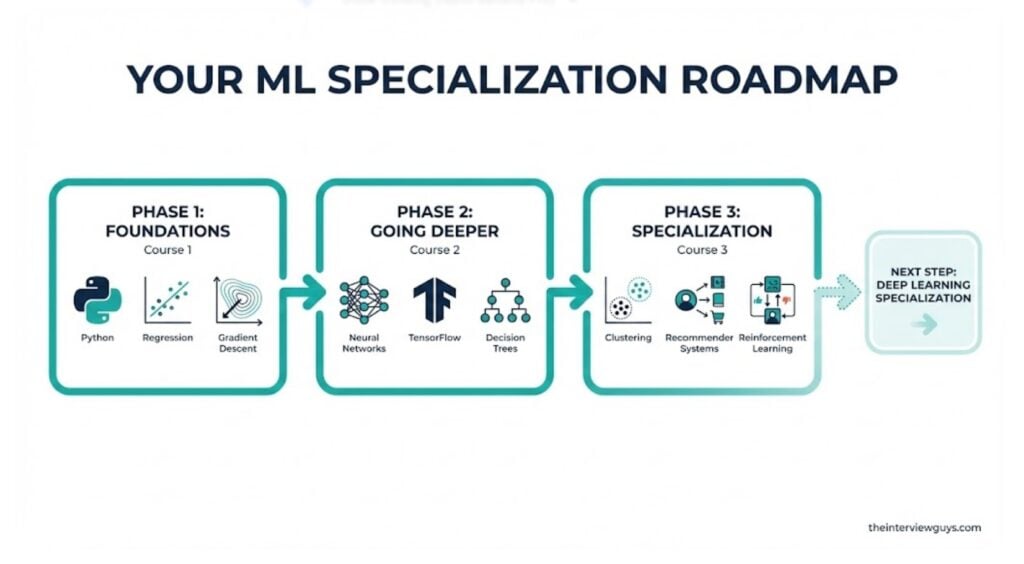
This specialization consists of three courses, not the dozens of modules you might expect. Each one builds on the last, and together they create a solid foundation that maps directly to the skills employers are looking for in AI roles.
Phase 1: The Foundation (Course 1: Supervised Machine Learning)
This is where everything begins. You’ll learn supervised learning, which is the type of machine learning that powers the vast majority of business applications today. Think prediction, classification, and pattern recognition.
What you’ll actually master:
- Linear regression and logistic regression (built from scratch in Python)
- Cost functions and gradient descent (the engine behind most ML algorithms)
- Overfitting, regularization, and model evaluation
- NumPy and scikit-learn for real implementation
Andrew Ng doesn’t skip the math, but he also doesn’t drown you in it. He walks through each concept with clear visualizations and then immediately has you code it. That combination of theory and practice is what makes this course stand out from the dozens of “learn ML in 30 minutes” tutorials flooding the internet.
Interview Tip: When interviewers ask “How does linear regression work?” they’re not testing whether you memorized a formula. They want to hear you explain the intuition behind minimizing a cost function. This course gives you exactly that intuition.
Phase 2: Going Deeper (Course 2: Advanced Learning Algorithms)
Here’s where it gets career-relevant. Course 2 introduces neural networks and TensorFlow, which are the building blocks of modern AI applications. You’ll also cover decision trees and ensemble methods like random forests and XGBoost.
What you’ll actually master:
- Neural network architecture and forward/backward propagation
- TensorFlow for building and training models
- Decision trees, random forests, and boosted trees
- Practical advice on ML project strategy (bias vs. variance, iterative development)
- Best practices for model evaluation and improvement
The TensorFlow section is particularly valuable because it’s the most widely used deep learning framework in production environments. Learning it here, with Andrew Ng’s guidance, gives you a genuine competitive edge.
Interview Tip: After completing this course, you can confidently answer “What’s the difference between a neural network and a decision tree, and when would you use each?” That’s a question that trips up a surprising number of ML interview candidates.
Interview Guys Tip: The “ML development cycle” content in Course 2 is interview gold that most candidates overlook. Hiring managers love hearing candidates talk about iterative model improvement, error analysis, and knowing when a model is “good enough.” These essential AI skills separate engineers from tutorial-followers.
Phase 3: Specialization (Course 3: Unsupervised Learning, Recommenders, and Reinforcement Learning)
Course 3 rounds out your toolkit with unsupervised learning techniques and introduces two hot areas: recommender systems and reinforcement learning.
What you’ll actually master:
- K-means clustering and anomaly detection
- Principal Component Analysis (PCA) for dimensionality reduction
- Collaborative filtering and content-based recommendation systems
- Reinforcement learning fundamentals
The recommender systems module is the closest thing this specialization has to a capstone project. You’ll build a working recommendation engine, which is the kind of portfolio piece that catches a hiring manager’s eye during an interview.
Interview Tip: Anomaly detection is one of the most in-demand skills in industries like finance, cybersecurity, and healthcare. If you’re targeting those sectors, make sure you can discuss the anomaly detection techniques from this course fluently and connect them to business impact.
Who Should Skip This Certification
Not every certification is right for every person, and being upfront about that builds more trust than pretending otherwise.
- Skip this if you have zero programming experience. The prerequisite is “basic Python” (loops, functions, if/else statements), but “basic” is doing some heavy lifting here. If you’ve never written a line of code, spend a month learning Python first. Otherwise you’ll be struggling with syntax when you should be focused on algorithms.
- Skip this if you’re already an experienced ML engineer. If you’ve been building and deploying models professionally for a few years, this specialization will feel like review. The Deep Learning Specialization would be a better investment of your time.
- Skip this if you expect a certification alone to get you hired. We’ve said it before and we’ll say it again: no certificate, no matter how prestigious, replaces a portfolio of real projects and strong interview skills. If you’re changing careers, this is step one of a larger plan. Not the entire plan.
- Skip this if you need production-level MLOps skills. This specialization teaches you how to build and train models. It doesn’t teach you how to deploy them, monitor them in production, or manage ML pipelines at scale. Those are different skills for a different course.
The Career Math: What This Investment Actually Returns
Let’s talk numbers, because your time and money deserve an honest accounting.
Cost Breakdown:
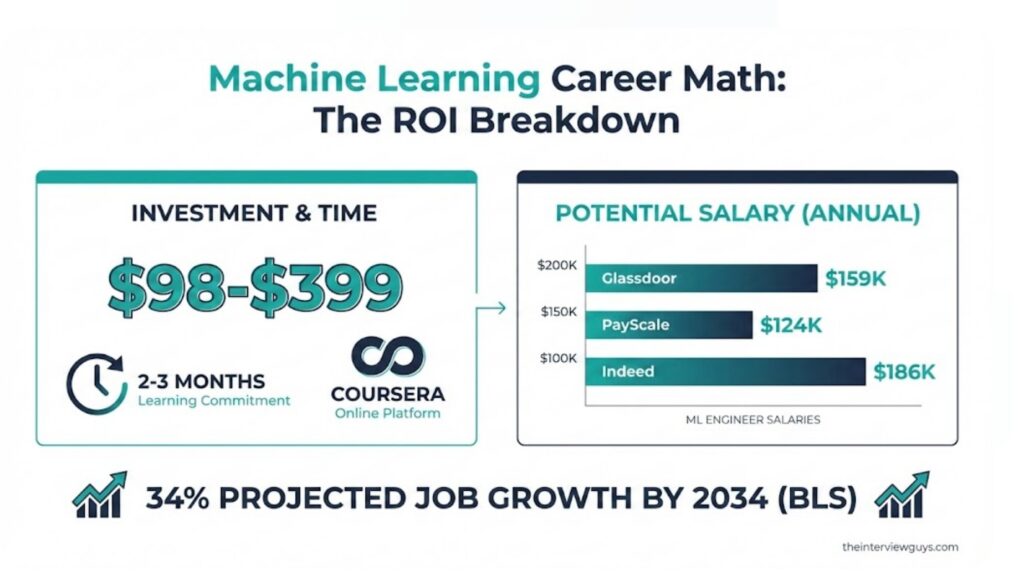
- Individual specialization subscription: $49/month
- Coursera Plus monthly: $59/month (unlimited access to 10,000+ courses)
- Coursera Plus annual: $399/year ($33/month effectively)
- Realistic completion time: 2-3 months at 9 hours per week
If you complete the specialization in 2 months at $49/month, your total investment is $98. That’s less than a single college textbook. If you opt for Coursera Plus annual, you’ll pay $399 for the year but gain access to the Deep Learning Specialization, the TensorFlow Developer Certificate, and thousands of other courses that complement this one.
Salary Context:
The salary landscape for ML professionals is genuinely compelling. According to Glassdoor, the average machine learning engineer salary in the United States is approximately $159,000 per year, with the typical range falling between $128,000 and $201,000. PayScale reports a median of $124,000, while Indeed puts the average at $186,000.
These numbers vary widely because “machine learning engineer” spans a huge range of experience levels and industries. But even entry-level ML positions command salaries well above the national average.
The Bureau of Labor Statistics projects that data scientist roles will grow 34% between 2024 and 2034, making it the fourth fastest-growing occupation in the economy. That’s more than 10 times the average growth rate for all occupations.
The ROI reality: A $98-$399 investment that gives you the foundational knowledge for a career field with a median salary north of $124,000 is, objectively, one of the best returns in professional development. But only if you actually do the work beyond just completing the courses.
Interview Guys Tip: Don’t just list this certification on your resume and call it a day. Build two or three personal projects that apply what you learned, post them to GitHub, and be ready to walk an interviewer through your code and reasoning. That’s the combination that turns a certification into a career opportunity.
What This Certification Won’t Teach You (And What to Stack With It)
No single specialization covers everything, and knowing the gaps is just as important as knowing the strengths.
Gap 1: Deep Learning and Neural Network Specialization
The ML Specialization introduces neural networks in Course 2, but it only scratches the surface. For roles involving computer vision, natural language processing, or generative AI, you’ll need the Deep Learning Specialization by Andrew Ng. It picks up exactly where this one leaves off and covers convolutional networks, sequence models, and more.
Gap 2: MLOps and Deployment
You’ll know how to build models but not how to put them into production. Look into the Machine Learning Engineering for Production (MLOps) Specialization on Coursera to learn deployment, monitoring, and pipeline management. These are increasingly non-negotiable skills for ML engineer roles.
Gap 3: Real-World Data Wrangling
The datasets in this specialization are clean and well-structured. Real-world data is messy, incomplete, and often requires significant preprocessing before any model building can happen. Supplementing with a data engineering or data wrangling course will fill this gap.
Here’s the learning roadmap we recommend: Start with this Machine Learning Specialization, then move to the Deep Learning Specialization, then add MLOps. If you’re on Coursera Plus, all three are included in your subscription, which makes the annual plan an exceptional value for anyone serious about building a complete ML skillset.
That three-specialization combination covers the fundamentals, advanced techniques, and production skills that top-paying AI roles actually require.
The Honest Verdict
Certificate: Machine Learning Specialization (Stanford University & DeepLearning.AI)
Difficulty: 2.5/5 (Beginner-friendly with basic Python prerequisite, but the math gets challenging in places)
Time Investment: 2-3 months at 9 hours/week (approximately 100 total hours)
Cost: $98-$147 (2-3 months at $49/month) | Start your 7-day free trial
Best For: Career changers and early-career professionals with basic Python skills who want to break into machine learning, data science, or AI engineering without going back to school
Not Right For: Experienced ML engineers looking to upskill (too foundational), complete beginners with no coding background (learn Python first), or anyone expecting a single certification to guarantee a job
Key Hiring Advantage: The Stanford and DeepLearning.AI branding combined with Andrew Ng’s reputation creates immediate credibility on a resume. The Python-based, hands-on curriculum produces candidates who can actually implement algorithms, not just describe them.
The Brutal Truth: This certification will not make you a machine learning engineer. It will make you someone who understands machine learning well enough to build on that knowledge, contribute to real projects, and hold your own in a technical interview. Your success depends entirely on what you do after completing it: building projects, networking, and continuing to learn.
Our Recommendation: Worth every dollar and every hour if you’re committed to building a career in ML or AI. For $98-$399 and 2-3 months of focused study, you get a world-class foundation taught by one of the most respected names in the field. Among AI certifications available in 2026, this remains the gold standard starting point.
Interview Guys Rating: 9.0/10 for career changers entering ML | 6.5/10 for experienced practitioners
Start your 7-day free trial on Coursera
FAQ
Is this worth it without a computer science degree?
Absolutely. The specialization assumes basic Python and high school math, not a CS degree. Many successful ML practitioners started with this exact course as their entry point. That said, you’ll eventually want to supplement with linear algebra and statistics knowledge as you advance. The certification itself carries weight regardless of your academic background.
How long does it really take to complete?
Coursera estimates 2-3 months at 9 hours per week. Based on learner feedback, most people finish in 8-12 weeks if they’re consistent. If you’re already comfortable with Python and math concepts, you could push through faster. But rushing defeats the purpose. The labs and practice exercises are where the real learning happens.
Is the Machine Learning Specialization enough to get a job?
On its own, probably not. Combined with 2-3 solid portfolio projects, a well-crafted resume, and strong interview preparation, it becomes a powerful part of your application. Think of it as the foundation, not the finished house. Employers want to see that you can apply what you learned, not just that you completed a course.
How does this compare to the original Andrew Ng Machine Learning course?
This is the updated replacement. The original course used Octave/MATLAB and was a single course. The new specialization uses Python (NumPy, scikit-learn, TensorFlow), is split into three focused courses, and includes updated content on modern ML practices. If you took the original, this version is a significant upgrade.
Should I take this before or after the Deep Learning Specialization?
Before. The Machine Learning Specialization builds the foundation that the Deep Learning Specialization assumes you already have. Start here, then progress to deep learning once you’re comfortable with supervised learning, neural networks basics, and model evaluation.
Bottom Line
The Machine Learning Specialization by Andrew Ng isn’t just another online course. With 4.8 million+ learners and a 4.9/5 rating, it’s earned its reputation as the definitive starting point for anyone serious about a career in machine learning.
Here’s your action plan:
- Step 1: Start the 7-day free trial and complete the first week of Course 1 to make sure the teaching style and difficulty level work for you.
- Step 2: Commit to a consistent study schedule of 9+ hours per week and complete all three courses, including every lab assignment.
- Step 3: Build 2-3 portfolio projects on GitHub that demonstrate your ability to apply ML concepts to real problems.
- Step 4: Stack the Deep Learning Specialization to round out your skill set and unlock higher-paying, more specialized roles.
If you’re ready to invest 2-3 months and build the foundation for a career that averages well over six figures, this specialization delivers exactly what it promises. No hype. No shortcuts. Just a world-class education from one of the most respected names in artificial intelligence.
Enroll in the Machine Learning Specialization today
Here’s what most people don’t realize: employers now expect multiple technical competencies, not just one specialization. The days of being “just a marketer” or “just an analyst” are over. You need AI skills, project management, data literacy, and more. Building that skill stack one $49 course at a time is expensive and slow. That’s why unlimited access makes sense:
Your Resume Needs Multiple Certificates. Here’s How to Get Them All…
We recommend Coursera Plus because it gives you unlimited access to 7,000+ courses and certificates from Google, IBM, Meta, and top universities. Build AI, data, marketing, and management skills for one annual fee. Free trial to start, and you can complete multiple certificates while others finish one.
After twelve years of writing advice like this, we built the tool that does it with you. It's called Longbow, and here's the whole story.

ABOUT THE INTERVIEW GUYS (JEFF GILLIS & MIKE SIMPSON)
Mike Simpson: Co-founder of The Interview Guys and Longbow. He has been the voice behind our interview advice since 2013 — his work has reached over 100 million job seekers around the world. The strategic mind behind Longbow, our new career platform.
Jeff Gillis: Co-founder of The Interview Guys and Longbow. He built the systems that put our work in front of those readers, and he leads the engineering on Longbow, the cutting edge career platform built for today’s job seeker.