
Andrew Ng’s Deep Learning Specialization Review: The $200 Certification Behind $130K+ Careers

What a Hiring Manager Actually Thinks When They See This on Your Resume
We talk to hiring managers every day who tell us the same thing: they have plenty of AI and machine learning applicants, but almost no one can explain why they chose a particular neural network architecture.
They get resumes loaded with buzzwords. “Experienced in deep learning.” “Proficient in TensorFlow.” “Passionate about AI.” But when they ask “walk me through how you’d design a model to detect anomalies in production data,” most candidates stall out.
Does the Deep Learning Specialization fix that problem, or is it just another badge for your LinkedIn profile?
Here’s what we know. The BLS projects software developer employment to increase 17.9% through 2033, and data scientist roles are growing at 36%. The deep learning market was valued at $14.97 billion in 2023 and is projected to grow at 22% annually through 2030 (Grand View Research). Companies need people who can build intelligent systems.
The Deep Learning Specialization carries a 4.9 out of 5 rating from over 120,000 learners on Coursera. Over one million people have enrolled. Those aren’t vanity metrics. That’s a community-validated program with serious staying power.
But a high rating doesn’t automatically mean career impact. Let’s talk about what really happens when a hiring manager sees “Deep Learning Specialization, DeepLearning.AI” on your resume.
The Andrew Ng Brand Signal
First, the name recognition. Andrew Ng co-founded Coursera, led Google Brain, served as Chief Scientist at Baidu, and teaches at Stanford. When a hiring manager sees his name on your certification, they think: “This person chose to learn from a legitimate authority.”
In a stack of 200 resumes where half the candidates list random Udemy courses, the DeepLearning.AI brand stands out. It signals you were intentional about your learning path.
The “Can They Do the Work?” Question
Here’s the hiring manager’s biggest concern: hiring someone who memorized theory but can’t implement anything.
The good news is this specialization forces you to build neural networks from scratch before using frameworks. You implement forward propagation, backpropagation, and gradient descent in raw Python before touching TensorFlow. That’s exactly the foundational understanding that separates strong candidates from weak ones in technical interviews.
But the programming assignments are guided. They walk you through the code step by step. You won’t leave this specialization ready to architect a production ML pipeline from a blank screen. You’ll need practice projects beyond the coursework.
It’s not a degree. Don’t treat it like one. This certification is a foundation, a signal, and a launchpad. It’s not a replacement for a CS degree, and it won’t get you hired at Google Research by itself. But combined with personal projects and smart interview preparation, it can absolutely open doors that were previously closed.
Interview Guys Tip: When listing this certification on your resume, don’t just write “Deep Learning Specialization.” Add context: “Deep Learning Specialization (5 courses, DeepLearning.AI / Coursera) with projects in CNNs, sequence models, and ML strategy.” That level of specificity tells hiring managers you actually completed the work. For more guidance, check out our article on how to list certifications on a resume.
☑️ Key Takeaways
- Andrew Ng’s name carries real weight with technical hiring managers, signaling you learned from one of the most respected voices in AI.
- The 5-course structure builds genuine neural network fluency, not surface-level buzzword knowledge, by making you code from scratch before using frameworks.
- Deep learning engineers earn $132K to $192K in total compensation, making this one of the highest-ROI certifications you can complete for under $300.
- You’ll need to supplement with PyTorch, generative AI, and MLOps skills to be fully competitive for 2026 roles, but this gives you the foundation to learn them fast.
Disclosure: This article contains affiliate links. If you purchase through these links, we may earn a commission at no additional cost to you.
The 5 Interview Questions This Certification Prepares You to Crush
Knowing the curriculum is one thing. Knowing which interview questions it maps to? That’s where the real career value lives.
1. “Explain how backpropagation works and why it matters.”
Course 1 (Neural Networks and Deep Learning) walks you through backpropagation from first principles. You’ll implement it manually, which means you can explain the chain rule, gradient computation, and weight updates without hand-waving. This is the single most common technical screener question for deep learning roles.
2. “How would you diagnose a model that’s performing well on training data but poorly on test data?”
Course 2 (Improving Deep Neural Networks) is built around exactly this problem. You’ll learn bias vs. variance analysis, regularization techniques like dropout and L2, and optimization strategies like Adam and learning rate decay. Walk the interviewer through your diagnostic process step by step.
3. “Tell me about a time you had to make a strategic decision on an ML project with limited data.”
Course 3 (Structuring Machine Learning Projects) is uniquely valuable here. Most certifications skip ML strategy entirely. This course teaches you to diagnose errors, prioritize which problems to solve first, and make tradeoffs like transfer learning vs. collecting more data. Use the SOAR Method (Situation, Obstacle, Action, Result) to frame your answer around one of the case studies from this course.
4. “Walk me through how a convolutional neural network processes an image.”
Course 4 (Convolutional Neural Networks) gives you a thorough understanding of convolution operations, pooling layers, and architectures like ResNet and YOLO. You’ll be able to explain not just what happens, but why each architectural decision matters for different computer vision tasks.
5. “How would you build a system that generates text summaries from documents?”
Course 5 (Sequence Models) covers RNNs, LSTMs, GRUs, and attention mechanisms, which are the building blocks behind NLP applications. You’ll understand how sequence-to-sequence models work and be able to discuss the evolution from basic RNNs to transformer-style attention.
Interview Guys Tip: Don’t just memorize these answers. Build a mini-project for at least two of these topics. A hiring manager who asks “walk me through a CNN” will be far more impressed when you say “I built one that classifies X-ray images with 94% accuracy” than “I learned about them in a course.” For more on preparing for AI-focused interviews, check out our guide on essential AI skills.
Here’s what most people don’t realize: employers now expect multiple technical competencies, not just one specialization. The days of being “just a marketer” or “just an analyst” are over. You need AI skills, project management, data literacy, and more. Building that skill stack one $49 course at a time is expensive and slow. That’s why unlimited access makes sense:
Your Resume Needs Multiple Certificates. Here’s How to Get Them All…
We recommend Coursera Plus because it gives you unlimited access to 7,000+ courses and certificates from Google, IBM, Meta, and top universities. Build AI, data, marketing, and management skills for one annual fee. Free trial to start, and you can complete multiple certificates while others finish one.
Curriculum Deep Dive: What You’ll Actually Master
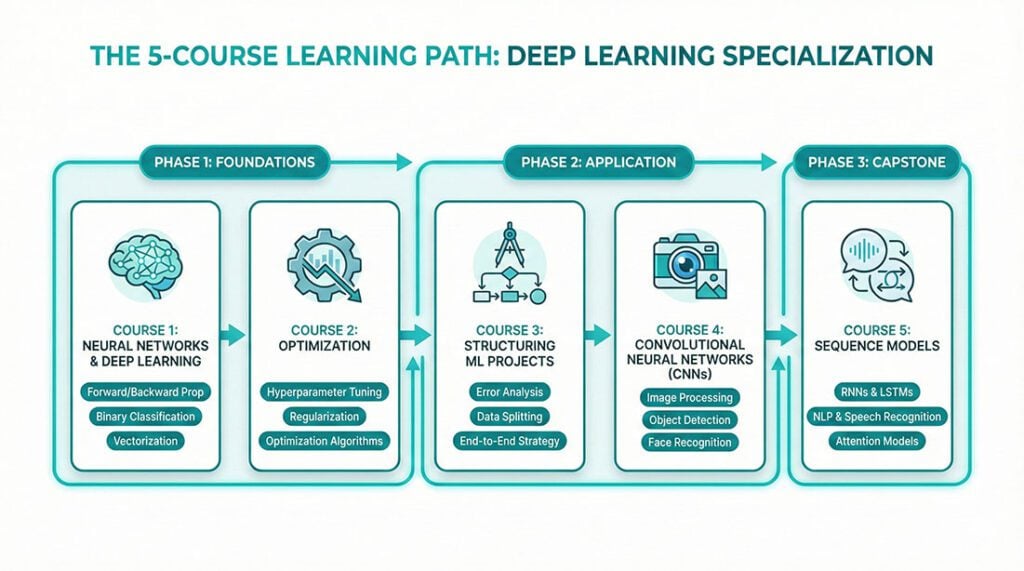
Rather than a dry course-by-course breakdown, let’s talk about what you’ll walk away knowing at each phase.
Phase 1: Building the Foundation (Courses 1-2)
What You’ll Master: The ability to build, train, and improve neural networks from the ground up.
Course 1 starts at the beginning, but here’s what sets it apart: you build everything in raw Python first. No TensorFlow. No Keras. Just NumPy, math, and understanding. By the end, you’ll have a working deep neural network that recognizes images. That’s a portfolio-ready project.
Course 2 shifts to optimization. Xavier and He initialization, batch normalization, dropout, and the Adam optimizer all get covered in depth.
Key skills you’ll develop:
- Vectorized implementation of neural networks in Python
- Forward and backward propagation from scratch
- Hyperparameter tuning and systematic debugging
- Regularization strategies to prevent overfitting
- Understanding of optimization algorithms beyond basic gradient descent
Interview Guys Tip: When discussing your background, mention that you implemented backpropagation from scratch. This immediately distinguishes you from candidates who only used high-level APIs.
Phase 2: Real-World Application (Courses 3-4)
What You’ll Master: ML project strategy and computer vision, which is where this specialization gets directly career-relevant.
Course 3 is short but arguably the most unique offering in any online ML program. Andrew Ng shares lessons from his years leading ML teams at Google and Baidu. You’ll learn to structure projects, diagnose errors, and decide when to use end-to-end learning vs. pipeline approaches. This is the course that teaches you to think like an ML team lead.
Course 4 dives into convolutional neural networks. You’ll study classic and modern architectures (ResNet, Inception, YOLO), implement object detection, and work on face recognition and neural style transfer.
Key skills you’ll develop:
- Error analysis and systematic debugging of ML projects
- Transfer learning and when to apply it
- Building CNNs for image classification and object detection
- Understanding of modern architectures used in production
- Neural style transfer and face verification systems
Interview Guys Tip: Course 3’s strategy content is gold for behavioral interview questions. When asked about project decision-making, reference the error analysis framework. Describe a Situation where you had model underperformance, the Obstacle of limited data or compute, the Action of applying bias/variance analysis to prioritize solutions, and the Result of improved performance.
Phase 3: Sequence Models and the Capstone (Course 5)
What You’ll Master: Natural language processing fundamentals, attention mechanisms, and the architecture concepts behind modern AI systems.
Course 5 covers recurrent neural networks, LSTMs, GRUs, and the attention mechanism that powers transformer models. You’ll build a machine translation system, a trigger word detection system, and work with word embeddings.
While you won’t build GPT from scratch, you’ll understand the foundational concepts that make large language models possible. That conceptual understanding is exactly what hiring managers test for.
Key skills you’ll develop:
- Building and training RNNs and LSTMs for sequence data
- Implementing attention mechanisms
- Working with word embeddings and NLP preprocessing
- Designing systems for tasks like translation and speech recognition
Interview Guys Tip: The attention mechanism project is your strongest portfolio piece from this course. Be ready to explain how attention works, why it improved on vanilla sequence-to-sequence models, and how it connects to the transformer architecture used in modern AI systems.
This entire specialization maps well to the AI skills employers are prioritizing in 2026, making it a smart investment for career changers.
Who Should Skip This Certification
Not every certification is right for every person. Here’s who should look elsewhere.
Complete beginners with no Python experience. This specialization assumes Python proficiency. If you’ve never programmed, start with a Python fundamentals course first.
People who want to learn generative AI specifically. This covers foundational deep learning, not chatbots, LLM fine-tuning, or diffusion models. Look at DeepLearning.AI’s newer short courses for those topics.
Anyone expecting a guaranteed job. No certification guarantees employment. Without personal projects, interview prep, and networking, this certification alone won’t change your trajectory.
Senior ML engineers looking for cutting-edge content. If you already deploy deep learning models professionally, most of this will be review. Spend your time on research papers or open-source contributions instead.
If you’re an aspiring career changer wondering where AI skills fit into your transition plan, our guide on how to change careers can help you think through the bigger picture.
The Career Math: What This Investment Actually Returns
Let’s talk numbers, because that’s what really matters.
The Cost
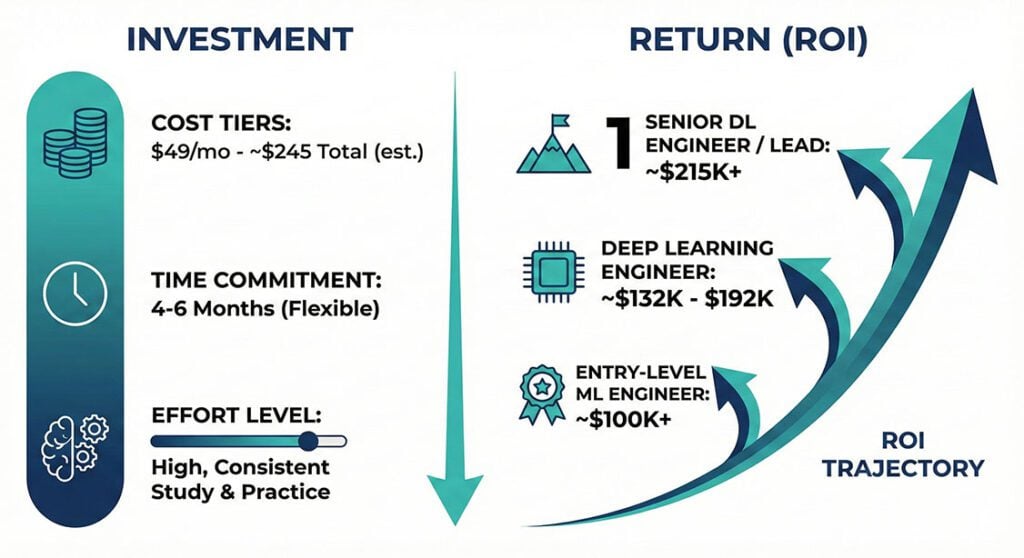
Option 1: Pay per specialization. At $49/month for this specific specialization, most learners finish in 3 to 5 months. That’s $147 to $245 total.
Option 2: Coursera Plus. At $59/month (or $399/year for the annual plan), you get unlimited access to 7,000+ courses. If you plan to stack additional certifications after this one, the annual plan is the better deal.
Option 3: Speed run. Some highly motivated learners with strong math backgrounds have completed the entire specialization in 4 to 6 weeks. At $49/month, that’s under $100 total. One reviewer on Reddit noted completing it in about 3.5 weeks at 30 hours per week for a single month’s subscription fee.
Start your 7-day free trial on Coursera and see if this program fits your learning style before committing.
The Salary Upside
Deep learning roles command some of the highest salaries in tech:
- Deep learning engineer: $132,131 average base, with total compensation reaching $191,765 (Glassdoor, January 2026)
- ML engineer with DL skills: $125,195 average (PayScale), with senior roles exceeding $200K
- Senior deep learning engineer: $214,551 average total compensation (Glassdoor)
- Entry-level ML engineer: Around $100,010 in average total compensation (PayScale)
Even if you’re targeting entry-level ML roles, you’re looking at six-figure compensation in most major markets.
The ROI Reality Check
A $200 to $400 investment that prepares you for roles paying $100K+ is exceptional ROI on paper. But let’s be realistic about what “prepares you” means.
This certification alone won’t land you a $130K deep learning engineering role. It gives you the knowledge foundation, portfolio projects, and credential to get interviews. What gets you hired is combining this with personal projects, strong interview prep, and understanding what the highest-paying AI jobs actually require.
The time investment is real too. Coursera estimates about 5 months at 10 hours per week. Most people take 4 to 6 months while working full-time.
What This Certification Won’t Teach You (And What to Stack With It)
Being honest about gaps builds trust, so here’s where you’ll need to supplement.
Gap 1: PyTorch
The specialization teaches TensorFlow, which is still widely used in production. But PyTorch has become the dominant framework in research and is increasingly popular in industry. If you’re targeting ML engineering roles, you’ll want PyTorch fluency.
How to fill it: Take a PyTorch-specific course on Coursera or work through the official PyTorch tutorials. With the TensorFlow foundation from this specialization, picking up PyTorch takes weeks, not months.
Gap 2: Generative AI and Large Language Models
The attention mechanism in Course 5 provides conceptual grounding, but the specialization doesn’t cover modern generative AI techniques like fine-tuning LLMs, RAG architectures, or prompt engineering. These are increasingly expected skills in 2026.
How to fill it: DeepLearning.AI offers several short courses on generative AI topics. If you have Coursera Plus, many of these are included in your subscription, making it a natural next step.
Gap 3: MLOps and Deployment
You’ll learn to build and train models, but not to deploy them in production environments. Real-world ML engineering requires knowledge of model serving, monitoring, CI/CD pipelines, and cloud infrastructure.
How to fill it: Look into MLOps specializations or cloud-specific ML certification programs (AWS, GCP, or Azure). The online certifications that pay well article on our site covers several complementary options.
Interview Guys Tip: Hiring managers are increasingly asking about your full ML workflow, not just model building. After completing this specialization, spend a weekend deploying one of your projects using a free-tier cloud service. Being able to say “I trained the model AND deployed it as an API endpoint” instantly levels up your candidacy. Check out our guide on must-have AI skills for your resume to make sure you’re covering all your bases.
The Honest Verdict
| Criterion | Score |
|---|---|
| Curriculum Quality | 10.0 / 10 |
| Hiring Impact | 7.0 / 10 |
| Skill-to-Job Match | 9.0 / 10 |
| Value for Money | 10.0 / 10 |
| Portfolio and Interview Prep | 7.0 / 10 |
| Accessibility | 6.0 / 10 |
| Interview Guys Rating | 8.4 / 10 for ML Specialization graduates entering deep learning |
| 8.9 / 10 for experienced ML engineers adding formal deep learning depth |
Certificate: Deep Learning Specialization (DeepLearning.AI)
Difficulty: 3/5 (Intermediate — requires the ML Specialization or equivalent Python and ML foundations; math gets genuinely challenging in places)
Time Investment: 4–6 months at 10 hours per week (6–8 weeks possible with strong math background and 20+ hours weekly)
Cost: $147–$245 (3–5 months at $49/month) | Start your 7-day free trial
Best For: Graduates of the ML Specialization ready to go deeper into neural networks, software engineers with Python and ML foundations transitioning into deep learning roles, and ML practitioners who want formal credentials and structured depth in CNNs, RNNs, and attention mechanisms
Not Right For: Complete beginners with no ML foundation (take the ML Specialization first), anyone targeting generative AI or LLM-specific roles without adding supplemental training, or candidates expecting an employer consortium or structured career pipeline (this is an academic specialization, not a career certificate program)
Key Hiring Advantage: Andrew Ng’s name and the DeepLearning.AI brand are recognized by technical hiring managers in ML and AI circles worldwide. Building neural networks from scratch in raw Python before touching TensorFlow produces genuine understanding that shows up in technical interviews — candidates can explain why architectures work, not just demonstrate them. The ML project strategy course (Course 3) is uniquely valuable for roles with any team leadership component, teaching error analysis and prioritization frameworks that most programs skip entirely.
The Brutal Truth: This specialization does not include a capstone project, employer partnerships, or a structured job pipeline. Every portfolio piece comes from your own initiative to extend the guided lab work into independent projects. The programming assignments are excellent but guided — you won’t leave ready to build a production deep learning system from a blank screen. PyTorch fluency and MLOps knowledge both require supplemental investment after completing this program. Candidates who treat completion as the finish line will be disappointed. Those who push code to GitHub, build two or three independent projects, and continue into the generative AI and MLOps space will be genuinely competitive.
Our Recommendation: The natural and necessary next step after the ML Specialization for anyone serious about deep learning engineering. At $147–$245 with Andrew Ng teaching CNNs, sequence models, and ML project strategy at depth, it’s an objectively excellent investment in a career field where the median total compensation exceeds $130,000. Stack it with PyTorch practice and two independent portfolio projects, and you have the technical narrative that gets you past deep learning engineering technical screens.
Interview Guys Rating: 8.4/10 for ML Specialization graduates entering deep learning | 8.9/10 for experienced ML engineers adding formal deep learning depth
Experienced ML engineers score higher because the credential stacks credibly on demonstrated production experience, their portfolio immediately reflects the new knowledge, and the prerequisite barrier is a non-issue. Newcomers from the ML Specialization score very well but need more supplemental portfolio work to compete at the same level.
Enroll and start your 7-day free trial on Coursera
FAQ
Is this certification worth it without a computer science degree?
Yes, but you’ll need solid Python skills and basic linear algebra. The course explains math intuitively, and many successful completers come from non-CS backgrounds like physics, engineering, and statistics. It won’t replace a CS degree for top research labs, but it opens doors to applied ML positions where demonstrated skills matter more than credentials.
How long does this specialization really take?
The official estimate is 5 months at 10 hours per week. Motivated learners with programming experience often finish in 3 to 4 months. With a strong math background and 20+ hours weekly, 6 to 8 weeks is achievable. Don’t rush just to save money. The goal is understanding, not a speed record.
Is it outdated since it focuses on TensorFlow and not PyTorch?
The core concepts (neural networks, CNNs, RNNs, attention mechanisms) are framework-agnostic. Understanding backpropagation doesn’t change between TensorFlow and PyTorch. TensorFlow is still widely used in production, and transitioning to PyTorch after this course takes weeks because the underlying principles are identical.
How does this compare to Fast.ai or other free alternatives?
Fast.ai takes a top-down approach (build first, understand later), while Andrew Ng goes bottom-up (understand first, then build). If you want deeper theoretical understanding and a recognized credential, the Deep Learning Specialization wins. If you want to build working models fast and don’t need a certificate, Fast.ai is excellent and free.
Will this help me get a job in AI?
It will make you a stronger candidate, but it’s one piece of the puzzle. Pair this with 2 to 3 personal projects, a polished resume that highlights your AI skills, and solid interview preparation. The certification gets your resume past screening. Your projects and performance get you the offer.
Bottom Line
The Deep Learning Specialization is one of the most respected online AI programs available, and it earns that reputation.
Here’s your action plan:
- Start the 7-day free trial and complete the first week of Course 1. If Andrew Ng’s teaching style clicks, commit.
- Budget 4 to 5 months of consistent study at 10+ hours per week. Don’t try to cram it into two weekends.
- Build at least 2 independent projects during or after the specialization. Use real datasets. Deploy them if you can.
- Stack complementary skills in PyTorch, generative AI, and MLOps to round out your profile for 2026 hiring.
The certificate proves you’re committed. The deep learning knowledge makes you capable. The projects give you evidence. And Andrew Ng’s brand opens doors.
If you’re ready to put in that work, start your free 7-day trial today and take the first step toward your career in AI.
Here’s what most people don’t realize: employers now expect multiple technical competencies, not just one specialization. The days of being “just a marketer” or “just an analyst” are over. You need AI skills, project management, data literacy, and more. Building that skill stack one $49 course at a time is expensive and slow. That’s why unlimited access makes sense:
Your Resume Needs Multiple Certificates. Here’s How to Get Them All…
We recommend Coursera Plus because it gives you unlimited access to 7,000+ courses and certificates from Google, IBM, Meta, and top universities. Build AI, data, marketing, and management skills for one annual fee. Free trial to start, and you can complete multiple certificates while others finish one.
After twelve years of writing advice like this, we built the tool that does it with you. It's called Longbow, and here's the whole story.

ABOUT THE INTERVIEW GUYS (JEFF GILLIS & MIKE SIMPSON)
Mike Simpson: Co-founder of The Interview Guys and Longbow. He has been the voice behind our interview advice since 2013 — his work has reached over 100 million job seekers around the world. The strategic mind behind Longbow, our new career platform.
Jeff Gillis: Co-founder of The Interview Guys and Longbow. He built the systems that put our work in front of those readers, and he leads the engineering on Longbow, the cutting edge career platform built for today’s job seeker.