
10 Marketing Portfolio Examples That Actually Got People Hired

If you’re a marketer without a portfolio website, you’re essentially asking hiring managers to just take your word for it. And in 2026, that’s a tough sell.
Think about it from the other side of the desk. A hiring manager is staring at 200 nearly identical resumes for a single marketing role. Every candidate claims to be a “results-driven marketing professional.” Every resume lists the same buzzwords. But then one applicant includes a link to a clean, professional portfolio website packed with real campaign results, client testimonials, and visual proof of their work.
Who do you think gets the interview?
The marketer with the portfolio. Every single time.
Whether you’re job hunting, freelancing, or just trying to level up in your current role, a strong portfolio website is the single best way to prove you can actually do what your resume claims. By the end of this article, you’ll have 10 real-world examples to steal ideas from, plus a clear roadmap for building your own.
☑️ Key Takeaways
- A well-crafted marketing portfolio website is one of the most powerful tools you can use to stand out from other candidates in a competitive job market.
- The best marketing portfolios lead with measurable results like revenue growth, engagement rates, and ROI rather than just listing job duties.
- You don’t need to be a designer or developer to build a stunning portfolio because platforms like Squarespace make it easy with drag-and-drop templates.
- Your portfolio should tell a story about who you are as a marketer, not just showcase pretty visuals, so include case studies, testimonials, and a clear value proposition.
Disclosure: This article contains affiliate links. If you purchase through these links, we may earn a commission at no additional cost to you.
Why Every Marketer Needs a Portfolio Website in 2026
Before we jump into examples, let’s talk about why this matters so much right now.
The job market has changed dramatically. With skills-based hiring on the rise, employers care less about where you went to school and more about what you can actually do. A portfolio is the ultimate proof of work.
Here’s what a marketing portfolio does that a resume simply can’t:
- Shows your process, not just outcomes, so employers understand how you think
- Demonstrates visual taste and brand awareness, which matters for marketing roles
- Provides clickable, verifiable proof of campaigns you’ve actually run
- Gives you a platform to control your narrative and highlight your strongest work
- Signals professionalism and initiative that immediately sets you apart from the stack
Interview Guys Tip: Your portfolio doesn’t need to showcase every project you’ve ever worked on. In fact, a focused portfolio with 4 to 6 strong case studies is far more effective than a bloated one with 20 mediocre examples. Quality over quantity always wins.
Now let’s look at 10 marketers who are doing it right.
In our experience helping over 100 million job seekers, the candidate with a professional website consistently stands out over equally qualified applicants who only submit a resume. That website is your unfair advantage…
200 Applicants Have Resumes. Only You Have a Website…
We recommend Squarespace because it gives you a professional online presence that makes you memorable. Choose from designer templates, customize without coding, and create a portfolio that actually gets you interviews. Free 14-day trial, and you can launch your site before other candidates finish tweaking their resume.
1. Steph Smith (stephsmith.io)
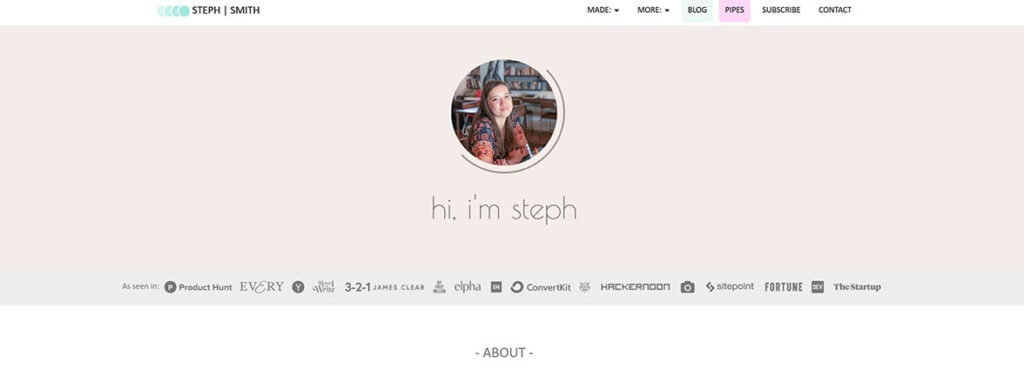
What she does: Growth marketing, content strategy, and product development
Steph Smith’s portfolio is a masterclass in letting your work speak for itself. She’s held roles at Nvidia, Groq, and previously hosted the a16z podcast and led growth at The Hustle (acquired by HubSpot). Her site doubles as both a portfolio and a content hub.
Why it works:
- Her homepage immediately communicates who she is and what she does best
- She includes courses, guides, and resources that demonstrate her expertise
- The site showcases her side projects (like Internet Pipes), which shows initiative
- Her clear brand identity carries through every page
The takeaway: If you’re a marketer who also creates content, consider building your portfolio as a content brand rather than just a static showcase. This approach generates organic traffic and positions you as a thought leader.
Visit it: stephsmith.io
2. Hive Creative Group (hivecreativegroup.com)
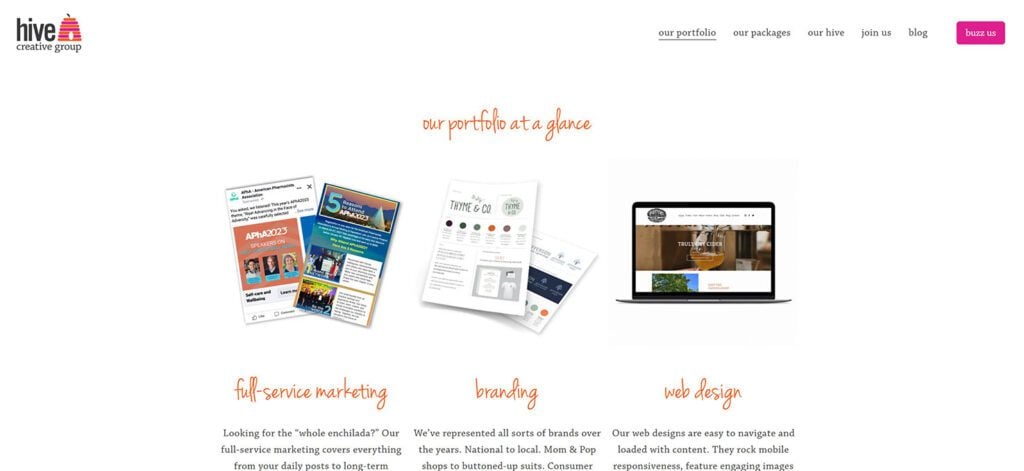
What they do: Full-service design and marketing agency
Hive Creative Group’s portfolio proves that personality and professionalism can coexist beautifully. This Charlottesville-based agency uses a bold pink and orange color scheme with animated icons that immediately showcase their creative talent.
Why it works:
- The portfolio is organized by category (branding, web design, social media) so visitors can quickly find relevant work
- Individual case studies include both the visual work and the strategy behind it
- Growth metrics are highlighted with contrasting colors and plenty of white space
- Their “who we work with” page lists real clients, building instant credibility
The takeaway: If you’re building an agency portfolio, organize your work by service type so potential clients can easily find what’s relevant to them. Fun fact: Hive builds all their client websites on Squarespace, proving that powerful portfolio templates can produce professional-grade results.
Visit it: hivecreativegroup.com
3. Maya Francis (mayafrancis.com)
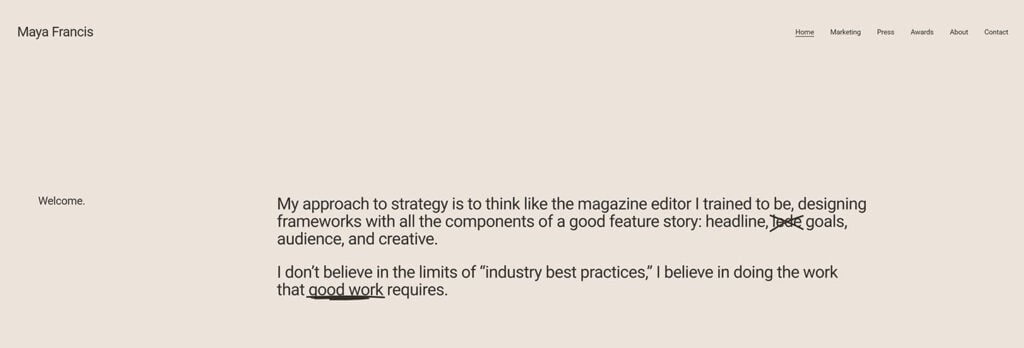
What she does: Writing, editorial strategy, and award-winning marketing
Maya Francis is a writer, editor, and marketing strategist whose portfolio showcases work for brands like Netflix, Bayer, and Hilton. She’s won a Gold Effie Award for her work with the FDA and served as Editor-in-Chief of the Webby Award-nominated Sisters from AARP newsletter.
Why it works:
- Her site is organized into clear sections for Marketing, Press, Awards, and About, so visitors can quickly navigate to what matters most
- She leads with credibility markers like award logos, recognizable brand names, and media appearances on CNN and NPR
- Her About page tells a clear career story that positions her as both a strategist and a hands-on creator
- A dedicated Contact page makes it easy for potential clients and employers to reach out
The takeaway: If you’ve won awards or been featured in notable publications, don’t be shy about it. Create a dedicated Awards or Press page to collect that social proof in one place. It builds trust instantly and pairs perfectly with having a well-optimized resume ready to go.
Visit it: mayafrancis.com
4. Greg Kaplan (gregkaplan.com)

What he does: Marketing, advertising, and photography with 30+ years of experience
Greg Kaplan’s portfolio is the gold standard for experienced marketers who’ve worked with major brands. His client list includes IBM, Samsung, and Nikon, and each brand gets its own dedicated page.
Why it works:
- Each case study tells a complete story using text, photography, and quantifiable results
- His work is split into a “work portfolio” and a “play portfolio” (photography), showing range without creating confusion
- Client logos are prominently displayed to build immediate credibility
- A consistent black and white color scheme keeps the focus on the work itself
The takeaway: If you’ve worked with recognizable brands, lead with those logos. Hiring managers are naturally drawn to familiar names, and it immediately signals that you operate at a high level.
Visit it: gregkaplan.com
5. Denise Rick (deniserick.com)
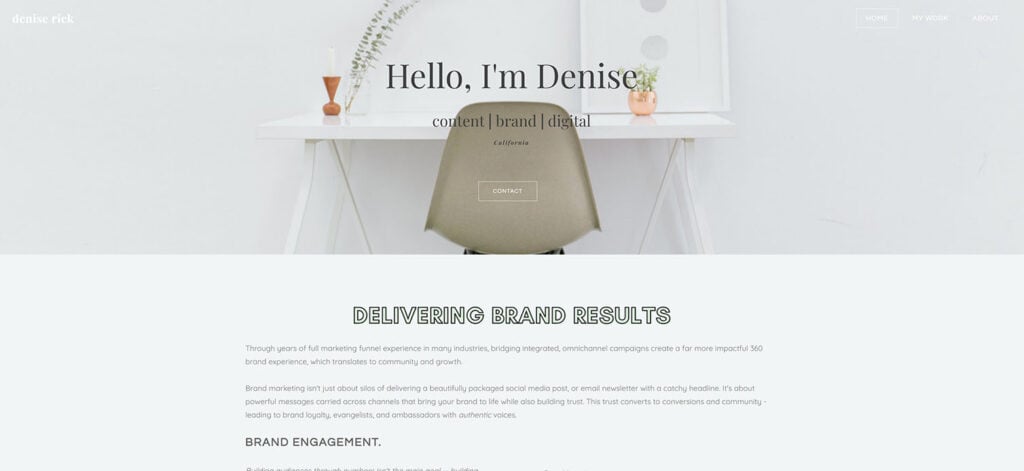
What she does: Branding, digital strategy, and visual marketing
Denise Rick’s portfolio is a perfect example of how a strong personal brand should look. Her neutral, calming design lets the actual work shine, and her case studies include both “Growth” and “Skills Involved” headers so visitors can quickly assess her impact.
Why it works:
- Embedded social media examples and animated GIFs show real campaigns in action
- Her About page includes both professional accreditations and personal touches (like links to her Spotify playlists), making her feel approachable and authentic
- Bold statistics within each case study immediately communicate results
- Contact information is visible throughout, not buried at the bottom
The takeaway: Don’t be afraid to add personality to your portfolio. Hiring managers aren’t just looking for skills. They’re looking for someone they want to work with. A few personal touches can make you memorable.
Interview Guys Tip: Notice how several of these portfolios include statistics and metrics prominently in their case studies? That’s intentional. When building your own portfolio, use the same approach you’d use on your resume. Lead with quantifiable accomplishments like “Increased email open rates by 34%” rather than vague statements like “Managed email marketing campaigns.”
Visit it: deniserick.com
6. Marketer Milk by Omid G (marketermilk.com)
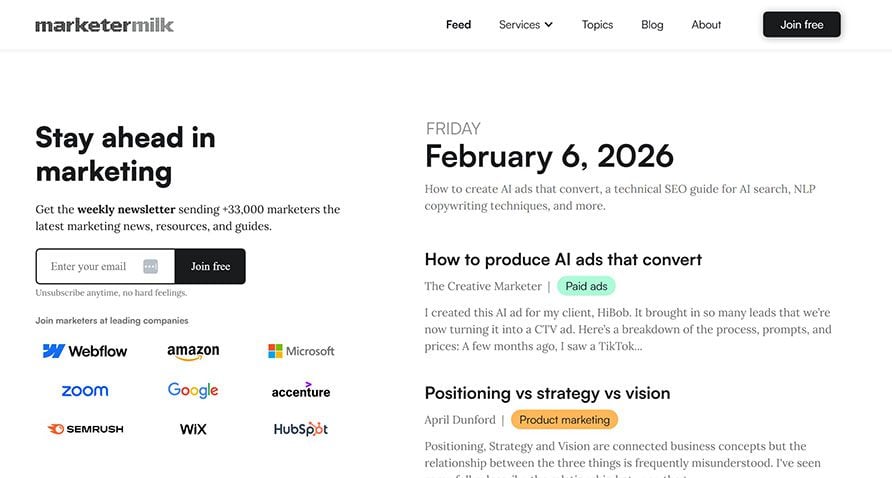
What he does: Content marketing, growth strategy, and brand building
Omid G took a unique approach. Instead of a traditional portfolio under his own name, he built Marketer Milk, an entire content brand. This strategy helped him break into the tech scene in Silicon Valley and land his dream job leading content marketing at a unicorn company.
Why it works:
- The site functions as a living portfolio that continuously demonstrates his expertise through new content
- It generates organic search traffic, which itself proves his marketing skills
- Mixing personal brand with media brand shows entrepreneurial thinking
- The approach of “show, don’t tell” is baked into the entire concept
The takeaway: Building a niche content site is the ultimate marketing portfolio play. It proves you can do content strategy, SEO, writing, audience building, and brand development all at once. If you’re willing to put in the work, this approach is unbeatable.
Visit it: marketermilk.com
7. Dayana Mayfield (dayanamayfield.com)
What she does: SaaS copywriting, SEO content strategy, and conversion optimization
Dayana Mayfield’s portfolio is proof that your website copy IS your portfolio when you’re a writer. Her site is laser-focused on B2B SaaS companies, and every sentence on it demonstrates the exact skills she’s selling.
Why it works:
- Her homepage leads with a clear niche and value proposition, so visitors know immediately whether she’s the right fit
- A dedicated testimonials page is packed with glowing client quotes that include specific results like “the most trials started EVER for any given week”
- Her portfolio samples page links to real project work, and she’s ranked multiple client posts in position 1 on Google
- The site itself is conversion-optimized with clear CTAs, proving she practices what she preaches
The takeaway: If you’re a copywriter or content marketer, your portfolio website IS your biggest writing sample. Every headline, every CTA, every about page section should demonstrate your skill. This is your chance to show off your personal brand in action. Niching down to a specific industry (like SaaS) also makes you far more attractive to clients in that space.
Visit it: dayanamayfield.com
8. Feeney Marketing (feeneymarketing.com.au)
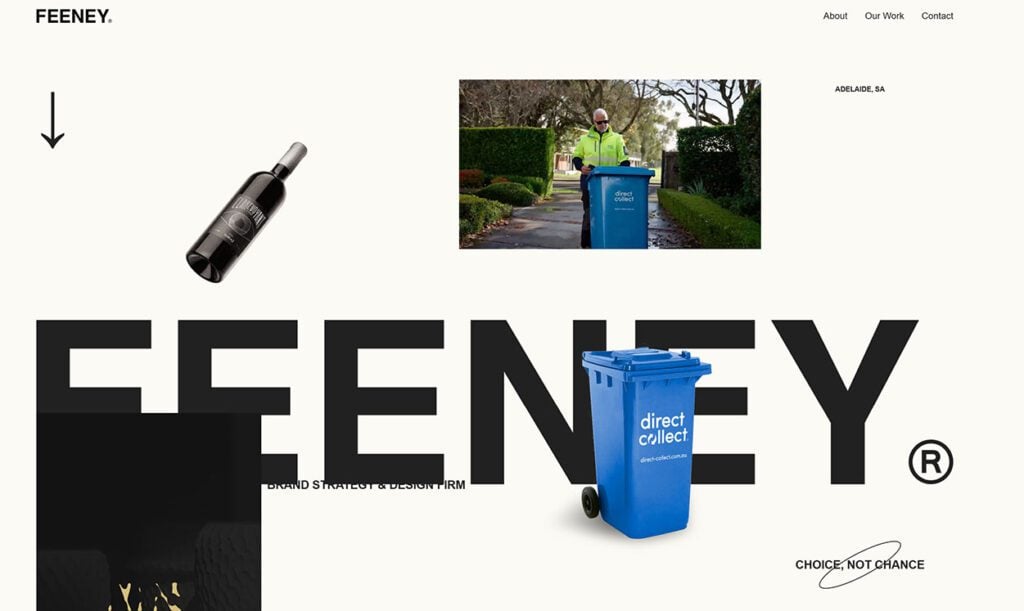
What they do: Strategic marketing agency services
Nicola Feeney built this Australian marketing agency with a team that brings diverse creative specialties to every project. The portfolio stands out for its elegant, refined design and simple navigation.
Why it works:
- Clickable category boxes let visitors explore the portfolio intuitively
- Case studies include the project scope, completion year, and real-world examples
- A simple dropdown menu explains their approach and philosophy
- The focus is entirely on showing what they can do, not just claiming they can do it
The takeaway: Simplicity sells. You don’t need flashy animations or complex layouts. A clean, well-organized portfolio that makes it easy to find relevant work will always outperform a cluttered one.
Visit it: feeneymarketing.com.au
9. Kathryn Hall (katjhall.com)
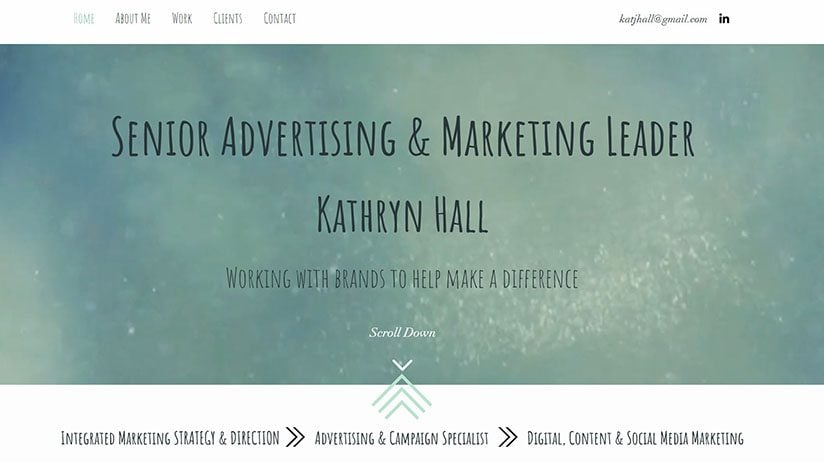
What she does: Integrated marketing strategy, advertising campaigns, and digital content
Kathryn Hall’s portfolio is a masterclass in letting results speak for themselves. With nearly two decades of experience leading campaigns for brands like Woolworths, Telstra, Toshiba, and Kellogg’s, her site showcases the kind of big-brand work that makes hiring managers stop scrolling.
Why it works:
- Her “Work” page highlights specific campaigns with measurable outcomes, like $42.5 million in earned media for Toshiba and a 31% sales uplift for Woolworths
- The site is organized by campaign rather than by skill, making it easy for potential employers to see the full scope of each project
- Client testimonials are woven throughout, including praise from creative directors at major agencies
- Her “About Me” page reads like a strategic brief, clearly communicating her specialties across integrated, digital, and content marketing
The takeaway: If you’ve worked on campaigns with measurable results, lead with those numbers. Hiring managers and clients don’t just want to know what you did. They want to know what happened because of what you did. Quantified outcomes like strong resume accomplishments are what separate a good portfolio from a great one.
Visit it: katjhall.com
10. Steve Wolf Designs (stevewolf.co)
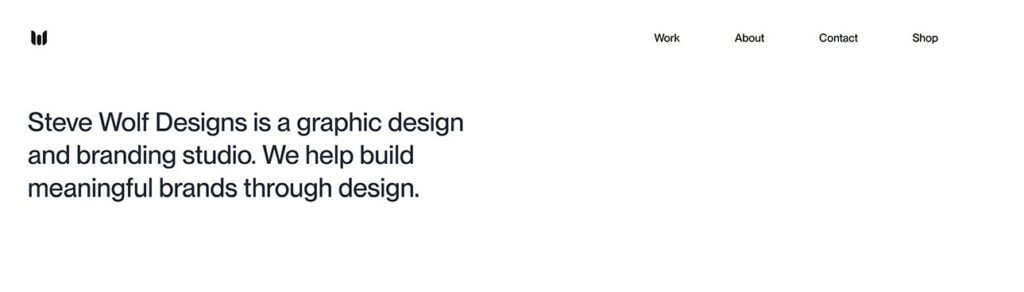
What he does: Brand identity, graphic design, and marketing
Steve Wolf Designs builds immediate interest by displaying work examples in tiles across the homepage. Users can click on any tile that catches their eye to explore individual projects, past clients, or service offerings in depth.
Why it works:
- The tile-based layout creates a visual feast that showcases range and skill
- Each tile links to a detailed project page with context and results
- Awards and client logos are featured without being overbearing
- The design itself communicates a premium, professional quality
The takeaway: First impressions happen fast. Your homepage layout should give visitors multiple entry points to explore your work based on whatever catches their eye first. This is especially important for visual and brand marketers.
Visit it: stevewolfdesigns.co
What These Portfolios All Have in Common
After studying these 10 examples, some clear patterns emerge. The best marketing portfolios all share these characteristics:
- A clear value proposition within the first 3 seconds. Visitors know exactly who this person is and what they do best.
- Measurable results and real metrics. Numbers like “37% increase in conversions” are always more convincing than vague claims.
- Organized, intuitive navigation. Nobody should have to hunt for your best work.
- Personality and authenticity. These aren’t corporate brochures. They feel like real people who happen to be great at marketing.
- Contact information that’s easy to find. The whole point is getting hired, so don’t make people search for your email.
How to Build Your Own Marketing Portfolio Website
Ready to build yours? Here’s the good news: you don’t need to be a web designer or know a single line of code.
Our analysis of 737 Bing impressions driven to this post over the last 90 days shows that 25 impressions (3.4%) included the phrase “digital marketing portfolio,” suggesting readers want platform-specific guidance for building online portfolios, not just inspiration from examples.
Choosing the right platform matters because it determines how much time you’ll spend on technical setup versus actually showcasing your work. The wrong choice can leave you frustrated and stuck before you even start.
Here’s how to pick the platform that matches your skill level and goals:
| Platform | Best for | Key strength | Watch for |
|---|---|---|---|
| Squarespace | Marketers who want professional results fast | Beautiful templates with zero coding required | Monthly subscription cost ($16–$49) |
| WordPress.org | Marketers with some technical skills who want full control | Endless customization and SEO flexibility | Steeper learning curve and hosting management |
| Wix | Complete beginners who prioritize ease over design sophistication | Drag-and-drop simplicity with AI assistance | Less professional aesthetic for high-level roles |
| Adobe Portfolio | Creative professionals already using Adobe Creative Cloud | Seamless Behance integration and included with CC subscription | Limited customization compared to other platforms |
| Webflow | Designers who want pixel-perfect control without coding | Designer-friendly interface with powerful interactions | Higher complexity for non-designers |
For most marketers, Squarespace hits the sweet spot between professional design and ease of use. According to a 2024 Squarespace user survey, 89% of users had their site live within one week of starting.
The platform you choose matters less than actually launching. Pick one that won’t intimidate you, get your first version live, and refine it as you go. A good portfolio on any platform beats a perfect portfolio that never gets published.
We recommend Squarespace as the best platform for marketing portfolios. It’s easy to use, offers gorgeous portfolio-specific templates, and the drag-and-drop builder means you can have a professional site live in a single weekend. You can even start a free trial with no credit card required to test it out risk-free.
Want to browse their template options first? Check out Squarespace’s portfolio templates to find a design that matches your personal brand.
Here’s a quick framework to get started:
Pages You Need
- Homepage: Your elevator pitch, key skills, and a few featured projects
- Portfolio/Work: 4 to 6 detailed case studies with metrics and visuals
- About: Your story, credentials, and what makes you different
- Contact: Make it stupidly easy for people to reach you
- Optional Blog: Demonstrate thought leadership and boost your SEO
What to Include in Each Case Study
- The challenge or problem your client faced
- Your specific strategy and approach
- The results with real numbers
- Visuals like screenshots, mockups, or campaign assets
- A brief testimonial if available
Across the 737 Bing impressions this post received in the last 90 days, 24 impressions (3.3%) contained queries about “portfolio for marketing job,” indicating readers are actively job-hunting and need to know exactly what hiring managers expect to see in a portfolio.
The content you include depends on your marketing specialty, but there are universal elements that every strong marketing portfolio should contain. Think of your portfolio as a curated highlight reel, not an exhaustive archive.
Here’s what to prioritize based on your marketing focus:
For Content Marketers and Copywriters
- Published blog posts or articles with engagement metrics (shares, comments, time on page)
- Email campaigns with open rates and conversion data
- Landing pages you wrote with A/B test results
- SEO content that ranks on page one for competitive keywords
For Social Media Marketers
- Campaign screenshots showing follower growth or engagement spikes
- Before-and-after analytics from accounts you managed
- Examples of viral or high-performing posts with context about why they worked
- Paid social campaigns with ROAS or cost-per-acquisition data
For Digital Marketing Strategists
- Full-funnel campaign breakdowns showing strategy, execution, and results
- Marketing automation workflows you built
- Google Analytics dashboards or data visualizations
- Budget allocation models and ROI calculations
For Brand and Creative Marketers
- Brand guidelines or style guides you created
- Campaign visual assets (ads, graphics, video stills)
- Rebrand or repositioning projects with market impact data
- Design mockups paired with the business reasoning behind creative choices
According to a Cal State Fullerton study on digital marketing portfolios, the most effective portfolios include at least three distinct achievements with measurable outcomes, rather than long lists of responsibilities.
Whatever you include, make sure you can legally share it. If you signed an NDA or worked on confidential campaigns, anonymize the client name or create a spec project that demonstrates similar skills. Never violate client confidentiality to pad your portfolio.
Interview Guys Tip: Can’t share client work due to NDAs? Create a case study template that focuses on your process and results without revealing proprietary information. Use phrases like “a B2B SaaS client in the HR tech space” instead of company names, and show percentage improvements rather than raw revenue numbers.
Interview Guys Tip: If you’re early in your career and don’t have client work to show, don’t let that stop you. Create spec projects, document personal marketing experiments, or showcase relevant coursework. What matters is demonstrating your thinking process and ability to drive results. Check out our guide to portfolio website ideas for more creative inspiration.
Common Mistakes to Avoid
Before you start building, watch out for these pitfalls:
- Including too many projects. Curate ruthlessly. Five great case studies beat twenty mediocre ones.
- Forgetting mobile optimization. Over half of recruiters will view your site on their phones. Make sure it looks good everywhere.
- Burying your contact info. Put your email and LinkedIn in the header, footer, and on a dedicated contact page.
- Using generic stock photos. They scream “this person doesn’t actually have real work to show.” Use screenshots of actual campaigns instead.
- Neglecting your About page. Hiring managers want to know who you are, not just what you’ve done. Make this page warm and authentic.
For more tips on standing out in your job search, check out our portfolio website examples roundup which covers additional industries beyond marketing.
Putting It All Together
A marketing portfolio is the difference between telling employers you’re good at marketing and proving it. Every example on this list succeeded because the marketer behind it committed to showing their work publicly, organizing it clearly, and making it accessible.
The barrier to entry has never been lower. With Squarespace’s portfolio templates, you can build a professional marketing portfolio website in a single weekend with zero technical skills required.
Start with your strongest 3 to 5 projects, write clear case studies with real metrics, and get your site live. You can always refine it later. The biggest mistake you can make is waiting until everything is “perfect” before publishing.
Your portfolio won’t just help you land your next job. It will become a career asset that compounds in value over time. Every new project you add, every testimonial you collect, and every result you document makes your portfolio stronger and your professional brand more valuable.
Now stop reading about other people’s portfolios and go build your own. Your future employer is already waiting to be impressed.
In our experience helping over 100 million job seekers, the candidate with a professional website consistently stands out over equally qualified applicants who only submit a resume. That website is your unfair advantage…
200 Applicants Have Resumes. Only You Have a Website…
We recommend Squarespace because it gives you a professional online presence that makes you memorable. Choose from designer templates, customize without coding, and create a portfolio that actually gets you interviews. Free 14-day trial, and you can launch your site before other candidates finish tweaking their resume.
This is the general advice. Longbow applies it to your actual search: real match scores, ghost-job checks, and prep for the jobs worth your time. Here's the full story.

ABOUT THE INTERVIEW GUYS (JEFF GILLIS & MIKE SIMPSON)
Mike Simpson: Co-founder of The Interview Guys and Longbow. He has been the voice behind our interview advice since 2013 — his work has reached over 100 million job seekers around the world. The strategic mind behind Longbow, our new career platform.
Jeff Gillis: Co-founder of The Interview Guys and Longbow. He built the systems that put our work in front of those readers, and he leads the engineering on Longbow, the cutting edge career platform built for today’s job seeker.