
Springboard Data Science Bootcamp Review 2026: Is It Actually Worth $9,900?

We Talk to Hiring Managers Every Day. Here’s What They Say About Bootcamp Grads.
We hear the same thing from data science hiring managers over and over again: “I get dozens of applicants who list Python and machine learning on their resumes, but when I ask them to walk me through a real project, they freeze.”
That’s the gap. Not the technical knowledge. The ability to apply it to messy, real-world data and then explain what you found to someone who doesn’t speak code.
So the question with Springboard’s Data Science Career Track isn’t really “will I learn data science?” It’s “will I walk away able to do the job, talk about the job, and convince someone to hire me for the job?”
After digging through alumni reviews on Course Report, Trustpilot, Reddit threads, and Medium posts from actual graduates, plus cross-referencing the curriculum against what hiring managers tell us they’re actually looking for, here’s our honest take.
The short version? This is one of the best data science bootcamps available in 2026. The combination of real mentorship from working professionals, a legitimate job placement guarantee, and a curriculum that actually prepares you for interviews makes it a standout. It’s not for everyone, and we’ll get into that. But for most career changers serious about data science, this is the program we’d recommend. Let’s break it all down.
☑️ Key Takeaways
- Springboard’s 1:1 mentorship with working data scientists is the program’s biggest differentiator and the feature alumni consistently rate as the most valuable part of the experience.
- The job guarantee is one of the strongest in the bootcamp industry and fundamentally changes the risk equation, though you should read the eligibility requirements carefully before enrolling.
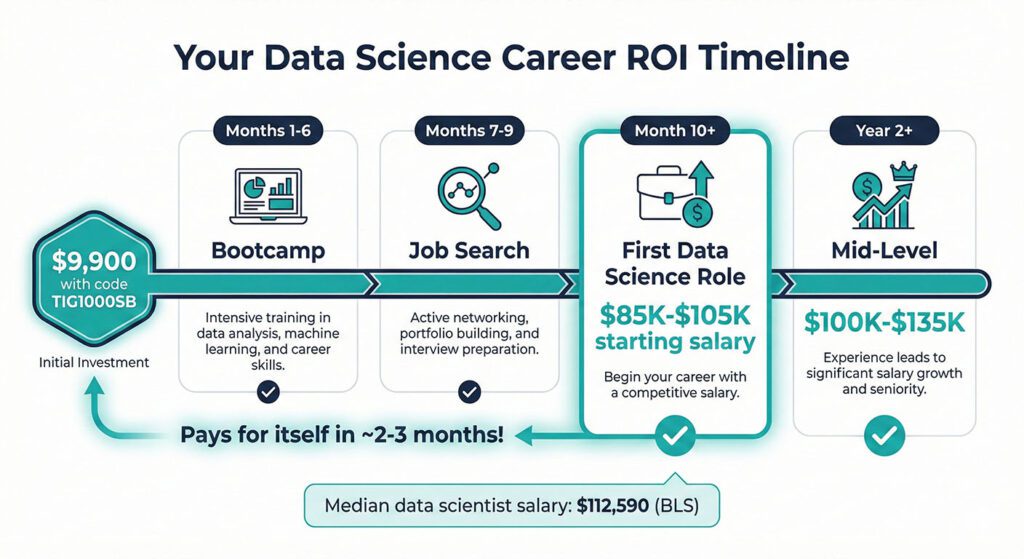
- At $10,900 to $12,900 in tuition, Springboard sits in the mid-range for data science bootcamps and offers strong ROI given that entry-level data scientists earn $85,000 to $105,000 per year.
- Self-paced flexibility is both the program’s greatest strength and its biggest risk because students without strong self-discipline may struggle to finish on time.
What You’re Actually Getting for Your Money
Before we talk about whether Springboard is worth it, let’s be clear about what you’re buying. This isn’t a Udemy course you’ll forget about in a week.
The basics:
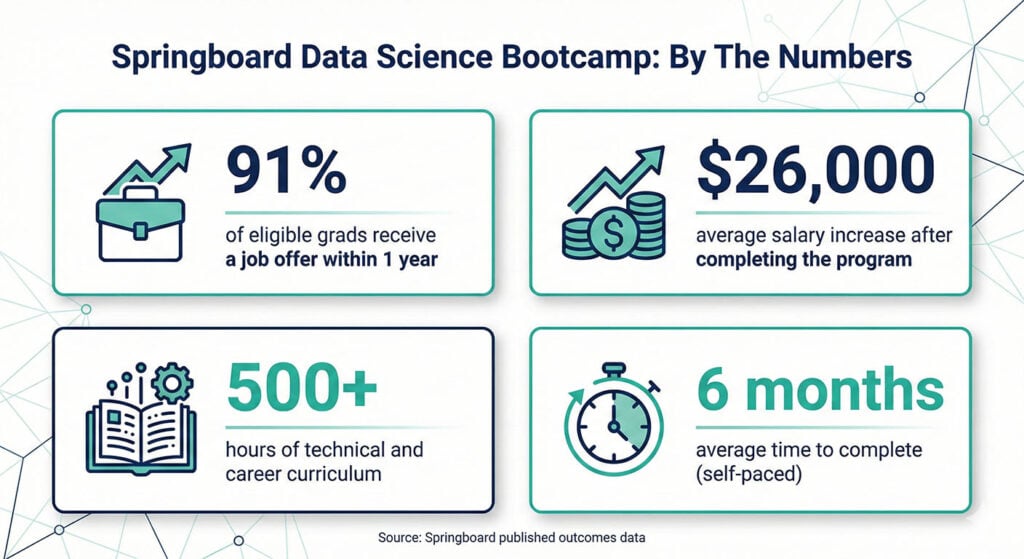
- Duration: 6 months (self-paced, 20 to 25 hours per week)
- Curriculum: 500 to 600 hours of technical and career content
- Projects: 28 mini-projects and 3 capstone projects
- Mentorship: Weekly 1:1 video calls with a working data scientist
- Career support: Resume coaching, interview prep, salary negotiation
- Job guarantee: Full tuition refund if you don’t land a qualifying role within 6 months of graduating (terms apply)
- Prerequisites: 6 months of coding experience plus basic probability and statistics
The cost breakdown:
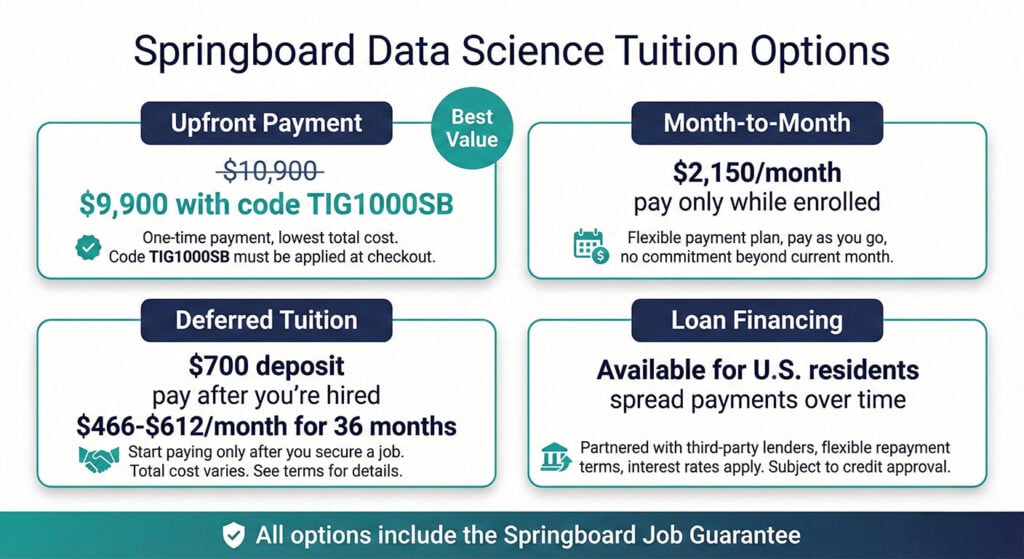
- Upfront (discounted): $10,900 (-> $9,900 with our discount code)
- Month-to-month: $2,150/month (roughly $12,900 if you finish in 6 months)
- Deferred tuition: $700 deposit, then $466 to $612/month for 36 months after you’re employed
- Loan financing: Available through lending partners for U.S. residents
And here’s something most reviews won’t tell you: we’ve partnered with Springboard to offer our readers $1,000 off tuition. Use the code TIG1000SB when you apply through our link to save. That brings the upfront price down to $9,900 and monthly payments to roughly $11,900 total.
Now let’s talk about whether that investment actually pays off.
The Curriculum: What You’ll Learn and What’s Missing
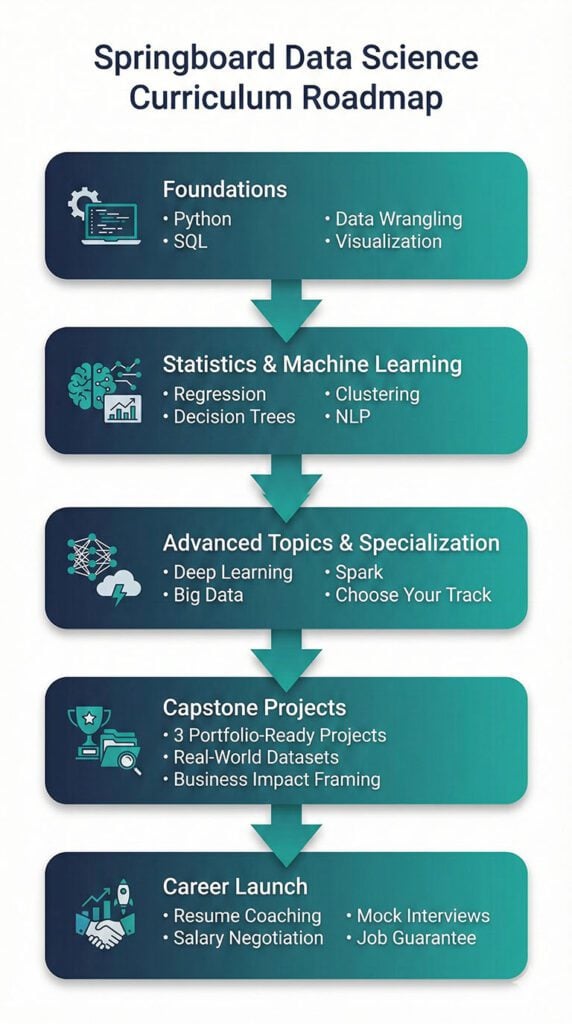
The Springboard Data Science Career Track covers the core toolkit that hiring managers expect. The curriculum was built in partnership with DataCamp and follows a logical progression from foundations to advanced topics.
Phase 1: Data Science Foundations
You’ll start with the Data Science Method, which is a structured approach to solving problems with data. This isn’t just “here’s how to code in Python.” It’s “here’s how to take a vague business question and turn it into something you can actually answer with data.”
Core skills in this phase:
- Python programming and key libraries (Pandas, NumPy, Matplotlib)
- SQL for querying databases
- Data wrangling and cleaning
- Exploratory data analysis
- Data visualization with Seaborn and Matplotlib
Interview Guys Tip: When hiring managers ask “walk me through your analysis process,” they’re testing whether you think like a scientist or just a coder. The Data Science Method training here gives you a framework to answer that question confidently. If you want to explore which certifications look best on your resume, the data science space consistently ranks near the top.
Phase 2: Statistical Analysis and Machine Learning
This is where the curriculum gets serious. You’ll move from descriptive statistics into inferential statistics, hypothesis testing, and then the machine learning algorithms that employers are actually hiring for.
What you’ll cover:
- Probability and statistics (the math behind the models)
- Linear and logistic regression
- Decision trees and random forests
- Clustering and dimensionality reduction
- Natural language processing basics
- Deep learning fundamentals
One thing we noticed in alumni reviews is that Springboard doesn’t just throw algorithms at you. The curriculum forces you to understand when to use which approach. That’s the difference between someone who can run a random forest in scikit-learn and someone a hiring manager actually wants on their team.
Phase 3: Big Data and Advanced Topics
The final technical phase covers working with larger datasets and more complex tools. You’ll get exposure to Apache Spark, cloud computing basics, and data storytelling.
Here’s where you’ll also choose a specialization, which lets you tailor your last few weeks toward a specific career path. Options have included natural language processing, deep learning, and advanced machine learning.
What the Curriculum Doesn’t Cover Well
Let’s be real about the gaps, because every bootcamp has them.
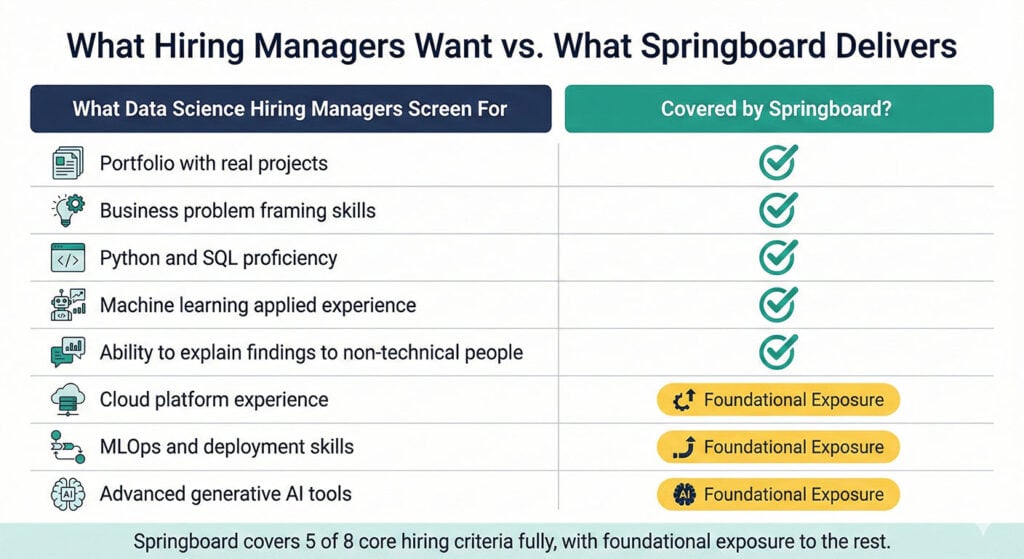
- Cloud infrastructure depth. You’ll get exposure to cloud platforms, but you won’t leave as an AWS or GCP expert. Most entry-level data science roles don’t require this, but it’s increasingly showing up in job descriptions.
- MLOps and model deployment. Building a model is one thing. Deploying it to production is another. Springboard touches on this but doesn’t go deep.
- Advanced SQL. The SQL coverage is solid for basics, but complex queries, window functions, and query optimization could use more attention based on what we see in job postings.
- Generative AI tooling. Given how fast this space is moving, the curriculum could do more to incorporate AI skills that employers are actually hiring for in 2026.
None of these are dealbreakers. But you should plan to supplement with free resources in these areas if you want to be competitive. The Bureau of Labor Statistics projects 35% job growth for data scientists through 2034 with a median salary of $112,590, so the investment in filling these gaps is absolutely worth your time.
The Mentorship: Springboard’s Real Secret Weapon (And Why It’s Worth the Price Alone)
If we had to point to one single reason to choose Springboard over cheaper alternatives, this is it.
Every student gets paired with a working data scientist who serves as their personal mentor for the entire program. You meet weekly for 30-minute video calls. They review your work, answer your questions, share industry insights, and hold you accountable.
No other bootcamp in this price range offers this level of personalized, 1:1 professional guidance. Not Coursera. Not DataCamp. Not self-study YouTube playlists. This is the feature that transforms a “course” into a genuine career accelerator.
After reading through dozens of alumni reviews, mentorship is the single most praised feature of the entire bootcamp. And it’s not even close.
One alumni reviewer on Course Report wrote that their mentor was “the best thing ever” and provided detailed feedback on 11 assignments submitted in a single week. Another graduate, writing on Towards Data Science, specifically called out how valuable it was to have someone who could explain not just the how but the why behind data science decisions.
One small thing to be aware of.
Like any large mentorship program, mentor quality can vary slightly. Most alumni report outstanding experiences with highly experienced industry professionals. A small number have mentioned being matched with mentors whose backgrounds didn’t perfectly align with their goals. One candid review noted: “A good mentor is what on its own can make Springboard worth it.”
Our advice: When Springboard asks about your mentor preferences during enrollment, be specific. Think about your career goals, the industries you’re targeting, and what kind of guidance you need most. And if your assigned mentor isn’t an ideal fit, request a change early. Springboard is responsive to these requests.
Interview Guys Tip: Your mentor relationship is also a networking asset. Many graduates report that their mentors provided referrals, introductions, and insider knowledge about specific companies. Treat this relationship like a professional connection, not just a tutoring session. When it comes time to list your bootcamp credentials on your resume, your mentor can also help you frame your projects in the language hiring managers respond to.
The Accountability Premium: What You’re Really Paying For
Let’s address the elephant in the room. A lot of the technical content in Springboard’s curriculum is sourced from places like DataCamp, Khan Academy, and open university lectures. Several alumni have pointed this out, and some critics have questioned why you’d pay $12,000 for material you could theoretically find for free.
Here’s our take, and it’s based on a pattern we’ve seen over and over with the job seekers we work with.
The content isn’t the product. The structure is.
The completion rate for self-directed online learning is notoriously low. Research consistently shows that fewer than 15% of people who start a MOOC actually finish it. Springboard’s model is designed to solve exactly this problem.
You’re paying for weekly mentor accountability. You’re paying for a structured learning path that someone else sequenced properly so you don’t waste months going in circles. You’re paying for career coaches who know how to position a bootcamp graduate’s resume. You’re paying for capstone projects that give you portfolio pieces with real feedback.
If you’re the type of person who can genuinely self-teach by piecing together free resources and staying disciplined for six months, then yes, Springboard may not be the best use of your money. But most people aren’t that person. And there’s no shame in that.
The alumni who get the most value from this bootcamp are the ones who treat it like a job. They show up to every mentor call prepared. They go beyond the minimum on their capstones. They actively engage with the career services team. The bootcamp provides the scaffolding, but you still have to climb it.
The Job Guarantee: A Genuine Safety Net (With Conditions)
Let’s be real. Very few bootcamps put their money where their mouth is. Springboard does.
Their money-back job guarantee means that if you complete the program and don’t receive a qualifying job offer within six months of graduating, they’ll refund your tuition in full. That’s not marketing fluff. That’s a real financial commitment from Springboard that fundamentally changes the risk equation for students.
Think about what that signals. A company doesn’t offer a guarantee like this unless they’re confident their graduates are getting hired. And the data backs it up: Springboard reports that 91% of eligible graduates receive a job offer within one year, with an average salary increase of $26,000. Those are not just strong numbers. Those are among the best in the bootcamp industry.
That said, the fine print matters. Here’s what you need to know:
- You must complete 100% of the core curriculum within the expected timeframe
- You need to be authorized to work in the U.S. within one year of graduation
- Geographic requirements apply. Historically, you needed to be willing to work in one of several major U.S. metro areas (cities like New York, San Francisco, Chicago, Seattle, and others)
- You must actively apply to jobs and follow Springboard’s career services requirements, including submitting a minimum number of applications per week and completing networking activities
Some Trustpilot reviews have highlighted occasional friction with the guarantee process, particularly around eligibility questions. This isn’t unique to Springboard and tends to happen across the bootcamp industry when students don’t fully understand the terms going in.
Our recommendation: Before you enroll, read the guarantee terms carefully and confirm your specific track is covered. Ask about what counts as a “qualifying position.” Being proactive here ensures you get the full protection this guarantee offers.
The bottom line on the guarantee? It’s one of the strongest in the industry. Springboard reports that 91% of eligible graduates receive a job offer within one year, with an average salary increase of $26,000. When a bootcamp is willing to stake its revenue on your success, that tells you something about how seriously they take outcomes.
The Capstone Projects: Your Interview Golden Ticket
This is where Springboard really earns its keep from a career perspective.
You’ll complete three capstone projects during the program, and these aren’t toy exercises. They’re designed to be portfolio pieces that you can walk through in detail during job interviews.
The final capstone is especially important. You’ll take a real dataset, define your own problem, apply the full data science method, build and evaluate models, and present your findings. Alumni consistently cite this as the most valuable part of the program.
Here’s why this matters so much from a hiring perspective. When we talk to data science hiring managers, the number one thing they want to see from career changers is evidence that you can work with messy, real-world data and extract meaningful insights. A completed capstone project with a clear business framing and well-explained methodology does exactly that.
Interview Guys Tip: Don’t just meet the minimum requirements on your capstone. Go above and beyond. Add a “business impact” section that quantifies your recommendations. Create clean visualizations you can pull up during a screen share. Write a companion blog post explaining your process. These extras are what separate “I completed a bootcamp” from “I’m ready to do this work.” Explore our guide to online certifications that pay well for more ways to stack credentials alongside your bootcamp completion.
What Real Alumni Say (The Good, the Bad, and the Honest)
We dug through reviews on Trustpilot, Course Report, SwitchUp, Medium, and Reddit to get the unfiltered picture. Here’s what patterns emerged.
The Positive Patterns
Mentorship gets the most praise by far. Alumni use words like “invaluable,” “incredible,” and “best thing ever” when describing their mentor experience. One graduate shared that their mentor “was an incredible sounding board while I was learning Python, during my capstone ideations, and throughout their execution.”
Career services get solid marks. Multiple alumni specifically credited the career coaching team with helping them rewrite their resumes, prepare for interviews, and negotiate salaries. The mock interview sessions were called out as particularly helpful.
The structure works for working professionals. The self-paced model consistently gets praise from people who were working full-time while completing the program. Several alumni mentioned that the flexibility was the deciding factor over competitors like General Assembly.
The Drawbacks (Because No Program Is Perfect)
Self-paced means self-motivated. The open-ended timeline is a double-edged sword. If you thrive with flexibility, you’ll love it. If you need hard deadlines to stay on track, build your own schedule and stick to it. The weekly mentor calls help with accountability, but ultimately the pace is up to you.
Curated content has small tradeoffs. Because some curriculum material comes from external sources like DataCamp, the teaching style can shift slightly between modules. The content quality is consistently high, but a few alumni noted the transitions could feel less seamless than a fully proprietary platform.
The community could be more active. Unlike in-person bootcamps, Springboard’s online model means less organic peer interaction. Springboard offers community forums and Slack channels, and some cohorts are more engaged than others. If community learning is important to you, make an effort to participate early and often.
You’ll still need to hustle after graduating. This applies to every bootcamp and educational program on the planet, but it’s worth stating clearly. Graduates who landed the best roles combined their Springboard work with personal projects, active networking, and smart job search strategies. The bootcamp gives you the foundation and support. Your effort determines the outcome.
How Springboard Stacks Up Against Alternatives
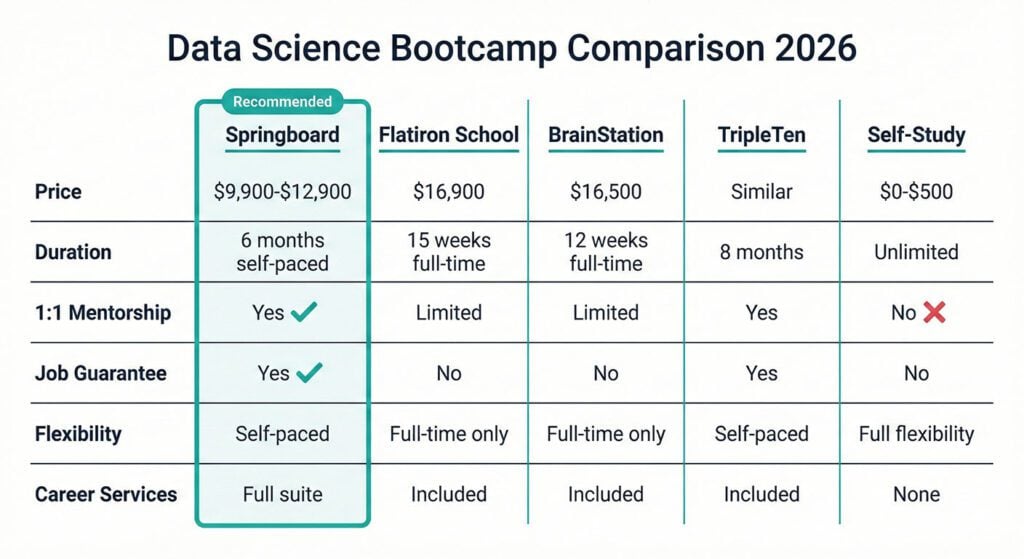
For context, here’s how the Data Science Career Track compares to other popular options:
- Flatiron School: $16,900 for 15 weeks full-time. More expensive, less flexible, but more immersive.
- General Assembly: Full-time only. Not ideal if you’re working.
- BrainStation: $16,500 for 12 weeks. Also more expensive.
- TripleTen: 8 months, comparable pricing. Offers “externship” projects with real companies.
- DataCamp/Coursera self-study: $0 to $500, but no mentorship, no accountability, no career services.
Springboard hits the sweet spot that most competitors miss. It’s significantly cheaper than Flatiron and BrainStation while offering features (1:1 mentorship, job guarantee) that those pricier programs don’t always match. And compared to free or cheap self-study options, the structure, accountability, and career services justify the investment many times over.
For working professionals making a career change, Springboard offers the best combination of flexibility, support, and career outcomes in the data science bootcamp space.
Who Should (and Shouldn’t) Enroll
This bootcamp is a great fit if you:
- Have some coding experience and want to formalize your data science skills
- Are working full-time and need a flexible, self-paced program
- Learn well with 1:1 guidance rather than classroom settings
- Want career services and a job guarantee as part of the package
- Are making a career change from an analytical field (engineering, finance, research) into data science
Think twice if you:
- Are a complete beginner with zero coding or math background (consider the prep course first)
- Need a lot of peer interaction and collaborative learning to stay motivated
- Are targeting senior or specialized roles where a master’s degree is the standard expectation
- Struggle with self-paced learning and need someone to set a rigid schedule for you
- Are outside the U.S. and want the job guarantee (geographic restrictions apply)
How to Maximize Your Investment
If you do decide to enroll, here’s what separates graduates who land great jobs from those who struggle. These insights come directly from alumni who’ve been through it.
Start networking from day one. Don’t wait until you graduate to build your professional network. Join data science communities on LinkedIn, attend virtual meetups, and start connecting with people in your target industry while you’re still in the program.
Go deep on your capstones. Treat each capstone project like you’re presenting it to a CEO, not a professor. Frame everything in terms of business impact. Include dollar figures wherever possible. Hiring managers love candidates who think in terms of outcomes, not just outputs.
Supplement the gaps. Spend extra time on SQL (LeetCode has great practice problems), get comfortable with at least one cloud platform (AWS free tier is your friend), and stay current on generative AI tools. These extras will make you stand out.
Use the career services aggressively. Book every available coaching session. Get your resume reviewed multiple times. Do as many mock interviews as they’ll let you. This is part of what you’re paying for, so extract every dollar of value.
Build in public. Post about what you’re learning on LinkedIn. Write about your capstone projects. Share your code on GitHub. The job seekers who get found by recruiters are the ones who are visible. Check out our guide to listing AI and data skills on your resume for specific strategies.
The Bottom Line: Our Verdict
Here’s how we’d rate the Springboard Data Science Career Track across the categories that actually matter for your career:
- Curriculum quality: 4.5 out of 5. Comprehensive, well-sequenced coverage of core data science skills with minor gaps in bleeding-edge topics.
- Mentorship: 5 out of 5. The standout feature and worth the price of admission alone. No other bootcamp in this range offers comparable 1:1 professional guidance.
- Career services: 4.5 out of 5. Strong resume coaching, mock interviews, and salary negotiation support that alumni consistently credit for their job search success.
- Job placement support: 4.5 out of 5. The money-back job guarantee is among the strongest in the industry. 91% of eligible graduates receive offers within a year.
- Value for money: 5 out of 5. Mid-range pricing with premium features. Factor in the job guarantee and the $1,000 discount with our code, and the risk-to-reward ratio is outstanding.
- Flexibility: 4.5 out of 5. Self-paced, fully online, and designed for working professionals.
Overall: 4.7 out of 5.
Springboard’s Data Science Career Track is one of the strongest bootcamp investments you can make in 2026. The mentorship model gives you something that no amount of self-study can replicate: personalized guidance from someone who does this work professionally every day. The job guarantee gives you financial protection that almost no other educational investment offers. And the curriculum, while not perfect, covers the core skills that hiring managers are actually screening for.
Is it a substitute for a master’s degree in data science? No. It’s not trying to be. But for career changers who want a structured, supported path into a field where the median salary is $112,590 and jobs are growing 35% faster than average, this is the program we recommend.
If you’re serious about breaking into data science, Springboard’s Data Science Career Track is our top recommendation for 2026. The mentorship alone sets it apart, and the job guarantee means you’re not taking this leap alone. Use our exclusive link to apply and don’t forget to use the code TIG1000SB to get $1,000 off your tuition. That’s a real discount that makes an already strong investment even smarter.
The bootcamp gives you the curriculum, the mentor, and the career support. What you do with those tools is up to you.
Frequently Asked Questions
Is Springboard’s Data Science Bootcamp worth it in 2026?
For most career changers with some coding background, yes. The combination of 1:1 mentorship, portfolio projects, career services, and a job guarantee makes it one of the more complete bootcamp offerings on the market. The key is whether you have the self-discipline to follow through on a self-paced program.
How long does the Springboard Data Science Bootcamp take?
The program is designed to be completed in about 6 months at 20 to 25 hours per week. However, it’s self-paced, so motivated students can finish faster and less available students can take longer. Finishing faster also means paying less if you’re on the month-to-month plan.
Can I do Springboard while working full-time?
Absolutely, and this is one of the program’s biggest strengths. The self-paced format and flexible mentor scheduling were specifically designed for working professionals. Many successful graduates completed the program while holding full-time jobs.
What jobs can I get after completing Springboard’s Data Science Bootcamp?
Graduates typically target roles like Junior Data Scientist, Data Analyst, Machine Learning Engineer, and Business Intelligence Analyst. According to Springboard, 91% of eligible graduates receive a job offer within one year, with an average salary increase of $26,000.
How does the Springboard job guarantee actually work?
If you complete 100% of the curriculum, meet all career services requirements (including applying to a set number of jobs per week), and don’t receive a qualifying job offer within six months of graduating, Springboard will refund your tuition. You must be authorized to work in the U.S. and willing to work in designated metro areas. Always confirm the specific terms before enrolling.
Disclosure: This article contains affiliate links. If you enroll through our partner link and use code TIG1000SB, you’ll save $1,000 on tuition. We only recommend programs we genuinely believe provide value to job seekers.
This is the general advice. Longbow applies it to your actual search: real match scores, ghost-job checks, and prep for the jobs worth your time. Here's the full story.

ABOUT THE INTERVIEW GUYS (JEFF GILLIS & MIKE SIMPSON)
Mike Simpson: Co-founder of The Interview Guys and Longbow. He has been the voice behind our interview advice since 2013 — his work has reached over 100 million job seekers around the world. The strategic mind behind Longbow, our new career platform.
Jeff Gillis: Co-founder of The Interview Guys and Longbow. He built the systems that put our work in front of those readers, and he leads the engineering on Longbow, the cutting edge career platform built for today’s job seeker.