
How to Ace Skills Assessments (The Tests Replacing Job Interviews)

The hiring game has fundamentally changed. If you’re still polishing your resume and rehearsing interview answers, you’re preparing for yesterday’s job market.
Today, 76% of employers use some form of skills testing to screen candidates, according to TestGorilla’s 2025 research. Companies like Target, Apple, Goldman Sachs, and Netflix have replaced significant portions of their traditional interview process with skills assessment platforms. These aren’t simple multiple-choice quizzes. They’re sophisticated evaluations that simulate real work scenarios, test your coding abilities in live environments, analyze your problem-solving approach, and even measure personality traits through AI-powered analysis.
The shift is dramatic. Research shows work sample tests are among the strongest predictors of future job success, far outperforming traditional interviews in accuracy. While unstructured interviews have only a 0.14 correlation with actual job performance, cognitive ability tests and work samples show correlations between 0.65 and 0.74, making them significantly more reliable.
For job seekers, this transformation creates both challenges and opportunities. On one hand, you’re facing standardized tests that leave little room for charm or improvisation. On the other, these assessments level the playing field by focusing purely on your abilities rather than your interview polish, educational pedigree, or personal connections.
By the end of this article, you’ll understand exactly which platforms companies use, what types of assessments you’ll encounter, and most importantly, how to prepare strategically for each one. Whether you’re applying for technical roles requiring Codility coding challenges or customer service positions using HireVue video assessments, you’ll know how to showcase your real capabilities when it matters most.
☑️ Key Takeaways
- 76% of employers now use skills tests during hiring, with work sample assessments becoming the gold standard for evaluating real-world capabilities
- Companies using skills assessments report 82% better quality of hires and 89% higher employee retention compared to traditional interview-only approaches
- Skills assessment platforms like HireVue, Codility, and TestGorilla evaluate everything from coding abilities to personality traits through standardized, AI-powered tests
- Proper preparation requires platform-specific practice, understanding assessment types, and simulating real test conditions before your actual evaluation
Why Skills Assessments Are Replacing Traditional Interviews
The numbers tell a compelling story about why employers are moving away from conventional interviews.
Traditional hiring methods are failing. Studies reveal that 46% of new hires made through resume and interview-based selection fail within 18 months. Only 19% of traditionally hired employees reach “unqualified success” in their roles, while 82% of hiring managers acknowledge their current hiring process isn’t working effectively.
The problem isn’t just bad hires, it’s expensive ones. The Department of Labor estimates each bad hire costs at least 30% of the employee’s first-year salary. For a $50,000 position, that’s $15,000 lost in wasted recruiting time, training costs, productivity losses, and team disruption.
Skills assessments solve multiple hiring problems simultaneously. They reduce unconscious bias by evaluating candidates against standardized criteria rather than subjective impressions. They predict job performance more accurately than resumes or interviews. And they dramatically speed up the hiring process by quickly filtering out candidates who lack necessary competencies.
Major corporations recognize this value. About 80% of Fortune 500 companies now use personality and skills assessments as core components of their hiring strategy, according to Psychology Today. These organizations aren’t adopting these tools experimentally. They’re seeing measurable returns in reduced turnover, improved quality of hire, and faster time to productivity for new employees.
The pandemic accelerated this shift by making remote hiring standard practice. Companies needed objective ways to evaluate candidates they’d never meet in person. Skills assessment platforms provided the solution, offering standardized evaluations that worked just as effectively for remote candidates as in-person applicants.
Interview Guys Tip: Don’t view skills assessments as obstacles to overcome. They’re actually opportunities to prove your capabilities to employers who might have dismissed your resume for lacking traditional credentials like specific degrees or brand-name companies. These tests focus on what you can do, not where you’ve been.
Before you prepare, note that the SPECIFIC Skills Assessment Interview questions depend on your company and role:
Understanding the Major Skills Assessment Platforms
Your Resume Needs Multiple Certificates. Here’s How to Get Them All…
We recommend Coursera Plus because it gives you unlimited access to 7,000+ courses and certificates from Google, IBM, Meta, and top universities. Build AI, data, marketing, and management skills for one annual fee. Free trial to start, and you can complete multiple certificates while others finish one.
Different companies use different platforms depending on the roles they’re filling. Here’s what you need to know about the major players.
HireVue: Video Interviews Meet AI Analysis
HireVue combines video interviewing with AI-powered assessment of your responses. The platform has evaluated over one million job seekers for more than 100 employers, including companies like Amazon, Delta Airlines, and major financial institutions.
When you take a HireVue assessment, you’re typically recording video responses to pre-set questions. The AI analyzes multiple factors including your word choice, speech patterns, response structure, and in some implementations, facial expressions and vocal tone.
What makes HireVue distinct is its focus on soft skills and cultural fit alongside technical evaluation. The platform uses game-based assessments to measure cognitive abilities, problem-solving speed, and decision-making patterns in ways that feel less like traditional testing.
Codility: The Technical Assessment Standard
Codility has evaluated over 16 million engineers across 68 countries, earning a 96% customer satisfaction rating among hiring companies. If you’re applying for developer, data scientist, or engineering roles, you’ll likely encounter Codility.
The platform provides a real-time coding environment where you complete programming challenges that mirror actual work scenarios. Codility’s AI automatically detects plagiarism, analyzes code efficiency, and evaluates your problem-solving approach, not just whether your code produces correct output.
Codility assessments typically range from 60 to 90 minutes and cover everything from basic syntax to complex algorithm design. The platform supports multiple programming languages and provides detailed reports on code quality, performance optimization, and edge case handling.
TestGorilla: Comprehensive Skills Evaluation
TestGorilla offers over 300 different assessment types covering coding, cognitive abilities, personality traits, and job-specific skills. The platform is designed for versatility, allowing companies to build custom test combinations that evaluate multiple competencies in a single assessment battery.
TestGorilla’s assessments include anti-cheating tools like webcam proctoring, question randomization, and time limits. Their 2025 State of Skills-Based Hiring Report found that 85% of employers are now using skills-based hiring, marking a significant shift from traditional resume screening.
Pymetrics: Neuroscience-Based Assessment
Pymetrics takes a unique approach using neuroscience-based games to assess cognitive, social, and behavioral traits. The platform analyzes how you make decisions, respond to patterns, process information under pressure, and demonstrate emotional intelligence.
What makes Pymetrics controversial is its use of traits assessment rather than skills testing. The games measure innate characteristics like risk tolerance, attention span, and fairness considerations. Companies like Unilever and JPMorgan use Pymetrics to identify candidates who match their top performers’ behavioral patterns.
HackerRank: Collaborative Coding Evaluation
HackerRank focuses on technical assessment with over 2,500 pre-built coding challenges across 45+ programming languages. The platform has conducted over 12,000 AI-powered interviews as of 2025, evaluating candidates on knowledge depth, problem-solving strategies, and code quality.
HackerRank’s live interview feature allows companies to observe your problem-solving process in real time through pair programming sessions. The platform includes Proctor mode for full-session replays to detect suspicious activity.
Types of Skills Assessments You’ll Encounter
Understanding what you’re being tested on helps you prepare strategically.
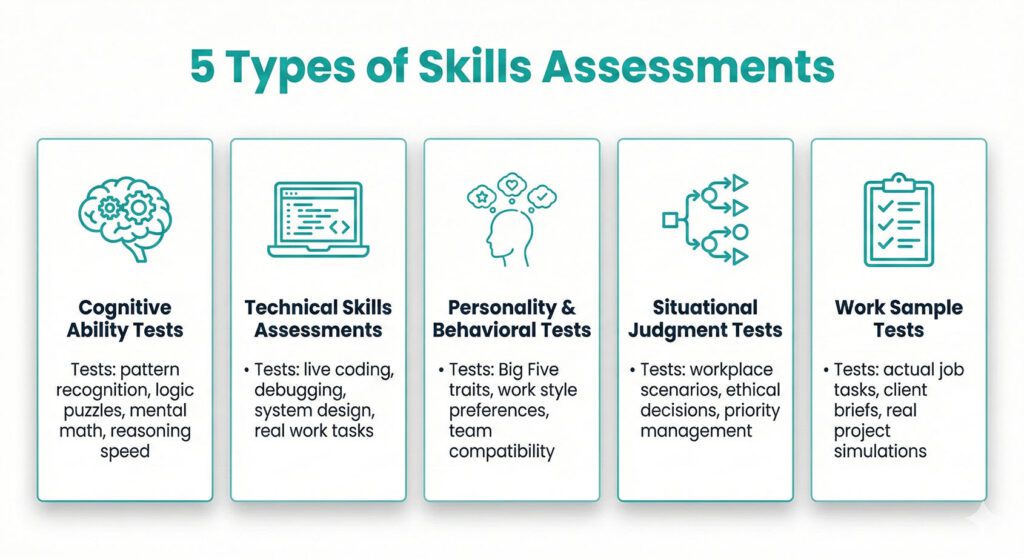
Cognitive Ability Tests
These assess your reasoning, memory, arithmetic skills, reading comprehension, and problem-solving speed. Cognitive ability tests have a 0.65-0.74 correlation with job performance, making them four times more predictive than education level and three times more predictive than experience.
Questions might ask you to identify patterns in sequences, solve logic puzzles, analyze data sets, or perform mental math. These tests are timed, with the difficulty increasing as you progress through correct answers.
Technical Skills Assessments
For tech roles, you’ll complete actual coding challenges, database queries, system design problems, or debugging exercises. These work samples evaluate what you can actually do, not just what you claim to know.
82% of companies using these assessments report improved quality of hires. The tests simulate real job tasks, offering hiring managers accurate predictions of your on-the-job capabilities.
Personality and Behavioral Tests
These evaluate traits like conscientiousness, extraversion, openness to experience, agreeableness, and stress tolerance. The most widely used framework is the Big Five personality model, which has been validated across thousands of studies.
Companies aren’t looking for a single “correct” personality type. They’re identifying whether your natural working style aligns with role requirements and team dynamics. A sales position might prioritize extraversion and resilience, while a data analyst role might value conscientiousness and openness to experience.
Situational Judgment Tests
These present realistic work scenarios and ask how you’d respond. You might see questions about handling difficult customers, managing conflicting priorities, navigating ethical dilemmas, or responding to workplace conflicts.
Situational judgment tests measure your practical decision-making rather than theoretical knowledge. There are often multiple acceptable responses, with scoring based on how closely your choices align with the company’s values and proven best practices.
Work Sample Tests
These are the most predictive assessment type. You complete actual job tasks like writing code that solves a business problem, designing a marketing campaign based on a client brief, analyzing financial data and presenting recommendations, or handling simulated customer service interactions.
89% of businesses report increased employee retention after implementing skills-based hiring with work samples. These tests show employers exactly how you’ll perform in the role, eliminating much of the guesswork from hiring decisions.
Interview Guys Tip: Work sample tests level the playing field dramatically. Candidates who might stumble through traditional interviews often excel when given the chance to demonstrate their actual skills. Approach these assessments with confidence, knowing they’re designed to showcase your real capabilities.
How to Prepare for Skills Assessment Platforms
Generic test prep won’t cut it. You need platform-specific and assessment-type-specific strategies.
Research the Specific Platform
Find out which assessment platform the company uses. Check the job posting, company careers page, or ask your recruiter directly. Many companies explicitly mention using HireVue, Codility, or other specific platforms.
Visit the platform’s website and review their practice materials. Most major platforms offer sample questions, demo tests, or candidate preparation guides. Codility provides practice coding challenges. HireVue offers video interview tips and sample question formats.
Join online communities where candidates discuss their experiences. Reddit’s job search forums, Blind, and Glassdoor company reviews often contain detailed breakdowns of what specific assessments involve.
Master Your Technical Environment
Technical assessments require you to work in specific coding environments or interfaces. Practice in the actual IDE or testing environment before your assessment date.
If you’re taking a Codility test, familiarize yourself with their web-based IDE interface. Understand how to run test cases, view error messages, and submit your final solution. If it’s HackerRank, practice using their code editor and test runner.
Check your technology setup thoroughly. Ensure your internet connection is stable, your webcam and microphone work properly, and your computer meets the platform’s technical requirements. Test everything in advance, not five minutes before your assessment starts.
For video assessments, practice your lighting, camera angle, and background. You want to look professional without seeming overly staged.
Practice Under Real Conditions
Taking practice tests casually in your living room doesn’t replicate actual assessment pressure. Simulate real test conditions as closely as possible.
Set strict time limits matching the actual assessment. If you’ll have 90 minutes for coding challenges, give yourself exactly 90 minutes during practice. Don’t pause the timer or give yourself extra time.
Complete practice assessments in a quiet environment without distractions. Treat it like the real thing by dressing professionally, minimizing interruptions, and maintaining focus throughout.
Track your performance on practice tests to identify patterns. Are you consistently running out of time? Struggling with certain question types? Missing edge cases in your code? Understanding your weak points directs your preparation efforts effectively.
Study Relevant Frameworks and Methodologies
For behavioral assessments, review common frameworks like the SOAR Method (Situation, Obstacle, Action, Result) for structuring your responses. We cover this extensively in our guide to mastering AI-powered job interviews.
For technical assessments, review fundamental algorithms and data structures. Even senior developers benefit from brushing up on basics like sorting algorithms, search algorithms, tree traversal, graph problems, and dynamic programming.
For personality tests, understand what traits the assessment measures and why companies value them. You can’t fake these tests effectively, but understanding their purpose helps you respond authentically without second-guessing every answer.
Understand Anti-Cheating Mechanisms
Modern assessment platforms include sophisticated integrity monitoring. Codility detects code plagiarism by comparing your solution against millions of previous submissions. HireVue uses proctoring technology to monitor unusual activity.
Don’t attempt to cheat. You’ll likely get caught, and even if you don’t, you’ve only set yourself up to fail in a job you can’t actually perform.
Instead, understand what’s considered acceptable. Can you reference documentation during coding tests? Most platforms allow checking syntax or API references but prohibit copying entire solutions. Can you use AI tools for preparation? Absolutely, but not during the actual assessment.
Manage Test Anxiety Strategically
Assessment anxiety is real and can significantly impact your performance. Develop specific strategies for managing stress before and during tests.
Practice relaxation techniques like deep breathing or progressive muscle relaxation. Use them both during preparation and immediately before starting your assessment.
Remember that skills assessments are designed to measure your actual abilities, not trick you. Companies want to see what you can really do. If you’re qualified for the role, the assessment will reflect that when you perform authentically.
If you make a mistake during the test, don’t let it derail your performance on remaining questions. Move forward and focus on what you can still get right.
Platform-Specific Preparation Strategies
Each major platform has unique characteristics requiring tailored preparation.
HireVue Preparation
Practice speaking clearly and concisely to the camera. HireVue typically gives you limited time to respond to each question, so verbosity works against you.
Structure your video responses using frameworks like SOAR. Start with a brief situation overview, identify the obstacle or challenge, explain your specific actions, and conclude with measurable results.
Review common behavioral interview questions before your HireVue assessment. While you won’t know the exact questions, you’ll likely encounter variations on themes like handling difficult situations, demonstrating leadership, working in teams, and managing competing priorities. Our guide on common job interview questions covers these patterns extensively.
For game-based assessments, complete practice games on the HireVue website. These aren’t the actual assessment games, but they demonstrate the format and help you understand how gamification testing works.
Pay attention to technical details. Ensure good lighting on your face, position your camera at eye level, minimize background distractions, and test your audio quality. These factors influence how evaluators and AI systems perceive your responses.
Codility Preparation
Focus on writing clean, efficient code rather than just solving problems. Codility’s evaluation considers code quality, not just correctness.
Review time and space complexity concepts. Understand Big O notation and be able to analyze your solution’s efficiency. Many Codility problems have multiple valid solutions, with better scores awarded for more efficient approaches.
Practice writing code without debugging tools. While Codility provides a basic IDE, you won’t have the full debugging capabilities of your usual development environment. Strengthen your ability to mentally trace through code and spot logical errors.
Work through Codility’s public practice problems before your actual assessment. These give you direct experience with the platform’s interface, question format, and difficulty level.
Time management is crucial. Most Codility assessments include multiple problems. If you’re stuck on one question, move to another rather than burning all your time on a single challenge.
TestGorilla Preparation
TestGorilla assessments combine multiple test types. Prepare across different domains rather than focusing narrowly on one area.
Review role-specific skills relevant to the position. If you’re applying for a marketing role, brush up on marketing fundamentals, analytics interpretation, and campaign planning. For administrative positions, review organizational systems, communication skills, and attention to detail.
Take TestGorilla’s sample tests to understand their question format and interface. The platform uses various question types including multiple choice, ranking exercises, file uploads for work samples, and open-ended responses.
Understand that TestGorilla tests your breadth of knowledge across soft skills, cognitive abilities, and technical competencies. Don’t neglect any area in your preparation.
Pymetrics Preparation
Pymetrics games assess innate traits rather than learned skills. You can’t study for these assessments the way you would for technical tests.
The best preparation is understanding what the games measure. Each game evaluates specific traits like risk tolerance, attention to detail, fairness considerations, pattern recognition, or emotional regulation.
Approach the games authentically rather than trying to manipulate your responses. Pymetrics uses sophisticated algorithms to detect inconsistent behavior patterns that suggest you’re not responding naturally.
Complete the practice games Pymetrics provides. While they’re not identical to the actual assessment, they familiarize you with the format and help you understand what to expect.
Get adequate rest before your assessment. Since Pymetrics games measure cognitive performance under various conditions, fatigue significantly impacts your results.
Interview Guys Tip: For platforms using AI analysis like HireVue or Pymetrics, the technology is evaluating patterns across thousands of data points. Trying to “beat” the AI by overthinking each response usually backfires. Your most authentic performance typically produces the best results.
Don’t go into your interview without knowing the Skills Assessment Interview questions your specific company uses:
Common Mistakes to Avoid
Even well-prepared candidates make avoidable errors that hurt their assessment performance.
Underestimating Preparation Time
Skills assessments aren’t something you can wing. The data is clear: candidates who practice systematically outperform those who don’t prepare.
Allocate specific practice time based on the assessment complexity. For technical coding tests, plan at least 10-15 hours of focused practice. For behavioral video assessments, dedicate time to rehearsing structured responses and testing your recording setup.
Start preparing as soon as you know you’ll face an assessment, not the night before.
Neglecting the Instructions
Every assessment begins with detailed instructions. Read them carefully and completely before starting.
Instructions tell you whether you can reference external resources, how much time you have for each section, whether questions must be completed in order, and how your responses will be evaluated.
Skipping or skimming instructions leads to avoidable mistakes like spending too much time on early questions, using prohibited resources, or misunderstanding what the question actually asks.
Failing to Check Technical Requirements
Nothing derails an assessment faster than technical problems you could have prevented.
Test everything at least 24 hours before your scheduled assessment. Verify your computer meets minimum requirements, your internet connection is stable, your browser is updated, and all required plugins or applications work properly.
Have a backup plan. Know what to do if your internet drops, your computer crashes, or the assessment platform encounters issues. Most platforms provide support contact information for technical emergencies.
Rushing Through Questions
Time pressure causes many candidates to rush, which ironically costs more time through careless errors.
Read each question completely before formulating your response. Understand what’s actually being asked, not what you assume the question says.
For coding challenges, spend time analyzing the problem requirements before writing code. Planning your approach saves time compared to coding immediately and debugging later.
For multiple-choice questions, eliminate obviously wrong answers before selecting your response. This improves accuracy without taking significant additional time.
Overthinking Personality Assessments
Personality tests trip up candidates who try to game the system by selecting what they think employers want rather than answering honestly.
Assessment platforms include validity scales that detect inconsistent response patterns. When your answers contradict each other or seem socially desirable rather than authentic, algorithms flag your results as unreliable.
Answer personality questions based on your actual preferences and tendencies. There’s no universally “right” personality type. Companies use these assessments to find good role fits, not to identify candidates who claim to have every positive trait.
Ignoring Instructions to Use Resources
Some assessments explicitly allow you to reference documentation, search for syntax, or use other resources. Don’t interpret these tests as memorization challenges when they’re actually evaluating practical problem-solving.
If Codility says you can look up API documentation, do it. Trying to recall everything from memory when you’re allowed to check references wastes time and increases errors.
Understand what resources are permitted and use them strategically to supplement your core knowledge.
After the Assessment: What Happens Next
Understanding the post-assessment process helps manage expectations and follow up appropriately.
Timeline for Results
Assessment platforms provide results to employers almost immediately after you complete the test. The algorithms score your performance automatically.
However, hearing back from the company takes longer. Hiring managers typically review assessment results alongside other candidates before making interview decisions. This process can take anywhere from a few days to several weeks.
If the company provided a timeline, respect it. Don’t follow up before the specified date unless they told you to.
How Companies Use Assessment Results
Skills assessments rarely serve as the sole hiring criteria. Companies use them to screen candidates for the next interview round rather than making final decisions based purely on test scores.
Strong assessment performance moves you forward in the process. Weak performance might eliminate you from consideration. Borderline results often lead to additional evaluation through interviews or supplementary assessments.
Your resume, interview performance, references, and assessment scores all contribute to the final hiring decision. An excellent assessment can overcome resume gaps, while a poor assessment can derail an otherwise strong application.
Requesting Feedback
Some platforms provide candidates with feedback on assessment performance. Others keep results confidential to employers.
You can ask the hiring company for feedback, though they’re not obligated to provide it. Frame your request professionally and specifically. Instead of “How did I do on the assessment?” try “I’m committed to improving my skills. Would you be willing to share any insights about areas where my assessment could have been stronger?”
Many companies won’t share detailed assessment results, but some provide general feedback that helps you improve for future opportunities.
Learning from the Experience
Every assessment provides valuable learning opportunities, regardless of the outcome.
Reflect on what went well and what you’d do differently. Did time pressure cause problems? Did certain question types prove more challenging than expected? Did your preparation strategy prove effective?
Document your experiences for future reference. Note which companies use which platforms, what question types appeared, approximately how long different sections took, and what strategies worked best.
This information helps you prepare more effectively for subsequent assessments and helps other job seekers when you share experiences in online communities.
The Future of Skills Assessment in Hiring
Skills assessment platforms will become even more sophisticated and prevalent.
By 2026, analysts predict that nearly all Fortune 500 companies will use AI-powered skills assessments as primary screening tools. The technology continues improving, with better fraud detection, more nuanced evaluation criteria, and increasingly realistic work simulations.
New assessment types are emerging. Virtual reality assessments place candidates in simulated work environments to evaluate performance under realistic conditions. You can read more about this trend in our article on virtual reality interviews.
Multi-modal assessments combine video analysis, cognitive testing, personality evaluation, and work samples into comprehensive batteries that evaluate candidates from multiple angles simultaneously.
The shift toward skills-based hiring benefits job seekers who have capabilities but lack traditional credentials. As assessments become more sophisticated and fair, they create more opportunities for candidates from non-traditional backgrounds to prove their abilities objectively.
Understanding skills assessment platforms isn’t optional anymore. It’s fundamental to navigating modern hiring processes successfully. The good news is that these assessments, when prepared for properly, provide clear opportunities to showcase your real capabilities to employers who value demonstrated skills over polished interviews or impressive resumes.
Conclusion
Skills assessment platforms have fundamentally transformed hiring. With 76% of employers using skills tests and 85% implementing skills-based hiring practices, these assessments aren’t a trend to wait out. They’re the new standard for how companies evaluate talent.
The platforms vary significantly. HireVue analyzes video responses and personality traits. Codility tests technical coding abilities in real time. TestGorilla offers comprehensive multi-skill batteries. Pymetrics uses neuroscience games to measure cognitive patterns. Each requires specific preparation strategies.
The key to success is deliberate, platform-specific practice under realistic conditions. Research which platform you’ll encounter, complete practice tests, master the technical environment, review relevant skills and frameworks, and simulate actual test conditions during preparation.
Remember that these assessments ultimately benefit candidates willing to prepare properly. They evaluate your actual abilities rather than your resume polish or interview charisma. When you understand the platforms, know what’s being tested, and prepare systematically, skills assessments become opportunities to prove your capabilities directly.
For more guidance on modern interview techniques, check out our comprehensive resource on how AI chatbot screening interviews work and our guide to job interview preparation in 2025.
You’ve got this. Go show them what you can really do.
This is the general advice. Longbow applies it to your actual search: real match scores, ghost-job checks, and prep for the jobs worth your time. Here's the full story.

ABOUT THE INTERVIEW GUYS (JEFF GILLIS & MIKE SIMPSON)
Mike Simpson: Co-founder of The Interview Guys and Longbow. He has been the voice behind our interview advice since 2013 — his work has reached over 100 million job seekers around the world. The strategic mind behind Longbow, our new career platform.
Jeff Gillis: Co-founder of The Interview Guys and Longbow. He built the systems that put our work in front of those readers, and he leads the engineering on Longbow, the cutting edge career platform built for today’s job seeker.