
The 2025 Job Market Year-End Review: How AI Reshaped American Employment [Research Report]
As 2025 draws to a close, American workers and employers find themselves navigating the most profound transformation of the job market in modern history. What began as experimental AI adoption has crystallized into a fundamental restructuring of how work gets done, who gets hired, and what qualifications matter most.
The numbers tell a stark story:
- Average time-to-hire stretched to 44 days, up from 31 days just two years ago according to comprehensive industry benchmarking data
- Entry-level positions plummeted by 29 percentage points since January 2024 based on Randstad’s analysis of 126 million global job postings
- Ghost jobs now represent between 18% and 30% of all online postings, wasting countless hours of job seekers’ time
- AI-related job postings surged 25.2% in Q1 2025 alone, with median salaries hitting $157,000 per Veritone’s labor market analysis
But beneath these headline statistics lies a more nuanced reality. This isn’t simply a story of AI replacing humans or technology eliminating jobs. Instead, 2025 revealed a complete reimagining of the employment landscape where 83% of companies now use AI resume screening despite 67% acknowledging bias concerns. Where job seekers submit an average of 32 to 200 applications before receiving an offer. Where remote work battles intensified even as hybrid arrangements stabilized as the dominant model.
This comprehensive year-end review synthesizes data from the U.S. Bureau of Labor Statistics, PwC’s Global AI Jobs Barometer analyzing nearly a billion job ads, Stanford research, McKinsey surveys, and analysis of over 126 million job postings globally. We examine what actually happened in 2025 across AI adoption, hiring timelines, entry-level opportunities, remote work evolution, and salary trends.
Whether you’re a job seeker trying to understand why the market feels so different, an employer wrestling with AI implementation decisions, or simply someone trying to make sense of conflicting headlines about the future of work, this report provides the data-driven answers you need.
☑️ Key Takeaways
- The hiring process expanded dramatically in 2025, with average time-to-hire reaching 44 days while application volumes exploded and ghost jobs proliferated, creating a paradox where millions of openings existed alongside millions of frustrated job seekers
- Entry-level positions declined 29 percentage points since January 2024 as AI adoption and economic uncertainty forced employers to raise the bar, fundamentally disrupting the traditional career ladder
- AI moved from experimental to essential in 2025, with 65% of recruiters implementing AI tools and AI-related job postings growing 25.2% year-over-year, but the technology created as many concerns as opportunities
- Remote work battles intensified even as hybrid became the dominant model, with major RTO mandates from Amazon, Dell, and federal government creating talent migration while 80% of companies reported losing employees due to inflexibility
The Numbers That Defined 2025
The Hiring Slowdown
The American job market in 2025 wasn’t characterized by dramatic unemployment spikes or mass layoffs. Instead, it was defined by something more insidious: a slow, grinding deceleration of hiring activity that left job seekers in limbo.
The extended timelines were staggering:
- Average time-to-hire reached 44 days across industries, up from 31 days in 2023 according to multiple benchmarking sources
- Manufacturing moved fastest at 30.7 days, while financial services lagged at 44.7 days
- Entry-level positions required 46 days to fill on average, despite being theoretically simpler roles
- Executive searches stretched to 90-120 days, consuming massive amounts of organizational time and energy
This represented a 42% increase in hiring duration in just two years, fundamentally changing the job search experience for millions of Americans.
The extended timelines weren’t just inconvenient. Research from Infeedo.ai revealed critical consequences:
- 57% of job seekers lose interest when hiring processes drag on beyond reasonable timelines
- Over half expect offers within one to two weeks, creating massive gaps between candidate expectations and employer reality
- The average interview process alone takes 23 days, not counting pre-interview screening or post-interview deliberations
Yet companies kept adding interview rounds, assessment stages, and stakeholder reviews, creating a mismatch that frustrated everyone involved.
Interview Guys Take: The obsession with immediate follow-ups is outdated advice that needs to die. When the average interview process stretches to 23 days, candidates who follow the old “check in after 3 days” wisdom just annoy hiring managers who are still 20 days away from making decisions. The real skill isn’t persistence, it’s patience paired with volume. Apply to multiple opportunities simultaneously so you’re not emotionally invested in any single glacial-paced process.
The Application Volume Explosion
While hiring slowed, application volumes exploded in the opposite direction. Job seekers in 2025 faced a brutal numbers game where success required playing a high-volume strategy.
The application reality for most job seekers:
- 32 to 200 applications submitted before receiving an offer, depending on industry and experience level
- Only 0.1% to 2% of cold online applications result in job offers, making the process feel like throwing darts blindfolded
- Many job postings attracted 100+ applicants, yet only a tiny fraction advanced to interviews
- 7.74 million job openings existed in January 2025, but only 5.1 million hires occurred in August according to BLS JOLTS data
This massive gap between posted opportunities and actual hiring created a paradox that defined the year. The sheer volume overwhelmed applicant tracking systems and exhausted hiring teams.
For job seekers, the emotional toll of sending dozens or hundreds of applications with minimal response became one of 2025’s defining workplace mental health challenges, as documented in our comprehensive burnout research.
The Ghost Job Epidemic
Perhaps no single issue captured 2025’s job market dysfunction better than the ghost job phenomenon. These phantom postings for positions that don’t exist or that employers aren’t planning to fill immediately represented one of the year’s most frustrating revelations.
The scope of deception was staggering:
- 18% to 22% of all online job postings were ghost jobs according to Greenhouse’s analysis of major hiring platforms
- 45% of HR professionals admit they “regularly” post ghost jobs, while another 48% post them “occasionally” per LiveCareer’s March 2025 survey
- 93% of HR professionals engage in this practice to some degree, making it nearly universal
- Nearly 30% of job openings in June 2025 never resulted in hires, representing more than 2.2 million phantom roles according to MyPerfectResume’s BLS analysis
Geographic patterns emerged showing where the problem hit hardest:
- Los Angeles led at 30.5% of postings classified as ghost jobs
- Philadelphia followed at 30.1% and Indianapolis at 27.8%
- Seattle showed the lowest percentage at just 16.6%
Why did companies do this? Motivations varied widely:
- Building talent pipelines for future roles that might never materialize
- Signaling growth during hiring freezes to maintain market perception
- Leaving approved positions in limbo due to budget cuts
- Satisfying internal posting requirements without genuine hiring intent
- Testing market conditions or gauging salary expectations
The backlash intensified throughout 2025. Kentucky introduced legislation in January to ban ghost jobs outright. California passed similar legislation in March, requiring employers to disclose whether postings were for actual vacancies. A petition on Change.org seeking to clamp down on ghost jobs garnered nearly 50,000 signatures.
The AI Revolution in Hiring
Rapid Adoption Across Industries
AI adoption in recruitment moved from experimental to mainstream in 2025, with the statistics documenting this shift painting a clear picture of transformation.
The adoption numbers were striking:
- Over 65% of recruiters implemented AI by year-end according to comprehensive recruitment statistics
- Primary motivations included saving time (44%), improving candidate sourcing (58%), and reducing costs by up to 30% per hire
- 89% of HR professionals recognized AI’s potential to improve the applicant application process
- 87% of industries increased AI usage, including sectors less obviously exposed to AI such as mining and agriculture per PwC’s Global AI Jobs Barometer
PwC’s comprehensive analysis of nearly a billion job ads across six continents revealed that AI adoption accelerated dramatically across nearly every sector. Companies raced to integrate AI screening tools, chatbots for initial interviews, and automated resume parsing systems.
However, adoption wasn’t uniform across the market:
- Tech giants led the charge with comprehensive AI integration across recruitment workflows
- Financial services, healthcare, and professional services accelerated AI implementation throughout 2025
- Construction, hospitality, and trades remained largely human-driven in their hiring processes
- Mid-market companies moved cautiously, often implementing pilot programs before full rollouts
The Candidate Experience Gap
The rapid AI adoption created a significant disconnect between employer enthusiasm and candidate concerns. 66% of U.S. adults say they would avoid applying for jobs that use AI in recruitment, revealing deep skepticism about algorithmic fairness.
This wariness wasn’t unfounded. The data revealed troubling contradictions:
- 83% of companies use AI resume screening according to our comprehensive analysis
- Yet 67% acknowledge bias concerns exist with algorithmic screening
- 35% of recruiters fear AI may overlook unique talent, creating tension between efficiency and effectiveness
- 66% of job seekers express discomfort with AI-driven hiring decisions
Forbes research found interesting benefits. Candidates selected by AI rather than humans have a 14% higher chance of passing interviews and an 18% higher chance of accepting job offers when offered, suggesting algorithms might reduce certain biases even while introducing others.
The job seeker response created an arms race:
- 50% of Gen Z candidates reported using AI tools in their job search by mid-2025
- Gen X followed at 37% and Baby Boomers at 29%
- Both employers and candidates deployed increasingly sophisticated tools, each trying to game the other’s systems
- AI-powered resume optimization became essential for passing initial screening stages
Interview Guys Take: The “AI is biased, avoid those companies” crowd is missing the bigger picture. AI screening isn’t going away, and pretending otherwise just shrinks your job pool. The uncomfortable truth is that algorithmic screening, for all its flaws, often introduces less bias than the hiring manager who unconsciously favors candidates from their alma mater. The winners in this market aren’t those boycotting AI-screened applications, they’re the ones who’ve mastered speaking both languages: human storytelling in cover letters and keyword optimization for the machines.
The Entry-Level Collapse
If any single statistic captured AI’s immediate impact on employment, it was the decimation of entry-level opportunities. The numbers told a devastating story for new workforce entrants.
The decline was unprecedented:
- Global entry-level job postings fell 29 percentage points since January 2024 according to Randstad’s analysis
- U.S. postings for entry-level jobs declined 35% since January 2023 per Revelio Labs data
- SignalFire found a 50% decline in new role starts by people with less than one year of experience at major tech firms
- Junior tech roles declined 35%, logistics by 25%, and finance by 24%
The pattern repeated globally with disturbing consistency:
- Indian IT services reduced entry-level roles 20-25% due to automation according to EY analysis
- European job platforms noted 35% declines in junior tech positions across major EU countries
- The World Economic Forum warned that 40% of employers expected to reduce staff where AI could automate tasks
The human impact was devastating. Our research revealed that 76% of employers hired the same number or fewer entry-level employees in 2025 than in 2024. As of June 2025, the unemployment rate for college graduates aged 22-27 hit 4.8%, notably higher than the overall rate of 4.0%.
This wasn’t just about young workers. The traditional career ladder that allowed workers to start at entry level and rise to executive positions was fundamentally disrupted, as documented in IEEE Spectrum’s analysis.
The AI Job Market Boom
While AI eliminated many traditional entry-level roles, it simultaneously created explosive demand for AI-adjacent positions. The paradox of 2025 was that AI both destroyed and created opportunities, though not always for the same people.
The growth in AI-specific roles was remarkable:
- AI-related job postings rose 25.2% in Q1 2025 with median salaries hitting $157,000 per Veritone’s analysis
- Between January and April, postings more than doubled from 66,000 to nearly 139,000
- Machine learning engineers saw 41.8% year-over-year growth, making them the fastest-growing job category
- Data scientists experienced 10% growth, with new emphasis on generative AI capabilities
LinkedIn’s Future of Work Report documented that AI-related job postings on the platform grew 38% between 2020 and 2024, making it one of the fastest-growing categories globally.
Skills demand exploded across sectors:
- Healthcare saw 40% increases in job postings for AI specialists since 2020
- Financial services experienced similar surges in AI-related hiring
- Generative AI skills grew from 55 job listings in 2021 to nearly 10,000 in May 2025
- New positions emerged including Generative AI Engineer, AI Product Manager, AI Governance Lead, and AI Ethics Specialist
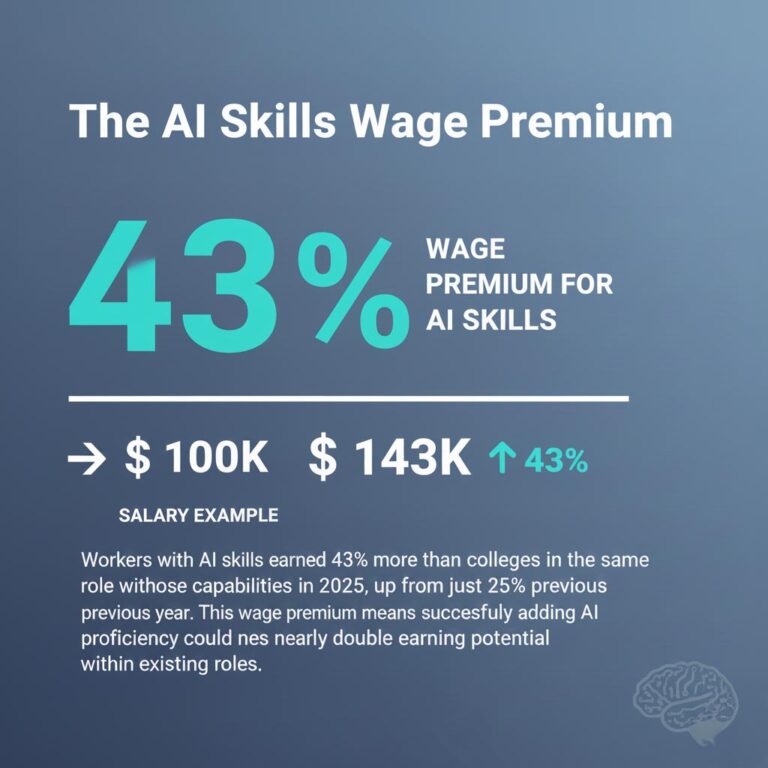
The wage premium was substantial. Workers with AI skills earned 43% more than colleagues in the same role without those capabilities according to PwC’s research, up from 25% the previous year. This meant successfully adding AI proficiency could nearly double earning potential within existing roles.
Understanding essential AI skills for your resume became crucial for workers across all industries, not just technology.
Remote Work: The Battle Continues
The Mandate Wave
If AI dominated the first half of 2025’s employment headlines, return-to-office mandates dominated the second half. What many thought was settled in 2024 roared back as major employers drew hard lines on in-office presence.
The mandate announcements came in rapid succession:
- Amazon mandated five days per week in-office starting January 2026, affecting thousands of tech workers
- Dell eliminated hybrid work entirely in March 2025, forcing a choice between full office return or departure
- JPMorgan Chase, Boeing, AT&T, and UPS implemented similar full-time office mandates throughout the year
- The federal government made the biggest splash with President Trump’s January 2025 executive order affecting hundreds of thousands of workers
The motivations behind these mandates remained controversial. While executives publicly cited collaboration, innovation, and company culture, research from BambooHR revealed more calculated strategies:
- One in four C-suite executives admitted they hoped RTO policies would lead to voluntary turnover
- One in five HR professionals acknowledged their in-office policy was explicitly designed to make staff quit
- Some companies used RTO mandates as “stealth layoffs”, avoiding formal layoff processes and severance costs
This practice drew increasing scrutiny as the year progressed, as documented in comprehensive remote work research.
The Employee Response
Workers didn’t accept these mandates quietly. The pushback throughout 2025 was substantial and immediate, with data revealing the depth of employee commitment to flexibility.
The resistance was widespread and quantifiable:
- 46% of hybrid and remote workers would be unlikely to stay if called back full-time according to Pew Research Center
- 80% of companies already lost talent because of RTO mandates by mid-2025 per Resume Builder
- High-performing employees were 16% more likely to have low intent to stay if facing RTO mandates based on Gartner research
- Companies with strict RTO had 13% higher turnover (169% vs. 149%) according to ZipRecruiter data
The compensation trade-offs workers were willing to make revealed the depth of their commitment:
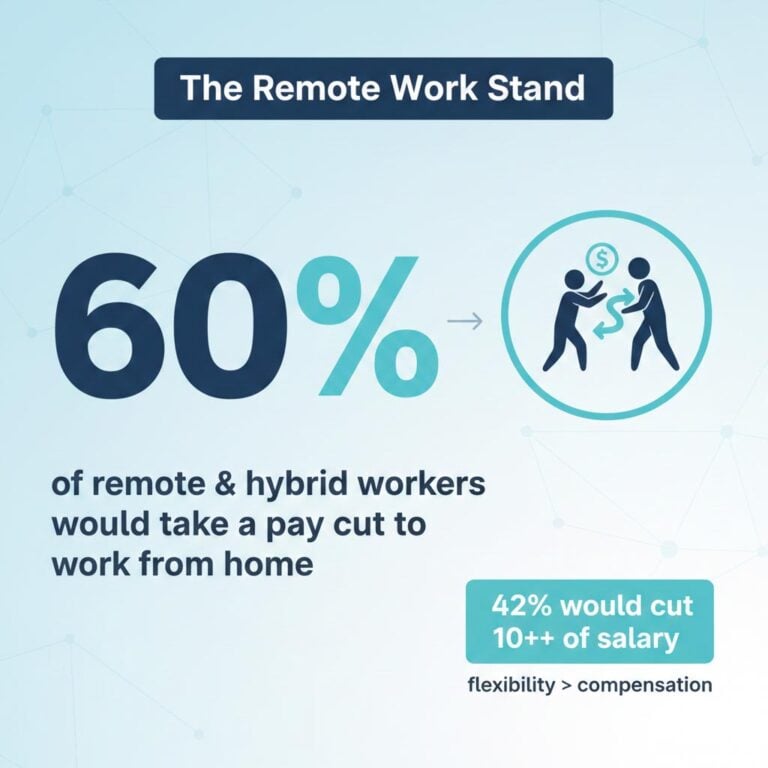
- 60% of remote and hybrid workers would take pay cuts to continue working from home
- 42% would accept pay cuts of 10% or more to maintain flexibility
- Stanford research showed hybrid work flexibility was valued at approximately 8% of salary equivalent
- Workers effectively took implicit pay cuts to maintain location independence
Some workers simply ignored mandates or began requesting formal accommodations to stay remote, creating compliance challenges and stress for HR departments trying to enforce policies.
The Hybrid Reality
Despite headline-grabbing mandate stories, the actual data showed hybrid work stabilizing rather than disappearing. The numbers revealed a more nuanced picture than doom-and-gloom headlines suggested.
The real distribution of work arrangements in early 2025:
- 61% of full-time employees were completely on-site, showing traditional offices still dominated
- 26% worked hybrid arrangements, representing the fastest-growing segment
- 13% were fully remote, down from pandemic peaks but still substantial
- 60% of remote-capable employees preferred hybrid according to Gallup, with 30% wanting fully remote and less than 10% preferring on-site
Stanford economist Nicholas Bloom reported that most professionals worked in hybrid setups by year-end, typically attending offices three days per week. While fully remote roles declined sharply from 21% in 2023 to just 7% in 2024, hybrid arrangements proved remarkably resilient.
Interestingly, the picture wasn’t universally negative:
- 31% of businesses reduced remote-work options in 2024, but 33% expanded them according to ZipRecruiter
- U.S. national office vacancy rate remained at 19.7% as of March 2025, unchanged despite RTO mandates
- Coworking spaces gained 25% year-over-year as companies and workers sought flexible alternatives
- Small and mid-sized companies often offered more flexibility to compete for talent against bigger firms
Interview Guys Take: The death of remote work has been greatly exaggerated by CEOs with expensive commercial real estate leases. Here’s what the data actually shows: while headline-grabbing Amazon and JPMorgan mandates dominate the news, thousands of small and mid-sized companies are quietly scooping up remote-friendly talent that big tech just alienated. The real arbitrage opportunity isn’t geographic anymore, it’s finding companies where leadership actually trusts their employees. Those organizations exist, and they’re currently getting first pick of talent fleeing the RTO mandates.
The Geographic Shift
One underreported aspect of 2025’s remote work evolution was the geographic arbitrage and talent migration it enabled. As some companies mandated returns while others doubled down on flexibility, talent flowed toward accommodating employers.
The migration patterns were significant:
- Workers maintained high-paying jobs while relocating to lower cost-of-living areas
- Environmental benefits gained attention, with remote workers cutting emissions by 54% compared to office-based peers
- Commuting traffic volumes eased by 10%, leading to reduced air pollution in major metros
- Geographic salary arbitrage became a wealth-building strategy for savvy remote workers
However, proximity bias emerged as a significant concern. Wall Street Journal analysis of two million white-collar workers showed that remote staff got promoted 31% less frequently than their hybrid or full on-site peers.
This created a new calculus for workers:
- Accept flexibility and work-life balance while potentially sacrificing career progression
- Return to offices to maintain visibility and advancement opportunities
- Navigate hybrid arrangements strategically to balance both flexibility and presence
- Choose between short-term quality of life and long-term career trajectory
Salary and Compensation Trends
Wage Growth Stabilizes
After the dramatic salary increases of 2021-2023, compensation growth stabilized in 2025 at levels still above pre-pandemic norms but below recent peaks.
The overall compensation picture:
- Employers planned salary increase budgets averaging 3.9% for 2025 according to The Conference Board’s survey
- Actual wage and salary increases hit 3.5% per the Bureau of Labor Statistics Employment Cost Index
- Benefit costs increased 3.8% in the twelve months ending September 2025
- 85% of workers expected to receive base pay bumps, according to Payscale’s Salary Budget Survey
While increase rates were moderating from 2023’s peak of 4.4%, they remained above the 3% pre-pandemic baseline that had been standard for years. This represented a meaningful stabilization rather than a return to historical norms.
Quarterly compensation data showed consistency:
- Compensation costs rose 0.8% for the three-month period ending September 2025
- Real wage growth turned positive as inflation moderated faster than wage increases declined
- Workers gained purchasing power for the first time in several years
- The wage-price spiral concerns that dominated 2022-2023 largely dissipated
Industry Variations
Not all sectors experienced uniform wage growth. Significant variations emerged based on industry, company size, and role type, creating winners and losers in the compensation landscape.
The highest wage growth sectors:
- Insurance, energy/agriculture, and communications reported the highest planned overall increases
- Science, engineering and government employees experienced salary bumps greater than 4%
- Healthcare and financial services offered competitive increases to combat worker shortages
- Tech roles commanding AI skills saw extraordinary premium increases
The lagging sectors told a different story:
- Retail, customer service and education saw smaller increases of just 3.1%
- Consulting services and utilities reported modest declines in planned increases relative to 2024
- Trade and diversified services showed the lowest planned overall increases
- Entry-level positions across sectors saw compressed starting salaries due to reduced demand
AI skills commanded the most substantial premiums. The wage premium for AI skills reached 43% according to PwC’s research, up from 25% the previous year. This meant that adding AI proficiency could nearly double a worker’s earning potential within their existing role.
Smaller organizations tended to budget higher increases:
- Salary increase budgets ranged from 3.5% to 4.2% across different organization sizes
- Smaller firms used higher raises to compete when they couldn’t match corporate prestige
- Budget allocations reflected efforts to retain talent amid tighter competition
- Market-based adjustments became more common than tenure-based increases
Beyond Base Salary
Perhaps the most notable compensation trend in 2025 was the shift toward variable pay and non-salary benefits as core retention tools. Organizations recognized that base salary alone couldn’t address all talent challenges.
The alternative compensation strategies gaining traction:
- Nearly 14% growth in companies leveraging recognition programs, providing psychological rewards
- 6% growth in equity compensation usage, tying workers to long-term company performance
- 70% of organizations earmarked funds for pay equity adjustments, addressing systemic imbalances
- Most allocated 0.5-1.0% of payroll for off-cycle adjustments like promotions and retention bonuses
The flexibility premium became quantifiable through Stanford research showing hybrid work flexibility was valued by employees at approximately 8% of salary equivalent. This meant:
- Workers effectively took implicit pay cuts of up to 8% to maintain flexibility
- Employers could offer somewhat lower salaries and remain competitive with strong flexible work policies
- Total rewards packages mattered more than base salary alone
- Work-life balance considerations influenced compensation decisions significantly
Performance-based compensation expanded:
- One-time bonuses became standard for managing costs while rewarding performance
- Recognition programs beyond financial rewards gained importance for engagement
- Companies experimented with creative benefits from mental health support to student loan assistance
- The definition of “total compensation” expanded beyond traditional salary and benefits packages
The Skills Gap Intensifies
The Credentials Inflation Crisis
One of 2025’s most troubling trends was the widening gap between required qualifications and available opportunities, particularly for early-career workers navigating an increasingly complex landscape.
The credential paradox was stark:
- Gen Z faces credential inflation despite higher education rates than previous generations
- Entry-level positions now require years of experience that weren’t expected from earlier cohorts
- “For the first time in modern history, a bachelor’s degree is no longer a reliable path” warned Gad Levanon, chief economist at Burning Glass Institute
- Students pursue expensive degrees only to discover credentials insufficient without practical experience
The catch-22 became increasingly frustrating:
- Gaining practical experience requires entry-level positions that demand that very experience
- Internships and apprenticeships became essential rather than optional for career entry
- Traditional training programs disappeared as companies expected job-ready hires
- The expectations-reality gap created widespread disillusionment among new graduates
Employers increasingly expected new hires to arrive with practical skills, not just theoretical knowledge. The traditional model where companies trained fresh graduates was replaced by expectations that candidates already mastered relevant tools, technologies, and workflows.
The Skills-Based Hiring Movement
Paradoxically, even as formal credential requirements rose, 2025 also saw accelerated adoption of skills-based hiring approaches that theoretically de-emphasized traditional degrees.
The skills-first approach gained momentum:
- Companies recognized that focusing purely on educational pedigree missed talented candidates
- Boot camps, online certifications, and apprenticeships produced workers with applicable skills
- Alternative pathways emerged for developing capabilities outside traditional four-year degrees
- Skills assessments and portfolio reviews supplemented or replaced resume screening
However, implementation remained uneven across the market:
- Many companies publicly committed to skills-based hiring but defaulted to degree requirements
- 62% of HR professionals cited skill validation as a barrier to faster hiring according to SHRM research
- Verification challenges made companies reluctant to abandon credential shortcuts
- Successful implementations combined structured assessments with work simulations
The most effective approaches included:
- Structured skills assessments that demonstrated actual capability
- Portfolio reviews showing real-world work examples
- Work simulations revealing how candidates approach actual job challenges
- Pre-screened candidate pools based on verified skills from trusted platforms
The Upskilling Imperative
For workers already employed, 2025’s rapid changes created urgent upskilling imperatives. Standing still meant falling behind as the nature of work itself evolved.
The generational learning gap was striking:
- 75% of Gen Z used AI to learn new skills, ahead of Millennials (71%), Gen X (56%) and Baby Boomers (49%)
- The World Economic Forum ranked AI and big data among the fastest-growing required skills
- Younger workers increasingly distanced themselves from older colleagues who didn’t adapt
- Continuous learning became essential rather than optional for career sustainability
Employers recognized the challenge but struggled with implementation:
- 75% of U.S. employers made lifelong learning a top priority according to National University research
- However, just 26% of employees received training on AI tools their companies expected them to use
- The gap between expected adoption and training mirrored earlier failures around hybrid work preparation
- Companies mandated changes without equipping workers with necessary capabilities
The most in-demand skills for 2025:
- AI and machine learning fundamentals for workers across all industries
- Data analysis and interpretation as organizations became increasingly data-driven
- Interpersonal communication skills that AI couldn’t replicate
- Adaptability and learning agility to navigate continuous change
The Job Search Experience
Application Strategies Evolve
The dramatically changed landscape forced job seekers to fundamentally rethink their approaches. Old strategies simply stopped working as competition intensified and processes dragged on.
The new application reality required different tactics:
- Job seekers submitted 32 to over 200 applications before receiving offers depending on industry
- High-volume necessity created both logistical and emotional challenges
- Many candidates reported burnout from relentless application grind with minimal feedback
- Success required systematic approaches rather than spray-and-pray methods
The most successful job seekers developed comprehensive strategies:
- Tracked applications meticulously using spreadsheets or specialized tools
- Followed up strategically based on industry norms and company size
- Diversified beyond online applications to include networking and direct outreach
- Leveraged LinkedIn strategically to connect with hiring managers
Learning to read company signals became essential:
- Identified genuine opportunities versus likely ghost jobs through research
- Assessed whether RTO mandates aligned with personal preferences
- Evaluated whether AI-heavy screening would fairly assess qualifications
- Researched company culture and values before investing application time
The Mental Health Toll
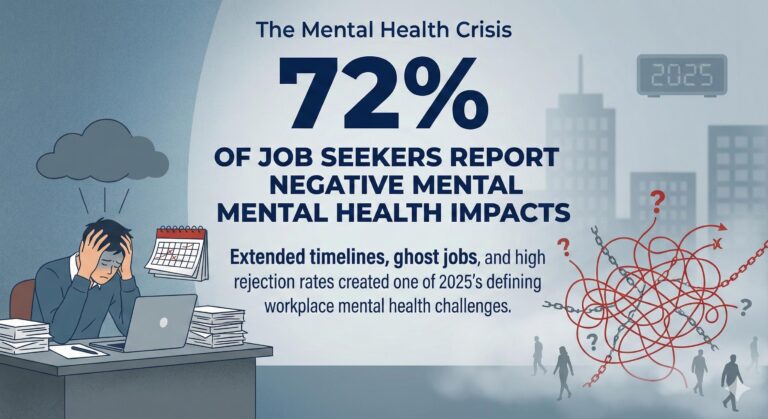
The extended job search timelines, ghost job prevalence, and high rejection rates took significant mental health tolls on job seekers throughout 2025, as documented in our comprehensive burnout research.
The psychological impact was substantial:
- 72% of job seekers reported negative mental health impacts from long hiring processes
- Poor employer communication exacerbated anxiety and uncertainty
- Applying to dozens or hundreds of positions with minimal response created depression
- The problem particularly affected recent graduates and early-career workers
Real stories illustrated the human cost. Ashley Terrell, who graduated with a business administration degree in 2024, told CNBC: “I have noticed in the last couple months that there have been fewer job postings that I am qualified for. Some of my friends have kind of settled for the underemployed route, and some went to trade school.”
The psychological impact extended beyond individuals:
- Undermined faith in meritocratic principles when qualified candidates couldn’t secure employment
- Created disillusionment with traditional career pathways
- Affected broader economic confidence as job search frustration spread
- Highlighted need for systemic changes in hiring processes
Interview Guys Take: Let’s be brutally honest about something most career advice glosses over: the 2025 job market is designed to break your spirit. When 72% of job seekers report mental health impacts from the process, that’s not a personal failing, it’s a systemic problem. The entire system runs on exploiting your desperation. Ghost jobs waste your time. Extended hiring processes drain your savings. Rejection emails (when you’re lucky enough to get them) chip away at your confidence. The only way to survive this psychologically is to recognize the game is rigged and refuse to internalize the rejection. Track your metrics, celebrate small wins, and remember that companies rejecting you are often the same ones complaining they “can’t find talent.”
The Role of Professional Networks
As traditional application processes became less reliable, professional networking’s importance surged in 2025. The numbers told a clear story about why relationships mattered more than ever.
The networking advantage was quantifiable:
- Referral candidates were significantly more successful than cold applicants
- Success rates many times higher than the 0.1-2% average for online applications
- Your next job is exactly 2.6 connections away on average through extended networks
- Professional relationships became essential rather than nice-to-have
The most successful networking strategies in 2025:
- LinkedIn connection strategies focused on genuine relationship building
- Alumni network activations leveraging shared educational backgrounds
- Industry event attendance for face-to-face connections
- Informational interviews that provided insights and often direct referrals
Informational interviews proved particularly valuable:
- Low-pressure conversations provided industry insights and company culture information
- Often led to direct referrals into hiring processes bypassing initial screening
- Savvy candidates identified target companies and connected with employees proactively
- Relationship-based job search dramatically outperformed application-only approaches
Looking Ahead: What 2026 Holds
Continued AI Integration
The AI transformation documented throughout 2025 showed no signs of slowing. Industry projections suggested even more comprehensive integration in 2026 and beyond.
The AI trajectory for 2026:
- AI-powered tools expected to reduce hiring timelines by 15% by 2030 according to forecasting organizations
- Companies plan expanded use of AI for candidate sourcing, screening, and initial interviews
- The backlash against purely algorithmic decisions is growing, forcing smarter implementations
- Most effective approaches combine AI efficiency with human judgment for nuanced decisions
The regulatory landscape was also evolving in response to concerns:
- Following Kentucky and California’s 2025 legislation, expect more states to impose transparency requirements
- The FTC’s Joint Labor Task Force formed in February 2025 suggested federal action might follow
- European regulations on AI in hiring are likely to influence U.S. practices
- Companies face growing pressure to explain and justify AI-driven hiring decisions
The Entry-Level Recovery Question
Whether entry-level opportunities would recover remained 2026’s biggest uncertainty. The 29% decline in positions since January 2024 represented fundamental restructuring, not just cyclical downturn.
The competing predictions for entry-level jobs:
- Some economists predict as AI integration stabilizes, companies will recognize need for talent pipelines
- Others suggest the traditional entry-level-to-executive career ladder might be permanently disrupted
- Alternative pathways like apprenticeships and contract-to-hire may replace conventional trajectories
- Certain industries will maintain traditional entry positions while others fundamentally reimagine development
The most likely outcome involves continued segmentation:
- Healthcare, education, trades, and in-person roles will likely preserve entry opportunities
- Tech, finance, and professional services may continue leaning on AI for routine work
- Skills-based hiring approaches will gain traction across sectors
- Companies experiment with new models for developing junior talent
Remote Work Settlement
After 2025’s renewed battles, 2026 may finally see remote work arrangements reach sustainable equilibrium. The data suggested hybrid work with 2-3 office days emerged as the dominant stable model.
The predictions for workplace arrangements:
- Companies mandating full returns will likely face continued turnover challenges
- Remote-first organizations doubling down on flexibility will attract frustrated talent
- The four-day workweek may emerge as the next flexibility frontier
- Geographic considerations will continue mattering less for many roles
Several high-profile companies announced four-day week pilots for 2026:
- 27% of workers found four-day weeks appealing according to Owl Labs research
- Many would sacrifice 8% of salary for the benefit
- Successful pilots could trigger mainstream adoption
- This represents the next evolution of workplace flexibility
The talent migration patterns established in 2025 will likely intensify:
- Workers with options gravitate toward employers offering flexibility
- Companies using RTO as stealth layoffs may face policy reversals after talent losses
- Small and mid-sized companies will continue leveraging flexibility as competitive advantage
- Geographic salary arbitrage strategies will become more sophisticated
The Bottom Line: A Market Transformed
The 2025 job market was defined by paradoxes that will shape employment for years to come. Millions of job openings coexisted with millions of frustrated job seekers. AI created both opportunities and obstacles. Remote work battles intensified even as hybrid arrangements stabilized. Credentials mattered more and less simultaneously.
Three clear themes emerged from the year’s tumultuous changes that every worker and employer must understand:
The traditional employment model fundamentally broke. The predictable progression from education to entry-level position to career advancement no longer functions as designed. Entry-level position declines, extended hiring timelines, ghost jobs, and credential inflation created barriers previous generations didn’t face.
AI moved from experimental to existential. No longer a future consideration, AI became a present reality reshaping virtually every aspect of employment from recruitment to role definition to required skills. The organizations and individuals who successfully adapted to AI-augmented work gained substantial advantages over those who resisted.
Flexibility became non-negotiable for many workers. The remote work genie couldn’t be put back in the bottle despite concerted efforts. Workers with options gravitated toward employers offering flexibility, creating talent migration that will shape competitive dynamics for years to come.
The Path Forward
As we move into 2026, the key question isn’t whether the job market will return to pre-pandemic or pre-AI norms. It won’t. Instead, the question is how quickly organizations and individuals adapt to the new realities documented throughout 2025.
For job seekers, success requires understanding that old strategies don’t work anymore:
- High-volume applications combined with strategic networking become essential rather than optional
- AI-optimization of application materials is necessary for passing initial screening
- Flexibility around geographic location and work arrangements expands available opportunities
- Continuous skill development replaces one-time educational credentials
For employers, success requires recognizing that talent competition intensified even as hiring slowed:
- The companies winning weren’t necessarily those with biggest compensation budgets
- Compelling combinations of growth opportunities, flexibility, and meaningful work attracted top talent
- Cultures where people could thrive mattered more than ever
- Authentic employer branding became essential as ghost job backlash damaged credibility
Final Thoughts
The job market of 2025 will be remembered as the year AI stopped being theoretical and became tangible, when remote work battles reached their peak intensity, and when the entry-level crisis forced complete rethinking of career development.
The state of Gen Z in the workplace revealed how youngest workers navigated unprecedented challenges. Analysis of workplace burnout showed the mental health costs of continuous disruption. Understanding how to navigate career changes became essential as market dynamics shifted rapidly.
Yet opportunity still existed for those who understood the new rules. Human skills like interpersonal communication remained irreplaceable even as technology advanced. Strategic job search approaches still yielded results for persistent candidates who adapted to new realities.
The question for 2026 isn’t whether change will continue. It will. The question is whether we’ll learn from 2025’s lessons and build more functional, equitable, and sustainable employment systems, or whether the problems documented throughout this year will compound into even more significant challenges ahead.
Resources & References
This report draws on comprehensive research from authoritative sources including government labor statistics, global consulting firm analyses, academic research, and industry surveys conducted throughout 2025.
Government & Labor Statistics
U.S. Bureau of Labor Statistics – Employment data, compensation trends, and labor market statistics including JOLTS (Job Openings and Labor Turnover Survey)
BLS Employment Cost Index September 2025 – Comprehensive wage and salary growth data showing 3.5% year-over-year increases
Federal Reserve Bank of Atlanta Wage Growth Tracker – Real-time wage growth tracking for individual workers
Major Research Reports
PwC 2025 Global AI Jobs Barometer – Analysis of nearly one billion job ads revealing 43% wage premium for AI skills
World Economic Forum Future of Jobs Report 2025 – Global perspective on AI impact and 40% of employers expecting to reduce staff where AI can automate
Randstad Global Workplace Blueprint 2025 – Survey of 11,250 workers and analysis of 126 million job postings showing 29% decline in entry-level positions
Hiring Trends & Time-to-Hire Analysis
Average Time to Hire Industry Statistics 2025 – Documentation of 44-day average time-to-hire, up from 31 days in 2023
Indeed Hiring Lab September 2025 Labor Market Update – Analysis of job posting declines affecting new workforce entrants
Veritone Q1 2025 Labor Market Analysis – AI job growth data showing 25.2% year-over-year increases
AI Adoption in Recruitment
DemandSage AI Recruitment Statistics 2025 – Comprehensive data showing 65% of recruiters using AI despite 66% of candidates expressing concerns
McKinsey Global Survey on AI 2025 – Research revealing 78% of companies adopted AI in 2024, up from 55% in 2023
National University AI Job Statistics – Analysis showing 30% of current U.S. jobs could be fully automated by 2030
Ghost Jobs Research
Congressional Research Service Ghost Jobs Overview April 2025 – Official government analysis of fake job posting prevalence and legal implications
MyPerfectResume Ghost Job Economy Analysis – Research showing 30% of June 2025 job openings never resulted in hires
Greenhouse Software Ghost Jobs Study – Major hiring platform data revealing 18-22% of online postings are ghost jobs
Entry-Level Position Analysis
CNBC Entry-Level Jobs Analysis November 2025 – Investigation of 76% of employers hiring same or fewer entry-level workers than 2024
Rest of World AI Impact on Engineering Graduates – Global analysis showing 35% decline in junior tech positions across major markets
IEEE Spectrum AI Entry-Level Jobs Analysis – Technical analysis of programmer employment falling 27.5% between 2023-2025
Remote Work & Return-to-Office Data
Founder Reports Return-to-Office Statistics 2025 – Survey data showing 64% of employees prefer remote/hybrid over full-time office
Cisco 2025 Global Hybrid Work Study – Research on 21,513 employers and employees revealing 77% believe RTO mandates driven by lack of trust
Pew Research Center Remote Work Trends – Survey finding 46% of remote workers would quit if flexibility eliminated
Oyster Remote Work Status 2025 – Analysis showing 60% prefer hybrid, 30% fully remote, 10% on-site
Salary & Compensation Research
The Conference Board US Salary Increase Budgets 2024-2025 – Employer survey showing planned 3.9% increases for 2025
Payscale 2025 Salary Budget Survey via WorldatWork – Forecast of 3.5% average pay raises with industry variations
Related Interview Guys Research
Ghost Jobs Exposed: The Companies Posting Fake Job Listings – Deep dive into 93% of HR professionals admitting to ghost job practices
The Entry-Level Drought: 29% Fewer Starting Positions – Analysis of career workarounds Gen Z developed
State of Remote Work 2025 – Comprehensive research on hybrid arrangements and RTO mandate impacts
The State of Gen Z in the Workplace 2025 – Research on youngest generation navigating unprecedented challenges
Workplace Burnout in 2025 Research Report – Documentation of mental health impacts from job market challenges
Essential AI Skills for Your Resume – Guide to AI capabilities commanding salary premiums
What Are Interpersonal Skills and Why They’re Your Secret Weapon – Analysis of human skills remaining irreplaceable despite AI advances
How AI Is Revolutionizing the Job Search Process – Practical guide to leveraging AI tools in job hunting
How to Find a Job Fast in Today’s Market – Strategies for accelerating job search in challenging conditions
The Ultimate Guide to Changing Careers – Framework for career pivots in response to market disruption

BY THE INTERVIEW GUYS (JEFF GILLIS & MIKE SIMPSON)
Mike Simpson: The authoritative voice on job interviews and careers, providing practical advice to job seekers around the world for over 12 years.
Jeff Gillis: The technical expert behind The Interview Guys, developing innovative tools and conducting deep research on hiring trends and the job market as a whole.